If I Were A Conspiracy Guy

Tin Foil Hat GuyI’m not much of a conspiracy guy. I’m confident that Lee Harvey Oswald acted alone in killing JFK, and that the ‘magic bullet’ behaved unpredictably because that’s what bullets do. I don’t think 9/11 was an inside job, and I’m 99.3% certain Buzz Aldrin and Neil Armstrong landed on the moon in 1969 no matter what the shadows prove or how wavy the flag might be. Ronald Reagan did not invent AIDS to kill black people, and Obama is not a sleeper cell Muslim from Kenya with a nefarious plan he just keeps… not unfolding.

I always wince when Fox Mulder or Buffy Summers or any Marvel character enters the ginormous underground facility where thousands of people work in TOP SECRET. In a world where Kim Kardashian can’t fart without a week of coverage over the implications and 24/7 news is desperate for breaking scandal in every political stumble, I just find most large-scale paranoia implausible.

But if I WERE a conspiracy theorist… here are a few things I’d wonder about in relation to our public schools and the current buzz surrounding ‘reform’ and ‘higher standards’ and whatever other rhetoric we’re throwing around at the moment. And I wouldn’t just wonder about these – I’d worry about them with a very serious, concerned look on my face.
 
Oswald Rock(1) Are we actually trying to break the current cycle of poverty, failure, crime, and dysfunction plaguing large segments of our pre-adult population? Are those in political power both locally and nationally – and those who vote for them – genuinely interested in what happens to a bunch of poor kids who look, you know, black? Or Mexican? Or dirty? Or otherwise unpleasant? 

A paranoid, unreasonable person might think our current approach looks very much like what we’re really wanting is political and moral cover – some sound and fury about raising standards, a supposed focus on teacher quality, and a pretty good rhetorical dog’n’pony show, but without substantive institutional change or funded application of stuff that might actually work. Yeah, communities tend to resist change, but so do teachers. And governors. And legislatures. And white people.

Not judging, just speaking in general historical terms.

(2) Do we really believe the root problems are systemic? Socio-economic? Maybe some lingering form of institutional racism? If I were a conspiracy guy I’d suspect instead that there’s a subliminal thread running through many current ‘reform’ debates that includes terms like ‘those people’ and suspicions that – while we’re not really allowed to come out and say it – a lot of it’s kinda “their” own fault. If they’d just X, Y, or Z… it’s not like the opportunity isn’t there. It’s not like I haven’t had a few struggles myself. Have they tried, you know… trying?

A cynical person might think we’re actually fine with failure as long as we can keep assigning blame to those most deeply mired in the cycle. 

Smoking Alien(3) Is most of what we do in the name of “higher standards” and “reform” just a cynical ploy to channel public funds and more power to a handful of textbook companies and corporate entities? This one, sadly, isn’t even all that conspiratorial anymore. It’s been addressed by so many people so much better than I could that it would be redundant to elaborate on that part of the equation here. There’s a second layer to it, though, that I don’t see discussed often, and which to me is just as horrifying.

(4) Public education needs major changes. Systemic changes. Dramatic changes. We’re trapped in a 19th century factory model that we know to be dysfunctional and doomed, but can’t seem to find the solution using current resources, or apply it in some homogenously massive scale if we could. Real innovation is required – risk and radicalism, minus the Damoclesian testing and fatuous evals so joyfully legislated over every teacher’s comfy chair.

If I were a conspiracy guy, I’d think the very concepts of ‘charters’ or ‘choice’ or even ‘reform’ itself has been consciously co-opted by moneyed interests who use their powers for short-term evil rather than long-term good. How brilliantly profitable – exploit the status quo by laying claim to vast portions of limited public resources in the name of change. It’s like mobsters selling ‘insurance’ to local merchants to protect them from ‘accidents’ – complete and total betrayal, while none dare call it treason. Forget Marzano – we should have been reading Crane Brinton.

If something like this were remotely plausible, those of us most interested in improvement might have found ourselves expending our energies resisting the ‘worse’ at the expense of  all potential ‘betters’. We could have lost the ‘forward’ path altogether as we burned ourselves out holding ground we don’t even want – the current model. I’m particularly glad THIS vile scenario is just TOO CRAZY to consider.

Nixon & Elvis(5) Finally, as long as we’re talking crazy talk, do those in power have any real interest in an educated populace? What, exactly, would be their motivation for such? Allotting time, energy, and resources to public education of any quality is generally a short-term loser politically. It’s expensive, and the results are long-deferred if they happen at all. There’s little consensus, and great political cost. Plus, there’s a very real danger that committed focus and resources and leadership on this subject could lead to… a much more educated, enlightened voting pool.

I realize this sounds particularly cynical, and I’m thus super extra thankful I’m not, you know… paranoid. If I were, though, I’d push the issue of what political leadership gains from a population which is harder to persuade with platitudes or emotionalism, or which demands a higher level of discussion in the decision-making process.

Why would the oligarchy want to sacrifice their power, their purses, and their children’s hegemony when it’s so very easy to simply maintain the facade of vigorous debate and struggle with one another? The major players are already quite gifted at maintaining the illusion they’re locked in passionate battles of principle, reality-TV levels of emotionalism, quality demagoguery, and rhetoric that sounds very founding-documentsy.

Shampoo AisleBut what if they’re like the shampoo aisle at the drugstore – packed with dozens of brands, each of which is broken into a half-dozen hair-types, fragrances, sizes, etc.? It’s almost overwhelming, all the different products available; what a miracle of American capitalism – too damn many shampoos.

Except that entire aisle represents maybe two actual corporations making every one of those shampoos – most of which aren’t all that different. The varieties are there to make you feel better, and to push aside real competitors. If there must be competition, compete with yourself – it works for fast food, bottled beverages, media outlets, and education movements. If you were a conspiracy theorist, you might start to feel a bit manipulated – like you’re being played, and not actually making informed choices at all.

You might even consider that perhaps those in power economically and politically would actually benefit from an even less-enlightened populace. Educated enough for the demands of the economy, of course, but not so much they question the nature of that economy – or its corresponding social and political structures. Educated enough to enjoy the circus – not so much they start wanting different bread.

That would be silly, of course. Probably a bit over-the-top. It’s at least completely unrealistic, and SO easy to rebut. I’m not sure why I even brought all of this up – I’m not a big conspiracy guy or anything.

Where Can I Find This Rooster?

“Who is the best marshal they have?’

The sheriff thought on it for a minute. He said, ‘I would have to weigh that proposition. There is near about two hundred of them. I reckon William Waters is the best tracker. He is a half-breed Comanche and it is something to see, watching him cut for sign. The meanest one is Rooster Cogburn. He is a pitiless man, double-tough, and fear don’t enter into his thinking. He loves to pull a cork. Now L.T. Quinn, he brings his prisoners in alive. He may let one get by now and then but he believes even the worst of men is entitled to a fair shake. Also the court does not pay any fees for dead men. Quinn is a good peace officer and a lay preacher to boot. He will not plant evidence or abuse a prisoner. He is straight as a string. Yes, I will say Quinn is about the best they have.’

I said, ‘Where can I find this Rooster?” 

‘Mattie Ross’, True Grit (Charles Portis)

“If you don’t have no schooling you are up against it in this country, sis. That is the way of it. No sir, that man has no chance any more. No matter if he has got sand in his craw, others will push him aside, little thin fellows that have won spelling bees back home.” 

‘Rooster Cogburn, True Grit (Charles Portis) 

Educators love false dichotomies, especially if they’re rather dramatic. For some, Common Core arrived as Moses, ready to raise its #2 Staff and part the Red Sea of Low Expectations. For others, it was clearly Pharaoh, seeking to drag the Hebrew descendants of Horace Mann back into the Egypt of Standardized Testing and building Pyramids with Bloom’s Taxonomy in bas-relief on each side. We fall into equally passionate camps if you bring up Teach For America, Charter Schools, Literacy First, or pretty much anything with the word ‘Initiative’ tacked on to the end.

Most recently, the subject of ‘grit’ has become a hot topic on Twitter, Facebook, and the other social media we old folks still use while feeling rather cutting edge about being online at all.

‘Grit’, of course, isn’t an entirely new concept. You can’t read anything useful about developing talent, attaining goals, or improving student mindsets without running into the research Carol Dweck did on this a few years ago, and of course we all remember British Prime Minister Winston “Eddie Lawrence” Churchill with that thing about never giving up on ships, which was apparently a pretty inspiring thing to say to British graduates in 1611. 

But ‘grit’ is a thing again lately, and producing all sorts of interesting snark. Don’t get me wrong, I’m a big fan of snark, but if Twitter were your only guide, you’d believe there are only two basic ways to approach students in terms of overcomage:

(1) Students must be taught ‘grit’, and grit comes from enduring. Therefore, we must prioritize the brutal drill’n’kill-type instruction they apparently love on PD days in Chicago. Determination means overcoming suffering, and suffering we must therefore inflict. Joy must die and hope must wither, for only thusly shall they learn to blindly, numbly press on. No pain, no gain.

OR…

(2) Students must be perpetually free, invigorated, encouraged, loved, and understood. If we simply prance through the classroom flinging Inspiration Daisies, students will climb over one another for opportunities to pursue all essential knowledge and unleash their natural hunger for personal excellence. Any hesitation, momentary confusion, or weariness, is a failure of the teacher to properly shoot rainbows from his or her pedagogical orifice. Struggle means you’re doing it wrong. Stop breaking the future! 

I’m not sure either are useful extremes.

I love my kids, but I haven’t found them to be particularly self-driven about anything tied to this week’s state standards. There are important discussions to be had about whether we’ve trained them from an early age that under no circumstances will we allow them to fail at anything, ever – especially in school. “Throw your limp drooling bodies into the Slough of Apathy if you wish, but by god we’ll keep remediating you and lowering that bar until you ooze over it whether you want to or not!” But those sound hard, and I don’t feel like it.

Instead, I’d like to share a few clips I post on the “Required Viewing” section of our class website and refer to throughout the year. They all involve finding solutions rather than simply offering more vehement expressions of one’s difficulties. I will of course editorialize endlessly for each.  

[[{“type”:”media”,”view_mode”:”media_small”,”fid”:”414″,”attributes”:{“alt”:””,”class”:”media-image”,”typeof”:”foaf:Image”}}]]

Go. Around. The. Leaf.  I show this the first week of school and it’s a mantra throughout the year. I am not unsympathetic about life’s complications – but bring me alternatives. Solutions. Make it work and I’ll almost always accept your means of getting there, or of going somewhere else with it.

This is not nearly as touchy-feely as it sounds, and most of the time it saves me time and energy, while teaching my darlings some modicum of responsibility – without merely dropping the piano of inflexible expectations on their heads. (That’s the state’s job.) 

[[{“type”:”media”,”view_mode”:”media_small”,”fid”:”415″,”attributes”:{“alt”:””,”class”:”media-image”,”typeof”:”foaf:Image”}}]]

Come on, this one’s easy – looking at problems a different way, etc.? Yeah, I knew you’d get that one.

[[{“type”:”media”,”view_mode”:”media_small”,”fid”:”416″,”attributes”:{“alt”:””,”class”:”media-image”,”typeof”:”foaf:Image”}}]]

No, the moral is not “shoot them.” I prefer something more along the lines of “don’t overlook the obvious,” or “sometimes you gotta cut through the drama to see the solution clearly.

[[{“type”:”media”,”view_mode”:”media_small”,”fid”:”417″,”attributes”:{“alt”:””,”class”:”media-image”,”typeof”:”foaf:Image”}}]]

This one is a classic. The lesson is rather obvious if you’re not the people on the escalator. But of course we often are, more than we realize. Not you and me, of course, but everyone else on our Facebook wall. Those people are a mess. Why can’t they just see it?

[[{“type”:”media”,”view_mode”:”media_small”,”fid”:”697″,”attributes”:{“alt”:””,”class”:”media-image”,”typeof”:”foaf:Image”}}]]

“The fences aren’t just ’round the farm…” Need I say more?

I don’t know if a few video clips will prove paradigm-altering for my darling students, but it’s a place to start. The hard part is helping them practice it throughout the year. Teaching students to persevere really makes you want to give up, sometimes daily.

But I can’t, because, um… the videos.

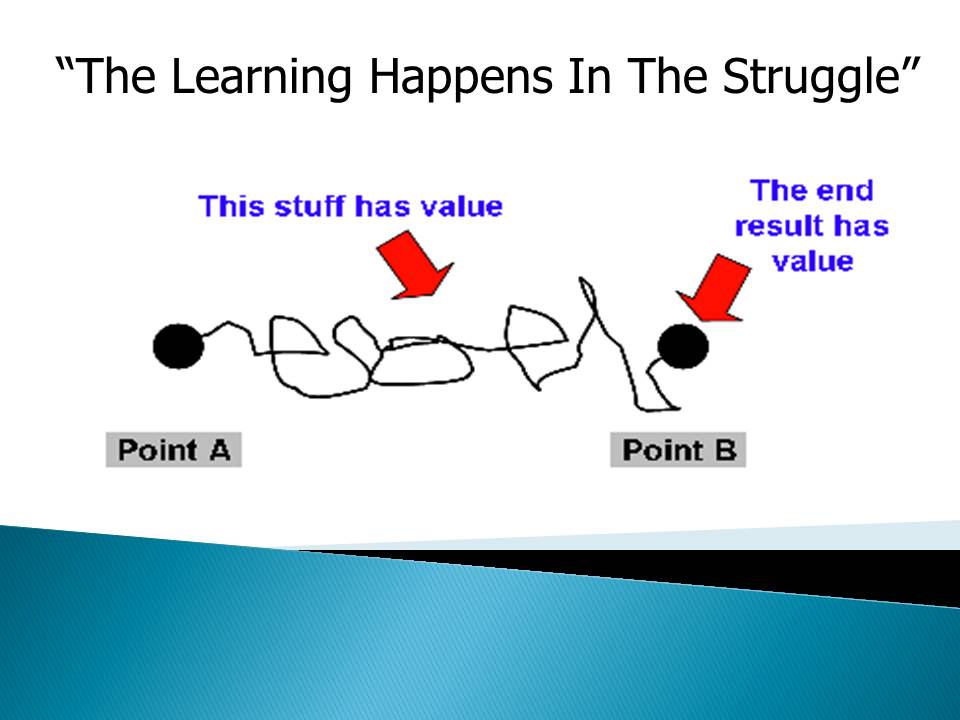
Curriculum Guru Ayn Grubb taught me a phrase that’s stuck with me ever since, and which has evolved into an entire teaching philosophy. I combined it several years ago with a nifty graphic I found online and haven’t been able to locate since, but I’m hoping it’s like peanut butter and chocolate in those old Reese’s commercials and that I now have something both legal and appealing to wrinkly aliens if condensed into pellet form:

The Learning Happens In The Struggle

Our darlings come to us at a variety of “Point A’s”, and we’re trying to get them as close as we can to “Point B” – some combination of skills, content knowledge, etc. The skills matter, a great deal. And the content matters, despite periodic trends suggesting that anything worth knowing is just a Google away, so why bother? 

But what is too easily forgotten is the value of the struggle in between – the value of getting confused, or frustrated, or getting stuff wrong, or even failing from time to time. And then figuring it out. And then getting back up. And then finding a way to succeed. And then doing it again. 

So, I’m not sure which dramatic extreme to join in the arguments about ‘grit’, but I hope my kids develop at least a little of it while in my care. I certainly learn enough about endurance and problem-solving from being with them, so it seems only fair. Why should I be the only one to suffer? 

Related Post: Hole in the Wall Education

Related Post: Teach A Kid to Fish


Pedagogical Time Loop Hell

Spiritual GorillaOne of my personal goals for this blog and this website is that I offset my various rants and carryings on that no one cares about with positive thoughts and potentially useful resources that no one cares about. I like to think of this as “being balanced.” 
That balance will not be helped by this post.

BUT PLEASE: Stop telling us to quit doing stuff we’re not doing, and stop acting like it’s the first time anyone even thought to mention it.

I realize not every teacher in every district of every state is in the same place pedagogically. I get that we collectively have far to go before we can claim to have moved public education – particularly in the social sciences – much past the 19th Century. But I swear to Horace Mann, if I read one more article encouraging me to ditch my mimeographed fill-in-the-blank worksheets and Ferris Bueller-style lectures for some cutting edge “interaction” with students, I’m going to hurl my McGuffey’s reader through someone’s chalk slate.

In the military this is known as “always fighting the last war.”  In the movies, it’s something far worse – the notorious plot device known as the “Time Loop.”  

Groundhog DayMost of you remember Groundhog Day, a movie I felt like I’d seen a dozen times before I was even through my first box of Milk Duds. The basic premise – that something is causing a person, group, or starship, to repeatedly jump back in time to relive a set of experiences with only minor variations – was sci-fi trope long before Bill Murray had those extra pancakes.
The thing is, whether you’re in sci-fi or romantic comedy, it sucks to be the character gradually becoming aware you’re stuck in this season’s time loop.

Don’t misunderstand – there’s nothing wrong with revisiting the fundamentals of effective teaching. It’s when we repeatedly present the same few platitudes as epiphanies and brave new truths that I get a bit… hostile.

(1) Worksheets aren’t exciting kids about learning. 

Make sure Watson writes that one down. “The worksheet did nothing in third period – that was the curious incident!”

WorksheetWorkshop leaders or edu-bloggers rarely “open” with this grand bit of modern wisdom – it’s saved for the ‘impact’ moment of the autobiographical anecdote demonstrating both connection with the audience and touching vulnerability – the kind that makes you trust someone enough to buy their book.

It’s always the same anecdote – “I taught for 72 years and couldn’t figure out why my kids didn’t love history [or literature, or math, etc.] as much as I did, although I lectured every day and assigned thousands of vocabulary words and only used one book – the textbook – for everything. One day, I had [insert epiphany experience] and suddenly I understood! This crap was boring! Who knew? Now I’m on the lecture circuit pointing very serious, passionate-for-the-children fingers at any of you who don’t applaud or at least nod enthusiastically when I reveal this magnificent bromide.

No one who needs to be told that worksheets are boring and largely useless is going to read your book, Cassandra. No one uses the damn things believing they’re good for anything other than shutting the kids up for a period or filling some of the required number of grades to be given each week. It’s far more likely they just don’t care – in which case we have a problem, but a very different problem than you’ve assumed. We may be lazy, bitter, and apathetic, but we’re not stupid. You should move on to a more current, relevant problem in public ed, like kids staying home once planting season starts, or cholera.

(2) Lectures are obsolete, boring, and destroying the future.  

I’m going to go out on a bit of a limb and tell the PD world and the “Education”-tagged section of the Blogosphere that, while amusing in the occasional sitcom or 80’s movie, NO ONE DOES THIS ANYMORE, so you can STOP TELLING US NOT TO DO THIS.

Boring TeacherI’m sorry you had that one boring teacher in high school all those years ago, I really am. I got sick on chocolate chip pancakes when I was 17 and projectile-vomited all over the hall bathroom, but I’m 47 now and don’t carefully construct each week’s menu around the dangers of Bisquick. Get over it.

Yes, too much lecture can lose its effectiveness, and some people suck at it all the time. I feel the same way about foldables, but no one’s damning them with impunity every time two or more are gathered. My students love most of my lectures, and this is true of more history teachers than not. They remember the stuff we cover that way, and ask me to do it more often.

I’ve dialed back the straightforward ‘teaching’ stuff in recent years because of my department’s focus on skills and transitioning students into being able to learn on their own. As a result they learn less history over the course of my year and have less excitement about it, because they’ve heard fewer stories and I’m far less Sesame-Street-On-Crack than I was a decade ago. I don’t regret pushing them to wear their big-student panties, but I do miss the joys of so much content flowing freely and without guilt. 

It’s a trade-off between good and better, not repentance from a life of sin and direct instruction.

(3) Names, dates, places, and other facts don’t matter anymore – kids can Google that stuff.

Like lecture, this is a special favorite of non-history people explaining to us simple social studies folks about how things work here in the post-moon-landing world. They don’t seem as quick to tell the math people that kids don’t need to know numbers or what those funny signs (+ ÷ ≥ ¾ ≠) are because math is about the process and they can look up this ‘pi’ so often discussed by those trapped in the dark times. And we actually encourage building vocabulary in English class in order to help kids become better readers, rather than casting ‘words’ aside as quaint relics of days past. 

Google ItThe funny thing about history is that most of it cannot, in fact, be effectively understood without some knowledge of specifics. Yeah, it’s the big picture stuff that often matters most, and connects us to the past, and teaches us those grand lessons and such, but it’s all built out of particulars. History generally happens to people in places at certain times. 

You can Google just about anything, but the important answers are often long and complicated and assume you have a precursory body of knowledge for them to make any sense. Eventually in order to learn anything of value you have to know something on which to build. 

Give our teachers a little credit for knowing what they’re doing and why they’re doing it. And if there are a smattering stuck in the 19th century and unwilling to at least throw on some elbow patches and join us in the 1970’s, the problem is most likely something OTHER than not having read your blog. 

He Tests… He Scores!

Stars Raise SticksOn April 27th, 2014, the Dallas Stars were only a few game minutes away from an improbable 4-2 home victory over the conference-leading Anaheim Ducks. It had been a storybook game with glorious hits, highlight reel scoring, and the sort of scrap and grit that made the Stars (rather than their opponents) the Disney-movie-ready heroes – IF they could tie up this best-of-seven series and force their way back to Anaheim for a final brouhaha.

Then, with seconds to go, the Ducks tied up the game and forced an overtime – in which they quickly knocked the Stars out of the playoffs. It was a crushing defeat, and – if you were the sort to be on Twitter during such things – one laden with personal animosity slung freely between fans on both sides. 

The Stars season was over, and in the worst possible way – they didn’t have to lose. They had this. It was… they just… well, damn. 

And yet, after a few moments of shock and vicarious trauma on the part of 19,363 fans at the American Airlines Center, applause began breaking out, then swelling, then exploding. The team stayed at center ice and raised their sticks, and the home crowd adored them for a bit before a microphone was handed to Captain Jamie Benn, who thanked the crowd for their support, said all the right things about the team, and promised they’d be back next season badder and better. 

It’s been a few weeks, but if you ask the casual fan, the die-hard Stars supporter, any other team or owner or commentator in the NHL, this past season was a huge success. Not because of where they’d ended up, exactly, but because of how far they’d come.

Blackhawks Raise CupBy what should one measure success in professional hockey? It’s so relative, and it matters deeply where you started, what adversities you’ve faced, how much support you’ve had, how much talent you have to work with, Finances matter, and sometimes there’s a fair amount of luck involved.

There’s one clear measure – each season one team takes home the Stanley Cup, and the rest don’t. Some make it to playoffs, and the rest don’t. 

In a few days, I’ll be entering final grades for this semester. I hate it. I try to be firm – you get what you get – but in reality I’ll end up browsing the final scores of each class, noting especially which students ended up a few points away from a different letter grade one way or the other. 

What exactly am I attempting to measure here? Is it how much they’ve done? How far they’ve come?  How well they’ve met state curriculum expectations? What they can DO decently in terms of social studies skills? Effort? Cooperation? Whether or not they’re a huge pain in the @**? 

What am I measuring each time I give one of these ‘grades’? 

Benn FightI’ll go back to my hockey analogy, mostly because it’s easier to find supporting visuals that way. How do we measure success in a specific game? Not just for the team, but for the individual stu– er… players? What do we measure and thus value in hockey?

Scoring a goal. Stopping the other team from scoring a goal. Taking the puck away from a player from the other team. Passing the puck to a player from your team. After that it gets complicated. 

I mean, sure it sounds easy – you gotta score goals, right? So, score a goal, you get a point. Maybe you helped score the goal instead, so… pass to a guy, and he scores the goal? That’s also a point. Easy.

Joey Johnston Hockey CardBut the other team is trying to score also. Huh. OK, OK… if you’re on the ice when your team scores a goal, that’s +1 for you. If you’re on the ice when the other team scores on you, that’s -1. Keep a running total, and it’s clear: the higher your +/-, the better player you are. So, like, Sidney Crosby finished the season at +18. That’s pretty good. Down from +26 last season, but there were other factors, because –

No! No other factors – we have to keep this measurable. No other factors. Let’s not run away from high standards and accountability.

T.J. Oshie, +19. Jamie Benn, +21. Alex Ovechkin, -35. Ryan Getzlaf, +28. Seth Jones, -23. 

Seth JonesWait – that can’t be right. Alex Ovechkin is one of the best-known and most valuable players in the league. Is that a typo? And Seth Jones – he’s going to be great. Young kid out of Dallas, playing for Nashville – I mean, what he DID this year for his age and background!

Yeah, OK – there must be other factors. Dammit. 

If you’re a sports statistics person, or if you’ve seen Moneyball, you know it gets pretty weird pretty quickly when you try to figure out which numbers matter the most. Under what circumstances were these players on the ice? For how long, and how often, and during which games? Who were they on the ice with? (Turns out it’s much easier to score goals if you’re surrounded by other great players than if you’re the only guy with a clue on the team.) 

All sorts of information can be useful to improve coaching, or help players improve their performance. Very few bits of information are useful in isolation to decide who the ‘good’ players are and who the ‘bad’ players are. Often we can’t even agree what those terms mean. 

Maybe you have a defenseman with lots of blocked shots to his credit. That’s great – the other team can’t score if he’s throwing his body in the way of the puck. Valid thing to measure. But, wait… why are opposing teams taking so many shots while he’s on the ice? Shouldn’t the priority be to get the puck away from them and send it back up the ice with one of your guys? Maybe there’s more to that measurement…

Sidney Crosby Shooting StatsYou have a goalie with a great save percentage. That’s awesome – that is, in fact, their primary job. How many games is that percentage based on? In what circumstances did he play? He may be on a team that could pretty much leave their net empty and have no worries because their defensive play is so strong. On the other end of the ice, though, is a goalie working miracles but losing games because the team sucks. So save percentage is an important number, but not nearly as simple as it first appears.

You got a guy with too many penalty minutes, too much time in the box leaving your team short-handed? Yeah, that’s probably bad. Well, unless they were ‘good’ penalties to take – defending star players, or establishing physical presence on the ice. Maybe it’s just poor officiating – a ref having an off night can swing the entire dynamics of the game. Things like that can impact someone’s entire learn – er, I mean playing experience over time. 

The measurements all matter. They all mean things. But the more you try to narrow everything down to one number, or statistic, or letter, or percentage, the less sense that system makes.  

Which brings me back to these end-of-year grades. I’m a huge fan of accountability, and high standards, and that children are the future, teach them well and let them lead the way – all that stuff. But I’m having a hard time believing my own grading is a useful part of that.

The ‘intentional non-learners’ – as we call them around here – are easy. They wouldn’t do it, didn’t know it, tuned out for whatever reason, and they have a single percentages in all categories as a result.  The overachievers are pretty easy as well. Although I’m not always sure how much they’ve learned, they’ve turned in everything twice, done the extra credit, brought the Starbucks gift card at Christmas, and have triple digit percentages. 

Goofus & Gallant

But as I once again try to boil down everything a kid is, or has done, or has learned, or has survived, or could be, or should do, or… other stuff – I find myself increasingly cynical about the value of a single number, or a single letter. Better I should predict their day based on their astrological sign – at least that gives me TWELVE options with which to overgeneralize. 

Letter GradesI believe it was Winston Churchill who said that our current grading system is the worst one there is except for all of the other systems that have been tried (I might have the details a little fuzzy). The thing is, we haven’t really tried that many others. And yes, I realize as soon as we open that door, there are huge arguments to be had about what we should measure and how and yada yada yada. 

But I’d much rather have those arguments and risk doing it wrong in a variety of new ways than to be at peace with the current system. As sports aficionados of all sorts wrestle with evaluating performance on deeper and more meaningful levels, and in evolving ways, perhaps educators – striving to prepare our lil’ darlings for the future – should at least loosen our grip on yet another relic of the sort of factory-system education which lost its relevance nearly a century ago.

Oh, and #GoStars.

Hockey Table

Related Post: Assessment & Grades – Why?

Related Post: In Defense of Due Dates & Deadlines

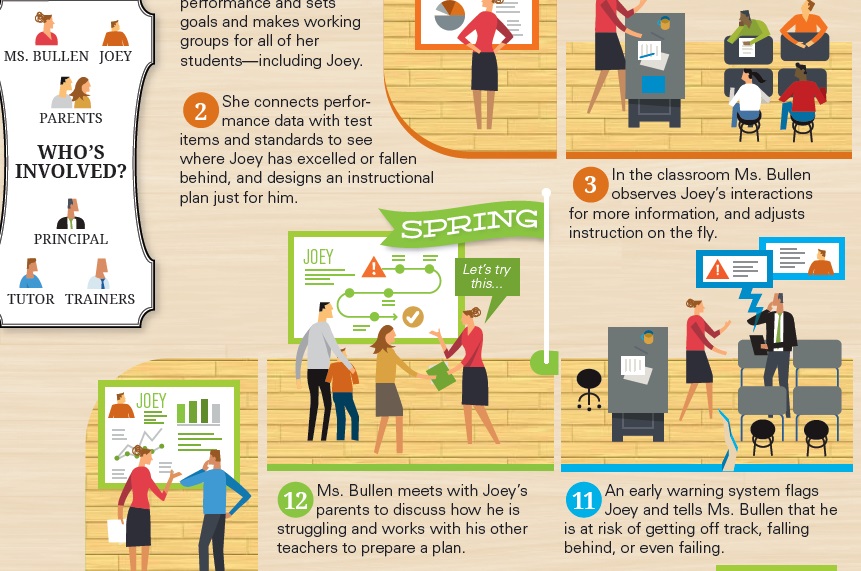
Ms. Bullen’s Data-Rich Year

Spider-Man Costume FailYou ever across something while browsing online, and wish you hadn’t? I believe it was Tosh.0 that did a segment called “Things You Can’t Unsee.” Sometimes they just gross you out, or cause emotional distress, and sometimes they’re just inappropriately violent or pornographic or just plain wrong.
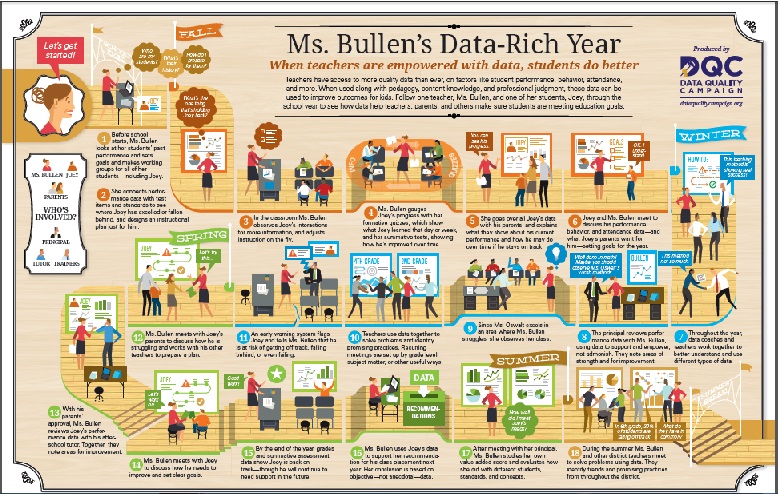
This one is none of those, except perhaps ‘just plain wrong.’ It’s from the OKSDE website, and of course it’s about Data-Tracking, and Value Added Measurement, and all sorts of other bureaucratic verbiage designed to disguise a much simpler phrase, “blame everything on teachers whatever it takes.” It’s also the death knell of my efforts to focus on the positives in education.

Here is what the State of Oklahoma – and the State Department of Education in particular – thinks of you, the teacher, represented here by dear Ms. Bullen: 

MsBullenAll

I know you can’t read the small print yet, but already a few things are clear:

(1) VAM / TLE / State Data in General is designed to consciously require a giant graphic full of small print to even begin to understand. 

(2) The OK SDE / State Legislature is glad you’re not married and thus presumably lack any sort of a family, otherwise you’d never be able to put in the kind of time outside the school day we’re expecting. So much for a pay scale based on having a spouse with a real job! [Confused Reader: “But, married women can use the ‘Ms.’ – it’s marital status neutral, that’s the whole point.” Me: “Clearly you’ve never been to Oklahoma.”]

(3) The OK SDE / State Legislature is under the impression you are approximately nine years old. (In which case I suppose it’s just as well you’re not married.) On the other hand, if you can find Waldo in this picture, you may get a sticker!

Let’s take a closer look at a few parts of this wonderful chart:

MsBullen1

(4) On zooming in, I think we have a much better idea why Ms. Bullen is not married.  Elective cosmetic surgery is such a risky venture – just ask Kenny Rogers, Bruce Jenner, or Ms. Bullen. Yikes!

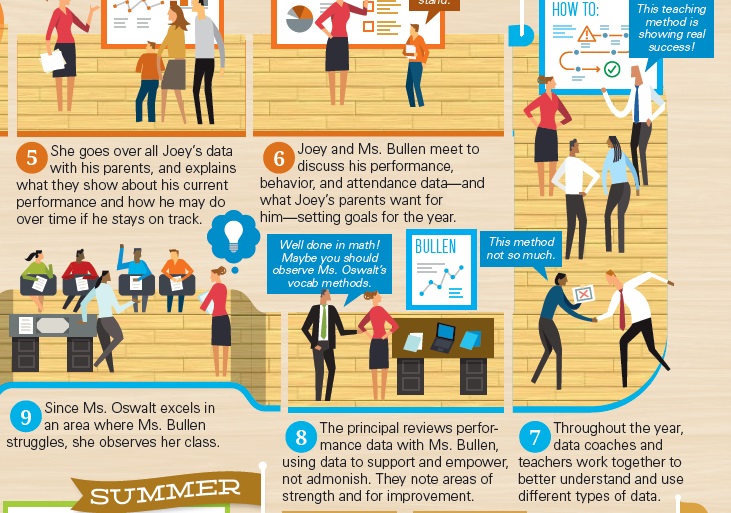
(5) How wonderful that Ms. Bullen is able to use one of those pesky PD days before school begins for something so unlikely to develop her as a professional. Instead, she can spend her time labeling, tracking, and otherwise pre-judging her students based on how they did last year. Given that she’ll have approximately 170 of them, this might take several days, comfortably cut off from her department, administration, or other professionals. But all the best educational studies show, of course, that the ideal way to tap into a child’s full potential is to form judgments about their abilities and potential before you’ve even met them! 

MsBullen2

(6) It seems I’ve been a little unfair in assuming this will all be on Ms. Bullen, as Joey apparently comes from a very involved two-parent family. Plus, Ms. Bullen’s principal has nothing but time to help design IEPs for all 1,246 students in the building, so that’s not really a problem – unless he or she also wishes to complete all 73 levels of the required Teacher Leader Evaluation System for every adult in the building as well. But, some of the burden can be shared by the many Tutors and Trainers in the building. 

Hey, you know what would be fun? Let’s each stop for a moment and see if we can remember the name(s) of the Tutor(s) and Trainer(s) in our buildings who will help us with all of this when it’s our turn… 

Imaginary Friends

How did you do? If you came up with “none of these positions even exist,” you get another sticker, just like they do in Tennessee

(7) You are expected to create an IEP for each and every one of your students before school even begins! (Step Two) Setting aside the fact that this is insane, it’s still nine full steps before Step Eleven, where an ‘early warning system’ (which appears to be an iPad app) will send an alert to a strange man in the room that Joey is off-track, or failing. Presumably the strange man will tell Ms. Bullen, who can call Joey’s very involved parents in to look at the full-sized mural she’s devoted to the Chutes & Ladders version of Joey’s educational journey. Thank god there’s finally a way to know when students are failing – other than the fact that they’re, for example, failing.  

(8) You are expected to immediately discard the approximately 170 IEP’s you’ve spent weeks creating so you can “adjust instruction on the fly” (Step Three) based solely and exclusively on the perceived reactions of Joey. We can only hope the 34 other students in the room are not offended at the impact this must have on their individualized learning experience. At the same time, this is a great moment – it’s the only point in All 18 Steps that assumes for even an instant that you (represented here by Ms. Bullen) have any idea what you’re doing without consulting a few dozen spreadsheets of data. But don’t worry – you won’t be stuck teaching ‘on the fly’ for long! 

MsBullen3

(9) You will have plenty of time to meet one on one with each of your students (Step Six) to discuss their behavior, attendance data (which is different from attendance… how?), and performance, as well as what Joey’s parents want for him – during the one moment in which is overly involved parents are conspicuously absent. You’ll set some individualized goals for the year to replace that IEP you developed before you met him, then threw out in Step Three.

Assuming you have approximately 168 students, and that each of these meetings take about 10 minutes, that’s only about… 28 hours each week. Or is it each month? I’m not sure how often this one is supposed to happen. Let’s assume it’s just once – it’s not like Joey’s performance, behavior, goals, or attendance are likely to change throughout the year. So we’ll just use that extra 28 hours floating around during, say… October.  Nothing that important happens in October anyway. 

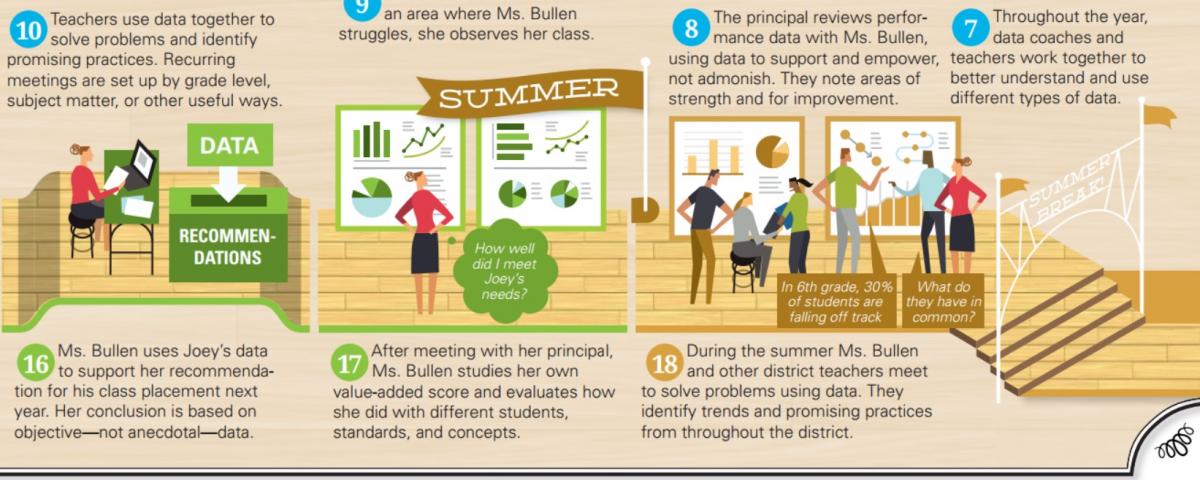
(10) I’m not sure what “Data Coaches” are (Step Seven), although each school apparently has several (they must share office space with all the Tutors and Trainers – no wonder Oklahoma schools are so darned inefficient with how they spend district money!)  Apparently while teachers celebrate their one collective decent idea, the Data Coaches do some sort of ceremonial handshake – or perhaps it’s a dance. I’m not familiar with that culture, but I’d really like to see that. There simply aren’t enough dances based on hard educational data.

(11) The Building Principal, on the other hand, reviews “performance data” with Ms. Bullen, but don’t worry – he does it to “support and empower,” not “admonish” (Step Eight). You have to remember that Ms. Bullen is nine years old and unlikely to marry due to a botched elective cosmetic procedure – she cannot be treated like an adult and simply discuss how things are going with her class. Wait! I mean… with Joey. Just how things are going with Joey. 

MsBullen4

(12) We’ll skip ahead a few steps to where you can’t leave for the summer until you make sure Joey and each of your other 167 students are properly tracked and categorized for the next school year (Step Sixteen). It’s important Joey not have any input on what he might be interested in or challenge himself by taking advanced coursework. We don’t want to risk student engagement in a way that might threaten the data! It would actually be more efficient to simply divide the classes by socio-economic status, race, or educational level of whatever parental units happen to be in the picture, but we might miss a few outliers that way. So, we stick to DATA.

(13) Because you haven’t spent nearly enough time in data meetings for Steps One through Sixteen, and are assumed to have no idea how the year went based on the formal and informal assessments you give throughout the year, your relationship with each student, or anything else that might indicate you have a pulse, you’ll meet with your principal some more and work on your own Value Added Measurement numbers (Step Seventeen).

(14) This would be a great time for Ms. Bullen to lower than neckline a bit and talk to that building principal about making sure she doesn’t have any ELL, Integrated, or otherwise low-performing classes next year. Although she has a heart for struggling students like Joey, they’re totally killing her VAM scores. As Roster Verification and Teacher Linkage become dominant, she’s growing rather resentful of any little turd that hurts her scores and means she’s not getting the merit pay those Pre-AP teachers probably will. I suggest some aggressive accessorizing to distract from those rectangular lips.

(15) You and the other district teachers will spend your summers looking at data on your own time (Step Eighteen), although you’re barely paid for the required 180 days you’ve already spent at school. Only when you pass through the gate painted to look like that trip to Six Flags you can never afford are you free to begin tracking and prejudging next year’s students based on their test scores.

Of course, you’re not in this profession for the summers, or the money, or the remnants of hope you had only a few years ago – that’s not what teaching is about. You have something better than a sense of purpose to what you do, or remnants of self-respect, or even the resources to take your family on even a modest trip – you have data.

Congrats Ms. Bullen! You may have low VAM scores, endless meetings, no summers to yourself, and no money to try to fix that botched surgery, but you’ve had a data-rich year!