Cognitive Dissonance

Frustrated TeacherIt’s been a rocky school year. I’ve been doing this for fifteen years now, and thought I had a pretty good handle on how to teach freshmen. But they’re not getting it. It’s not that they can’t – it seems they’re going out of their way to NOT.

This is frustrating, because I like to think I’m a pretty decent teacher. I’ve taught the same subject for several years now, so I’m scrambling less – which is good, because I’m getting a little older and a little tireder.

So what’s the root of the problem?

It matters because what I’m observing, feeling, and experiencing, don’t mesh with what I believe about myself and my chosen profession. This creates cognitive dissonance – it rubs me the wrong way, internally and often subconsciously.

We’re wired to want cohesiveness, patterns, things that make sense and allow us some control over our responses. When things don’t fit, we make them – even if that means adjusting our priorities, our perceptions, or the facts themselves. Otherwise the world is playing out of tune with itself, just a shade sharp and off-tempo – and it’s maddening.

So, what’s up with my students this year?

Maybe it’s me. Maybe I’ve been careless or cocky or I’m just getting tired. Perhaps I haven’t been as focused, or put in as much energy. I could be letting other things take too much of my time – like this blog, for instance. I don’t like that solution, though – it makes me feel like a failure, and I don’t want to spend less time on the other stuff I like.

History DetectiveMaybe it’s this focus on skills. I used to just teach some history, but no – we’re supposed to make them think and analyze and all that. From po’ baby to independent learner in less than a year? When everything else in their world is designed to coddle and entertain them? Impossible! I like this solution better, but… I kinda value the skills thing. And it’s not an entirely new thing, so it can’t completely explain the problem this year.

Maybe it’s this generation of freshmen. I’ve already noticed more helicoptering parents, more coddling by concerned adults, more learned helplessness. I mean, it’s not that they CAN’T do this stuff! They just don’t… listen! Or think! Damn kids – I do all this work, and they go out of their way to be clueless!

THIS satisfies on several fronts. It explains the results I’ve been getting, but without reflecting poorly on me as a teacher. It doesn’t require any major shifts in my personal priorities or beliefs about pedagogy or anything else. It’s easily reinforced as I interact with coworkers – I’ll always find agreement on negatives.

Best of all, the students can’t defend themselves since I’m unlikely to actually explain why I seem so increasingly hostile. They lack the tools or information to make a case for themselves even if I did.

Choosing a PathOnce I’ve unconsciously chosen a path towards resolution (of my cognitive dissonance), I find a trove of evidence supporting my solution. These freshmen really are clueless sometimes. That’s always been true, but that doesn’t matter – it’s true right now and feeds my narrative. There are always a few who go out of their way to be irritating. Again, always – but for now, proof.

“I mean, there’s only so much I can do if they simply refuse to pull their heads out of their behinds!” This really helps build some steam, as it lends emotional intensity to what could still prove an intellectually messy paradigm if confronted consciously. The more emotions in play, the less reason is required – awesome!

I’m unlikely to even question my internal framing – the assumptions behind “they simply refuse” and the disdain implied by “heads up behinds.” I just feel, perceive, and believe

Because I’m not making an argument – I’m resolving an internal conflict. Like breathing, blinking, sweating or swallowing, these inner workings proceed involuntarily and automatically. I’d have to stop and focus to suspend them for even a few moments. To do that, I’d have to be aware of what was happening – which I’m quite contentedly NOT.

Cognitive dissonance results from conflicting attitudes, beliefs or behaviors. It’s uncomfortable, which usually leads to a change in attitudes, beliefs or behaviors to reduce the discomfort and restore balance. 

Cognitive Dilbert 2

It’s so clear in others – the smoker who can rationalize away any health warning or medical problem, the friend whose husband shows every warning sign of cheating but turns on you when you express your concern. It’s a large part of why students with a ‘fixed intelligence’ mindset reject or belittle work they find challenging or confusing. It’s an even larger part of why they don’t “care how much you know” until they “know how much you care” – no one wants to meaningfully learn from someone they don’t like or respect. It creates dissonance.

End of the WorldA small group of believers know the time and date of the Second Coming. In preparation, they sell all they own, forsake jobs and families, and stand ready. It doesn’t happen. What would you expect to come next?

Those who admit they were wrong or deceived are a minority. The truly faithful double down, increase evangelical efforts, refigure times and dates, and become more passionately committed as a result. Facts are adjusted, doubts eliminated.

People with clear opinions about climate change, military spending, or immigration, are provided extensive information which may challenge those opinions. The most common result is greater conviction in their original views, not adjustments to them based on new facts.

Ferguson ProtestComrades of a police officer, soldier, teacher, doctor, or clergyman who takes a questionable turn have a natural sympathy for the position in which that individual finds themselves. They understand better than most how things can be, could have gone, or should be different. They feel the feels, face the challenges, and share the convictions which led them to the profession to begin with.

They face the same daily grinds and the same withering judgment of those on the outside, who simply don’t know…

As that comrade is questioned or criticized, dissonance intensifies. The easiest solutions are to either reject the accused (which creates its own internal conflict) or throw oneself more wholeheartedly into their defense. As commitment solidifies, facts adjust in support. Priorities shift to accommodate.

Militarized Police

It doesn’t make us bad people – it’s the most human of reactions. It does sometimes mean we’re dangerously wrong. It makes it easier to do unforgiveable things to maintain congruence. It allows us to corrupt ourselves and harm others rather than face our dissonance in other ways.

If there’s an ‘other side’, the same thing may be occurring. Grays are washed away as sides are chosen. Moderation is condemned from all angles. While it’s unlikely that both sides are equally right or wrong, an unbalanced equation does not justify the dismissal of all inconvenient variables.

Life is messy, and almost everything important is more complicated than it first appears. Real conviction is impossible without a willingness to dismiss messy details (hence faith’s essential untethering from ‘sight’). We would be crippled by doubt if we properly pondered all information and considered every possible angle before every important decision.

Blinders OnBut let’s not fool ourselves regarding our passions. We value conviction and consistency more than we do content. We prize clarity over breadth of vision. It’s how we’re built, so presumably there are uses and advantages to such inner workings.

In my classroom and in my world, though, I’m going to try to do a better job of stepping back and being aware of how unreasonable my convictions may be. Right or wrong, I’m going to try to recognize my internal paradigm shifts and reality adjustments. I’m going to strive to expand my vision, and increase my clarity.

Besides, that way, I can do a much better job of setting everyone else straight on theirs.

Related Post: Condemnation Bias
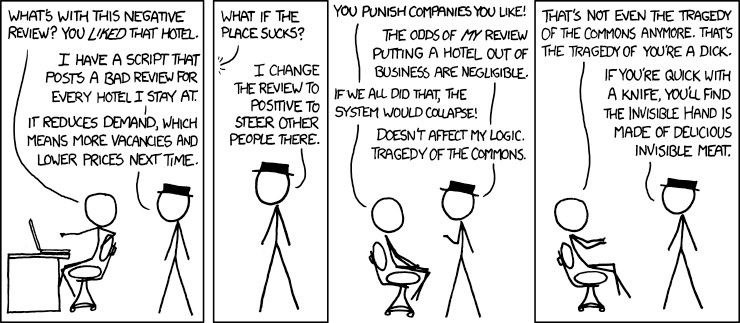
Tragedy of the Commons

Tragedy of You're A Dick

The Tragedy of the Commons is a situation in which reasonable people, acting in their own best interest, use or otherwise exploit resources shared by the whole – leading to negative results for everyone, including themselves. The term was first coined in 1968 by ecologist Garrett Hardin, but the idea can be documented much earlier – all the way back to the Greeks, I’m told, if one looks hard enough.

The classic example involves overgrazing a plot of common land. Each individual benefits substantially and personally from adding cows or sheep or whatever, although in the long-term they suffer when the land is no longer useful due to overgrazing. The bad stuff is shared in common, however, while the benefits are individualized.

Also in play is the awareness that an individual who decides NOT to take advantage – who limits the number of animals they graze, in this case – will (a) not actually solve the problem, since others will still do it, and (b) will suffer as a result of their community-mindedness, since they’ll have fewer cows.

The motivation for NOT being part of the problem is, therefore, nada.

Libertarians cite this as a fundamental case for land ownership and private property protection – one of the few ideals laid out in both the Declaration of Independence AND the Constitution (which don’t generally agree about much else). If each villager owned a small plot of land, to continue this particular example, they’d take better care of it long-term – or so the theory goes.

[[{“type”:”media”,”view_mode”:”media_small”,”fid”:”256″,”attributes”:{“alt”:””,”class”:”media-image”,”typeof”:”foaf:Image”}}]]

It is not far removed from the so-called ‘Unscrupulous Diner Dilemma’, in which a group of hungry cohorts agree ahead of time to split the cost of their collective meal. For each individual diner, the cost of ordering a more expensive meal and maybe an appetizer or two is thus greatly reduced. Although everyone will pay more as a result, the negative consequence of the choice is not proportional to the benefit.

The obvious solution is for everyone to pay for their own meal. Problem solved. Unless it’s not. Sometimes we want the benefits of collective resources.

[[{“type”:”media”,”view_mode”:”media_small”,”fid”:”255″,”attributes”:{“alt”:””,”class”:”media-image”,”typeof”:”foaf:Image”}}]]

In both cases, something intended as a collective good has negative results based on people being people. No one involved has to be particularly evil – they simply behave as people do rather than as idealized versions of what we wish people would do. In both cases, the solution seems so simple – to each his own. Everyone gets their own plot; everyone buys their own dinner.

But that’s where the proverbial devil enters into the details.

Someone will fail to take care of their land. Or it will turn out to not be very good land, compared to the next field over. Or one landowner will sell his plot to another to pay off debts, or because they wish to move, etc. Or the river will flood on some people’s plots but not others. Or ninjas. Or this, or that, or something else.

Inequality creeps in.

Even if the imbalance begins with human failure, the consequences are handed down to the eldest sons (keep in mind we’re working with the cow grazing example here – the ‘eldest sons’ part may vary in specifics). One way or the other, it doesn’t take many generations before some people have more land than others, or better land than others, and we’re faced with a disparity completely untethered to the individual choices of the landowners in question.

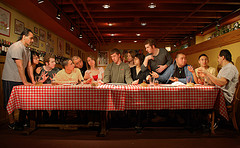
Faux Last SupperIn the more confined example of the Table for Twelve who’ve decided to each pay their own way, inevitably someone will lack sufficient cash to buy their entrée. They may have enough for an appetizer, but as they return to work slightly less-nourished than their peers, they will produce less – and the next visit to the restaurant may find them ordering a glass of water, no lemon, and swiping a few breadsticks from their cohorts.

Maybe some of the others will feel compelled to buy dinner for this poor chap! No one should starve when we have food – so they’ll share, or someone will step up and buy, no big deal. Or perhaps some of those contributing begin to resent the freeloader, or a sense of expectation gradually develops on the part of the recipient of these kindnesses until he no longer even realizes that he could ever be expected to pay his own way.

The point is that there are problems with communal ownership. There are pretty substantial problems with private ownership. The third option – government ownership – is rife with difficulty as well. Like all things smacking of socialism (which I use not as a loaded term but as an effort to approximate government-directed ‘sharing’), what works in theory and what people do in practice rarely cooperate.

If all men were angels…

If there’s no coordination from above, people don’t cooperate on a large scale – at least not in ways large enough to consistently impact the system. If there is coordination, that means rules, and laws – things that inevitably benefit some players more than others. Rules which are by their nature coercive, and often corrupt.

Pie. Just Pie.Add a more explicit financial element, and the impetus for avarice and corruption is almost irresistible. Laws can attempt to herd in certain behaviors, but can never eliminate them – and can certainly never do so equitably or effectively. Prohibition is only the most glaring example of men working the system for personal gain and the unintended consequences of government ‘help’. Think tax code, or health care, or military bases, or college scholarships.

Or think public education.

Like access to that theoretical bit of grazing land, education has become a basic human right. An enormous pool of resources is dedicated to the task, but despite its size, there are always more cows than grass. How do we distribute these quinzillions most effectively? Or should it be most fairly? Most efficiently?

Public School Cows will always need more – none have too much, and many have nowhere near enough. The field is also open to the Sheep of Charter Schools, the Taipar of Virtual, This Reform Bison, That Reform Gopher, the Reform-to-end-all-Reforms Zebra, and the Reform-to-end-all-Reforms New & Improved Zebra w/ Technicolor Stripes. The Textbook and Testing Goats eat way more than their share, as do various Grasshoppers trying to control everything from what kids eat for lunch to how much physical activity they get between classes.

Actually, maybe those should be Locusts.

Sort of a CowThere’s no motivation to take less, you see – the system is in fact weighted to encourage each and every player to get all they can as quickly as they can, or another player will. There’s no such thing as ‘results’ in the Tragedy of the Commons, but if there were, we’d find that what claims to be a measuring sticks turn out to be more like a lawn mower.
None of our solutions are appealing.  People in large numbers simply don’t play nice with any consistency. Governments are horrible at husbandry.  Private ownership is, in this case, loathsomely immoral. Normally this is where I’d unveil the solution – witty, a bit sardonic, but suddenly so very obvious. Normally, this is where we bring this baby home.

Moo.

10 Lessons Learned from Common Core Testing

10 Lessons Screen ShotThe Journal, an online periodical dedicated to “transforming education through technology” recently posted a fascinating list: “10 Lessons Learned from the Assessment Field Tests – Schools and districts that took part in the PARCC and Smarter Balanced trial runs share their experiences to help you prepare for online testing this spring.”

If you’re one of my Eleven Faithful Followers, you know I’m not particularly anti-Common Core. Oklahoma’s not even a Common Core state this month. Still, I work enough in surrounding states which ARE that I thought it would be worth perusing.

And… oh my god. The list… it’s… well, irony is dead to say the least.

All ten are the same lesson, repeated without irony or complaint – “Spend More Time and Resources Hyper-Focused on Computer-Based Testing.”

Lesson #1: Prioritize Your Infrastructure

Many school tech directors “talk about the devices first.” That’s the wrong approach… “You have to talk about the infrastructure first. Get that working, get that up to speed, spend the money where you need to there, and then talk about the devices.”

Too many schools are wasting their resources on instructional items or those overpaid tenured classroom teachers. Let’s prioritize, shall we?

Nothing on this list makes even a token effort to suggest “kids knowing stuff” should even be a factor, let alone a priority. Any resources devoted to learning are specifically redirected to things like…

Lesson #2: Do A Dry Run

Computer RoomSetting aside the unpleasant implications of having dry runs, you should monopolize the manpower and classroom space required for testing well in advance of the ‘real thing’. This carries the additional benefit of eliminating early any lingering sense we should care about anything else. Ever.

…If you’re taking a room that’s normally used for other purposes and dedicating it to testing, you may find that once you’ve packed it with “30 computers and 30 people, the air conditioning isn’t adequate to keep it cool. It’s not the thing you’d think of right off the bat.” Another possible scenario: You find out too late there isn’t enough power to run all the systems…

You might have enough Internet bandwidth coming into the school, but it may be that the access point that serves a particular sector of the school was expecting a dozen devices, and all of a sudden you have 30 or 40, and it’s not built for that much capacity.” There’s no substitute… “for setting up all your computers and getting the equivalent number of people in front of those computers, whether it’s students volunteering to stay after school to play around or a bunch of parents and teachers bringing up a practice test and trying it out and making sure everything works.”

Finally, something to do with all of those teachers and kids always wanting to hang around for hours after school – they can take practice tests online! That way, if there are problems, the school can promptly renovate their technological infrastructure solely to facilitate more testing. Bonus!

Lesson #3: Prepare Staff for New Priorities

New PrioritiesSo… what were the old priorities?

The Student Information Office dedicated two months to getting everything ready for the test, including working… to develop a schedule of testing sessions that they kicked back and forth for days on Google Docs…

“I didn’t have much to do at all with standardized testing before… Now we were totally dedicating our time to working on it.” Once the schedule was in place, the IT department dedicated about a month and a half to preparing the devices, “something that normally they wouldn’t have to do.”

It’s difficult to know where to begin mocking something so naturally horrifying and full of self-parody. Keep in mind no one included or quoted is complaining – they’re sharing their keys to success.

Lesson #4: Try a “SWAT” Approach

…There’s no such thing as over-planning when a school is undertaking a major initiative such as the transition to online testing… make sure you have a lot of people to help you out… 

If there’s one thing schools have in abundance, it’s helpful people without anything to do. We hardly know what to do with them anymore! Thank goodness testing is here so they won’t be bored or anything.

Lesson #5: Adjust on the Fly

Good news! No matter how much you plan, tons of stuff will go horrible wrong. Be ready to be consumed with dealing.

Clearly the rules for PARCC and Smarter Balance testing are different than other standardized tests in which the slightest wrinkle requires full shut down and execution of all witnesses, including the young. 

During the field testing, both the state department of education and Pearson held a daily briefing with district representatives to share problems and possible solutions…

I gotta give these people credit – they sound so enthused over the days spent troubleshooting a variety of devices. I’d be far less giddy over test-software-compatibility-alignment.

Computer & ChildLesson #6: Get All Hands on Deck

Although teachers acted as proctors during Burlington’s field testing, members of multiple departments were enlisted to provide in-school support… “We brought in as many team members as we possibly could.”

I don’t know about you, but I do get pretty fed up with people in the building wasting their time on stuff other than testing, test-prep, setting up for testing, or pretending to test so the testing tests go testier.

Lesson #7: Try Out Various Scheduling Scenarios 

If you’re not sure which approach to scheduling will be best, consider testing different schemes at different schools…

The best part about massive online resource-heavy testing is that there’s no reason every school should do it in the same way or under similar conditions. Variety and personalization are what makes it standardized and therefore such an effective tool.

KeyboardsLesson #8: Deal With Keyboards

Both PARCC and Smarter Balanced have mandated the use of external keyboards for their tests, but some districts have discovered that they should probably be optional. 

Um… but they’re not. Does anyone involved in this process understand how “standardized” works? Your personal flavor choices aren’t a factor – THAT’S THE WHOLE POINT. It’s why real teachers hate these.

“The students in Burlington don’t use an external keyboard. They like the on-screen keyboard. The fact that PARCC required it was actually a bit of a challenge for the kids who weren’t used to having it.” During the field test, he said, “Many of our kids disconnected the external keyboard and stayed with the on-screen keyboard. We just wanted to make sure they were using it however it was most comfortable for them.”

So maybe it’s not “standardized” causing the confusion so much as “mandated.” Or could we have been using that #3 pencil all along without retribution?

“Our students didn’t like having to sit at stations taking long stupid tests, so they looked up the answers on Wikipedia and then played Candy Crush. We just wanted them to be comfortable.”

Still, given that the districts quoted so far all have 1-to-1 technology, I can see how it might be important that every student have their own personalized test-taking device with which they’re so comfortable – just like every other child who’s ever going to have their worth judged by these assessments. Oh, wait…

Good thing there’s no possible correlation between your technological comfort-level and your ability to demonstrate what you know or are able to do academically.

Students TestingLesson #9: Practice the Sample Tests

Students will need help finding their way around the online assessments. Sample tests provided by both PARCC and Smarter Balanced can give them the introduction they need… “The performance tasks were certainly a new element, and that was probably the biggest change we saw… Part of that was building understanding around which tools the student can use during the assessment, such as dragging and dropping and drawing lines.”

To help students get comfortable… “We wanted all of our sites to have the time to make multiple practice tests before the field tests… so we could do it well in advance of the real test.”

I don’t have to even say it, do I?

Lesson #10: Put Your Communications Experts to Work

Although Smarter Balanced and PARCC have robust informational websites, the amount of content they make available can be overwhelming…

Yeah, lots of content can be. So can the skills required to effectively take ongoing technology-based assessments. 

Good thing we seem to have eliminated anything else which might clutter the minds or energies of our kids. 

With Friends Like These...

Dear Student of Color…

Writing LetterI should start with a warning that I’m probably going to say the wrong thing. I know this because I often say the wrong thing – not just with you, or with other students of color, but in general. Saying the wrong thing is something of a specialty of mine.

In this situation, however, the wrong thing is more daunting than usual. Here I am, an old white guy – one of a hundred or so Caucasians staffing this school, except for one assistant principal, one para, the security guard who subs when the regular guy is gone, and of course most of the custodial staff. And I want to talk to you about race – as if I have the slightest credibility to do so. You’ll feel partially obligated to listen, but I have no idea how it will actually be received or understood.

I’d like to apologize for – well, everything. I don’t mean this sarcastically or melodramatically, and under no circumstances am I interested in riding the liberal guilt train through your limited time here and expecting you to know how to respond. I’m pretty sure, though, that I’ve said or done things in our short time together which validate everything you find annoying about old white people, or perhaps add whole new things to the list.

It’s just… I try to avoid allowing racial subject matter to carry stigma or the wrong sort of power into my classroom or my interactions with students. Embarrassed whispers and the rushed clichés do little to improve our understanding of one another or anything we’re trying to learn.

I’m also trying to stay out of the sandtrap of comfortable white avoidance. It’s dishonest to simply steer around anything inflammatory, or reduce loaded issues to pre-compartmentalized tropes. It’s far too easy to reduce the most important human realities of social studies, literature, or history to abstractions with far less power to confuse or scare us. 

We distance ourselves from the strange creatures all those centuries ago capable of Indian Removal, Slavery, War with Mexico, or Japanese Internment Camps. I’m not ignoring that in some ways we’ve made huge strides towards equality and mutual respect and kumbaya – but we’re afraid to confess man’s eternal drive to camp with “us” and go to war with “them”. We tell ourselves you’re not developmentally ready to question or explore the evolutionary, social, political, or fiscal aspects of our collective urge to form teams and fight over land, food, women, cultural norms, or oblong inflated pigskins.

I’m sure in my efforts to be transparent and ‘real’ I’ve often only managed crass, or clichéd, or awkward, or just… wrong. I may make things worse as often as better, but if the alternative is to avoid these discussions altogether, I’ll keep taking that risk.

I apologize for my muddling, though, and I hope you recognize my intent if not my navigational skills.

As to race or other elements which make people more interesting, most of my understanding is second-hand. Through no control of my own, I was born a straight white male, and a fairly conservative one at that. As my preferred political party lost their collective minds over time, I drifted towards a kind of libertarian idealism… but one willing to settle for liberal efforts until some sort of educational revolution makes self-sufficiency a plausible –

You know what? I’m rambling, and I know from our last quiz that most of you don’t actually know the meaning of half of the things I just said.

What I’m getting at, though, is that it wasn’t until I started teaching that I started really caring about and trying to understand why some students act this way or that, while others are more likely to do such and such. In the abstract I have limited patience for talk of the ‘culture of poverty’ or ‘racial identity development’ – I just want anyone without a clearly defined disorder to make some effort to do their work, show a little mutual respect, and not be, you know… annoying.

But my students aren’t abstracts. Like you, they’re right here – with names and personalities and wants and needs and everything. And most of the time I really like them. My beliefs or opinions or emotional reactions to abstracts or groups of abstracts were no longer helpful.

I found I could care deeply about my students and still not ‘get’ them, which made it difficult to really fulfill that whole touch-the-future teacher thing.

That’s not always because of race, of course. White kids can make no damn sense plenty of times, and there are limitless reasons why I may grasp one kid’s world more intuitively than another’s. But clearly there are… trends. Visual clues who I’d ‘get’ and who I’d not. Even outside of class, stuff I’d hear or read began to resonate differently because they were suddenly not about abstract types of theoretical people but MY KIDS.  

As you continue to read and learn and experience things, you’ll discover that “us” and “them” loses its endurance when real faces and names enter the picture. You know from our last unit how important it is to demonize and “other”-ize the enemy in times of war. Without effective propaganda and group buy-in, it’s rather difficult to get super-excited about shooting someone in the face or blowing up their family. You may have noticed that even in ‘shooter’ video games you’re generally mowing down masses of generic scary looking –

I’m getting distracted again. I’m sorry. I’m not sure I’m doing a very good job here.

I guess what I want you to know is that I’m trying. I’m reading books about racial dynamics and adolescence and trying to understand more about cultural norms and common experiences without reducing you or anyone else in my care to a category – the Asian, the Mexican, the Beautiful Strong Dark Black Girl.  I’m on social media listening, asking, and sometimes annoying those I think useful. I don’t mean to annoy, but they can handle themselves – they’re of age and not my personal responsibility.

You are, at least while you’re here.

I hope you feel free to speak to me about anything related to… you know, stuff. Feel equally free NOT to speak to me about it. My ignorance may impact you, but it’s not your responsibility. You don’t owe me lessons on your world – you’re 14. That’s also why I won’t actually have this conversation with you. It’s just me and my Eleven Faithful Followers on the interwebs.

One more thing, though – something I probably WILL approach you with before the year is out. You know we have a pretty diverse group of students here. We’ve talked in class about what a huge advantage that is for us collectively, and I mean that – it’s not inspirational fluff like most of what we fill you with. But you’ve probably also noticed that, as I referenced above, we have a painful scarcity of teachers of color. I assure you the mass of old white folks running things really do mean well, but we’re somewhat limited by being, um… a bunch of old white folks.

As you move through high school and decide where to go for college… as you discover the strange mix of amazing options and inexplicable hurdles which await you… please consider teaching.

You’re one of my best – and I don’t mean “for your race” or whatever. I mean you’re quality – period. You’ll have more options than I could have imagined at your age. I’m not telling you not to follow your calling if it lies elsewhere. I’m certainly not telling you money and professional respect don’t matter, because they do – and you won’t get much of either if you teach anywhere in this beloved state.

But what you could do, if you’re so led, is to be that teacher you didn’t have. That example, that reference point, that option, that important part of the equation that we’re not nearly close enough to at the moment. I don’t know if I can promise you’ll change the world in the kind of dramatic ways we see in the movies, but – at the risk of being a little cheesy – we all change the world by what we do while we’re here. We all make “a difference”, for better or worse.

Consider making this one, better than me, for the ones who’ll be you when you’re me. Consider being amazing for them in small, thankless ways, because I wasn’t, or couldn’t, or just didn’t.

Thanks for hearing me out. You should head to class.

Roster Villification

Evil Hacker MaskedNote: After losing most of this blog and website just before Halloween of this year, I’ve been rebuilding it from salvaged text cut’n’paste into long documents with some pretty strange formatting. Since I’m having to redo any posts I wish to retain anyway, most are getting fresh edits – or at least being shortened a bit. Many are simply not being reposted. 

This was going to be one of those. 

But this week two First Grade teachers in Tulsa, Oklahoma, took a principled stand against subjecting their students to any more abuse in the name of standardized testing. Their story and the letter they sent home to parents made waves, and they are likely to be fired for doing what’s best for their students. 

I couldn’t help but remember a few months ago when I did the opposite, and caved in the face of almost no pressure. I’m reposting this as a confession in contrast to their courage and their conviction. My other rebuilt posts retain their original posting dates for logistical reasons; this one will not. It was originally posted April 16th, 2014. 

Roster Vilification 

Right now I hate my job. 

I like my co-workers, my administrators – even the nice lady from the ESC who had to talk us through Roster Verification this morning. I may hate myself a little, now that I think of it. 

DDDiceI don’t even teach a tested subject this year. State law as it stands this week (it’s been rather flaky lately, so who knows what 30 days from now might bring?) says I can pretty much make up my own standards for VAM in my department, while my friends down in the Math & Science halls are tied to tests already taken and cut scores which are determined by random rolls of leftover D&D dice sometime in July.  
What do I care, seriously? What difference does it make what bureaucracy I agree to, just to move things along? Why am I blogging this only so I don’t write my 2-week letter – THIS time of year of all times? 

I just looked through a list of 168 students and confirmed with God as my witness that I am 100% responsible for everything they’ve ever done or will do, good or bad.  Kids I haven’t seen in months. Kids who’ve been through weird circumstances, or who haven’t but have just shut down anyway. I’m also taken credit for kids I don’t think I’ve really taught much to – they’re just ‘those kids’ who show up and do most of what I ask.

They may have 102% in my class, but I don’t think they’re leaving with a love of learning so much as reinforced cynicism about just playing along with the system.  

Which is what I just did. 

Roster VerificationThis is wrong – this electronic tying of each teacher to each kid based solely on who’s on your grade book at a given point. It doesn’t matter that I have upper middle class white Methodists from two-parent families who only miss school for golf or family vacations to Europe, while the guy next to me has kids suspended so often he has more class admit forms than completed assignments. 

There’s nothing in the measurement to indicate where a given kid might be mentally, or emotionally, or how often I’ve even had them physically in front of me. I don’t even recognize some of the names I just said were mine. 

But I agreed to it all. 

I agreed to it all because refusal doesn’t make things difficult for the State – it makes things difficult for my building principal, who I love and respect. It makes things particularly difficult for the nice lady from the ESC who started off so determined not to take my comments personally, but who hasn’t dealt with me often enough to know how unrealistic that was. (She actually did very well until my first effort to submit everything locked up the network – probably at the State’s end – and we had to reboot and start over.) 

I agreed they’d been with me in such and such class all year, even though first semester was an entirely different course with a different name and number. I agreed although 140+ kids from various teachers including myself were pulled out of our sections in November and given to the new guy – but I couldn’t remember which ones and didn’t want to try to dig through old records to fix it.  I agreed even though it was wrong – wrong mathematically, morally, pedagogically, and emotionally.

I agreed because refusing to cooperate wouldn’t change anything, and would be a huge pain in the ass for people who aren’t actually the ones causing the problem. I agreed because realistically this won’t even affect me that much – I teach Social Studies. No one cares what we do most of the time. We don’t get much support or respect compared to other cores, but we also don’t get called to the same meetings or face the same stress. I’m 47 and tenured, and could probably make the same money doing workshops and PD full time. I agreed because this isn’t really my problem. 

Malala Newsweek CoverWhich is the opposite of what I teach my kids all year. It’s the antithesis of that stuff that helps maintain the thin illusion that anything we’re doing here matters, or has value, or could change anything. “Don’t rock the boat – it won’t help!” That should replace the other posters in my classroom for the last two weeks. Just sit in the back of the damn bus. Just finish the wire transfer from the hidden account. Just ignore the policies that maintain poverty for political gain, or segregation for social stability. Just walk past the problem.

You don’t even have to pull the trigger – just don’t step in front of the gun. You’re not that important – you can’t change something this big with some small, symbolic gesture that’s going to do nothing except make everyone around you have to work harder because you’re an ass. Pick your battles, dude – just click the ‘Submit’ button. This is Oklahoma – what are the chances that whatever policy is going to save us all this week will even be around in a year? 

So I went along with it. I did what the instructions said, cynically, but in order to move along – much like my most successful students, now that I think about it. They do it because we tell them to, and that’s how you get an ‘A’. I fight it all year, wrestling for their academic souls, and just gave mine away for a bowl of convenience stew. 

None of my kids will know, or care. My co-workers get it, but figure – correctly, no doubt – that I’m overreacting. My bosses might even agree, but can’t come out and say so.

But none of that really matters, because right now I hate my job. I hate my state. I hate the naiveté that’s kept me doing this for so long as I move past my otherwise employable years. I hate the other professions I turned down because I thought I was that f***ing important – a difference maker – a world shaker. I hate how when that little moment of decision came, I did the easy thing because I didn’t think the big thing was even a possibility. I just fed the machine, and it let me go back to class. 

Grapes of Wrath CoverI have students coming in 15 minutes, and we should be discussing what we’ve read so far in The Grapes of Wrath. I’d meant to talk about “Joe Davis’s boy,” who drives the tractor that’s tearing up their land and down their homes, and I’ll ask them whether he’s part of the problem or not.

They’ll say he is, most of them. And they’re right. 

We’ll talk about the ‘monster’ that’s bigger than the people who work for it and in it, and – being young – they’ll take a more defiant stance than the characters in the book are able to at this stage in the story. A better stand than I did today. Eventually, maybe, they’ll learn to just… go along. I can hardly steer them otherwise. 

I hate myself today. And I’m sorry.