
Like A Metaphor

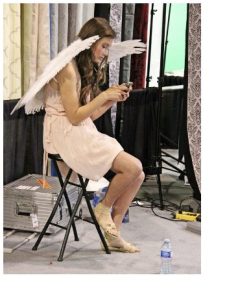
girl dressed as an angel sitting on foldup stool textingI’m about to commit the gravest of blasphemies against ELA doctrine, so I might as well get it out of the way up front.

It’s silly that we have different names for “similes” and “metaphors.” They’re the SAME THING. The distinction is purely technical and largely irrelevant.

Alliteration is alliteration whether it occurs in multiple sentences or a single pair of words. The name doesn’t change based on whether the repeated consonant is hard or soft, capitalized or lowercase.

Onomatopoeia is onomatopoeia whether the sounds being emulated are emitted from living creatures or inanimate matter – loud or soft, comforting or frightening.

Personification is personification. Imagery is imagery. Foreshadowing is foreshadowing. Themes are themes.

But metaphors are only metaphors if they don’t use “like” or “as.” If either of those words appears, suddenly they’re similes. As a result, we spend so much time trying to help students distinguish between the two that we lose sight of why these devices exist in the first place.

A metaphor compares two things which aren’t otherwise alike in order to emphasize one or more characteristics of the primary character or situation being described.

A simile, on the other hand, compares two things which aren’t otherwise alike in order to emphasize one or more characteristics of the primary character or situation being described… and uses “like” or “as” to do so, so it’s a tad less intense.

“You’re an angel” is a metaphor.

“You’re like an angel” is a simile.

These aren’t exactly the same, but they’re close enough that they shouldn’t require multiple worksheets to tell them apart. And just to complicate things, not every description using “like” or “as” is a simile.

“I’m going to the Halloween party dressed like an angel” is neither a simile nor a metaphor – it’s just a description. But we get kids so focused on that “like” and “as” nonsense that they feel betrayed when statements like this don’t qualify.

That’s a shame, because a decent metaphor (or simile) can bring connection, complexity, or any number of other interesting characteristics to a piece of literature, a simple poem, a pop song, or even a persuasive essay – often more efficiently and effectively than any other literary device. There are endless iterations of this across multiple genres, but for now I’m going to stick with a few easily digestible examples from popular music – the kind you’d use when first teaching these devices to kids.

Most musical examples are fairly straightforward…

From “I Am A Rock” by Simon and Garfunkel:

I’ve built walls – a fortress deep and mighty that none may penetrate

I have no need of friendship – friendship causes pain – it’s laughter and it’s loving I disdain

I am a rock – I am an island

From “Life Is A Highway” by Rascal Flatts:

Life’s like a road that you travel on – when there’s one day here and the next day gone

Sometimes you bend – sometimes you stand – sometimes you turn your back to the wind…

Life is a highway – I wanna ride it all night long

If you’re goin’ my way, well – I wanna drive it all night long

From “Hungry Like The Wolf” by Duran Duran:

I’m on the hunt, I’m after you

Mouth is alive, with juices like wine and I’m hungry like the wolf

From “We Got The Beat” by Talib Kweli:

Coming from the deep black like the Loch Ness, now bring apocalypse like the Heart of Darkness…

You get the idea. Others, though, are developed a bit more thoroughly, as in this excerpt from “Buggin’” by the Flaming Lips:

All those bugs buzzing around…

Well they fly in the air and you comb your hair

And the summertime will make you itch the mosquito bites

The buzz of love is busy buggin’ you

Well they fly in the air as you comb your hair

And they’re splattered up and down your windshield – the headlights

Well, they bite – yeah, they bite – but you can’t see them there

But they bite – yeah, they bite – but you can’t tell they’re there

Does love buzz? Because that’s what it does…

We have multiple things going on here. There’s all that onomatopoeia of the buzzing and splattering and the alliteration of the bugs biting. But there’s also an underlying metaphor – love is like bugs in the summer. It’s annoying and messy, but it’s everywhere and chances are, you can’t escape it. Love is probably the most written about subject in all of human history, but this quirky metaphor finds something new to say about it. Exactly what that is may be difficult to explain – but that’s why the writer uses the metaphor in the first place.

In “Brick” by the Ben Folds Five, we have the recurring metaphor referenced in the title:

Now that I have found someone, I’m feeling more alone than I ever have before

She’s a brick and I’m drowning slowly – off the coast and I’m headed nowhere

She’s a brick and I’m drowning slowly…

A brick isn’t a bag of concrete, but it’s enough that over time the pull becomes unbearable – especially when you can’t quite reach dry land and aren’t even sure what direction you’re going. The details described in the rest of the song are quite specific, but the experience of being pulled down by a relationship you don’t feel free to escape is universal – hence the power of the metaphor.

Things don’t always have to be so profound, of course. In “If I Were A Bell” from the musical “Guys and Dolls,” love interest Sarah Brown (a “good girl” missionary being swept off her feet by a “bad boy” gambler) uses a series of metaphors to express her happiness with just enough sexual innuendo to provide plausible deniability should anyone question her too closely:

Ask me how do I feel – ask me now that we’re cozy and clinging

Well, sir, all I can say is if I were a bell, I’d be ringing

From the moment we kissed tonight, that’s the way I’ve just gotta behave

Boy, if I were a lamp, I’d light – or if I were a banner, I’d wave

Ask me how do I feel, little me with my quiet upbringing

Well, sir, all I can say is if I were a gate, I’d be swinging

And if I were a watch, I’d start popping my springs

Or if I were a bell, I’d go ding dong ding dong ding…

Ask me how do I feel – ask me now that we’re fondly caressing

Well, if I were a salad, I know I’d be splashing my dressing

Or if I were a season, I’d surely be spring

Or if I were a gate, I would swing – have a fling – almost any old thing

Or if I were a bell, I’d go ding dong ding dong ding dong ding dong ding!

None of these are overly specific – a bell ringing, a gate swinging, a salad “splashing its dressing,” etc. Used this way, the metaphors suggest an emotional state through their cumulative effect. (They don’t all even make sense individually.) The character is experiencing something new and unexpected. She lacks the words to explain it – so… metaphors galore.

Admiral Twin does something similar in “Better Than Nothing At All,” although the cumulative effect of their metaphorical onslaught has a very different tone:

I’m a bitter pill on your tongue, but I tell you – I’m better than nothing at all

I go down as smooth as a nail or a memory drowning in alcohol…

I’m the ghost in your closet when you turn the lights out – I’m rattling ’round through your bones

I know all your secret designs and amusements – I’m listening on the phone…

I’m the rock at the bottom of where you are falling, and when we kiss you’ll be there

I’m the thorn in your side when you’re trying to be cool (but nobody really cares)

You’re afraid of the outside – you’re afraid of the outside creeping in

You don’t really want me, but you’d better believe

Oh, I’m better than nothing at all – oh, I’m better than nothing at all

A few of these could also be classified as “idioms,” but their purpose is the same. Something very difficult to accurately describe in literal language – in this case, a dysfunctional relationship of some sort – can be captured quite powerfully with the right metaphors.

Some writers use metaphors so subtly that the story (or poem, or song) works just fine without our conscious awareness that anything deeper is going on. I love this example from “Little Black Dress” by Sara Bareilles:

I tried to be everything you’d ever want and sometimes I even stood on my heart and stomped

Now I’m finally alone and dressed for the show – but going nowhere – they don’t need to see me crying

I’ll get my little black dress on, and if I put on my favorite song – I’m gonna dance until you’re all gone…

Now I’m fighting to find the ground again, to steady my feet

Get up off my knees and just remember that I am more than just somebody’s puppet

I can find the cord and then I’ll cut it

I stand a pretty good chance to dust myself off and dance

I’ll get my little black dress on, and if I put on my favorite song – I’m gonna dance until you’re all gone…

And if I tell myself that nothing’s wrong, this doesn’t have to be a sad song – now with my little black dress on

It’s time to connect the dots and draw a different picture up and paint it with the colors of everything I ever was

Return to the scene of the crime, the day I let the music die, and rewrite the final lines cause this time I –

I’ll get my little black dress on, and if I put on my favorite song – I’m gonna dance until you’re all gone…

And if I tell myself that nothing’s wrong, this doesn’t have to be a sad song

Not with my little black dress on

The song is a fairly straightforward celebration of self-empowerment after a bad breakup, and most students will catch the “puppet” metaphor easily enough.

It’s noteworthy, however, that it’s a little black dress – not red (suggesting danger or sexuality) or green (implying rebirth or new growth) or whatever. Black is the color one wears to a funeral. In this case, it’s not the death of an individual, but of a relationship. Combined with the elusive reference to “the day I let the music die” and the recurring insistence that “this doesn’t have to be a sad song,” it’s safe to say the choice was intentional.

You know how these artistic types are, after all.

But let’s just say it’s NOT intentional – that a “little black dress” is simply a standard, all-purpose go-to for many women. Does that invalidate the “funeral” metaphor I just spent so much time on? No, not at all. Metaphors and similes don’t rely on the intent of the author anymore than a pregnancy must be planned in order to produce a baby. Sometimes they just… happen.

The examples above are only a few very basic examples of some of the different ways metaphors and similes can be used; the possibilities are pretty much endless. Many songs, poems, and stories utilize these literary devices in “one-and-done” fashion to make a single point, while others weave thematic tapestries you could spend weeks unraveling. There are also some metaphors so common in stories, poems, and songs, that they’ll require their own separate post – windows, doors, weather, light, dark, seasons, water, birth, cars and driving (or crashing), waking up, falling asleep, etc. We’ll try to tackle a few of these next time.
Recognizing Allusions

Allusions are one of the trickiest literary devices to teach young people, largely because allusions by their very nature expect the reader to already understand people and events generally considered to be “common knowledge.”

You see the problem.

An effective allusion draws on characters or situations from history, literature, mythology, religion, Shakespeare, or even pop culture (including comics and television) to illuminate a less-familiar character or situation. They add drama, humor, or insight, and potentially offer new layers of context or foreshadowing to the story at hand.

Let’s start with something heavy by way of example. Doctor Martin Luther King, Jr., speaking in Memphis, Tennessee, on April 3rd, 1968 (just 24 hours before his assassination) closed with these words:

It really doesn’t matter what happens now… We’ve got some difficult days ahead. But it doesn’t matter with me now. Because I’ve been to the mountaintop. And I don’t mind.

Like anybody, I would like to live a long life. Longevity has its place. But I’m not concerned about that now. I just want to do God’s will. And He’s allowed me to go up to the mountain. And I’ve looked over. And I’ve seen the promised land!

I may not get there with you. But I want you to know tonight, that we, as a people, will get to the promised land! And I’m happy tonight. I’m not worried about anything; I’m not fearing any man. Mine eyes have seen the glory of the coming of the Lord!

Given that King was a preacher, it’s not exactly a surprise how often he referenced Biblical characters, stories, and values. Just as importantly, his audiences understood these allusions. Whatever the state of their eternal souls, most Americans in the 1960s knew their Bibles. In this case, they knew that after Moses led the Israelites (former slaves who remained marginalized for generations) for four decades, God informed him it was almost time for them to enter the Promised Land – but that Moses himself would not be joining them. By way of consolation, God led Moses to the top of Mt. Pisgah and showed him the land the Israelites would soon inhabit.

King didn’t have to explain the allusion – the audience erupted the moment he said it. The poignance it would carry in after his death wasn’t the issue; it was the idea that all of their struggles had been worthwhile. A new reality was coming, and soon. The implication was that God himself had heard their cries and would be directly involved in making things right. King’s Christ-like acceptance of suffering only reinforced the spiritual dynamics in play.

Notice that my explanation, inadequate as it was, took up way more time and space than what Dr. King said, while still somehow sucking energy and impact out of the story. In less than a dozen words, he brought in emotion, spiritual comfort, and a belief in inevitable victory by layering the right familiar story over his commentary on current events. That’s the power of allusion.

Here’s something a bit more artsy-fartsy, from Leonard Cohen’s “Everybody Knows”:

And everybody knows that the plague is coming – everybody knows that it’s moving fast

Everybody knows that the naked man and woman are just a shining artifact of the past…

Cohen likes to weave in religious imagery for mood even when specific meanings prove elusive (“I heard there was a sacred chord that David played and it pleased the Lord…”), but in this case the subtle allusion to Adam and Eve conjures up the ultimate loss of innocence with tragic consequences. In a song replete with betrayal, failure, and grief, we’re reminded that such experiences aren’t new, they’re foundational in the human experience – which also means we’re not alone.

Ben Folds is even more subtle in “Brick,” a song about a young man taking his girlfriend for a secret abortion and the emotional consequences of the relationship:

Six a.m, day after Christmas – I throw some clothes on in the dark…

Folds uses multiple literary devices throughout this one – imagery, tone, and the recurring “brick” metaphor. It’s possible that “day after Christmas” is simply intended to contrast the narrator’s state of mind with the intended joy of the season. But what is Christmas about, at least traditionally? A birth. A miraculous new baby.

They call her name at 7:30. I pace around the parking lot

And I walk down to buy her flowers and sell some gifts that I got…

They probably weren’t gold, frankincense, and myrrh, so maybe I’m reading too much into this one.

Can’t you see – it’s not me you’re dying for. Now she’s feeling more alone than she ever has before…

Nope. I’m not.

“It’s not me you’re dying for” is not something most of us would say to an aborted fetus, whatever our pain or regret. It does, however, suggest that a baby might be capable of dying “for” someone. You know, like a kid born on Christmas did a few years back.

An already dark situation is made more powerfully tragic by the subtle contrast with the Son of God. A direct comparison would be awkward and absurd, but Fold’s indirect allusion instead adds pathos and depth. The song works without it – it’s just more powerful with it.

Allusion doesn’t have to be heavy. Hanson’s “Juliet” is pretty much ALL allusion, and it’s outright celebratory:

Juliet, you’re my love – I know it’s true that around you I don’t know what to do

Can’t you see that you’re my sun and moon? …

Your window breaks the rising sun – by any other name, you’re still so beautiful

In everything I do, I will love you my whole life – if you’ll be my Juliet …

Juliet, you are a drug and it is quick – and with a kiss I lose my senses

Juliet, you are a fire, I am consumed – tonight I’m dying in your arms …

OK – there’s a tiny little dark undercurrent here (given that in the original, they both actually die in the end), but it’s utilized lightly and ironically. That’s another nice thing about allusions – as long as you honor the truth of the original, you can point it any direction you like. These aren’t scientific truths we’re playing with here; it’s literature, and therefore endlessly flexible and subjective.

Of course, not all allusions have to be profound or complicated. They simply need to bring something to the table – to add meaning, depth, or interest to what’s already being said. Sara Bareilles is arguably better at this than anyone else writing and performing today, as in this excerpt from “Hercules”:

I want to disappear and just start over – so here we are – and I’ll breathe again, ’cause I have sent for a warrior

From on my knees, make me a Hercules – I was meant to be a warrior, please – make me a Hercules

Literature and poetry tend to be more intentional and crafty with their use of allusions, but when learning to spot them and practice explaining them, pop music offers endless examples of the straightforward, “one-and-done” variety.

In “I Say No” from Heathers: The Musical:

You said you’d change, and I believed in you, but you’re still using me to justify the harm you do…

You need help I can’t provide – I’m not Bonnie, you’re not Clyde – it’s not too late, I’m getting straight… I say no!

In “Buddy Holly” by Weezer:

Ooh-wee-hoo, I look just like Buddy Holly – and you’re Mary Tyler Moore

I don’t care what they say about us anyway – I don’t care about that

In “Such A Saint” by Admiral Twin:

She and Joan of Arc were having lunch today down at the Blue Room

She told Joan she’d like to barbecue, then laughed as Joan began to cry

I’ve known evil, mean, bad people kinder than that – if you’re such a saint, reprieve me

The concept can be creatively varied and still be an “allusion,” as in Hindu Rodeo’s “McLife”:

Read my McNews, drink my McJav, eat my Egg McMuffin, kiss my Egg McWife

Go to McWork to get some McClass and buy some McStuff – gotta kick some McA**

I don’t ever think – I don’t even try – I don’t ever live – I like my McLife

I don’t ever dream – I live a McLie – learned to McLive, now I guess I’ll McDie

Literature and poetry are less likely to use pop culture references because of how quickly yesterday’s superstars and headlines fade into obscurity. When learning to spot allusions in a classroom setting, however, cartoon characters and comic book superheroes are fairly easy to find. The trick for those of us not traditionally steeped in ELA minutia is to distinguish between actual allusions and simply referencing well-known characters.

When the Spin Doctors sing as Jimmy Olsen assuring Lois Lane that he has a “pocket full of kryptonite,” I’m not sure they’re bringing depth or emotional interest to something new so much as playing with the DC universe for pure entertainment (which is a completely valid artistic expression itself). On the other hand, the Flaming Lips are going for something a bit more complicated in “Waitin’ For A Superman”:

Tell everybody waitin’ for Superman that they should hold on best they can

He hasn’t dropped them – forgotten or anything – it’s just too heavy for Superman to lift

In the end, it’s not always important whether an effective reference to a past character or situation is an “allusion” or just a reference, a “metaphor” or just an analogy. What matters is that it’s effective – that it communicates more completely what the author is trying to express.

Wicked Alliteration

I taught English for several years largely because I needed a change of pace – a fresh start, as it were. I’d been certified for years without actually teaching the subject, so while I was technically qualified, I didn’t actually have much idea what I was doing.

As it turned out, that mattered less than it might have in other circumstances. I moved to a high poverty urban district where I was assigned mostly freshmen classes – meaning they were all coming to us straight out of failing schools already under some sort of alternative governance and so forth. Most of the first semester was spent learning how to be a high school student, with a little reading, grammar, and discussion thrown in as circumstances allowed.

Thank goodness.

I did my best, and I’d like to think I got a bit better at it along the way. I was glad several years later to be offered a position in the history department. I’m still not sure I’m having much impact academically, but at least I know what I’m talking about in terms of the content and basic skills.

There’s one thing I really miss about ELA classes however – literary devices. You know, metaphors, onomatopoeia, imagery, symbolism, and other fun stuff like that. One that particularly surprised me in terms of its impact and omnipresence was alliteration – the repetition of consonant sounds close together in a passage or phrase. Obviously I already understood the basics, but I’d never really paid much attention before. As it turns out, alliteration is super easy to explain and recognize, but difficult to analyze in terms of its purpose or impact.

It does stuff, but unless someone intuitively “gets it,” it’s tricky to express just what “stuff” it does. This is my effort to explain alliteration to anyone not already enmeshed in its glories.

(1) Alliteration is catchy. It helps stuff stick in our brains. We know it works because of all the stuff we remember without always considering why – Coca Cola, Peter Parker, DoorDash, PayPal, LifeLock, Dunkin’ Donuts, Clark Kent, Lois Lane, Bruce Banner, etc. It’s also in numerous cliches and catch phrases, helping us remember them even when we overlook the alliteration itself:

“‘Tis better to have loved and lost than never to have loved at all.”

“Better safe than sorry.”

“The grass is always greener…”

“Ignorance is bliss.” (sssss)

“It’s a labor of love.”

“Who put a bee in your bonnet?”

“Are you a man or a mouse?”

You get the idea. Alliteration makes things easier to remember.

(2) Alliteration is sometimes used just to show off. There’s nothing wrong with this; language is intended to do many things, one of which is to entertain.

Tongue twisters are the most obvious examples. They’re not usually designed for emotional impact or thematic subtlety – they’re just hard to say real fast and that makes them “fun.”

Rap and hip-hop (I’m told there’s a difference) like to use rapid-fire alliteration as well. While the lyrical choices often have import beyond technical impressiveness, the wordplay is part of what makes the genre so appealing to listen to but difficult to emulate (although that doesn’t stop way too many youngsters from trying).

Here’s an example from Tupac Shakur’s “If I Die 2night

They say p**** and paper is poetry, power and pistols – plotting on murdering mother******* ’fore they get you

Picturing pitiful punk n***** copping pleas, puffin’ weed as I position myself to clock G’s

My enemies scatter in suicidal situations, never to witness the wicked s*** that they was facing

Pockets is packed with presidents, pursue your riches – evading the player-hating tricks, while hitting switches…

I’m sick of psychotic society, somebody save me – addicted to drama, so even mama couldn’t raise me…

It in no way diminishes the emotional message to suggest that the overabundance of ‘p’ sounds (broken up only by the ‘s’ and ‘w’ phrases) is largely there for the same reason as elaborate guitar solos in classic rock or high notes in jazz – just to show they can do it.

(3) Alliteration reinforces tone, mood, or theme. This is the most “legit” of the three, and the trickiest to recognize and understand – partly because it’s somewhat subjective and partly because when it’s too noticeable, it loses its effectiveness. Like makeup or salt, alliteration is at its most effective – at least from a literary standpoint – when it compliments what’s already there, not when it becomes the focus.

Many teachers introduce literary devices by highlighting examples from popular music. Even if students don’t know every song, these examples tend to be more accessible than traditional poetry or prose – that’s why they’re on the radio, after all.

Here’s one you’ll find anytime you search the internet for examples of alliteration…

When I find myself in times of trouble, Mother Mary comes to me

Speaking words of wisdom, “Let it be.”

And in my hour of darkness she is standing right in front of me

Speaking words of wisdom, “Let it be.”

Notice how the alliteration emphasizes the emotion:

“times of trouble” – the “t” sound is a bit of an aural irritant, almost sharp in your ears

“Mother Mary comes to me” – in addition to the religious allusion, “m” sounds are soft and comforting

“words of wisdom” – “w” sounds are also soft, almost warm

A moment later, “speaking” becomes “whisper” – doubling down on the alliteration while adding a touch of onomatopoeia to further enhance the quiet, comforting tone. (This contrasts nicely with the emotions in the Tupac example above. You can discuss how ‘p’ and ‘s’ sounds differ from ‘m’ and ‘w’ sounds. You may feel a bit silly, but it will stick.)

Songs from Broadway musicals are an easily overlooked gold mine of literary devices as well. Because they’re intended to be performed live, songs from this genre must use every tool at their disposal to communicate the maximum amount of information to the listener the first time through. They tend to be a bit richer in content than the average pop song, but far more accessible than legit “poetry.” Just like in other genres, alliteration is often at its most effective when you hardly notice it:

Oklahoma, where the wind comes sweeping down the plains, and the waving wheat can sure smell sweet when the wind comes right behind the rain…

Other than the momentary tangent into “sure smell sweet” (a use of ‘s’ sounds which somehow emphasizes sweetness as a characteristic as much as it does as a word) that’s a LOT of ‘w’ action. Then again, for a song which includes actual whooping (“And when we say, ‘Ee-ee-ow! A-yip-i-o-ee-ay!’”), perhaps it’s only appropriate it begins with a strong dose of ‘wuh’.

One of my favorite alliterative cornucopias is “Defying Gravity” from the ridiculously popular musical Wicked. The two main characters are Glinda (the “good” witch who helps the Munchkins) and Elphaba (soon to be known as the “Wicked Witch of the West”). This is a “moment of decision” song and closes out the first act.

Glinda (to Elphaba): “I hope you’re happy! I hope you’re happy now! I hope you’re happy how you hurt your cause forever! I hope you think you’re clever!”

Elphaba (to Glinda): “I hope you’re happy! I hope you’re happy, too! I hope you’re proud how you would grovel in submission to feed your own ambition!”

Together: “So though I can’t imagine how, I hope you’re happy right now!”

Just listen to all those “h” sounds. The exasperation in their voices is supported by syllables which sigh and huff at one another. Change the line to something like “I guess you’re happy!” or “I hope you’re satisfied!” and something important is lost even if the same basic meaning remains.

Glinda’s tone soon changes from frustrated to imploring…

Glinda: (spoken) “Elphie, listen to me. Just say you’re sorry…” (singing) “You can still be with the Wizard – what you’ve worked and waited for. You can have all you ever wanted…”

Elphaba: (spoken) “I know…” (singing) “But I don’t want it – no, I can’t want it anymore…”

The new tone is again reinforced by effective alliteration. From “listen… say you’re sorry” to the much softer “with the Wizard… worked and waited… wanted…” The line could just as easily have been “all you’ve hoped and waited for,” or “you can have all you’ve ever dreamed of,” but those just aren’t the same.

Speaking of which…

Elphaba: “Something has changed within me – something is not the same. I’m through with playing by the rules of someone else’s game. Too late for second-guessing, too late to go back to sleep. It’s time to trust my instincts – close my eyes, and leap!”

The alliteration evolves rapidly here as Elphaba undergoes her own dramatic transformation. (Yes, musical types really think this way.) The early ‘s’ sounds harken back to Glinda’s “say you’re sorry,” but also seem a bit plaintive. They continue with “through” (not quite an ‘s’, but certainly close), “rules,” “someone else’s,” “second-guessing,” “sleep,” “instincts,” and “close my eyes” – all without sounding like someone selling seashells by the seashore. That’s the difference between the mechanics and the artistry – when done well, the alliteration gets you emotionally and holistically long before you’re even aware of the logistics.

Remember those “times of trouble” we mentioned above, with the sharp ‘t’ sounds? We get those here as well, overlapping with all the ‘s’ action. “It’s time to trust my instincts…” As Elphaba claims her own agency, her words become less warm and soft and more assertive – in sound as well as meaning.

The second verse repeats this alliterative transition with the same consonants but more specific words:

Elphaba: “I’m through accepting limits ‘cuz someone says they’re so – some things I cannot change, but ‘til I try, I’ll never know! Too long I’ve been afraid of losing love I guess I’ve lost. Well, if that’s love, it comes at much too high a cost!”

You probably noticed the multiple ‘s’ variations (“through,” “accepting,” “limits,” and of course “‘cuz someone says they’re so,” etc.) followed by the more assertive ‘t’ sounds (“but ‘til I try… too long…”). This time around we get a third alliterative syllable – “losing,” “love,” “lost,” “well,” “love” (again), and so forth, before hitting those ‘t’ assertions again – “it comes at much too.”

Such excessive alliteration works because it supports the characterization, mood, and story being advanced in the song – it never steps over it. Literary devices should serve the writing, not the other way around.

Not all uses of alliteration are quite so extreme or carry such dramatic impact. Usually it’s simply sprinkled here and there to help the writer’s thoughts and ideas sound more intentional and perhaps a bit more creative or interesting. No amount of literary flourish can bring meaning to something meaningless, but the right touch here and there can help grab – and hold – the reader’s or listener’s attention long enough for them to at least give it a chance.