
 Liberty is a tricky concept. On the surface it seems so simple – you are either free, or you are not. You have options and opportunity, or you do not.
In practice, however, ‘liberty’ is one of the most disputed topics in history and politics, even today – not because anyone opposes the term, but because we don’t agree as to what it means.
My favorite explanation comes from Jonathan Haidt, citing philosopher Isaiah Berlin, who distinguished between ‘negative liberty’ and ‘positive liberty.’ The term ‘negative’ tends to strike us as rather, um… negative – but in this case it simply refers to the absence of restraints – the lack of things in your way to prevent you from doing as you choose.
If you’ve been in chains, and the chains are removed, you now have negative liberty. If you weren’t allowed to vote because of your gender before, but now you can, you’ve gained negative liberty. Even leaving an abusive relationship, so that the abuser no longer has direct control over your life, increases negative liberty because it removes restrictions. Students graduating high school and moving away to college or elsewhere often feel a surge of freedom from their newly acquired negative liberty! Finally! Freedom! I CAN DO WHATEVER I WANT WHENEVER I WANT FOREVER AND EVER AMEN!
 Only they can’t. Most can’t afford to live the way they wish to live or go all the places they wish to go. They may have to work just to eat. Social mores change around them as well, and while they may still technically behave any way they wish, they’ll begin to lose friends and employment, and their romantic options will be… unpromising. If they’re not particularly attractive or bright, the possibilities are even more limited. In a few years’ time, they’re back in mom and dad’s garage apartment, tolerating dinner conversation and being called ‘Brandon’ instead of ‘Sharktooth’ so they can eat something that doesn’t come in a box with a toy.
Why? With all of that freedom, how could they go wrong?
It’s because they lack ‘positive liberty’ – the power, knowledge, and resources to fulfill their potential. What good is negative liberty if you’re stuck in an economy or a society that offers you few real options? What good is ‘freedom’ if you haven’t been trained and oriented to take full advantage of it?
Often it’s about money or education. Sometimes it’s more about exposure to a different people and situations, and learning how to navigate them. Maybe it’s work ethic, or some desirable skill or trait – speaking Arabic, playing the drums, or even looking really good in the right shorts. These things all provide different degrees of ‘positive liberty’ – the power to DO, to ACCOMPLISH, to take advantage of whatever this life might offer you.
 The Wizard of Oz is full of examples. Dorothy and her cohorts encounter all sorts of opposition attempting to limit their ‘negative liberty.’ Angry trees, flying monkeys, and that green chick who sang ‘Defying Gravity’ all try to restrict or destroy them. When the primary source of this opposition – the Wicked Witch of the West – was removed, their negative liberty went way, way up!
And yet, the Scarecrow still thought he lacked a brain, the Tin Man a heart, etc. Only through the mechanizations of the faux Wizard were they enabled to utilize attributes which were technically there ALL ALONG. We don’t judge them harshly for not knowing already – if anything, we look down on the Wizard for not having mentioned it sooner. Apparently the old white guy who happenstance placed in charge figured it worked better for him if they didn’t too quickly recognize their true strength and value.
Wait for it. OK, ready to move on?
And Dorothy and those shoes! The entire story she just wants to get home – why doesn’t she just click the damn things together and go, save us all some peril and musical numbers?
Because she doesn’t know how. She doesn’t even know the shoes work that way. The rules in Oz are not the same as those in Kansas. While some realities transfer well (relationships matter, dogs are inconvenient and essentially useless), others must be explicitly taught. And as Alice discovered in Wonderland, sometimes what’s obvious to a native never does quite make sense to the newbie… so off with her head!
 Freedman after the Civil War were suddenly given ‘negative liberty’. They could go wherever they wished, and do whatever they wanted. Most, though, ended up doing pretty much what they’d been doing before – working the soil for food and shelter. They lacked ‘positive liberty’. Why the fuss over ’40 Acres & a Mule’? Because a plot of land and a work animal, taken from their former oppressors, would have given them at least minimal resources to take care of themselves, to make choices, to rise or fall on their own merits. Without those two essential bits of positive liberty, their negative liberty meant little.
The Joads. Newsies. Immigrants. Black protestors in the 1960’s or the 2010’s. Occupy Wall Street. Any Middle Eastern nation we’ve “liberated” from an evil dictator. Viewed through the single lens of liberty as absence of restraint, these folks simply MUST get over themselves. Get a job. Work harder. Stay in school. OMG, I did it – why can’t you?
 Sometimes the answer is that they don’t actually have the negative liberty we assume. A central theme of the #BlackLivesMatter movement is that police departments across the country forcibly prevent them from pursuing happiness, and sometimes take their lives as well. The Joads discovered serpents in the Promised Land of California – armed authorities limiting their movements, their speech, and their lifespans. Those are limits on ‘negative liberty’. Those are chains.
More deceptive and entrenched, though, is the dominant cultural expectation that those from vastly diverse backgrounds be held accountable for achieving the same outcomes, and for valuing those particular outcomes to begin with. Take a look at this picture:

Consider the boy on the left. Do you think his parents read to him? Take him interesting places? Push him to do well in school? How many balanced meals do you think he has each day? How quickly is he taken to the doctor if ill? We can’t say with 100% certainty, but odds are good he has every advantage – and that he’s probably going to be very successful by most standards.
What about this kid?

His parents aren’t making kale smoothies – his father is with his ‘new family’ in Vermont and his mom’s at work. How often does she read to him? Take him interesting places? Help him with his homework? What are the chances he’s eating balanced meals? You get the idea.
COULD he work hard in school anyway? Choose healthier food from whatever options are in the house? Utilize the blessings of technology and public libraries as partial substitutions for travel and interesting experiences?
I’d like to think so. And the first kid COULD become a screw-up, a drop-out, a ne’er-do-well. But would you bet on it? Out of a hundred of the first kid and a hundred of the second, what percentage of each would you predict become ‘successful’? Why?
At some point even Kid #2 will become at least partly responsible for the choices he makes. Eventually ‘fair’ becomes irrelevant when talking individual, personal accountability. And there will hopefully always be stories of those from worse backgrounds who make it, who achieve.
But there’s no such thing as a truly ‘level’ playing field. We’re all too diverse economically, and culturally, and the variety of one person’s life experiences are never quite the same as another’s. Life is unfair, and just to complicate matters, time and chance happen to us all.
As blessed as we are by the freedom and opportunity in this semi-progressive society of ours, it’s never as simple as making sure all of the ‘gates’ are ‘open.’ We absolutely must keep fighting to empower every last child with the understanding, agency, and resources to actually move through whichever of them he or she chooses.
RELATED POST: Liberty, Part One – The Causes Which Impel Them
 We hold these truths to be self-evident, that all men are created equal, that they are endowed by their Creator with certain unalienable Rights, that among these are Life, Liberty, and the Pursuit of Happiness…
 But it’s also a birth certificate in the sense that it describes and proclaims a new nation – a whole new KIND of nation, in fact. Lincoln will refer back to this Declaration in those terms fourscore and seven years later when he speaks of a nation ‘conceived in liberty’ and brought forth by fathers – in this case, ‘Founding’.
 Crane Britton in Anatomy of a Revolution argued that when taking over an existing government, there’s no need for a new flag – just change what the flag means. No reason for an entirely new government – so long as existing officials are willing to ‘adapt’. The more extant anthems, slogans, and other nationalistic symbols and phrases you can keep, the better – as long as you effectively reshape what they stand for. What they MEAN.
 Pretty tricky to reconcile slavery and subsequent treatment of immigrants and Amerindians with this one, isn’t it? It’s one thing to limit ‘men’ to, well… MEN; it’s another to presume this grand claim of the equality was obviously only intended for Anglo-Saxons of a certain income level. A more accurate rendering of the Founders’ general mindset might have read, “far more men are created essentially equal than most of you thought, although let’s not get carried away and think that’s necessarily everyone, or even a majority.”
 The ‘Creator’ part is also vague enough to mean whatever the reader wished it to mean. Many read ‘God’ without even consciously considering alternatives, while those less dogmatic could easily assume a less specific life force – be it Clockmaker, First Causer, or Nature itself.
 This one should be easy, right? And in some ways it is. It does get messy when we’re talking about anything involving a ‘right to die’ for the elderly or seriously damaged. Things get especially tricky when addressing reproduction – especially when it comes to ending existing pregnancies. Even the ‘do some heroin and have sex with your dog’ Libertarians are split over abortion, since this ‘right to life’ is so fundamental in the most original of American documents.
 I came across an amusing piece the other day which I’d seen before, enjoyed, then forgotten. I’ll excerpt a bit so you can get the idea even if you don’t read the
  It’s effective satire. It bites enough to hurt, but it’s still funny. It’s what John Stewart does when he’s at his best – throwing out a little red meat to those who already agree, and sharply prodding those who don’t, moderated somewhat by humor.
 In 1851, a largely unknown former slave going by the name ‘Sojourner Truth’ took the stage at a women’s rights convention in Akron, OH. There are several versions of her exact words, but something pretty close to this segment shows up in all of them:
 In 1830, a “Workingman’s Committee” was assembled in Philadelphia to “ascertain the state of public instruction in Pennsylvania” and propose improvements. Whatever their official status, their report reads like blue collar fathers wanting better for their children:
 Whoa there, cowboy – an aristocracy of what?!
  This is a common tactic used still today, although often much less convincingly. Every time a politician or business leader speechifies that “what Americans want is _______” or proudly proclaim they “BELIEVE in buzzword, patriotic catchphrase, and congruent parallel third item!” they’re trying to use shared values to persuade. They just do it so badly it makes us hate them.
 On the other hand, if your goal is to change something, we may need to set aside such glories for a bit. The Committee at some point had to decide whether they cared more about venting their true spleen regarding inequity and the power structure of the society around them, or improving education in a meaningful way for their kids.
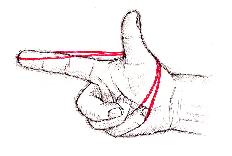
 Is there a culturally appropriate term for ‘Chinese finger traps’?
 It’s serious stuff, on a subject worthy of outrage. I respectfully suggest she gives us something better – effectiveness.
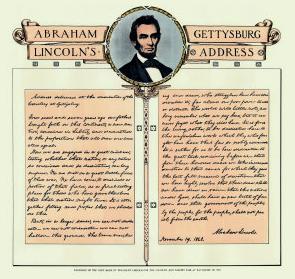 This one’s a little longer than I normally like – a fact which isn’t exactly helped by adding 54 words up front to tell you so. I wanted to wrap this one up, but couldn’t bring myself to cut more than I already have. For the #11FF actually plowing through these with me, my apologies
 I like it, and I cannot lie.
 What beautiful sentence structure. He’s already hit us with repeated uses of ‘dedicate’ in the opening segment. Either he needs a thesaurus, or he’s intentionally layering in a theme before becoming more specific with his thesis.

 This part is difficult for my kids. Even those who are Sunday-go-to-Meetin’ types don’t really do much super-sacred any more. We talk about what these ‘brave men’ must have done to ‘consecrate’ that ground. They came, they fought, they died, all for a hypothesis about men being created equal, according to Lincoln.
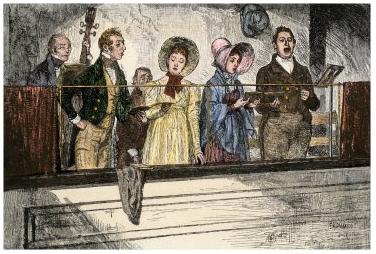 “Would you be free from your burden of sin? There’s POWER in the BLOOD, POWER in the BLOOD…”
  That’s a mouthful, and the hardest part for students to memorize when they’re reciting it to the class for extra credit. Lincoln’s word-weaving turns the purpose of the occasion, the war, and the entire nation inside out – bringing to the foreground the ideals we still espoused, but had long since negated through abuse and neglect.
  Lazarus, John Baptizing in the Jordan, Jesus emerging from the tomb – it’s all about the rebirth, baby. There’s a reason we hunt eggs (of all things) on Easter.
 When I talk about this speech in workshops, I never know how much to assume teachers already know, or whether my ‘givens’ and their ‘givens’ are likely to be compatible. We cover so many different things in so many different ways… there’s very little we can assume to be universal in Social Studies content knowledge (or pedagogy, for that matter). And that’s OK.
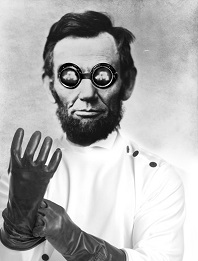 Why do we call them our ‘fathers’? What makes someone a ‘father’?
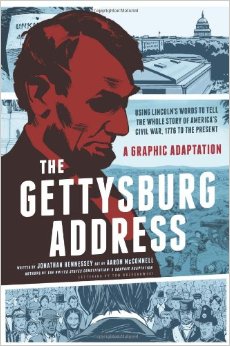 But Baby ‘Merica isn’t dedicated to God – at least according to Lincoln . (Don’t tell the Republicans!) It’s dedicated to an idea, a proposition – that all men are created equal.
 Does that work? This… ‘all men are created equal’ – can you run a country based on that, or will it fail?
 This, incidentally, would have been news to many of the men being honored that day. Most thought they were fighting for the Constitution, the Union, maybe their states or families, or just because they were annoyed with the people on the other side. A few sensed the long game, but it was hardly the norm.