
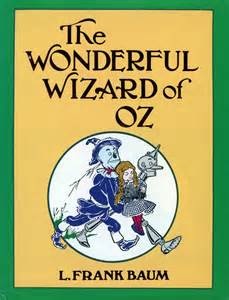
 In 1900, L. Frank Baum published The Wonderful Wizard of Oz, a children’s book he wasn’t convinced would do particularly well – not compared to his fabulous Mother Goose and Father Goose collections a few years prior. Turns out it was a hit, and spawned multiple stage versions – usually musicals – and thirteen written sequels by Baum.
It was also turned into one very odd black and white silent film in 1925, directed by and starring a man with the very unfortunate name “Larry Semon.”
Egads.
The story was thus already pretty well-known when MGM released the vehicle by which most of us became acquainted with the Land of Oz – the 1939 Judy Garland film responsible for getting “follow FOLLOW follow FOLLOW…” stuck in our heads. After CBS decided to show it pretty much annually from 1956 until hell freezes over, in a time of three and only three major networks, it became a staple of Americana.
In the mid-1960’s, an educator by the name of Henry Littlefield published a piece arguing that The Wonderful Wizard of Oz was in fact an allegory of sorts – that in the spirit of Gulliver’s Travels or Animal Farm, Baum’s innocent tale was actually commentary on politics and economic policy in the late 19th century.
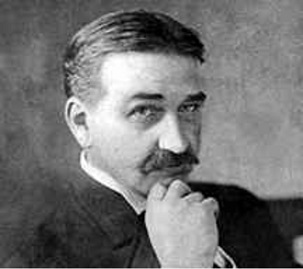
I’m no expert, but those who are find it highly unlikely Baum intended any such thing. Then again, I care very little what he INTENDED when he wrote it; I’m of the school that once an author releases his work into the world, it’s no longer his to control. If I want to use it as a ‘Parable of Populism’ – to make the history and fiscal disputes of the day a bit more palatable to teenagers – that’s damn well what I’m going to do.
Take that, dead writer guy.
It doesn’t take much Googling to find Littlefield’s essay or dozens of sites sharing their own variations. For those of you who aren’t quite THAT interested, but may nevertheless feel mildly curious enough to at least finish THIS post, the highlights go something like this:
The Scarecrow = Midwestern Farmers. While not considered particularly intellectual, they were smart in practical and stubborn ways. No matter how often they were knocked down or otherwise disassembled, they bounced back time and again. What they needed was to recognize this in themselves – they’d had it all along, you see.
“You see,” he continued confidentially, “I don’t mind my legs and arms and body being stuffed, because I cannot get hurt. If anyone treads on my toes or sticks a pin into me, it doesn’t matter, for I can’t feel it. But I do not want people to call me a fool, and if my head stays stuffed with straw instead of with brains, as yours is, how am I ever to know anything?”
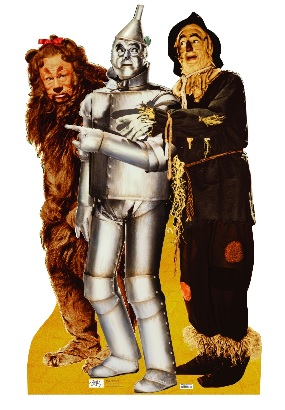 The Tin Man = Northeastern Factory Workers. Having slaved away under dehumanizing conditions for so long, they’d essentially lost their souls – their hearts – the parts which make us most human. Upton Sinclair would capture this less festively a few years later in The Jungle, a book he intended to be about the factory-driven destruction of the human spirit and instead ended up being about how gross sausage is. Meat-packing was reformed; factory labor continued to kill the human spirit for another few generations.
I thought I had beaten the Wicked Witch… [but] she thought of a new way to kill my love for the beautiful Munchkin maiden, and made my axe slip again, so that it cut right through my body, splitting me into two halves. Once more the tinsmith came to my help and made me a body of tin, fastening my tin arms and legs and head to it, by means of joints, so that I could move around as well as ever. But, alas! I had now no heart…
[[{“type”:”media”,”view_mode”:”media_small”,”fid”:”1352″,”attributes”:{“alt”:””,”class”:”media-image”,”typeof”:”foaf:Image”}}]]
The Lion = William Jennings Bryan. Before he went down in history as they guy who argued for Biblical values and against monkey-men in the infamous Scopes Trials, Bryan was THE voice of the Populist movement – and their candidate for President in both 1896 and 1900. His ‘roar’ had great impact on the farmers of the Midwest but far too little on the factory workers of the Northeast. He lost both times.
…[T]here came from the forest a terrible roar, and the next moment a great Lion bounded into the road. With one blow of his paw he sent the Scarecrow spinning over and over to the edge of the road, and then he struck at the Tin Woodman with his sharp claws. But, to the Lion’s surprise, he could make no impression on the tin, although the Woodman fell over in the road and lay still.
Dorothy = ??? Dorothy is our protagonist, our ‘everyman’. She need not represent anything or anyone other than us, the reader, responsible for our role in confronting the realities around us without the power to fully control any of them single-handedly. Some argue she’s an echo of Mary Elizabeth Lease, a rather vocal lecturer and writer who argued for women’s suffrage and temperance but was best known for her passionate orations in defense of populism. This may be hinted at in Judy Garland’s Dorothy, but the child in the original text isn’t the “raise less corn and more hell!” type by any stretch.
 The Yellow Brick Road = The Gold Standard. It’s an almost sacred path to the Emerald City, but one fraught with inconsistency and danger. There are pitfalls and surprises, and even substantial gaps prohibiting all but the most creative travelers for going forward. But, when you add…
The Silver Slippers + The Yellow Brick Road = Bimetallic Standard. NOW we’re talking!
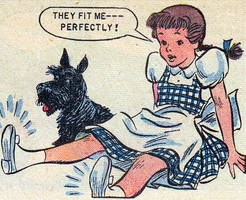
At that moment Dorothy saw lying on the table the silver shoes that had belonged to the Witch of the East. “I wonder if they will fit me,” she said to Toto. “They would be just the thing to take a long walk in, for they could not wear out.” She took off her old leather shoes and tried on the silver ones, which fitted her as well as if they had been made for her.
The folks at MGM were clearly unconcerned with allegorical monetary policy when they opted to give Dorothy ruby slippers to better demonstrate the glories of the relatively new ‘Technicolor’ of the day. You can’t trust Hollywood, children! If they’ll lie about shoe color, they’ll lie about ANYTHING!
The Wizard / The Emerald City = The President and Washington, D.C. The consummate politician, the man behind the curtain presents himself with a different face to whoever he’s speaking at the time. His power is based on illusion and on the willingness of the people around him to believe. Mandatory eyewear is locked on every citizen or visitor to maintain the illusion of green – wealth, growth, and envy – and while Oz lacks a real power source such as gas, it has plenty of hot air. Enough to power a balloon ride back to Omaha.
First they came to a great hall in which were many ladies and gentlemen of the court, all dressed in rich costumes. These people had nothing to do but talk to each other, but they always came to wait outside the Throne Room every morning, although they were never permitted to see Oz…
The Witches = Support from N/S, Opposition from E/W – particularly the moneyed interests of the Northeast and the Railroads and other large scale owners in the west. In the Presidential Elections of 1896 and 1900, most of Bryan’s support came – if you view the results with sufficient preconceptions – from the North and the South. McKinley won due to support from the West and the East. If you look at it the maps just… right…
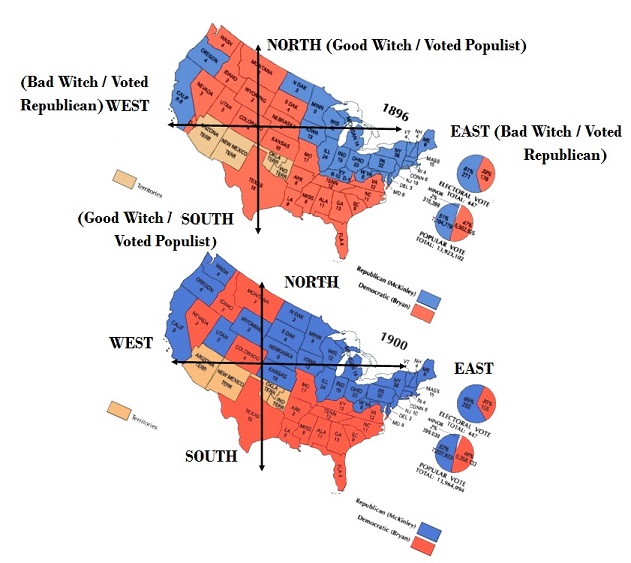
That’s the thing, though – once you’re looking for the allegory, it’s everywhere. Dorothy is constantly seeking and needing clean water, a primary obsession with any homesteader or farmer of the day. Water is what finally destroyed the Wicked Witch of the West, who primarily sends nature’s own dangers to thwart Dorothy and her friends. The Populist Party was born in Omaha, Nebraska – the birthplace of the Wizard once he’s no longer a political fraud and goes back to being a well-intentioned, if ineffective, travelling performer.
Soon the backstory of the flying monkeys seems to parallel the plight of American Indians and the field of poppies seems to have something to do with China and the people who break so easily are the postbellum South and –
It kinda takes on a life of its own.
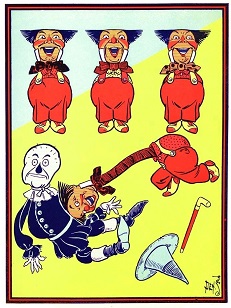 On the other hand, there are plenty of events which even the most creative mind can’t reasonably tie to history or populism. The Quadlings who lack arms but fire their heads at you on long necks are a fascinating obstacle, and the fragile ‘china people’ are far more poignant once you drop the weak ‘unreconstructed South’ connection. And how many varieties of ‘the little people’ (or field mice or Winkies or…) can one book have before it no longer makes sense to label them all with the same Jacksonian value?
If it’s an allegory, it’s a rather inconsistent one.
It could, of course, be both – partly inspired by events of the day, partly rounded out as a colorful children’s tale. Just because the latest Captain America or Batman movies don’t strictly mirror current events doesn’t mean they don’t have plenty to say about our national ideals and choices in a time of perpetual ‘war on terror’.
But as I said, I don’t care. It’s a tool, and as long as it helps make bimetallism, third party politics, and the plight of the Midwestern farmer a bit more palatable for my darlings, I’ll just keep trotting it out – without shame. I could go looking for some better answer, some amazing new solution instead, but… seems to me in this case the thing I most need has been with me all along.
[[{“type”:”media”,”view_mode”:”media_small”,”fid”:”1353″,”attributes”:{“alt”:””,”class”:”media-image”,”typeof”:”foaf:Image”}}]]
RELATED POST: Let’s Have A (Populist) Party!
RELATED POST: Singing Bi, Bi, For Our Money Supply…
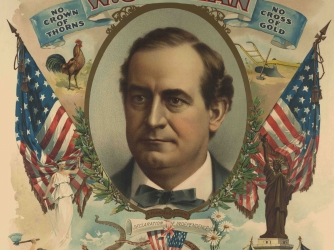 The Populist Party reached their zenith in the 1890’s. Although they won state and local elections here and there, before and after this decade, their only real shot at the Presidency came in the Elections of 1896 and 1900. Both times they ran William Jennings Bryan as their candidate, and both times the Democratic Party gave in and joined them in the nomination.
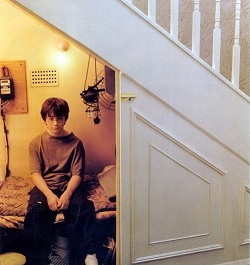 I mean, Harry Potter was safe and secure at the Dursley’s under the stairs – literally and completely. No harm could come to him. As the series progressed, he grew increasingly autonomous and faced greater and greater danger. Finally, released even from the rules of Hogwarts or the direction of Dumbledore – completely and totally independent – he frickin’ DIES!
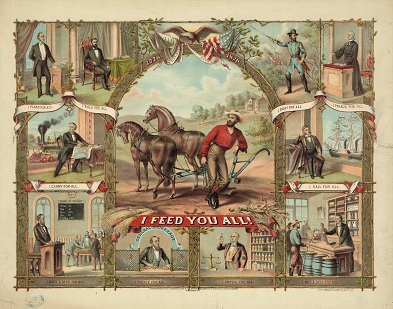 Not that most American farmers in the late 19th century were pondering such abstractions. Mostly they’d joined their voices – and their votes – to demand a few basic policy changes to compensate for what they perceived as gross imbalance in the economic order of things. They didn’t see themselves as wanting ‘help’ so much as fighting to remove cancers in the system.
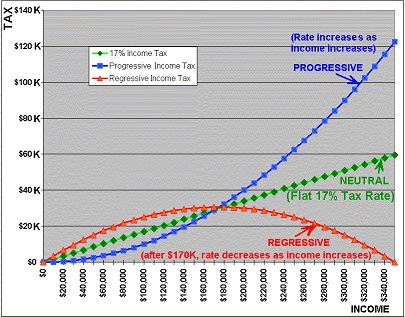 The Populists wanted a weighted system. If you made $10,000 this year, you pay little, or nothing. You made $50,000? Ten percent. $250,000? Twenty percent. $1,000,000? Fifty percent. Those making the most were still left with more than everyone else, and those making the least were freed from the burden of paying at all.
  If you’re a bi… cycle, you have two wheels.
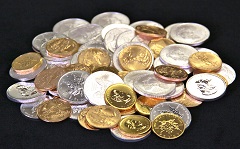 Silver is valuable and not at all common, but it’s far more plentiful than its friend gold. The change would be dramatic. More money in circulation lowers the value of each dollar – counterintuitively helping those with less money and especially those in debt.
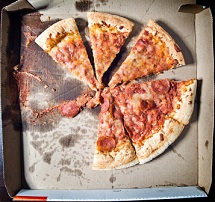 The food quickly draws attention and Max offers him a dollar for one of the slices. He accepts.
 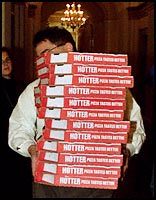 He sells most of the first box, but things quickly slow. Lowering the price to $1.00 helps a little, but it still looks like he’ll be stuck with 9 or 10 boxes of pizza with ten minutes to go. He panics and drops to 50 cents a slice… then a quarter… and manages to move enough that he’s only losing a little money for his troubles.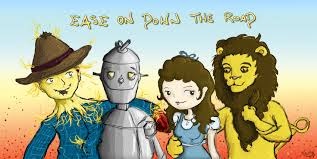
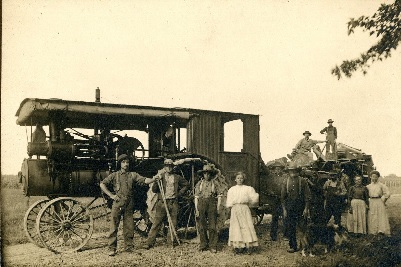
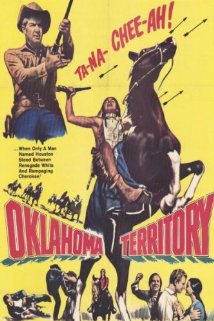
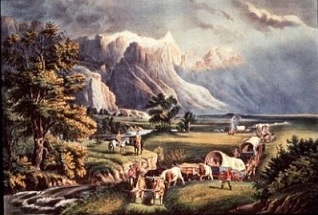 The 1890 Census would soon declare the frontier ‘closed’, to the chagrin of men like Frederick Jackson Turner who believed the westward struggle against nature and deprivation both defined and strengthened American character. Things were so desperate that white guys began looking lustfully at Oklahoma as their last best hope – the same ‘Indian Territory’ (I.T.) to whom the bulk of surviving Amerindians had been forcibly removed.
  It wasn’t always a lack of production. Many farmers across the Plains were quite successful – at least in the traditional sense. They were growing and raising more good stuff than ever before! Wheat! Corn! Cotton! Moo-cows! Chickens! Tomatoes! Quiche!
 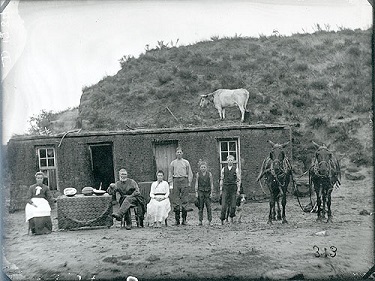 Farmers already worked 365 days a year, sun-up to sun-down. They worked on Sundays, birthdays, Christmas, and when they were sick. They labored in the earth and cared for any animals they held, enduring drought and deluge, heat waves and freezes, in hopes of coaxing forth from the earth sustenance for themselves and the world.
 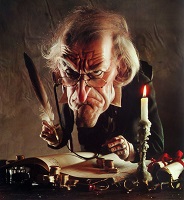 They didn’t actually grow anything, or produce anything your kids could eat, or wear, or even that you could smoke, drink, or otherwise enjoy.
 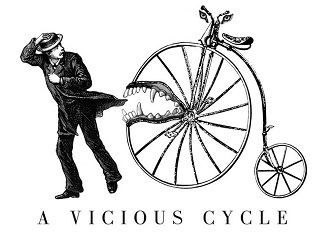 Which meant, of course, that prices went even LOWER. In some cases, less than was necessary to break even. Some couldn’t pay back their loans. So, they renegotiated, perhaps borrowed more, bought more, raised more…
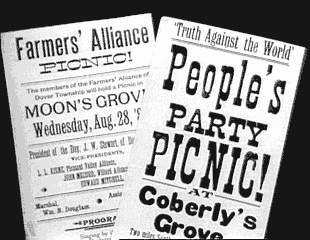 The Populist Party was born.
 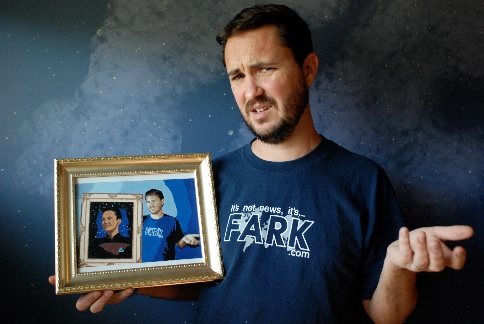 Wil Wheaton, for those unaware, is best known for his role as ‘Wesley Crusher’ on Star Trek: The Next Generation (1987 – 1994). He was a regular for the first four seasons, then a recurring guest for the final three.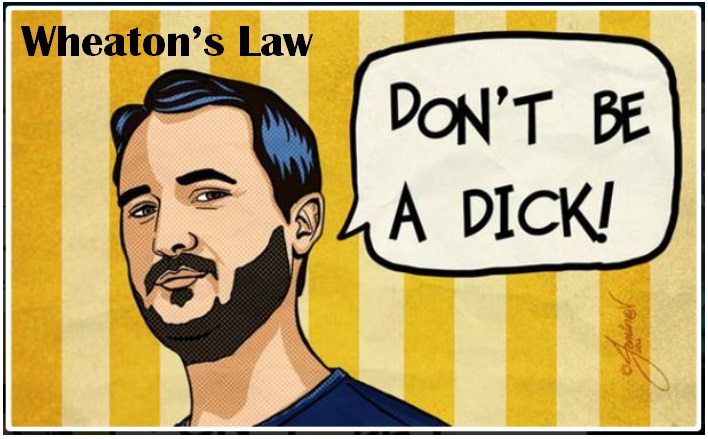
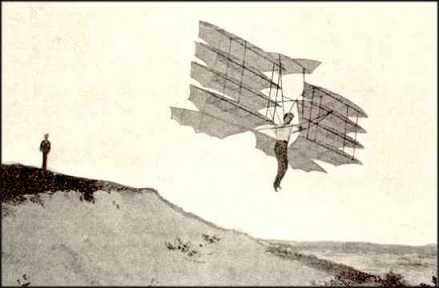 Chanute was an innovator who designed a few machines himself, but was too old to strap himself into some bizarre contraption and jump off a cliff. His greatest contribution to the field was his willingness to gather correspondence and information from all around the world regarding the aerial efforts of others. He compiled and edited specialized periodicals, and put people in touch with one another when he thought they might mutually benefit.
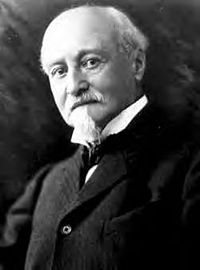 Occasionally he’d organize a dinner, or at least cigars in the den. That, I suppose, was the Skype of the day.
  Abraham Lincoln was a pretty big deal, but so were the Robert Andersons and Joshua Lawrence Chamberlains – not to mention nameless thousands who showed up and did their part. Katniss may be central to ending the Hunger Games and overthrowing President Snow, but without the talent, focus, and drive of Cressida, Messalla, and their ilk, we have an entirely different finale.
 In keeping with their love of all things dainty, the French introduced the metal frame, lighter and sturdier. Unfortunately, the large wooden wheels and lack of any sort of shock-absorbing mechanism led to another unflattering moniker: the “bone-shaker” – less foppish than ‘dandy-horse,’ but still unlikely to facilitate worldwide acceptance and marketability.
 The ‘Safety Bicycle’ allowed an even greater top speed than the ‘Ordinary’. More importantly, it suddenly made the bicycle easy to ride, fairly safe to steer, easier to control, lighter, and – as production increased to accommodate the wider customer base – less expensive than anything comparable prior.
  There are bicycles to suit pretty much any type of rider today – any gender, race, nationality, or income level – but by and large they’re all traceable back to that first ‘Safety’. I suppose we should pay appropriate homage to its ancestors as well – but many are rather awkward to consider.
  Suddenly something of great potential but limited use, realistic only for a few, became accessible. The experience reached for by a select minority in prior generations was suddenly not only possible, but intoxicating. It was fun. It was freeing. And it was so good for you – body, mind, and soul.