

This is not a year I’ve been proud of.
I’ve had a few over the past sixteen years that have sucked for reasons largely outside my control, but this is the first time since those first few semesters that I’ve felt almost entirely responsible – not as a cause, but as someone who knew better in terms of MY responses, and didn’t do it.
For… *sniff* – the children.
In years past I’ve been a pretty consistent hard-ass – quality of work, organization, due dates, etc. Like most teachers, exceptions abounded with circumstances. I’ve lost count of the number of individual deals I’ve made with students in difficulty, whether weird personal lives or academic struggles. If they’re trying, we’ll work something out.
I’ve had to stifle overt hostility every time we’re told from the golden podium to give 50% to students who haven’t shown up or done anything yet because some kid in an anecdote had a tough October and we’re too jaded and dillweedish to let them ever recover.
“Damn – they’re on to us! We got into this profession so we could cackle maniacally at the unjust failings of children! We especially like to crush the ones living in their cars, working three jobs, and taking care of eleven siblings even though they don’t have fingers or eardrums. Fail, Enrique! Fail!”
Apparently I don’t always stifle it.
But over time, reading enough tweets, enough blogs, enough articles, I softened. I weakened. I caved. Some of it was genuine doubt whether I could possibly be right and so many people smarter than me be wrong. Much of it, though – and this is where the self-loathing begins – much of it was laziness. The time and effort necessary to keep pushing every kid, to remember who was absent when and what that means for their make-up work and who had surgery and who was on a cruise, and the stories from other teachers about the parent calls, and emails, and meetings, and administrators, and…
Most headaches can be easily avoided if you pretty much accept anything a kid gives you, whenever they give it. I lost a battle drawing some lines with a parent years ago (by following district policies, no less), and haven’t wanted to do that again. Every time I’d watch what other teachers were going through simply for holding to basic expectations, I’d pat myself on the back for knowing better than to go down THAT road again.
I knew I was condemning my kids to much harder lessons down the road because I wasn’t willing to fight for their academic souls here, this year – when we all still basically love them and want to help them. This is the safest place in the world to struggle, or even fail a little. Not later, not somewhere else.
But I wouldn’t see it – their eventual awakening. I wouldn’t know how much harder it would be later. But I do.
That’s the wound; here’s the salt:
This ‘flexibility’, this over-generalized ‘compassion’, didn’t work. Not for behavior, not for grades, not for anything. The more flexible I became, the more students were mired in a swampy mixture of all the stress one would expect from academic and personal overload but the actual productivity one would find in a 19th century San Francisco opium den. They were doing less and less, but freaking out about it more and more.
What they eventually produced wasn’t usually very good, and often lacked context or use. Despite my most vehement exhortations, I couldn’t convince the majority of those so mired to keep up with what we were doing right now, in class, rather than dragging through that content review from last month’s quiz that they never seem to finish before they lose it and start over.
“What does it matter WHEN they learn it?” Turns out it matters a whole damn lot.
True student collaboration became impossible because only a slim majority of students were prepared to contribute in any useful way. Class discussions or even direct instruction became less and less effective because it’s hard to build on something a third of them haven’t learned yet, and might never.
History may never be easy, but it’s much less onerous when it’s experienced in order, and learned actively, together. Those opportunities vanished as I gradually ended up with 140 students in 40-50 different places, some analyzing and writing with great sophistication and others who’d pretty much ignored weeks of foundational work but suddenly wanted to get their ‘Skills Grades’ up and who had to be taught from scratch.
It wasn’t just academics. I let too many little stupid things slide early in the year because I was trying to be more understanding of their individual quirks and needs and such. When I did assign something punitive, like lunch detention or some sort of service work, I’d quickly lose track of the paperwork as some would attend, some wouldn’t, half were absent that day anyway, and others were in detention already from another class, and… and…
Eventually I just returned my energies to lesson planning and teaching. I now have a dozen kids throughout the day who aren’t “bad kids,” but who are 15 years old and still behave like a special needs group of 3rd graders when the spirit moves. I can’t skip the paperwork trail of consequences and just throw them all out in frustration (nor would I wish to), and there are four weeks left.
So I’m making do.
The worst part of it is, I’ve failed my best kids. Their grades are fine, but they learned early on that most of my energy, most of our curriculum, most of their headaches would be dictated by the bottom 20% of the class. I suppose this in many ways is preparing them for the ‘real world,’ but I hate creating so many cynical little Republicans before they can even drive.
I’ve failed my ‘challenging’ students because they’ve learned nothing, other than that they can pretty much do what they want and still move right along – thus reinforcing the very thing we complain about from our middle schools, who have about as much power to change that system as we do.
I’ve failed my ‘average’ kids because they weren’t pushed beyond quiet mediocrity, staying below the radar and not causing trouble. Not exactly the motivational poster I signed up for.
This freshmen class came to us as one of the least motivated, most pampered, quick-to-collapse, easily distracted, helpless, hopeless, shallow little nurslings I’ve ever encountered en masse, and I’ve accomplished absolutely nothing in challenging or changing any of that. There are some diamonds, believe me – and I love them all, somehow. But I fear for the rest if reality ever catches up.
Maybe it won’t. Maybe our society has evolved enough that the consequence for irresponsibility, ignorance, and apathy, is food, clothing, shelter, and days spent drifting aimlessly and checking their phones obsessively. Maybe it’s not a teenager problem, but imminent national collapse. And maybe I can’t change any of it.
But here’s what I CAN do. I can resolve next year to risk seeming merciless in my expectations, rigid in all things responsibility-ish, and demanding in my demeanor. I’ll fight the fights over standards and behavior, with or without official backing. I’ll lose some of them, but I’ll go down kicking and screaming – not because I’m an asshole who wants kids to fail, but because I love them. I want better for them. I want hope for them. And because I know from long, painful experience that the only true fulfillment or growth comes from actually accomplishing things. Actually learning stuff and doing things.
I’m sure we have about a dozen motivation posters to that effect in this hallway alone. Maybe they’ll be my defense.
I may not succeed. I doubt my humble efforts will prove to be some kind of miraculous solution. But I hope by May 2016, I’ll at least have offset some of the scalding awareness that I’ve become part of the problem.

RELATED POST: My 300 Epiphany
RELATED POST: In Defense of Due Dates & Deadlines
 I came across an amusing piece the other day which I’d seen before, enjoyed, then forgotten. I’ll excerpt a bit so you can get the idea even if you don’t read the
  It’s effective satire. It bites enough to hurt, but it’s still funny. It’s what John Stewart does when he’s at his best – throwing out a little red meat to those who already agree, and sharply prodding those who don’t, moderated somewhat by humor.
 In 1851, a largely unknown former slave going by the name ‘Sojourner Truth’ took the stage at a women’s rights convention in Akron, OH. There are several versions of her exact words, but something pretty close to this segment shows up in all of them:
 In 1830, a “Workingman’s Committee” was assembled in Philadelphia to “ascertain the state of public instruction in Pennsylvania” and propose improvements. Whatever their official status, their report reads like blue collar fathers wanting better for their children:
 Whoa there, cowboy – an aristocracy of what?!
  This is a common tactic used still today, although often much less convincingly. Every time a politician or business leader speechifies that “what Americans want is _______” or proudly proclaim they “BELIEVE in buzzword, patriotic catchphrase, and congruent parallel third item!” they’re trying to use shared values to persuade. They just do it so badly it makes us hate them.
 On the other hand, if your goal is to change something, we may need to set aside such glories for a bit. The Committee at some point had to decide whether they cared more about venting their true spleen regarding inequity and the power structure of the society around them, or improving education in a meaningful way for their kids.
 Is there a culturally appropriate term for ‘Chinese finger traps’?
 It’s serious stuff, on a subject worthy of outrage. I respectfully suggest she gives us something better – effectiveness.
 What follows are excerpts from Popular Education: For The Use Of Parents And Teachers, And For Young Persons Of Both Sexes. Prepared and Published in Accordance with a Resolution of the Senate and House of Representatives of the State of Michigan, by By Ira Mayhew, A.M. – Superintendent of Public Instruction (New York: Harper & Brothers, Publishers, 82 Cliff Street. 1850)
 I started blogging in March 2014, when the thoughts I had regarding the then-upcoming #oklaed rally demanded the world’s attention. (You see this wit and wisdom as a gift; I alone understand they are my burden to carry.)
 Or maybe it just doesn’t work that way. I have zero concern public school teachers can ever be replaced by computers on a meaningful scale, for example, because the human interaction, connection, and persuasion is simply too major a factor in dragging these little darlings into the light – if only for those brief moments. And if fancy software can’t teach my kids as effectively as a minimally competent nose-breather with a bachelor’s degree, how can a website become any more useful a resource than those ancillaries we used to get so excited about at new textbook time? (May the edu-gods forgive us for the decisions we made based on transparencies and test-maker discs.)
 Besides, most lesson plan sites are elementary and early middle school heavy – which I totally get. We expect teachers at that level to cover everything in every possible style with all kids for the entire day. There are a few sites heavy on the Powerpoints or educational video clips, etc., which have been useful for starting ideas from time to time. I’m absolutely NOT knocking anyone’s site or resources. They just weren’t doing anything for me.
  To begin posting 15 years of my favorite lessons, materials, ideas – most borrowed from sources I don’t even remember and modified on the fly no matter how many times I use them – is insane, right? Much of the flavor has to be lost in translation. Too much explaining is limiting, and insulting to teachers perfectly capable of figuring out how to make an idea work in their reality; too little explaining leaves new teachers or those looking to try new things without enough to go on.

 I’ve been revisiting the chapter on “Classroom Control” from Vol. I of the 12-volume The Class Room Teacher (1927-28). We were introduced last time to a very listy list of possible methods:
  The teacher is attempting to carry on a class recitation with one group of children while the others are supposed to be studying. Two or three large boys are lying on the floor with their feet propped against the stove. They are reading fiction which does not contribute in any way to their assignment. They later show a lack of knowledge as to the lesson content. Several girls are holding an animated conversation about the ways of securing pictures of the favorite “movie” actresses.
 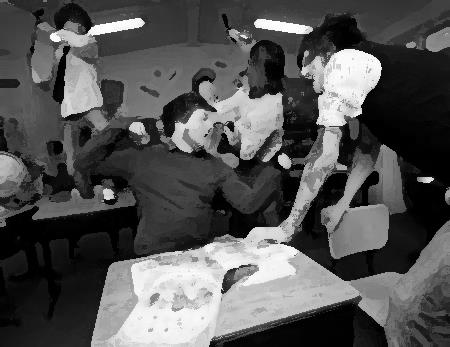 In case we’re not sufficiently horrified by the stove thing, here comes a barrage of projectiles and dirty notes. I KNEW we should never have allowed pens and paper in the classroom – such technology has no place in school without careful controls in place! It’s too distracting!
 Today I believe that would qualify as a ‘controversial statement’. Keep in mind that the 1920’s were still enmeshed in Progressivism – regulating the sausage factories and establishing national parks and such. It was also the age of more direct control of all levels of government by the ‘common man’, in hopes this would prove, um… purifying.
  Ever after the children study the lessons assigned by the teacher, answer her questions, and accept the punishment she doles out for misdemeanors and errors. They usually do no more than they are asked, and frequently they misbehave when the teacher is not looking.
  As colorful a term as ‘benign tyrant’ may be, it’s a bit too loaded with connotation for my taste. One of the things too easily overlooked in our kneejerking any time those high-structure charters are discussed is that some students, in fact, do very well with so much structure.
 Ah, she means (insert whatever political party you don’t belong to), doesn’t she?