What’s wrong with segregation?
I ask my students this when we talk about the underlying causes of the Tulsa Race Riots – the ongoing circumstances in place just waiting for something to trigger them. Dick Rowland stumbling into Sarah Page might have been an incident all by itself, but it wouldn’t have burned Greenwood to the ground without combustibles already in place. There were causes – one of which, I respectfully suggest, was segregation.
If they’ve paid attention when we discuss Indian Removal, or Reconstruction, or Immigration, they should have an idea where I’m going with the question. Otherwise, they stumble through the clichés on which they were raised. Segregation is bad because everyone’s the same… we’re all equal… it’s wrong because it’s bad…
 To their credit, some variation of ‘separate is inherently unequal’ eventually surfaces, whether they know Brown v. Board or not. They understand intuitively that when two groups are persistently kept apart, one will likely get a better deal than the other.
But what if it COULD be equal? We have Men’s bathrooms and Women’s bathrooms – separate, but similar. What if we could guarantee consistent quality, and equal value? Would segregation still be bad?
They’re sure it would, but aren’t often able to express why. Maybe they’re going on gut conviction; perhaps they’re simply THAT indoctrinated. Either way, we must discuss ‘The Other’.
When we lack relationships with people different from us, or when those relationships are so strictly defined as to preclude true interaction, we can’t help but see them as fundamentally unlike ourselves. We can’t know who we don’t know.
I don’t claim my district has eliminated all conceivable racial issues, but we’re a fairly diverse bunch – racially, economically, and to some extent culturally. We have lots of interesting colors, religions, a few very vocal non-traditional sexualities, and enough different home languages to keep things challenging.
 I, on the other hand, graduated from a nearby suburban school 30 years ago with a senior class of around 700, of which exactly two students were black – both guys, and both of whom played football and were nowhere near my social circle. There was one Vietnamese kid, and he was really good at math. That was it in terms of diversity.
Well, there was one gay kid. We all kinda knew he was gay, but he didn’t seem to be aware of it, so we just let it slide. He knows now, and we’re all Facebook friends, so that seems to have worked out.
I had a strong, albeit largely subconscious, sense of ‘The Other’. My students don’t – at least not to such an extent.
I wasn’t particularly racist or sexist by the standards of my peers, but I walked in the sort of conviction and clarity only possible with limited knowledge, and in the peace of truncated understanding. Separate is inherently unequal, but also inherently obscuring. You can’t love, accept, or even properly argue with what you don’t know and can’t see. You don’t even know what questions to ask.
When anything involving other cultures or races comes up in class, my kids are well-armed with polite clichés and politically correct worldviews. They may even think they mean them.
But they lack depth because, for so many of my kids, the idea of a world in which culture or race are a deep divide, capable not only of circumscribing what you do, but how you think, feel, or function – shaping reality itself… it’s just not there. At best it’s abstract and distant.
 In their defense, that’s true of 90% of anything we talk about – they’re Freshmen. They live in a perpetual ‘now’ with themselves, themselves, and those who amuse or arouse them this exact instant. And themselves.
They’ve been hearing the same handful of safe racial, religious, and sexual platitudes their whole lives, along with Stranger Danger and anti-bullying campaigns, but most have neither overtly experienced nor consciously perpetrated any of things being warned against. It can’t be real to them, any more than feudalism, factory labor, or war.
Most can’t consciously fathom ‘THE OTHER’. If only we could add odor to it, as with natural gas, so we’d be warned when it begins to affect us…
History is full of ‘Them’. It’s fundamental throughout time and place. Babies gradually learn to distinguish ‘Me’ from ‘Not Me’. ‘Family’ is different than ‘Not Family’. In some bucolic regions, ‘Neighbor’ is still different than ‘Not Neighbor’.
As an evolutionary or historical approach, it’s not such an evil thing. As the earliest hegemonies or social contracts developed, they would inevitably have ‘Us’ and ‘Them’ moments – whether over resources, food, land, or women.
Much like ‘all snakes are poisonous’ or ‘reality TV is fake’, universals are a practical necessity when life is otherwise nasty, brutish, and short. The benefit of attentive discernment is outweighed by the risk. You may find a few exceptions to your rules, but the payoff is too small to justify the energy invested. “Look! A non-poisonous snake! I’ve devoted precious time and mental capacity to identifying it so I can… have absolutely no use for it. And if I’m wrong I’ll die painfully!”
 Unless you happened to be in a Disney Movie or After-School Special, the chances of making a new bestie when you reached out your Capulet arms to embrace a Montague stranger were slim compared to likelihood you’d become someone’s slave or lose your teeth so they could make a nice necklace. ‘The Other’ was scary. Dangerous.
To be fair, evolving from ‘All against All’ into ‘Us’ vs. ‘Them’ was actually a huge improvement socially and politically. At least you had an ‘Us’ instead of simply an ‘I’. At least societies could be built.
Separately.
But the world has changed. We are safer, healthier, better educated, and more entertained and entertaining than at any other point in human history. In the U.S. in particular, we celebrate ‘diversity’ in its ever-multiplying forms, and speak of being a great ‘melting pot’. Our foundational ideals, in fact, proclaim unequivocally that “all men are created equal, and are endowed by their Creator with certain unalienable Rights.”
Apparently this was unclear to some, so we added a 14th Amendment which explicitly states that a people is a people is a people. There are no gradients or levels of personhood or value in the eyes of the law or in the ideals of the United States.
Period.
That’s led to a number of kerfuffles as various individuals and groups seek to be part of ‘Us’ rather than being content in their roles as ‘Them’. They wished to be less ‘Other’.
Some wanted to attend the same schools, ride the same busses, eat the same places, and live in the same neighborhoods as ‘Us’. Others wanted to form different sorts of families, promote different types of faith, or live some very different lifestyles, but with the same rights and respect as ‘Us’.

It can get rather complicated. To our Founders’ credit, though, we’re mostly still trying to make it work. Contrary to how it sometimes seems, we’re getting closer and closer. But it’s weird.
Yet the prevalence of ‘The Other’ persists. At times it seems there are more ‘Them’ than there are ‘Us’, even 225 years after those ideals were so effectively used to birth a whole new country whose primary task was to prove them workable.
Why?
I have a few ideas…
RELATED POST: The Other (Two)
 #OklaEd blogger extraordinaire Mindy Dennison recently
 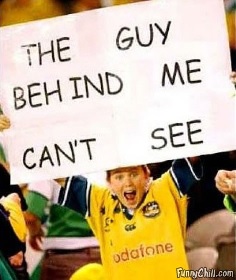 I confess I’ve always had a disproportionate revulsion and hostility towards people who cut in line, take up multiple parking places, or otherwise demonstrate an utter lack of interest in the possibility there are other people in the world but themselves.
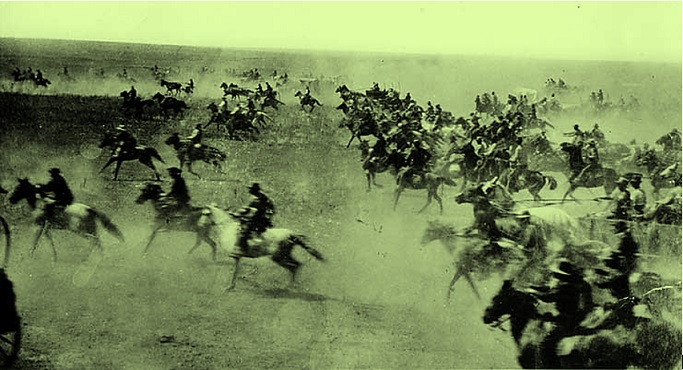
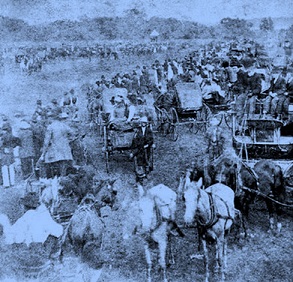 Perhaps we can excuse, if not entirely justify, the actions of desperate individuals willing to take big chances – to hide in the bushes or sneak past armed defenders. But what we so often gloss over in Oklahoma History is how many Sooners didn’t have to sneak in at all. They were there with permission. By orders, actually.
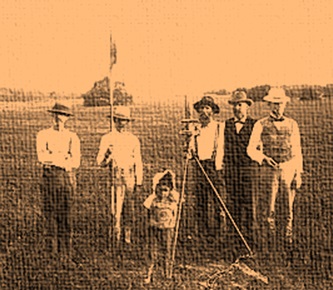 Soldiers, land-surveyors, law enforcement – anyone with the right connections to get themselves into the territory ahead of time and scope out the best land. Often they’d announce their resignations minutes before noon, presumably in anticipation of future accusations they’d violated the terms of their employment.
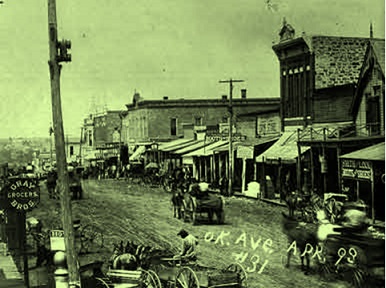 Sooners were far more likely to farm successfully, having started with better farms. They were generally more prosperous as merchants or other businessmen, having established ideal locations and opened for business while others were still gathering basic supplies. They’d produce the healthiest children who’d receive the best educations and have the best opportunities due to family connections and social savvy.
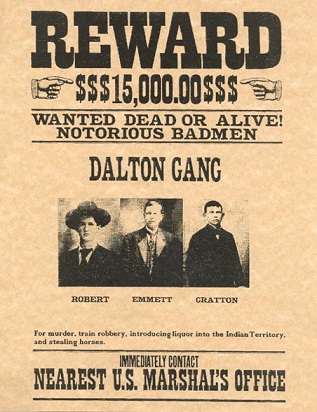 We may express periodic ambivalence towards Pretty Boy Floyd or the Daltons, but they at least robbed and killed those representing the system – the powerful – ‘the man’. Sooners robbed the commonest of common men, and did so just as he was risking everything to improve his condition and claim his small slice of the American Dream.
 Not all Sooners were such loveable characters, however. From the New York Times, April 25th, 1889:
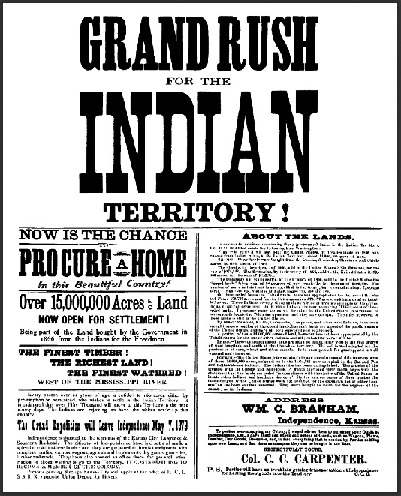
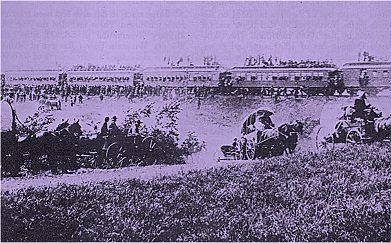 It was later announced that these lands would be opened up through a ‘Land Run’ – an approach which certainly reduced paperwork and eliminated the traditional 5-year waiting period before taking title to a section of this last remnant of American frontier, now being referred to more and more often as “Oklahoma.” It was a weird system even for the times – times far more interesting than usually credited.
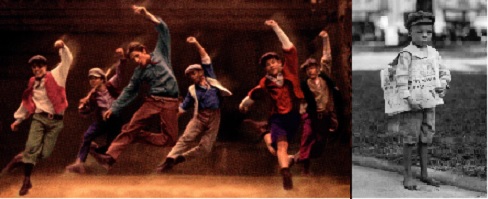 People were reading Kate Chopin, H.G. Wells, Bram Stoker, and Oscar Wilde, while Arthur Conan Doyle introduced a new character named “Sherlock Holmes.” Those kids from Newsies, led by a young Bruce Wayne, were doing that thing they wanted the world to know, although it’s unclear whether they used the same choreography as in the movie. L. Frank Baum was writing The Wonderful Wizard of Oz so that schoolchildren a century later could discuss bimetallism without losing consciousness, and those guys who kinda invented flying machines just prior to the Wright Brothers were crashing them in various interesting ways as part of their efforts to claim the skies.
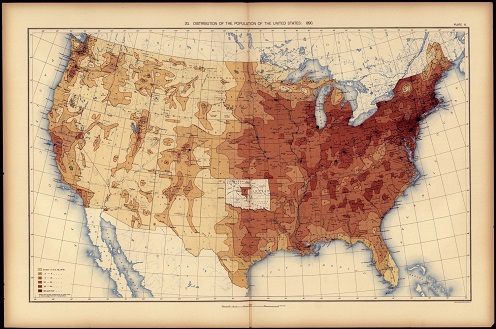 The census was a year away, but the sense that the nation was ‘filling up’ and land was ‘running out’ was hardly news to Boomers and others looking for those last few opportunities in the west. The future state of Oklahoma, once so disparaged that the Natives were placed there by force so white guys could have the GOOD land, was looking better and better as other options fell away. Necessity, it seems, was the mother of invasion.
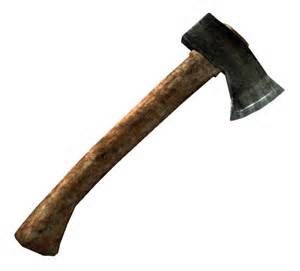 “Rather got ahead of ye, didn’t I, boys?” he asked, when they came up.
 Still, even this we might sweep aside as typical of the times. We must not judge the past by the standards of our far-more-convenient present. Perhaps hatchet lad, and Grant – who went on to shoot the bastard – may be excused for their Lord of the Flies behavior.
 “I’m not talking anymore! I can’t see over there! I’m being good! Just one more chance and if I mess up, you can move me! Please?!?!?? Pleeeeaaaaassssseeeee??!?!?!!!???”
 The issue is not bold defiance or soft incompetence. It’s a calculated risk on the part of the student – who knows you. She’s betting you won’t go nuclear on her – no referrals, no yelling, no hurling heavy objects. She’s ready at any point to back down and comply – at least until your attention has shifted. She’s also sure you have things you’d rather be doing than power struggle with her, and that you don’t actually dislike her – even if she is making you crazy at the moment.
 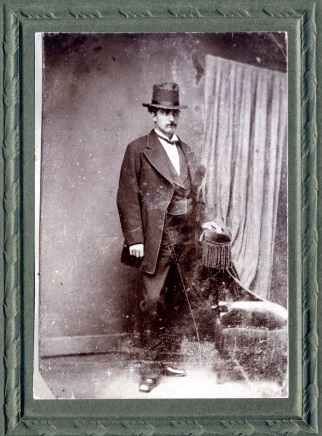 He had a common-law wife and a son who was, by definition, “out-of-wedlock.” He volunteered to fight for the Union as soon as the war broke out, then stayed in the army to help ‘civilize’ the Great Plains after. He fought under Custer and knew Kit Carson and Wild Bill Hickok.
 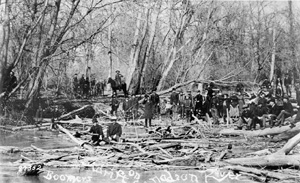 He was removed by the U.S. Army, but he went in again. He was removed again, then went in again. Removed, return, removed, return, removed, return, removed…
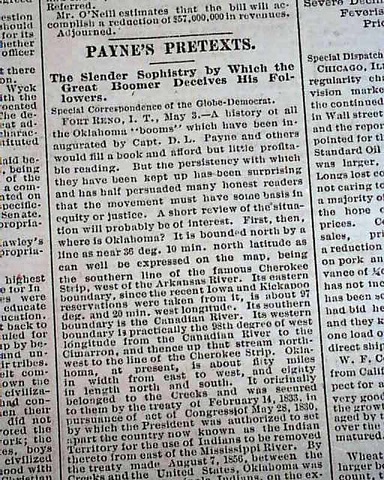 He KNEW the U.S. Army didn’t actually want to shoot anyone over this land. He was betting they wouldn’t even actually imprison him – or anyone else – for any length of time. Not for THIS.
 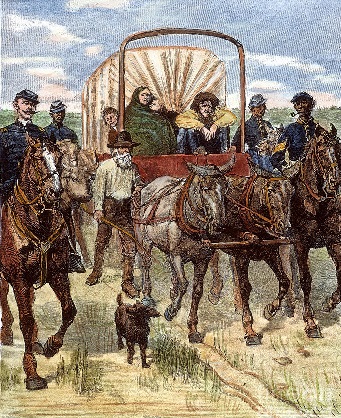 And then he returned.
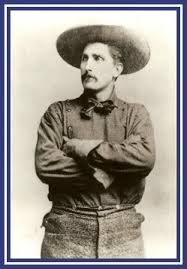 Payne believed.