Teacher Books (Gifts That Makes YOU Look GOOD)

Teacher Books

I have a confession.

I’m not actually a big fan of education books. I’ll wait here a bit while the expressions of shock, disappointment, loathing, and calls for violence and bodily harm against me play themselves out.

No doubt much of this is a reflection on my personality and style. I’m all about good pedagogy and understanding our kids, but most of what I do halfway decently comes from years of trial and error, stumbling into success or personal humiliation, then adjusting and throwing myself back into the madness for lack of a better plan. 

The other bits I’ve simply stolen from watching other teachers.  I’m can only think of one activity I like which originated in a teacher book I read at some point. It’s a good one, but still…

Teacher ReadingSome people love edu-books, it seems. I’m fine with that, but several I’ve started and discarded struck me as rather pompous – driven by edu-babble and postulation – which I despise. Others commit what is in my opinion the unforgiveable pedagogical sin, and insist that because something has worked for them at some point in a particular context, it is All-Truth Do-Now Silver-Machine-Gun-Bullets-In-A-Belt.

I hate that. 

Still, much smarter people than myself find great value in edu-title after edu-title. So maybe it’s just me.

That being said, there are several rather dramatic exceptions which I’d like to recommend, either for your personal consideration or as holiday shopping ideas for that aspiring #11FF in your world. Books make such a nice mid-level gift – as fillers to open along with the ‘fancy’ presents, or as modestly upscale purchases (by their very nature implying that both you and the recipient are at least KINDA smart) for people you care enough about to stuff some tissue paper and warm thoughts into that decorative bag you saved from last year, but won’t be spending Xmas morning drinking hot chocolate next to. 

My Favorite Teacher Books:

TheZenTeacherThe Zen Teacher (Dan Tricarico) – If you don’t follow Tricarico at www.thezenteacher.com, you might be thrown a bit by the title. He’s not kidding, if that’s what you’re wondering – he’s legit all up in the Zen. But neither is he spooky vague or touchy-feely nonsensical.

Rather, TZT is all about taking a breath and seeing our daily existence a bit more thoughtfully, and carefully… maybe even lowering our blood pressure a bit. Tricarico clearly knows the academia of Zen, but he’s also realistic about the practical grind of public education. He’s not looking to take you to another plane of reality; he’s offering very practical, good-humored insights into how you might bring more reality back to you. 

A Favorite Passage:

These days it’s hip to be prepared for the zombie apocalypse. But sometimes it feels like the apocalypse has already happened. So many of us spend our days powering through life, racing from one thing to another, unable (or unwilling) to slow down, uninterested in waking up and seeing what is right in front of us. As a result, we often lurch through our lives like extras in George A. Romero’s Night of the Living Dead.

If you haven’t noticed these modern-day zombies, you may be one. I know I certainly can be. On any given day, you’ll often find me staring in to the eerie glow of my phone or tablet, glued to the Internet, or otherwise buried in my work.

As author Joseph Campbell said, “The unpardonable sin is the sin of inadvertence, of not being alert, not quite awake.” Calling inadvertence, the act of not paying attention, an unpardonable sin is a strong statement, but he’s right.

TheWeirdTeacherHe’s The Weird Teacher (Doug Robertson)Robertson is NOT Zen. He’s actually a bit of a spaz, near as I can tell. This text is a loose gathering of his classroom, student, and life philosophy, shared not as a pedagogical lecture, but as late-night drinking friends who are passionate about their convictions but so comfortable with one another they can pull no punches yet provoke no offense.

Reading Robertson makes you love kids and your job again on those days you have trouble remembering what that was like. 

A Favorite Passage:

If I designed a teaching program for a university I would make a beginning acting class a requisite. What are we doing if not acting? The skill sets are very similar.

We have to memorize dialogue. We have an audience, possibly with us, possibly hostile, possibly only there to get out of the rain for a while. We have to keep the audience interested in what we have to say. We have to make complicated things comprehensible for the people in the way back of the room. And we have to do the same show over and over without getting bored.

Good actors connect with the material. Good teachers might not connect with multiplying fractions, but they know how to make it look like multiplying fractions is an interesting, amazing, important thing.

YoureWelcomeTHE Teaching Text {You’re Welcome} (Doug Robertson) – In this much shorter book (i.e., stocking-stuffer or office party size), Robertson takes on a fully satirized persona of every pompous edu-enlightener. And, as with any good satire, it hurts how thoroughly he punctures our vanity, cluelessness, and desperation.

I found it particularly daring how often he chooses wry & dry over zany madcap – rather risky, but trusting his audience to ‘get it’ for a much bigger payoff. This tiny little book is brilliant. 

A Favorite Passage:

I love to watch student faces lit with the soft, comforting glow of the computer screen, and adore seeing their furrowed brows as they work out complex equations in their heads.

I see your puzzled expression. Your head tilts, not unlike a confused Corgi wondering where the ball went. Of course in their heads. All skilled teachers impart upon their students the strategies and arcane secrets of mental calculation. Calculators and the vulgar phone have no place in the classroom and even less of a place in the testing environment.

If you cannot have your students, whether they be kindergarteners or high school seniors, rattling off facts from their heads, I question your dedication to the science of educating. I do not even allow my students scratch paper. Not even to roll up and scratch their backs with ha ha ha. (Humor has its place in the classroom, if used sparingly. This was an example of that. You’re welcome.)

TeachingMythologyTeaching Mythology Exposed: Helping Teachers Create Visionary Classroom Perspective (Starr Sackstein) – If you or your teacher friend prefer a kinder, gentler approach – especially one tailored towards the fresh-faced and hopeful (i.e., relatively new) classroom educator, Sackstein has just the thing.

TME is broken into manageable chapters tackling practical issues most teachers face at one time or another, with just enough encouragement and hard-won wisdom to keep it both positive and real. Get this for someone. Seriously.

A Favorite Passage:

We sometimes mistake a student’s attitude about compliance and authority with his/her ability to learn. By not focusing on the work (any or all products and proof of learning in our space), we fail the students by forcing them to jump through unnecessary hoops…

Kids learn in many different ways and just because they refuse to jump thorugh hoops in which they might not find value doesn’t mean they aren’t listening or that they aren’t capable. Don’t underestimate your students at any cost – talk to them first…

Education is not about justice; it’s about learning. Remember that when you are grading.

WhatFreshHellCurmudgucation: What Fresh Hell (Peter Greene)Greene is less warm and fuzzy, but deeply cathartic for those of you fighting the good fight both within and without of the classroom. This collection of ‘best essays’ from his Curmudgucation blog is ideal for that well-read co-worker across the hall or any parent, administrator, or classroom teacher who appreciates sharp insight and a scathing turn of the phrase.

The man is a modern day Oscar Wilde, but with an actual soul. 

A Favorite Passage:

The Wrongest Sentence Ever in the CCSS Debate… “Businesses are the primary consumers of the output of our schools, so it’s a natural alliance.”

As a semi-professional hack writer and fake journalist, I can tell you that it’s a challenge to fit a lot of wrong in just one sentence, but Mr. Golston has created a masterpiece of wrong, a monument of wrong, a might two-clause clown car of wrong. Let’s just look under the hood.

“Output of our schools.” Students are not output. They are not throughput. They are not toasters on an assembly line. They are not a manufactured product, and school is not a factory…

Talking about the “output” of a school is like talking about the “output” of a hospital or a counseling center or a summer camp or a marriage. When talking about interactions between live carbon-based life forms (as in “That girl you’ve been dating is cute, but how’s the output of the relationship?”), talking about output is generally nto a good thing.

“Primary consumers.” Here’s another thing that students are not. Students are not consumer goods…

ThisIsNotATestThis Is Not A Test: A New Narrative on Race, Class, and Education (José Vilson) – I conclude my recommended list with the most serious of the lot, a book by renowned speaker, blogger, and of course classroom educator @TheJLV. There are several good books on race and education which I could recommend, but this is arguably the most accessible and powerful no matter what the reader’s background or socio-political orientation.

Rather than choose a short excerpt to reproduce here, I suggest reading this chapter shared on Chalkbeat.org

I share my wisdom freely and without expectation of recompense, but keep in mind when you’re the Hero of Yuletide that you should share the blessings of Blue Cereal with all you encounter. That was the SECOND thing Ebenezer did after flipping some kid a coin to go buy that turkey. (By that point, of course, we’re all so teary-eyed and inspired that most of us completely miss the poignant scene in which he tweets links to favorite posts.)

In the meantime, go buy these books for people, and pick up one of each for yourself to read by the fire, drinking steaming hot nectar from your #11FF mugs. Feel free to make your own suggestions in the comments below. Just don’t include anything that sucks.


The Death of Captain Waskow

Ernie PyleErnie Pyle (1900-1945) was a journalist specializing in bringing the normal to intimate life through the written word. 
He was a self-tortured soul in many ways – never content with staying in one place, but perpetually longing for home while traveling. He traveled the United States several times over, writing reflective pieces usually focused on unexpected encounters, and the quirky specifics of characters he discovered – who somehow became everymen for readers of all castes. 

When World War II began, Pyle became what was then a very odd sort of war correspondent. He went to where the war was, but he wrote about people. Real soldiers, instead of the Captain America types otherwise put forth in the name of patriotism. 

No, he didn’t write about all of the war. He didn’t even attempt to capture the true horrors – even had he wished or been able, the censors never would have allowed it, nor the public wanted it despite thinking they did. 

But he made every mother, sister, wife, or other loved one back home feel like he was writing about their boy – their soldier. He made the lowest grunt feel like he was doing something worth doing in tangible, personal ways. 

Here’s to the power of the written word. 

His most famous column then and since tells a true story of a fallen soldier and the respect paid by the men who served with him. I’m posting it in full here without any sort of permission or rights to any of it, because… the internet. 

The Death of Captain Waskow

AT THE FRONT LINES IN ITALY, January 10, 1944 – In this war I have known a lot of officers who were loved and respected by the soldiers under them. But never have I crossed the trail of any man as beloved as Capt. Henry T. Waskow of Belton, Texas.

Capt. Waskow was a company commander in the 36th Division. He had led his company since long before it left the States. He was very young, only in his middle twenties, but he carried in him a sincerity and gentleness that made people want to be guided by him.

“After my own father, he came next,” a sergeant told me.

“He always looked after us,” a soldier said. “He’d go to bat for us every time.”

“I’ve never knowed him to do anything unfair,” another one said.

I was at the foot of the mule trail the night they brought Capt. Waskow’s body down. The moon was nearly full at the time, and you could see far up the trail, and even part way across the valley below. Soldiers made shadows in the moonlight as they walked.

Dead men had been coming down the mountain all evening, lashed onto the backs of mules. They came lying belly-down across the wooden pack-saddles, their heads hanging down on the left side of the mule, their stiffened legs sticking out awkwardly from the other side, bobbing up and down as the mule walked.

The Italian mule-skinners were afraid to walk beside dead men, so Americans had to lead the mules down that night. Even the Americans were reluctant to unlash and lift off the bodies at the bottom, so an officer had to do it himself, and ask others to help.

The first one came early in the morning. They slid him down from the mule and stood him on his feet for a moment, while they got a new grip. In the half light he might have been merely a sick man standing there, leaning on the others. Then they laid him on the ground in the shadow of the low stone wall alongside the road.

I don’t know who that first one was. You feel small in the presence of dead men, and ashamed at being alive, and you don’t ask silly questions.

We left him there beside the road, that first one, and we all went back into the cowshed and sat on water cans or lay on the straw, waiting for the next batch of mules.

Somebody said the dead soldier had been dead for four days, and then nobody said anything more about it. We talked soldier talk for an hour or more. The dead man lay all alone outside in the shadow of the low stone wall.

Then a soldier came into the cowshed and said there were some more bodies outside. We went out into the road. Four mules stood there, in the moonlight, in the road where the trail came down off the mountain. The soldiers who led them stood there waiting. “This one is Captain Waskow,” one of them said quietly.

Two men unlashed his body from the mule and lifted it off and laid it in the shadow beside the low stone wall. Other men took the other bodies off. Finally there were five lying end to end in a long row, alongside the road. You don’t cover up dead men in the combat zone. They just lie there in the shadows until somebody else comes after them.

The unburdened mules moved off to their olive orchard. The men in the road seemed reluctant to leave. They stood around, and gradually one by one I could sense them moving close to Capt. Waskow’s body. Not so much to look, I think, as to say something in finality to him, and to themselves. I stood close by and I could hear.

One soldier came and looked down, and he said out loud, “God damn it.” That’s all he said, and then he walked away. Another one came. He said, “God damn it to hell anyway.” He looked down for a few last moments, and then he turned and left.

Another man came; I think he was an officer. It was hard to tell officers from men in the half light, for all were bearded and grimy dirty. The man looked down into the dead captain’s face, and then he spoke directly to him, as though he were alive. He said: “I’m sorry, old man.”

Then a soldier came and stood beside the officer, and bent over, and he too spoke to his dead captain, not in a whisper but awfully tenderly, and he said:

“I sure am sorry, sir.”

Then the first man squatted down, and he reached down and took the dead hand, and he sat there for a full five minutes, holding the dead hand in his own and looking intently into the dead face, and he never uttered a sound all the time he sat there.

And finally he put the hand down, and then reached up and gently straightened the points of the captain’s shirt collar, and then he sort of rearranged the tattered edges of his uniform around the wound. And then he got up and walked away down the road in the moonlight, all alone.

After that the rest of us went back into the cowshed, leaving the five dead men lying in a line, end to end, in the shadow of the low stone wall. We lay down on the straw in the cowshed, and pretty soon we were all asleep.

Recommended Reading – Ernie Pyle’s War: America’s Eyewitness to World War II (James Tobin)

Recommended Reading – Here Is Your War: Story of G.I. Joe (Ernie Pyle) 

Impossible School

Impossible School

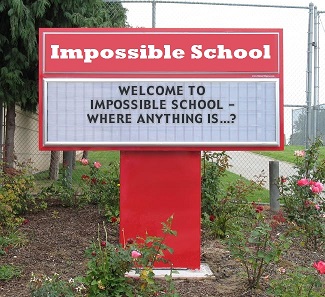
Welcome to Impossible School. I’m Blue, an adult in the building who apparently has enough time to show visitors around without sacrificing something far more useful I should be doing. That’s just the beginning of the many impossible things going on here at Impossible School! 

Let’s start with the foundation of our humble approach – the Possible Machine. I know, I know… the name sounds like a contradiction, but it’s this device which actually makes Impossible School, well… possible.

You’re familiar with pen and paper assessments, yes? (Sometimes they’re on computers, but that merely makes them more expensive – the substance is sadly the same.) Generally these ‘assessments’ make deeply flawed efforts to determine a student’s existing content knowledge. Sometimes they venture into the realm of hit’n’miss personality profiles or oversimplified learning styles. Rather ambitious for ‘Choose A, B, C, or D’, right?

The Possible Machine does this – properly – and much, much more. It allows faculty and staff critical insights into what each student needs in order to make a meaningful learning experience possible. We can, of course, never guarantee success no matter what we know or do, since student choice unfortunately remains a critical component of all education. But we CAN get SO MUCH closer to providing the best possible opportunities and pathways to each and every lil’ darling who crosses our threshold. 

Here, let’s slide into this classroom for a moment. That’s Ms. Lipsky over there, half-guiding that small circle discussion. These are kids who do best with personal interaction. They need the security that comes with structure, and they’ll read assigned material, but the information takes root and becomes meaningful when they have time to discuss it in a safe, somewhat organized environment. They’re capable of great things if they’re able to do this more often than a traditional classroom allows. 

See the young lady on the far right? She’s not saying much, is she? Normally that would be a red flag, but in her case – 

Oh! We’ve been asked to join in! Over half of the kids in this group were also identified by the Possible Machine as quite capable of professionally appropriate social skills – even at this grade level – if given a little guidance and opportunity. Consequently, they’ve been encouraged to take this sort of initiative.

No, thank you! We must continue the tour – but you’re doing great, kids!

Ah, here – Room 211. Mr. Zeller is giving a rather advanced lecture on the role of Calculus in AP Physics. You see we’re able to seat nearly 200 kids in this class, and have chosen an ‘auditorium’ style seating arrangement. Most of these students are on a self-selected Engineering track or other very #STEM sounding combinations of courses, and were identified easily and early as focused and self-driven. We have several assistants, of course, to provide individual or small group help, but you know the real challenge with this group?

Literature. They don’t naturally love literature. 

Oh, some dragon books and such, sure – but we had to use graphic novels just to build basic familiarity with the classics. We don’t bury them in it, of course, but everyone ought to know a little Jane Austen, don’t you think?

What’s that? The Purple Door? Of course we can. You’ll notice much smaller class size here, and a very relaxed dress code and casual seating arrangements. These students have a variety of needs and gifts, but what they have in common is a lack of intrinsic interest in academic subjects like math or history and varying levels of unsupportive or even chaotic home environments. 

Thanks to the Possible Machine, we were able to realize this immediately and set them up with teachers who, while quite qualified in their subject matter, are more about heart than head. They spend as much time on life skills as they do traditional content, and students are assessed for progress and effort rather than cut scores on state exams written by people who couldn’t on their best day so much as fathom their realities. Most of these kids need protein and access to mental health services more than they need a deeper understanding of the Progressive Era – ironic as that may seem. 

We do, of course, work on math and reading skills. The instructors are some of our most knowledgeable, but their focus is on stimulating interest and applying what’s learned towards successful living rather than simply punishing kids – however wrapped in fluffy platitudes – for their upbringing. 

Across the way here you see a classroom which at first glance looks similar – looser policies regarding dress and language, and a variety of seating options. These kids, however, are very motivated to do well, and consequently can be pushed much further in the cores and several extension topics which vary by semester. 

Pushed? Oh yes, I choose that word quite specifically. I said they were motivated, not intrinsically driven to truly learn. They come from families who care deeply about good grades and college prep and staying in just the right amount of activities. We don’t have to worry about these kids failing – the Possible Machine knew that from the moment they walked in the door.

The challenge with this group is actual learning. Sure, we have ‘grades’ as motivators, but Miss Benovidas and Mr. Carson have shown quite a gift for transitioning them into actual interest in the various subjects being taught. Under the old system, these kids would have been completely written off based on the numbers and letters they were able to secure by successfully gaming the system. We’d throw a few awards at them, give them an extra ribbon or two at graduation, and think we’d accomplished something as they went forth cynical and jaded, unable to see the wonders of string theory or appreciate the beauty of fractals as mathematical art. 

We’ve retained the outdated A-F labeling system, but only to smooth the transition. Miss B. and Mr. C. don’t measure their success or student progress by those silly letters; their challenge is to find ‘sparks’ in the eyes of these little darlings over something they didn’t think they could even care about – the Populist Movement, or the power of allegory in a great speech, for example. 

Thanks to the Possible Machine, we don’t insult students who come from educated, involved homes by dragging them through ‘financial literacy’ or ‘Constitution Day’, and we don’t unnecessarily traumatize them with ‘Sex Ed’ or hours of ‘how to calculate your GPA’. They can skip that and move into what their parents would call ‘real school’. 

On the other hand, we don’t neglect students who couldn’t otherwise ask essential questions about sex, or pregnancy, or health care. We’re able to identify those who couldn’t successfully watch an episode of The West Wing without more background knowledge, and those for whom the only pathway to success in science or math is through music and art. 

The Possible Machine confirms our instincts as to how many of our young ladies need to be told regularly that they’re strong, and beautiful, and smart, or that what happened to them wasn’t their fault – it wasn’t ever, ever, ever, in any way or by any definition – their fault. It points out the young men who seem fine, but who need someone to look them in the eye and ask how they’re doing several days a week, and the quiet ones who really are fine watching and listening and mostly staying… quiet. 

The Possible Machine tells us which kids need sports more than they need World History, and which kids will do better in World History if we use sports as leverage. It helps our teachers better intuit who to push, who to comfort, when to offer greater freedom and when to maintain the comfort and security of unyielding structure. 

We hear repeatedly that “all children can learn,” yes? And they can. Of course they can.

But they can’t all learn equally well in the exact same ways or on the same schedules. They can’t all move forward on the same tracks at the same speeds to hit the same checkpoints at the same time. That’s ludicrous. Imagine a public education system grounded on such an inane fallacy! Why, it would be mired in mediocrity for decades!

At Impossible School, all children can learn, and do so more widely and deeply than they could have imagined. At Impossible School, we build on the unique combinations of interests, strengths, and possibilities each child carries within them – and can reevaluate this yearly, monthly, or weekly if need be. 

We’re able to teach more than the ‘average’ student or the fictionalized ‘standard’ kid. Thanks to the Possible Machine, we’re able to figure out the intangibles of each student – each weird, wonderful, gifted, needy, broken, individualized student – and chart how they might best be stretched and realized intellectually, personally, and professionally. 

At Impossible School, we refuse to treat diversity as a disease only curable by standardization. 

Because it’s possible, somehow. It’s possible – for all of them. 

RELATED POST: Dolph & Lana Break The Rules

RELATED POST: Wil Wheaton, Aquaman, and Octave Chanute

RELATED POST: The Seven Reasons Every Teacher Must Know WHY Kids Learn!

Blue Serials (11/8/15)

Xmas Too Early

HARK HOW THE BELLS! SWEET SILVER BELLS! ALL SEEM TO SAY! THROW CARES AWAY! CHRISTMAS IS – 

I know, I know – we complain about it every year, but that doesn’t stop the machine from cranking this baby up as early as they think might squeeze a few more half-pennies from the masses. And it IS coming… sooner than you think. We’re past Fall Break, the new has worn off, the time has changed, and things just seem to get busier and busier. Sure, we MEANT to keep up with our online teacher friends and we bookmarked those edu-blogs to read, but…

No worries. I got you. It’s what I do. Here are the “Shouldn’t Miss” posts from #oklaed and beyond this past week or two…

Never Give Up Hope – Regular readers and vintage #11FF might not expect me to be quite so hooked on Jon Harper, aka Bailey & Derek’s Daddy, given his penchant for emotional, inspirational, warm and toasty caring kinda things. That’s not really my comfort zone. But it works for him, and underneath it runs a current not of sugar and fairy dust, but of risk – and gut checks – and breaking the $%&@ rules if it might be best for kids. In this short piece he rolls the dice on a troubled kid and seeks his help mediating between two younger boys. Then he walks away. Follow Harper on the Twitters at @jonharper70bd – really. Go, now – do it. 

Clutch / Breakthrough – As long as we’re full of hope and acknowledging the moments of healing light, here’s a double shot of Rebecka Peterson on OneGoodThing this past week. My daughter – who’s as sharp as a gar, but scathingly merciless regarding any teacher she deems unworthy (where do kids GET these attitudes?) – still loves Mrs. Peterson best of anyone she had in high school, including me. That’s OK, though – I do too. Bask in the mathematical and pedagogical wisdom of Peterson at @RebeckaMozdeh on the Twitters.  #oklaed 

#OurSchool – Seth Meier of Excellence In Mediocrity shares his take on this year’s release of the infamous Oklahoma Public Schools A-F Report Cards. **Spoiler Alert** He’s not impressed. It’s probably sour grapes, though – sounds like #HisSchool wastes all their time and resources on serving kids, growing their potential, and developing the sorts of relationships that lead to a lifetime love of learning and a belief in what’s possible when we apply ourselves to greatness. Pshaw! That crap is SO not on the high stakes state standardized tests. Follow Meier and his Twittering at @SethMeier.  #oklaed

Nothing {New} To See Here… – Mindy Dennison at This Teacher Sings drops a ‘DUH’ on those bewildered as to why treating people badly and paying them poorly makes them not want to teach. In other “Who Knew?’ news, politicians just want to get elected and pro wrestling is almost as fake as a Kardashians episode. Trigger Warning: I’m pretty sure I detect traces of snark and sarcasm from Dennison as she ponders HOW any of this remains so COMPLICATED for state leggies. What’s NOT complicated is following Dennison when she’s Twitterizing as @MrsDSings, so let’s go do that now, kay?  #oklaed 

On Slow Readers And What It Means for Student Reading Identity / Then It Just Doesn’t Matter – A pair from Pernille Ripp on Blogging Through the Fourth Dimension – both richer and truer than ought to be possible in such brevity. From the first: “Since when did taking your time as you read become something to be ashamed of?” and from the other: “So when they hate reading we must attack that first.  Not the strategies, not the skills, but the emotion that is attached to everything we are trying to do.  We must dig and dig and dig to find out why.  And we must ask, and we must talk, and we must give them a chance to change their mind, if even just in the slightest way, as we create classrooms that are run on a culture of love for our subject, rather than a need to cover curriculum.” Ripp excites me because she says things I would want to say if I’d realized how strongly I thought and felt them, then crushes me with how simply she pleads with us to please try to take care of our children in ways which should be so obvious. It’s like crying in church. Read her. Follow her. Buy her books. @PernilleRipp 

Finally, In Honor Of NaNoWriMo2015, A Post (and an Idea) Well Worth Another Look…

Detachment: An Object Lesson (November 2014)– Dan Tricarico, aka The Zen Teacher, shares a writing assignment I would have found bizarre and possibly pointless several years ago. Now I realize he was just a bit ahead of me on the ‘getting a clue’ curve (I can admit this because he’s too Zen to ever throw it back at me, but he knows it’s true), and I love Love LOVE this one. I’m going to find some pretense for doing this in my AmGovt class this month, because… defiance. And tenure. Oh – and it’s good for the children, too. Be good for your children by being in the moment with Dan on the Twitters at @TheZenTeacher and buying his book. At least add it to your wish list – I hear there’s a holiday of some sort coming up soon, and who knows what might turn up? 

Go, my #11FF Darlings – go be amazing, no matter what that looks like for you this week. I’ll leave you with a trifecta tribute to National Novel Writing Month, beginning with one of the strangest, wrongest things ever done to a Beatles song…

[[{“type”:”media”,”view_mode”:”media_small”,”fid”:”1505″,”attributes”:{“alt”:””,”class”:”media-image”,”typeof”:”foaf:Image”}}]]


Gonna write you a letter… gonna write you a book…

[[{“type”:”media”,”view_mode”:”media_small”,”fid”:”1506″,”attributes”:{“alt”:””,”class”:”media-image”,”typeof”:”foaf:Image”}}]]


It’s amazing what words can do…

[[{“type”:”media”,”view_mode”:”media_small”,”fid”:”1507″,”attributes”:{“alt”:””,”class”:”media-image”,”typeof”:”foaf:Image”}}]]

What was in that letter that calls to me, to me, to me? What was in that letter – straight to the very heart of me? What was in that letter that haunts me from this distance? What was in that letter – so sure, so persistent…? 

Yeah, I know – but I don’t think he means just a literal letter. Go write your book, in whatever form that means for you. Straight to the very heart. 

History Songs

Waaayyy back in 1996, the band Barenaked Ladies released their first moderately successful single in the U.S.:

[[{“type”:”media”,”view_mode”:”media_small”,”fid”:”1496″,”attributes”:{“alt”:””,”class”:”media-image”,”typeof”:”foaf:Image”}}]]


Broke into the old apartment – this is where we used to live 

Broken glass, broke and hungry, broken hearts and broken bones – this is where we used to live

Why did you paint the walls? Why did you clean the floor?

Why did you plaster over the hole I punched in the door? 

Why did they pave the lawn? Why did they change the locks?

Why did I have to break in? I only came here to talk – this is where we used to live

Broke into the old apartment – tore the phone out of the wall

Only memories, fading memories, blending into dull tableaux – I want them back…

History is a tricky thing. Personal or collective, it’s ridiculously difficult to reconstruct the past – even on those rare occasions when we have an abundance of materials with which to try. 

It’s a paradoxical truth in teaching history that the only two things you can say with any certainty are that (1) people everywhere, throughout time, are all basically the same – no matter what their circumstances, and (2) we can’t possibly fathom or understand people in other times, places, and circumstances – our worlds are simply too different. 

Plus, we never have ALL of the information and experiences needed. While we gain wonderful perspective from time and distance from whatever subject we choose to examine, we lose detail – seeing only through a glass darkly, or a rather pixelated type of historical Google Earth. 

Even when documentation abounds, it turns out we can hardly trust those who WERE there, consciously recording. Our human perception and memory are apparently pretty much crap whenever anything important needs recalling.

On the other hand, how many ugly break-ups does THAT explain?

And so far we’ve been assuming that all involved WANT to accurately preserve or recapture the past. That may not always be the case:

[[{“type”:”media”,”view_mode”:”media_small”,”fid”:”1497″,”attributes”:{“alt”:””,”class”:”media-image”,”typeof”:”foaf:Image”}}]]


As he feeds them to the fire, one by one, he’s dimly aware – he may have learned a thing or two, but tuition wasn’t cheap. And he’s only got these foggy notions of what he paid…

Author Milan Kundera of Czechoslovakia began his 1979 novel, The Book of Laughter and Forgetting, with a true story embedded into the narrative of Mirek, a fictional protagonist:

Chapter One: Lost Letters

In February 1948, the Communist leader Klement Gottwald stepped out on the balcony of a Baroque palace in Prague to harangue hundreds of thousands of citizens massed in Old Town Square. That was a great turning point in the history of Bohemia…

Czech Hat 1Gottwald was flanked by his comrades, with Clementis standing close to him. It was snowing and cold, and Gottwald was bareheaded. Bursting with solicitude, Clementis took off his fur hat and set it on Gottwald’s head.

The propaganda section made hundreds of thousands of copies of the photograph taken on the balcony where Gottwald, in a fur hat and surrounded by his comrades, spoke to the people. On that balcony the history of Communist Bohemia began. Every child knew that photograph, from seeing it on posters and in schoolbooks and museums.

Czech Hat 2Four years later, Clementis was charged with treason and hanged. The propaganda section immediately made him vanish from history and, of course, from all photographs. Ever since, Gottwald has been alone on the balcony. Where Clementis stood, there is only the bare palace wall. Nothing remains of Clementis but the fur hat on Gottwald’s head.

It is 1971, and Mirek says: The struggle of man against power is the struggle of memory against forgetting…

As it turns out, the fictional ‘Mirek’ is distracted from his otherwise tiny, irrelevant revolutionary efforts by his own quest to secure the return of some embarrassing letters from a former girlfriend – someone he now finds a bit ugly and offensive. 

You see the irony, of course. 

More recently, textbook behemoth McGraw-Hill took some heat when an annoyed mother circulated a snapshot of this insert from their Texas-approved history textbooks:

Textbook Snapshot

It sounds like they got a great deal on a vacation package from those people who keep spam-calling me from Orlando while I’m trying to eat dinner.

There are far more subtle ways to rewrite history than burning letters or euphemizing slavery, as this piece so effectively demonstrates. It’s not just Texas, of course – history is rewritten every time there are no normal-sized women on TV or in every chapter summary focused on Generals and Presidents over factory-workers and midwives. 

I own a dozen well-intentioned U.S. History texts from 1876 – 1961 which portray Christopher Columbus a dozen different ways and paint Indian Removal as everything from travesty to unfortunate necessity to “You’ve Just Won An All-Expense Paid Trip To Oklahoma!” 

Those same books, however, avoid any controversy at all regarding the women’s movements of the early 19th century. That’s because there’s no mention of Elizabeth Cady Stanton, Lucretia Mott, or even Susan B. Anthony in any of them. They simply didn’t make the cut. 

Kinda makes you wonder which is more troubling – being misrepresented, or being erased. *shudder*

It is, in fact, largely unavoidable that we’re going to make draconian compromises any time we try to write or talk about history, assuming we wish our discussion to take up less time and space than the original events. All the more reason, then, we should be hyper-aware of what’s NOT being told, and what’s NOT being asked. 

What’s happening just off-screen, as it were.

Even when we have the purest intentions, capturing the past – be it events long gone or the shifting shaping swirling of our own experiences – is an undertaking both elusive and unfair. Perhaps it’s a blessing to work from a scarcity of information; the impossibility of conveying the richness of the better-known may prove far more daunting.   

[[{“type”:”media”,”view_mode”:”media_small”,”fid”:”1498″,”attributes”:{“alt”:””,”class”:”media-image”,”typeof”:”foaf:Image”}}]]


It’s as if a fin, reaching from the swamp, grabbed me by my arm – tried to pull me in. But my arm was strong, and the fin was an inaccurately reconstructed fake…

For those of you less metaphorically inclined, the past is always “an inaccurately reconstructed fake.” Even when it does pull us in, it’s an interpretive approximation at best.  

It was right through those trees – I’m not insane! That’s where the fin tried to drag me in. Don’t look at me, look at where I’m pointing – close your eyes, see what I see!

That’s one of my favorite lines in all of known music. “Close your eyes, see what I see” – there’s the human experience in a nutshell. Please ‘get’ me – just a little! Fathom collectively with me, if only for an instant, said the shepherd boy to the lonely king. 

Please?  

If you can draw it in the air, or write it down, then you weren’t there. What’s gone is mute – someone changed the truth – they smoked the proof and there’s nothing left… 

But there is. There are our stories, and fragments, and framings, and efforts to capture – however imperfectly – some critical bits. Faded memories blending in to dull tableaux, yes – but also photos revealing Clem’s fur hat on someone else’s head. 

The past is maddeningly foggy, to be sure, but the lessons – and the flavors – too important to give up. So we grasp at the smoke and fill in the rest. Hoping.

RELATED POST: Useful Fictions, Part I – Historical Myths

RELATED POST: Useful Fictions, Part V – “Historical Fiction,” Proper