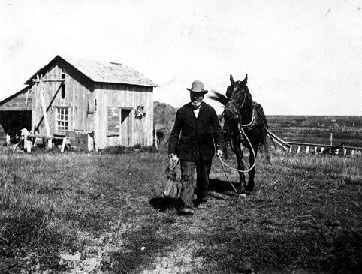
The Blacks in Oklahoma, Part I

Black Homesteader

I’ve been on a bit of a primary-sources-related-to-Oklahoma spree lately. Haven’t we all, at one time or another?

Many of them are interesting, most are informative, and a few contain information which is simply incorrect, however passionately delivered. There are a handful, though, which are simply a joy to read – repeatedly!

Er… for me, at least. As I’ve said before, my life isn’t what you might call “rip-roaring.” 

THE BLACKS IN OKLAHOMA – FLOCKING TO THE TERRITORY IN LARGE NUMBERS 

The New York Times – April 9, 1891

It had been nearly two years since the first land run opened the ‘Unassigned Lands’ in what was becoming increasingly thought of as simply ‘Oklahoma’. A second opening was anticipated in a few months, and people up north were naturally curious how things were going down there in wild country. 

Unlike today, when accuracy and perspective are editorial priorities as a matter of professionalism and respect, it wasn’t unusual in the late 19th century for stories about crazy events or bizarre behavior to capture the public imagination far more than the tedium of most real life. Sometimes news outlets even exaggerated a bit to keep readers entertained.

Of particular interest were stories feeding national preconceptions about race or culture. Were homesteaders at this late stage really such dirty, uneducated folks? Were Indians truly savages, or more like simple children, noble in their pathos? 

And what about the Negro? (That was the polite terminology of the day.) Even approaching 1900, a substantial number of white Americans in the northeast rarely if ever interacted with citizens of color. Oh, there were the Irish and Germans, who were bad enough, maybe an Eastern European sporadically, but a black man?  
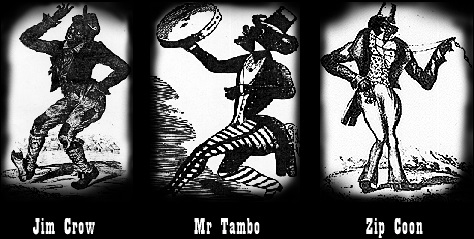
Minstrel Types

Minstrel shows were losing their popularity as Vaudeville became a thing, but the caricatures were well-instilled. On the other hand, there were those who insisted the Negro deserved the same rights and opportunities as white men – maybe not all of them, or to the same extent, but more than they seemed to be getting in the south, if what the papers wrote were true.

And then there was Oklahoma Territory. Formerly ‘Indian Territory’, it was gradually beginning to open its ‘surplus’ lands to white – and black – settlement. Social Darwinism at its purist – run in, hold your claim by any available means, and start from scratch along with everyone else to see what you can make out of these last few remnants of American opportunity.

That was the idealized version, at least. But it was about as close to starting on a ‘level playing field’ as most alive in that generation would ever see for Black Americans, however illusory the ‘level’ part of the equation may have been. 

Topeka, Kan., April 8.- Is Oklahoma really overrun with negroes, and has there been an influx of pauper negroes from the South? So many conflicting answers have been given in response to these two questions that it was impossible to arrive at the truth. 

In class, this is where we’d talk about ‘making good inferences’. What seems to be motivating this particular foray into the territory by this NY Times reporter? Why does he open with these questions? 

Good times, those inference discussions.  

The census taken there last Summer was of no use in aiding one to arrive at conclusions, for, while Guthrie enumerated, so it is said, the horses, dogs, and chickens as well as the “regular” population, Oklahoma and Kingfisher failed to count the men, women, and children, while Edmund, El Reno, and Lincoln are still in doubt as to what and who were counted, and Langston was not in existence.
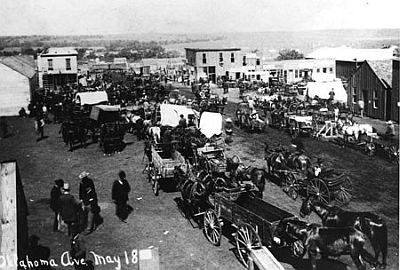
Guthrie

My students have this weird idea that in 2015, all computers and institutions everywhere are neatly connected and speak the same ‘language’. I assume they get this idea from bad action movies and federal health care legislation. 

But why they apply this assumption backwards through history is beyond me. Most of written history is an absolute mess. We make educated guesses – some fairly supportable, others just… the best we’ve got. 

It’s somewhat reassuring to know that as recently as 1891, at least one contemporaneous observer realized they really had no idea what was going on with who, or where. 

In order to determine the truth, THE TIMES’s representative determined to visit the Territory and see what was to be seen, and to learn from interested persons as much of the truth as they could be prevailed upon to surrender. 

He’s setting us up with tone. I respect that. 

Those who have never attempted to draw the truth from an Oklahomaite can hardly realize the difficulties that are presented. The Territory was born in falsehood, was baptized in falsehood, and falsehood has been the principal article of diet ever since that fateful 23rd day of April, 1889, when the “sooners” became the leading citizens of a country opened to settlement too late in the year for the planting of crops, and to which the poverty-stricken were invited by speculators and impecunious lawyers who had been permitted to enter beforehand by a pig-headed Administration, which could see nothing good outside the ague-stricken Wabash bottoms of Indiana. 

I can’t tell you how often this bit cracks me up. 

After basking in the pithy slander of early Oklahomans, don’t overlook the wonderful jab at President Benjamin Harrison. “{A}gue-stricken Wabash bottoms” just drips with disdain.

Harrison, of course, had made his way up the political ladder from Indianapolis, where he’s now buried. They’re rather proud of him up there – understandable, I suppose, since they really don’t have much else to boast on. I mean, you’ve seen the Colts in action, and their legislators are doing all they can to make Oklahoma’s current public education system look passionately committed to excellence compared to theirs.

But at least they have Ben Harrison’s corpse. That’s something, right?
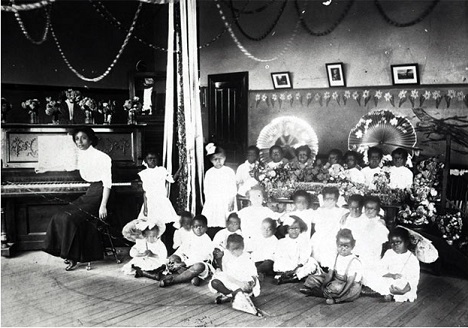
Guthrie Students

I don’t really mean that last bit about Indy. It was simply an example of the sort of inflammatory writing popular among some readers in the time period under discussion. I do it solely to help bring HISTORY to YOU. 

You’re welcome.    

Guthrie, being the headquarters of the Afro-American Colonization Company, has naturally been the objective point of the negroes who have been induced to migrate to Oklahoma. It is impossible to ascertain how many of the black race have arrived in that city, the estimates vary so largely. 

Those who are opposed to negro settlement declare positively that there are not fifty in the city. Those who favor the movement insist that there are more than two thousand in and about the capital. The latter is probably more nearly the correct figure, as an inspection of the city revealed many black faces, and an examination of many of the little houses in the suburbs showed a number of colored families comfortably situated. 

It’s hard to know when facts are being willfully fabricated to serve an agenda, or when the perceptions of those gathering them are simply so colored by preconceptions that they see what they expect and intend to see. 

Back then, I mean. Not today, when we have science. And numbers. And ALL THE FACTS. 

That these negroes are not all paupers is shown by their bank deposits, where they have sums ranging from $200 to $1,000. In one bank alone sums aggregating over $15,000 have been deposited by the negro settlers.

I’d pause at this point in class and ask my students to speculate where the author is going with this. You should as well. 

I’ll wait. 
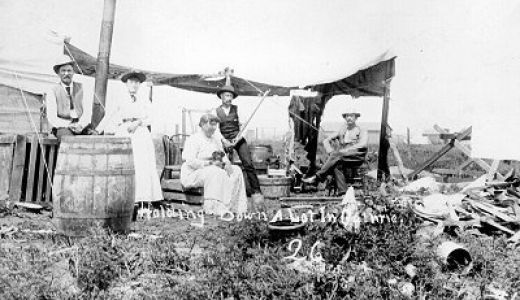
Holding Down A Lot

He may be simply refuting existing criticisms, point by point, in defense of Black settlers. Perhaps his point will be that they’re doing fine – just look at the evidence! 

But we’ve already had a taste of the author’s tone. The news may be valid, but it’s swaddled in snark and personality. We should be suspicious. Is he setting us up for… something? 

RELATED POST: The Blacks In Oklahoma, Part II

RELATED POST: The Blacks in Oklahoma, Part III

RELATED POSTS: A Chance In Oklahoma, Parts I & II

RELATED POSTS: Boomers & Sooners, Parts I – V

Blue Serials (12/13/15)

[[{“type”:”media”,”view_mode”:”media_small”,”fid”:”1583″,”attributes”:{“alt”:””,”class”:”media-image”,”typeof”:”foaf:Image”}}]]


Baby, It’s Tepid Outside. It doesn’t really feel like Xmas yet – maybe it’s the weather (at least in Oklahoma), or maybe it’s because school’s still in. Maybe it’s just age blunting the potential of the season.

Nevertheless, I have an early present for you. A collection of edu-posts from this past week(ish) which you simply must. not. miss. You’re welcome! 

(Oh, um… can you save that bow? We reuse those. Yeah, thanks.)

The Other Shortage – OKEducationTruths wrote last week about the shortage of competent, capable, not-going-to-hell-for-their-shenanigans people running for state office. We need more candidates, and better candidates, and – while he’s a bit more gentle about this than I am – we need to get our collective heads out of our behinds well before next November to figure out who we’re supporting and who we’re not, and why. 

It’s partly with this in mind that I’m starting an #OKElections16 feature in January profiling various members of our state legislature – especially in regards to their actions impacting public education. As new candidates arise – IF new candidates arise – I’ll try to cover a few of them as well. You know things are serious when Blue Cereal tackles legit, boring-but-so-important stuff. 

In the meantime, follow @okeducation on the Twitters – he’s not always serious, but he does say much that’s pretty important. (Don’t, um… don’t tell him I said that, would you?)

#OklaEd Funding, Vouchers Proposals, and Other ‘Bend Over, Like It, and We’ll Call It Love‘ State Legislative Rhetoric:

Fund Us. Support Us. Or STFU! – Claudia Swisher at Fourth Generation Teacher has had enough of lawmakers and others talking smarmily about how their mother and their sister and several of their ex-wives were all teachers and so I TOTALLY UNDERSTAND WHAT YOU’RE SAYING I HAVE ALL THIS CREDIBILITY. If you get it, she says, then do something useful; otherwise, Shut The F-

Well, you get the idea. Find the normally much calmer, sweeter @ClaudiaSwisher on the Twitters. She’s brilliant and effective and still feels awkward about the ‘STFU’ thing even though it made everyone smile and no one thinks she’s a potty mouth.

I Can Run A Spreadsheet Too (Rob Miller, A View From The Edge) – Rob explains why vouchers do NOT raise ‘per-pupil funding’ for public schools after all the wealthy white kids run to Word of Grace of Hope of Profit Academy in the suburbs. Rob’s on Twitter – @edgeblogger – go show him some love. 

A Blatant Double Standard (Rick Cobb, OKEducationTruths) – Of rhetoric and reality regarding voucher proposals in Oklahoma. My favorite part is about how public schools MUST be buried in bureaucracy because OMG STANDARDS! while the privates/charters/chosenfaves MUST be free from any and all accountability because OMG BUREAUCRACY CRUSHES INNOVATION AND QUALITY!

Rick’s on Twitter also – or were you not paying attention above? *sheesh*

Early #OklaEd Reactions to the recent passage of the More Delusional Rhetoric Act (aka, “Every Child Learns Everything At The Highest Levels Ever Just Because We Mandate It” Act, sometimes abbreviated to ESSA):

Music Stands Alone – Meghan Loyd at For the Love has hope for extra-curriculars under the revised federal… thing. Only Meghan could make me feel happy thoughts about anything 18,000 pages long and approved by the federal government – but she does. Be happy with Meghan on the Twitters – @meghanloyd.

The First Bite of the Elephant / The Next Big Bite of ESSA – Rob Miller of A View From The Edge has been on a roll lately. Thank goodness – he does all that… thinking and facts and stuff, so the rest of us don’t have to.

Finally, GO VOTE FOR THESE AMAZING #OKLAED EDU-BLOGGERS Who’ve Been Nominated for #Eddies15!

Best Individual Blog – OkEducationTruths

Best Teacher Blog – JennWillTeach and Mrs. Waters’ English

Best New Blog – This Teacher Sings (who has a pithy new post we didn’t have a chance to get to this week)

Best EdTech/Resource Sharing – ELAOK Teachers and Mrs. Waters’ English

Best Administrator Blog – A View From the Edge

It doesn’t take long to vote, and you’re a better person for having done so.

Next week I hope to get back to warmer, fuzzier topics and grab a few from outside our troubled state as well. I know we’re tired, and I know anyone paying attention is probably livid and discouraged most of the time – but I promise you, you’re doing the Lord’s work out there. What you say to your kids and the simple things you try to teach them mean more than any thousands of pages those principalities and powers can pass. So to hell with the system – go love your kids. Hold their heads under that water of knowledge until they have to either drink, or drown.

Merry Almost Xmas.

[[{“type”:”media”,”view_mode”:”media_small”,”fid”:”1584″,”attributes”:{“alt”:””,”class”:”media-image”,”typeof”:”foaf:Image”}}]]

Dear Frustrated Student…

Knocked Down

Hello. Pull up a chair. 

I know you came here to talk about grades, or get help on an assignment, or maybe just because your mom or one of your principals forced you to. That’s OK – I don’t take those sorts of things personally.

I can’t help but notice, however, that whatever your motivation, it does NOT seem to be a deep hunger for learning this particular skill or content. That’s also OK – like I said, not personal.

I can see your frustration. Seemed like you had all the time in the world to make up work, catch up on reading, figure out a plan… and now – suddenly – the semester is almost over, due dates are past, and you finally noticed the review sheet for the final and you don’t know ANY of this stuff – or so it feels.

Or maybe it’s a nagging disdain for school in general. Maybe you’ve begun to notice that the system itself isn’t particularly geared for deep, personal learning. It’s more like a weird bureaucratic game – fake some nice, show up and turn stuff in, and guess what each teacher actually wants from week to week. What you want, who you are, where you’re at, doesn’t seem to matter much.

And you’re right – it’s a stupid system. Some of us are working on that, but…

Library Girl

Hear me out – just for a moment. Please consider that even if grades are stupid, they’re still how the current system works. Even if they don’t accurately express who you are, what you know, or what you’ve done, they ARE attainable without extensive suffering. More importantly, grades give you options. 

Maybe your parents will go easier on you about stuff if your grades are good. You have more choices about what to take next year if your grades are good. It’s easier to get into things you want to join, or get the jobs you want if you start working while still in school.

When you graduate, those silly numbers and letters largely dictate how many choices you’ll have about where you go and what you do from here. It’s not about what I think you should do at that point – it’s about YOU having OPTIONS.

And those, for better or worse, largely come from grades.

Trombone Boy

I hope, too, that you realize that even if grades don’t always measure learning, there’s still lots of learning to be had here. Most of your teachers got into this profession out of some combination of caring about kids and loving whatever subject they’re teaching. 

Not ME, of course – I’m working out my personal issues by torturing teenagers – but I’m the exception. Most of the others felt a ‘calling’ to do this. They may seem jaded and bitter now, but the roots of their idealism are still there. You just have to tap into them. 

You don’t have to love every subject, and certainly not every assignment, but please don’t let your frustration get in the way of noticing when something really is kinda cool, or interesting, or important, or engaging. It’s OK to care from time to time. It doesn’t mean you’ve sold out or given in; it just means you’re listening and willing to learn. 

One other thing, then we’ll look at your grade and realistic options between now and the end of the grading period. Pretend you’re really listening to me here and I’ll probably go easier on you when it comes time to finalize this stuff. We like to feel like we’re ‘reaching the kids’. 

It’s possible you haven’t made very good decisions so far this year. Maybe this is the latest in a long series of rocky semesters, or maybe it’s new – school used to be easy until

If the underlying issues are about family, or legal stuff, or chemical imbalances, addiction, abuse, or simply good ol’ generalized rampant dysfunction – you need to understand that you’re not old enough for most of what’s happened to you in life so far to be your fault. 

For the same reasons we don’t let you vote, drive, decide whether or not to go to school, or let you manage your own behavior while here, etc., you’re not morally, legally, spiritually, or intellectually culpable for the vast majority of what’s happened to you up until now.

Even when you’ve made choices – good OR bad – they’re inevitably shaped by your upbringing, DNA, and events beyond your control.

Confused or Annoyed

It’s not that problems go away when you hit 18, but they become more and more YOUR problems to handle as best YOU can. Part of what sucks about being a teenager is you have so many near-adult responsibilities, but so little power to handle them as you see fit. 

That’s going to start changing, and suddenly all the rules will be different. Good decisions won’t always produce immediate good results, but a series of good decisions usually results in more good results than bad. All we can do is play the odds. 

Old people like myself used to hang this poem on our bathroom walls or behind our desks – it starts with something like, “God grant me the serenity to accept the things I cannot change, the courage to change the things I can, and the wisdom to know the difference.”

You can’t change your parents, or your teachers, or your past. I know that sucks, but that’s how it is. You’d be surprised how many people burn up all their time, energy, and emotion trying. It never works. 

You CAN do a better job with the parts IN your control. It won’t seem like it at first, but the learning happens in the struggle. You get better at it by doing it over and over. When it works, keep doing it; when it doesn’t, try again. 

I know, sounds easy, right? It’s always easier to see and understand when it’s someone else. 

Headache

Finally, you’re smart enough for this class. If you weren’t, you’d already be in another class. If there’s one thing we’re good at, it’s categorizing and tracking kids. I’ve been doing this for a long time, and if you were too stupid to be in here, I’d have taken you aside long ago and said, “Honey, I have some difficult news. You’re… well, you’re a great kid, but you’re simply too stupid for this class. I’m going to help you find a bozo class where you can be with your own people.”

But I didn’t, did I?

I promise you, then – you’re more than capable. Of course it’s hard. Why would we come to school and practice a bunch of stuff we could already do, or learn stuff we already know? Hmm? Oh, well – I can’t help how that other teacher does things, but that’s not what we SHOULD be doing, at least.

And you’re going to make it. It won’t be quick, but it WILL GET BETTER. Life doesn’t get easy, but you’ll get better at it being hard, I promise. Eventually you’ll be able to reach out to those around you less capable than yourself and help them get through their craziness as well. Because you’ll get it. Because you’ll have done it. 

I’ll stop now, but I’m right about all of this. I’m very, very old, and very, very wise. Understood?

OK. Let’s look at that grade…

Help

RELATED POST: 10 Points for the Overwhelmed Student

RELATED POST: 10 Points for the Overwhelmed Student (Director’s Cut)

A Chance In Oklahoma, Part II

Helen Churchill CandeeI may have mentioned how giddy I was to come across a wonderful piece by Helen Churchill Condee in Harper’s Weekly, from way back on February 23, 1901. When you combine insight, knowledge, and pithy writing, you have my heart forever.

Even if you’re long-dead, I suppose.

Condee is actually Helen Churchill Candee, but from time to time the ‘a’ becomes an ‘o’ in her writing credits. (I kept the ‘wrong’ spelling with the document since that’s how it appeared in Harper’s originally.)

Helen was a New York girl who grew up in Connecticut, eventually marrying a successful but abusive man. After their separation, she began writing articles for several ladies’ magazines to support herself and her two children.

Women’s magazines in the late 19th century tended to focus on household tips, womanly etiquette, and taking care of your man, but over time she went a bit Hillary Rodham and wandered into women’s rights, raising children, and even local politics. 

Give them a pen and a paycheck, and it’s all over, boys. 

Harpers1901Candee moved to Guthrie, Oklahoma, for several years, writing regularly for periodicals back east. It was around this time she published her first two books – How Women May Earn A Living and An Oklahoma Romance. The first became a landmark in women’s literature (a subject for another time) and the second – her only work of fiction out of the many successful books she’d continue to write – helped publicize and glorify life in the recently opened territory. 

It may have been based on personal shenanigans as well, but it used to be a lady didn’t come out and confess such things, so…

Somewhere in the midst of this she wrote the piece with which I’m so enamored, along with numerous others I’m currently tracking down. 

She went on to become an expert on world travel and, um… tapestries… and served as a volunteer nurse in the Great War overseas. She passed just short of her 91st birthday in 1949. 

The event for which she’s most remembered is not one directly related to her writing, however glorious. She was on the Titanic when it sank on April 15, 1912. Her written recollections are some of the most memorable and quoted of various survivor accounts, and her unpublished memoirs seem to have inspired a few of the key scenes in that DiCaprio film some of you may recall. 

HCC Titanic

There was this younger man, see, and a love triangle, and this glorious epiphany standing on the bow…

None of which, in my humble opinion, compare to the glory of her account of opening the Unassigned Lands in O.T.  I mean, that flashy stuff is all fine and well, but anyone can break their ankle leaping onto a lifeboat. Few can capture so much humanity in so few words as a passage like this:

The lands about to be opened are some that have long been coveted by the white men. Greed of land grows on those who hold it.

Oooohhhh… do you feel the truth tickling your innards? I sure do. 

The Wichita Mountains have long been like the promised land to the people of the Southwest, and as a rider reaches a hill-top of the rolling prairie, he exclaims, with extended arms: “See! That’s the Wichita range!  Beautiful mountains, and they say they’re full of gold and silver, copper and zinc, with some outcroppings of coal and traces of oil.” 

‘Full of gold and silver’ might have been a bit optimistic, but copper and zinc was spot on. Can’t believe she didn’t work in something poetic about lead as well. Hello!

Ironically, it would be coal and oil – here almost afterthoughts – which would soon thereafter drive the mineral boom in Oklahoma.

But not yet. 

Pres HarrisonAt that moment, it was still all about land – farming, growing, raising, living land. And this was it. Everything else was pretty much taken. The bar was closing and the men outnumbered the women 3 to 1. Time to make your play. 

And so, to get these lands, a bill was formed, but it stuck in the process at Washington. Then one day, as a surf-boat rolls safely up the beach on a big comber, the bill went through as a “rider” on a greater bill, and the opening of the new lands was made a certainty. 

If there’s one thing that resonates with Oklahomans, it’s a good boating metaphor. Must be a Northeasterner thing.

And imagine a time period in which major acts of Congress were unable to get passed the traditional way, so they were stuck onto completely unrelated legislation no one could afford to vote against and passed without some even realizing what they were supporting!

Back in the day, I mean. Long, long ago.  

Surveyors have been all over their surface now, and it is marked off into a checker-board of squares miles, each one containing four farms of one hundred and sixty acres – or a quarter-section, after the manner of the West.

Homestead Act SignThe allotment size was consistent with the Homestead Act from way back in 1862, signed by Lincoln during the Civil War. This was considered a sufficient spread to allow a homestead and plenty of planting land. A free man working without modern equipment would be unlikely to cultivate more than this productively. 

It was this same Homestead Act which the ‘boomers’ had repeatedly referenced as evidence they deserved a shot at the ‘surplus’ lands in Indian Territory. 

The size of the Kiowa and Comanche tract is 2,968,893 acres. This, as the merchants say, is gross: the net number of farms which are offered to those who wish to make a hazard for new fortunes is about 10,000 of a quarter-section each. That means the redemption of ten thousand men, their fortune assured if they are made of the stuff that can labor and struggle for two or three initial years.

Redemption. That’s what it was all about for many. 

Three-quarters of a century before, Mexican Texas had been the land of new beginning – escaping your own past, whether it meant legal entanglements, failed relationships, or political embarrassment, and starting anew in a seemingly unlimited Eden. The glories of Manifest Destiny had carried others to California, Oregon, and gradually filled in even much of the Great Plains.

Now the frontier was ‘closed’, or at least not nearly as frontier-ish as it had been, and hungry homesteading eyes turned to Oklahoma.

Middle Ages TapestryHow many others in that generation and prior had taken their shots, staked their claims, virtually everywhere else in the West? Those waiting now were the also-rans, the coulda-beens, desperate for one last chance at stepping into the role of Yeoman Farmer in the most democratic manifestation of the ideal. Redemption? Maybe so. 

‘Their fortune assured’? The American Dream was immutable law still at this late date. Perhaps some of this faith was galvanized by desperation, but it guided both policy and personal choices well into the 20th century.

It won’t last – at least not in the same form. The Dust Bowl and Great Depression would contradict all holy truths about hard work and good choices leading to independence and relative prosperity. But not yet.

They still believed.

The remaining acres of the reservation, amounting to nearly half, are disposed of in a way which treats considerately both Indian and white settler. Each of the 2,900 Indians is to have an allotment of one hundred and sixty acres, and these Indians are to choose themselves before the gates of the country are opened for the rush. In addition, 480,000 acres are allowed for Indian pasture. Fort Sill has a front lawn and back yard of 60,000 acres out of the tract, and about three hundred and thirty thousand acres make up the amount of land set aside for the support of schools and colleges. This disposes of the Kiowa and Comanche country.

‘Disposes’ is right. The issue of land allotment among the tribes deserves a separate post. It is difficult for Anglo minds to fully process why this was effectively the final wave of cultural genocide. “Oh my god – they gave the Indians title to their own property! How horrible!”

Yeah, yeah, white boy. Your culture is awesome, Indians were stupid, you were doing them a favor, blah blah blah. More on that next time. 

Note, that ‘these Indians’ get to ‘choose themselves’ before everyone else – almost like it’s an unfair advantage of some sort. Hey – what can go wrong when you have a choice?

[[{“type”:”media”,”view_mode”:”media_small”,”fid”:”1573″,”attributes”:{“alt”:””,”class”:”media-image”,”typeof”:”foaf:Image”}}]]

“It’s the Stay Put Landalot Man.”

Everything is now in readiness, and awaits the proclamation of the President, which is to declare the gates open, and which will say in effect, “Run in, my children, and help yourselves, but remember that only one grab is allowed for each.”

*pause*

Cynical as I am, I’m not entirely immune from the gilded glory inherent in a good land run. Condee gives me chills with this one. 

Then reality comes back.

RELATED POST: A Chance In Oklahoma, Part I

RELATED POSTS: 40 Credits & A Mule, Parts I – VII

RELATED POSTS: Boomers & Sooners, Parts I – V

A Chance In Oklahoma, Part I

Waiting To Run

There are times I just get GIDDY over a good document. (Yes, my life is that lame.) Imagine my euphoria, then, when I came across this enticing missive from Helen Churchill Condee published in Harper’s Weekly, February 23, 1901…

Not all of us are successful in life; possibly this is because we have not had a fair chance. The government of these United States, while it is looked upon as a cold, unapproachable body, like a corporation, once conceived the beneficent plan of giving a chance for success to any of its sons who chose to take it. 

What a rich framing of the initial land runs in Oklahoma – “a beneficent plan of giving a chance for success to any of its sons who chose to take it.”

I could spend a week on that sentence. Beneficent? Really? I thought the Boomers and others raised such a fuss the powers-that-be finally caved.

Look at the nuance in ‘chance’ for success (kinda like the right to ‘pursue’ happiness) for any ‘sons’ (it was still a man’s world, in law and on paper at least) who ‘chose to take it’. The American Dream may have evolved since the days of Horatio Alger (think Little Orphan Annie as a dude, or Oliver Twist without the British accent), but the ‘live right, dare big, work hard’ ethic of such tales still drove expansion and those willing to migrate into opportunity. 

In pursuance of this plan a tract of land containing about three million acres was thrown open in the middle of the Indian Territory, and every one was at liberty to take possession of one hundred and sixty acres without price. This was the beginning of Oklahoma, a Territory with a romantic and marvelous history of prosperity crowded into the short time of eleven years… 

This is the chance Uncle Sam is to give his unsuccessful sons and certain of his daughters.

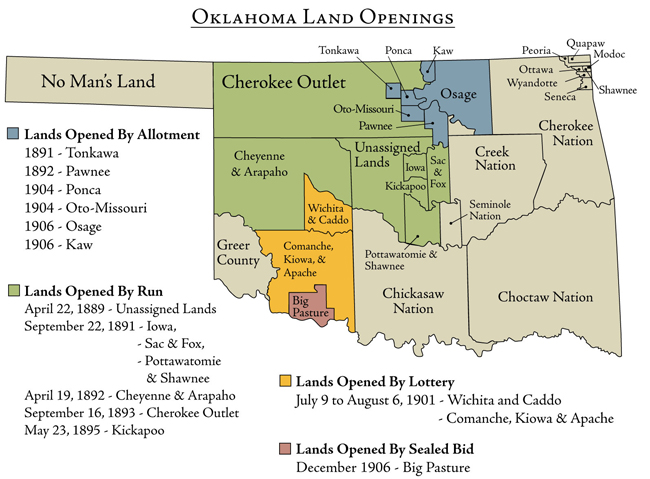
Oklahoma Land Openings

When was the last time you thought of Oklahoma as a land ‘with a romantic and marvelous history of prosperity’? And this was almost a decade before the oil boom! But Condee was right – our little state-to-be had become the last great hope for white homesteading anywhere on the continent. 

Which, you know, was exciting for white homesteaders, at least…

The new tract is the reservation of the Kiowa and Comanche Indians, with the possibility of the inclusion of the Wichita lands. It is not easy to decide on the justice of the question so far as the original owner, the Indian, is concerned. 

Those who live far from him look with disapproval on the gradual crowding into smaller and yet smaller space, of the taking away of his hunting-grounds and giving him the beef issue, of beggaring him by way of forcing civilization, of breaking even the treaties sworn to hold “as long as grass grows and water runs.” 

It’s easy to forget in retrospect that many of the same complexities we recognize in history were being wrestled with as current events. Condee pairs land allotment – the most recent process by which Amerindians had been stripped of their land – with the food allotments arranged by the same treaties. Which was more destructive, she seems to suggest – taking away the source of their own culture and self-provision, or maneuvering them into reliance on the outstretched whims of federal government?

As to ‘beggaring him by way of forcing civilization’ – I… I’m simply too aquiver to even analyze that one effectively.

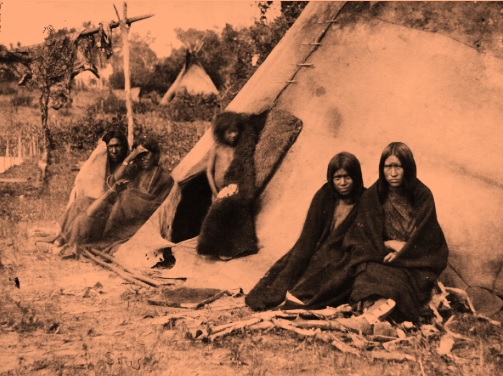
Arapaho Youngsters 

The U.S. picked a largely unjust war with Mexico, to be sure, but at least at some point war was declared, whatever the pretext. The vast majority of Amerindians were ethnically cleansed through handshakes and smiles and warmest assurances. The 19th century saw the U.S. perfect the art of stabbing you in the back for your own good, then resenting the few shoddy bandages it felt compelled to throw your way.

Or am I reading too much into seven words?

Those who live near the reservations see the Indian through different eyes. They regard him as a lazy, opulent child of fortune, possessing fertile lands, which lie fallow, himself rich through the simplicity of his needs and his share of the interest on the $43,000,000 which the government holds invested for his tribes. 

There’s a whole separate post to be written about paper wealth and Amerindians. Most of the wilder tales involve oil money, but the dynamic here is similar – ‘lazy’ and ‘opulent’ sets a nice tension, and surely Condee recognized the cruel irony inherent in ‘child of fortune’. 

The idea of untapped resources – especially LAND – was anathema to the white way of thinking. For the last generation of homesteaders all too aware their opportunities were quickly vanishing, it only fueled their resentment to see it ‘going to waste’.

And how much do you love Condee’s subtle rhetoric – ‘rich through the simplicity of his needs’ flowing almost as an afterthought into ‘and the interest on the $$$…’?

It angers a man who tills every acre of his quarter-section with unfailing industry to place his family above want to see his Indian neighbor, with boundless lands, cultivating but a tiny patch of corn, yet living in a cabin, keeping cattle, and driving off contentedly to receive from the government agent the issue of groceries and beef which the white man can only get in return for hard-earned dollars. 

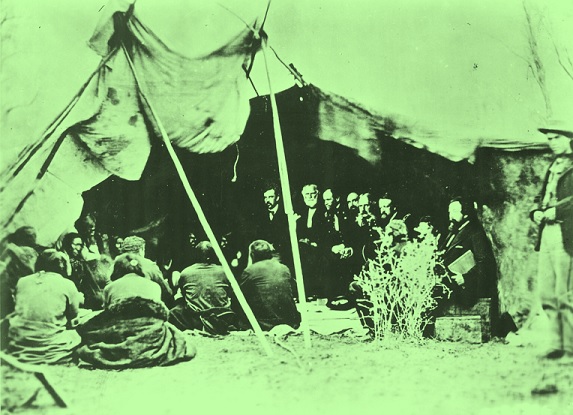
Treaty Negotiations

Condee would have made a great historian. (She actually did just about everything BUT that – she’s a story in and of herself.) Kudos to the white lady from the North who’s so able to put the reader into such a variety of other mindsets while maintaining her own narrative voice to hold it together. 

Without the perspective lent by distance, the envious fail to see that the Indian’s rations are only a crumb of the just return he should be entitled to for evacuating all the continent except a few little reservations; and the white man covets. He does it so ingeniously, too, that its results work like logical morality, and crimes are committed under the excuse of civilizing the Indian.

‘Its results work like logical morality’ – Oh. My. God. Can you excuse me? I need a moment alone.

How easily we vainly assumed that kind of insight can only come in retrospect, with the benefit of distance and the perspective it allows. But at least one pithy babe was unraveling the human condition contemporaneously. 

The lands about to be opened are some that have long been coveted by the white men. Greed of land grows on those who hold it. 

But perhaps more on those who don’t. 

I can’t help myself. We’ll have to continue this one – and talk a little more about Helen Churchill Condee. I’m still giddy – aren’t you?

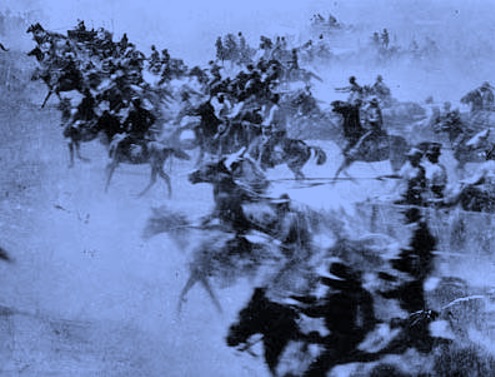
OK Land Run

RELATED POST: A Chance In Oklahoma, Part II

RELATED POSTS: 40 Credits & A Mule, Parts I – VII

RELATED POSTS: Boomers & Sooners, Parts I – V