Cursive, Foiled Again!

Joy Cursive

A few weeks ago, State Superintendent of Public Instruction Joy Hofmeister tweeted something about cursive being part of the revised ELA standards. Being me, I responded semi-snarkily about Morse code or quill pens or such. It was friendly, but I was oddly annoyed in a way I wasn’t quite ready to confess.

Joy being Joy, her response was diplomatic and included links to relevant research. In the exchange, I also somehow managed to antagonize a number of dyslexia advocates (er… they’re not advocating FOR dyslexia – you know what I mean), so… I let it go. 

Conflict wasn’t my goal, for once. I like Joy, and some of my best friends are, um… dyslexic, I guess. 

But… why did I even care? What was up with that? And then I remembered. All of it.   

I graduated from high school in 1985 completely unprepared for the academic and personal expectations of a legitimate university. I was ‘smart’ enough, but immature and underexposed to challenge. My high school’s “Honors” program was mostly a few pull-out sessions a week in which we did brain teasers and ‘leadership skills.’ I wasn’t exposed to anything like AP or IB until I was actually teaching, many years later. 

I dropped out of the University of Tulsa after five semesters, having failed a number of classes and lost most of my academic and other scholarships for lack of… doing much. 

It was over a decade before I went back. By that time I was married (which wasn’t going particularly well), had two small children, and had realized that neither my band nor my job were going to make me rich, famous, or fulfilled. In short, my life kinda sucked.

In the midst of this madness, my then-wife said something for which I am still thankful all these years later. “You should consider teaching. You’re already full of ****, so most people love you, and you tell a pretty good story as long as it doesn’t have to be accurate or appropriate. Why don’t you teach history?”

I didn’t have any better ideas, and what better way to offset my own bad choices and misery than bringing down as many others as possible? Ruining young lives, 153 at a time!

Best decision of my life. 

Still working almost full time, taking out ridiculous loans I could never repay, two small children at home with a decent mother but unhappy spouse, I returned to school.  

Initially, I was rather… discouraged by the caliber of people on the introductory education path. Dear god, no wonder schools were in such trouble. What was I doing?

Over time, however, those initial masses were culled a bit and things weren’t so awful. I hated the theory and the touchy-feely stuff, but I loved the history – despite those classes being particularly difficult for me. I knew so little about… anything. 

Two and a half years of full-time school, work, kids, rocky marriage, no money, smothering in-laws, and personal dysfunction. There were some great individuals and good moments, but I messed up more than I didn’t. I was slightly above average academically, but a train wreck at life skills and direction.

And yet, I made it. 

I graduated with a respectable GPA, given how I’d begun all those years before. I met the best people and earned the right honors, and was becoming potentially useful to the universe. 

Time to take the state test. The big, scary, ‘teacher certification’ exam.

Everything from this point forward is colored by emotional memory. For those of you who are facty thinkers, please understand that for some of us, REALITY is a series of EXPERIENCES which may or may not exactly correspond with purely objective recall. 

I can’t swear to the details, but I am certain as to the version forever burned into my psyche.

The test back then was big and comprehensive and scary. I remember trying to study from Oklahoma History textbooks while glazing over in disinterest, and cramming on World Cultures and Economics about which I still knew next-to-nothing, barring a few interesting centuries in Europe and how to effectively juggle overdraft fees.

As to the pedagogy and touchy-feely, well… I’d just have to fake it as best I could. As my first wife had suggested, I was fairly gifted at being “full of ****.” 

I arrived at the testing center nervous, but ready to dive in. I remember a locker for my personal belongings, and some guidelines I had to read. Then came the clipboard.

“Read and copy the following certification of something or other IN YOUR OWN HANDWRITING and sign and date at the bottom.” I hadn’t planned on this – a long list of formalities I’d have to copy in a foreign script before I’d even be allowed to begin the actual test. 

The timed test. The one determining if the past two-and-a-half years of my life had been worth it. The one potentially ruining everything. The one I was already worried about, despite weeks of stressful preparation. The one for whom the clock was already ticking. 

I hadn’t written in cursive since elementary school. I could read it, but I can listen to others play the piano without being able to reproduce the process. I’d printed – efficiently – throughout high school, retail, and college. I’d long-since stopped even thinking about it.  

I walked nervously to the desk and asked the lady… see, I don’t… could I…? 

No. Those were the rules. That was the system. 

So I started laboriously trying to copy this… this… required certification. In my memory it’s easily a page long, but I don’t know how technically true that was. 

I do know that at 30 years of age, with two kids at home and a wife who didn’t like me much but who’d devoted two-and-a-half years to getting me through school, after leaving a good-paying job (which, granted, I hated), I was shaking. The frustration, and helplessness, and anger, and… how stupid I felt. 

SO stupid. What was I thinking – that I was going to change the world? I couldn’t even copy the $%@&ing certification. Angry stupid. Impotent stupid. It overrode rational thought. 

Twenty years later, I’ve handled worse without it killing me. It seems melodramatic in retrospect. But at the time, it felt like the worst thing that had ever happened to me. It took me forever to get through, and I don’t even remember the rest of the day or the actual testing. 

I was telling my (new, hopefully permanent) wife about this after the Twitter exchange referenced above, and the emotions from that day ambushed me, rather unfairly. I nearly lost my suave – weird, given that I hadn’t thought much about it in the nearly twenty years since. 

There’s a lesson here about assessment and whether we’re actually measuring what we claim – no one warned me that working with teenagers hinged on my ability to write cursive under pressure. 

There’s probably a ‘grit’ lesson of some sort as well – I mean, I finally copied the damn thing in some butchered version and took the actual certification tests. I even passed – to the chagrin of my poor students each year. 

Mostly, though, it’s just a horrible memory that still stirs up things I don’t like to think about and feelings I don’t like to feel – helpless, stupid, angry things which I try to channel a bit more productively these days. 

None of which Joy Hofmeister could possibly know, and for which she can certainly not be held responsible. She wasn’t Superintendent then – she probably wasn’t even through high school yet.  

So… sorry I was snippy. Hope I hid it well. I promise, though, that I won’t argue about cursive anymore. It turns out I have a few lingering… issues on that subject. 

Not that anyone could ever tell. 
1, 2, 3, 4, 5 – Response to Purcell’s Edu-Blogger Challenge

You might think that these open ‘Edu-Blogger Challenges’ could be received as a task, or a distraction. I find most of them quite the opposite.

The freedom that comes in being asked questions or assigned a topic and a word limit may be paradoxical, but it’s freedom nonetheless. 

This particular challenge was issued by Anthony Purcell on Random Teacher Thoughts. Having finally met him – sort of – I can’t help but want to jump in and try to shine. His blog may be a sporadic arena, but he’s, like… all legit and stuff in person. 

Kinda makes me wish I’d shaved or worn a tie or something, you know?

You can find the original challenge – along with Purcell’s own responses – here

What has been your ONE biggest struggle during this school year?

I never want to be that teacher who throws up my arms in exasperation at how helpless and hopeless and victimized “this” group is compared to “how they were” X number of years ago. 

That being said, I find myself throwing up my proverbial arms in exasperation at how helpless and hopeless and victimized each group is compared to the last. I love them dearly, but we’ve long ago given up focusing on teaching history, or even history skills. Most of my energy is spent trying to drag them into the possibility that they have brains, and that by using them they can find solutions to the most mundane issues of their day – and maybe even figure out possible responses to my assignments as well. 

[[{“type”:”media”,”view_mode”:”media_small”,”fid”:”414″,”attributes”:{“alt”:””,”class”:”media-image”,”typeof”:”foaf:Image”}}]]

Share TWO accomplishments that you are proud of from this school year.

First, I’ve given up on professional boundaries. 

OK, that’s a bit of an overstatement. I’m old and tired and tenured enough, though, that I’ve stopped worrying about whether or not I SHOULD be letting kids talk to me about this or that, or whether it’s DEFENSIBLE IN AN OFFICE SOMEWHERE that I said X, suggested Y, or called Z a B. 

This is a group with few filters and many burdens. I want them to learn history, but to do that I first need them to survive the sloughs of despair we call 9th grade. So I let them talk, and I talk back, and then we try to get back to that Andrew Jackson speech. It’s actually LESS stressful to just let it happen.

Second, I’m proud of the Classroom Resources section on Blue Cereal. It’s not particularly fleshed out yet, but it feels like the riskiest thing I’ve done so far with this site. And while I don’t obsess over analytics, one of the Document Activities I’ve posted shows consistent visits over months and months. I hope that means it’s making itself useful out there somewhere. 

What are THREE things that you wish to accomplish before the end of the school year?

1. Still trying to figure out how things like student choice, moving away from the faux authority of letter grades, semi-flipped lessons, etc., work in limited practice for my kids and my class. I’d like to keep pushing.

2. The #OKElections16 stuff won’t be complete by the end of the school year, and it’s not directly classroom-focused, but that’s largely what makes it a challenge. My druthers over the years is to gripe a bit, then tune out state politics and such and just worry about the stuff I can control. I’m realizing now that this wasn’t “optimism” or “focus” so much as cowardice – or at least laziness. If we truly love our kids in the ways we’re so quick to meme, then we need to get out of our comfort zones and get involved in the yuckies. 

3. And… there’s one young lady, who obviously I won’t name. I want to understand why she keeps coming by and waiting, and why she mostly doesn’t talk. I want her to discover learning and find my room safe enough that she’ll speak – to me, to a peer, to anyone. My teacher-senses ache for whatever’s going on in her and I can taste the dark and empty, but I can’t DO anything about it. It’s not mine to reach. 

Gosh, that got heavy quickly. Sorry about that. 

Give FOUR reasons why you remain in education in today’s rough culture.

Mindy Dennison issued a challenge along those lines last summer. My response was essentially that it needs to be done, and I don’t know what else to do. The need is there, so we try. If someone better prepared, better qualified, would come do this – and better – I’d let them. 

There were quite a few really good responses, most with a bit more positivity. 

I haven’t really given you four, but I’ve given you one from me and a link to others. I’ll be particularly presumptuous and link to two poems that say it better than I can, and call that four. 

To the friend that once said, “You need to be realistic.” (Kris Giere, Involuntary Verbosity)

These Feet Will Drag (Jose Vilson, JLV)

Which FIVE people do you hope will take the challenge of answering these questions?

I’ve already passed the challenge along to a number of twittering blogger-types, although I always forget a few of the bestest. Instead, I’m going to challenge 5 people who aren’t regular bloggers – but any of whom could be. If they don’t wish to start or reboot their blogs in order to answer, but are kind enough to do so, they have open invitations to Guest Blog here. I would actually be quite honored. 

Sarah Pradhan – Who doesn’t yet fully appreciate how rare and powerful her words, ideas, and heart for kids truly are – especially in combination.

Lisa Witcher – Who responded to my very first blog with something better, thus both helping that initial effort and keeping me in check in a way only she and very few others can.

Kathy Dodd – Who dreams so big and strives so beautifully that she can rarely appreciate how much she’s done for the cause, because she wants so much more for those who can’t dream and strive nearly so well.

Alyssa Michelle – Who makes me believe it’s possible. All of it. With style. 

Matt Cone – Who has enough manliness to be the only guy on the list without it seeming unbalanced, and combines world-weary honesty with a hopeful glow I can never quite classify. 

Jonah’s Education

JonahThose of you who are not Sunday-go-to-meetin’ people may have to excuse me for a moment. So might those of you who are, but who live it like a calling rather than wielding it like a cudgel. 

I am by no means a preacher of the gospel. But if the powers-that-be are going to sling Bible around in defense of stockpiling weapons and demeaning the weak and the weary, I don’t feel too guilty suggesting that parts of it actually promote enlightenment, children, and self-examination.

With that in mind, I’d like to talk about Jonah. Yes, the one who was swallowed by a fish. 

While my personal theology includes a very real Jonah and a very large fish, you’re welcome to distance yourself from such orthodoxy and think of it as a parable or fable of some sort. Whether literal or figurative, it made it into the part of the Bible most evangelicals believe – “all of it.” That gives the story some validity either way – at least among those I wish would stop blaming Jesus for their own horrible political leadership.

Jonah, as the story goes, was given an assignment by God with a big ‘G’ (or Yahweh with an omni-sized ‘Y’, if you prefer). “Go to Nineveh and explain a few things so they won’t end up destroyed.” 

It wasn’t a particularly vague command, or one of those “does He mean X or did He really mean Y?” situations. He’s not a Greek Oracle – Jonah’s God was stern and direct, striking people down for minor infractions and such. Jonah understood exactly what he expected was to do.

But he didn’t want to.

Why?

Jehovah

There are various explanations, but the most consistent and plausible is that he didn’t think much of Nineveh. It was going to be a lot of work to “straighten them out.” They were yucky, and did bad things, and weren’t raised properly. 

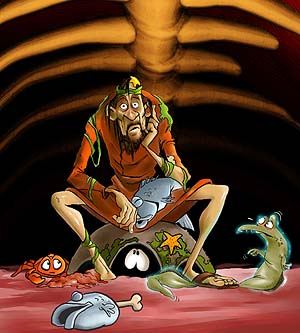
He would presumably have been quite willing to go preach to a cleaner, nicer nation – one full of happy white home-schooled children or properly disciplined Methodists whose parents read to them when they were little. And maybe that was the kind of thing Jonah normally did before, or would do after, the events recorded in this tale – we don’t really know. 

But Jonah didn’t like Ninevehians, and we can’t – in all fairness – entirely blame him. They’d made some poor choices and probably didn’t deserve his efforts towards their enlightenment. 

So he runs. 

Not a great move, given the whole ‘Omniscient God’ thing, but we don’t always do what we know is reasonable or right. Sometimes we’re slaves to our biases and fears.

Lesson one from Jonah’s little escapade is that even when we have some pretty good reasons to do the wrong thing, it’s still the wrong thing.

Lesson two is that when we neglect our professional responsibilities, we’re not the only ones affected. While Jonah dozes deep in the bowels of his getaway ship, everyone else on board is damn near killed by the resulting tempest. 

Jonah LMEven after they figure out the problem is Jonah and toss him over, that doesn’t bring back the cargo they lost trying to ride out the storm or the contents of their stomachs recently shared with the sea. Jonah left behind a mess, personally and fiscally.

Next comes the fish part. Jonah repents – at least temporarily – and is vomited onto land. This is a nice little grave’n’rebirth image, albeit smellier than most. Lesson three, if we’re to keep it temporal, is along the lines of “sometimes you need a good kick in the pants to do the right thing.”  

What I’m most interested in, though, comes after Jonah’s rebirth on the beach. 

God calls again and Jonah goes to Nineveh this time. It took several days to travel through the whole city, and while the story doesn’t record many specifics, it seems reasonable to think he spent much of that time explaining how things truly worked to those he encountered. Whether he was teaching or exhorting or complaining about life inside a fish, he said enough to get the king’s attention and the whole city ended up in sackcloth and ashes, repenting of their evil ways.

I can’t prove, Biblically, that he taught and challenged them during these three days. It’s entirely possible he just kinda walked around and maybe hung out at Applebee’s chatting up the wait staff over the weird drink options they keep pushing. 

But it makes more sense to imagine him – however begrudgingly – sharing the truth as he understood it and telling them stories of past nations in comparable situations. Once it started to click, it caught on. 

Nineveh H.S.Lesson Four, then, is that sometimes yucky people are the hungriest for attention and enlightenment – for someone to care enough to challenge them to reconsider their ways. Lesson Five is that sometimes you don’t need to win everyone to be effective – you have to win enough to change the momentum of the whole.


The part we often forget – because it’s awkward and hard to explain – is that the story ends with Jonah annoyed and pouting because his teaching was effective. He hates that he devoted his energy and resources to helping “those” people, who ended up better off as a result. 

It’s hard to spin this positively in the children’s books devoted to this otherwise nifty yarn. It’s kind of a jerk way to behave. 

Jonah finds himself a spot outside of Nineveh where he can keep an eye on the city from a distance and see if maybe they’ll be destroyed after all. He tends to his own comfort, and God helps him out by miracle-growing a big leafy plant overhead to provide a little extra shade. 

Jonah Bush

Prior to his visit, he could at least have argued that Nineveh deserved whatever they got. They’d made bad choices and with those often come natural consequences.

Now, however, Nineveh was on a much better track. They were doing what cities needed to do to stay in good standing with the Big Guy, and presumably peace and prosperity were coming their way (that’s how things tended to work in the Old Testament). Now any illusion that Jonah’s mindset was exclusively about behavior or choices is dispelled. 

He just doesn’t like these people. At all. He kinda wishes they’d just die, whether they’re doing everything he could possibly ask or not. Sure, his God loves them, blah blah blah, but why should he have to endure them?

Lesson Six, appropriately enough, is that people – even God’s chosen messengers – can be bitter and small and ugly and wrong. Some of it’s culture; much of it’s choice. 

Lesson Seven is from Jonah’s God, who took away the tree and upped the discomfort level for Mr. Sulky. “You’re mad about losing some of the perks and comforts you never really built or earned to begin with – temporal things of limited value. I’m more concerned about actual people – lots of them – who don’t even know how much they need education and understanding.”

And the story ends abruptly.

It’s possible Jonah learned a thing or two about empathy and continued his calling with a better attitude and a changed heart. Then again, maybe he ran for office and ended up peddling bad education policy across Oklahoma – forever fleeing Nineveh without regard for the consequences. 

RELATED POST: The Social Contract (aka “Haman’s Gallows”)

RELATED POST: Um… There Are These Kids We Call ‘Students’?

The Social Contract (aka “Haman’s Gallows”)

confused historyNo one knows history anymore.

I don’t mean those man-in-the-street interviews shaming commoners for not knowing who won the Civil War or which President gave the “I Have A Dream” speech. I’m talking a basic understanding of why we have society.

Western Civilization 101.

You may remember Thomas Hobbes, 17th century political philosopher. If not, you’ll probably at least recognize his oft-cited claim that life in a “state of nature” was “solitary, poor, nasty, brutish, and short.”

Before civilization, he argued, every man had “perfect freedom.” We could all say and do anything we liked, go anywhere we wished. Every individual was sovereign. Hallelujah.

In practice, however, this mostly meant a paranoid scattering of ooga-booga people: me with my dead squirrel and pointy stick, you with your onion and bangy rock. When we encountered one another, I’d shake my pointy stick, and you’d threaten with your bangy rock, and we’d go our separate ways.

lotfComplete freedom is chaos, and extremely limiting, when everyone has it. Nothing lasting can be accomplished because we’re all too… free – and selfish in our freedom.

So, Hobbes argued, men agreed to “lay down” some of their individual rights and give power to a single sovereign, who would make and enforce laws circumscribing a peaceful society. This “social contract” allowed individuals to partake of a wider range of “natural rights” – stuff like life, liberty, and property – and to specialize their interests, now that they could put down their pointy sticks.

Some became hunters, others craftsmen, etc., and they’d trade as needed. Economies of scale enable some members of society to invent instruments and create music, tell stories for entertainment or edification, or even establish an educational system.

Not everyone does the same thing, and not everyone benefits in the same way from every other person’s trade or function. Sometimes when we’re meeting our collective obligations, it feels like we’re doing it for others – but fundamentally we’re doing it for ourselves, so we can have onion with our squirrel while listening to some jazz.

Ultimately, it helps each of us when we find a place for all of us. On the whole, it’s good for each of us when we learn to value all of us.

John Locke’s version of the “social contract” was similar, but had some important distinctions you might recognize…

He agreed with Hobbes that the difficulties associated with the “state of nature” required a social contract to assure peace, but Locke argued that natural rights such as life, liberty, and property already existed in that state of nature, before society or government. They may not always be honored in practice, but they could never be taken away or even voluntarily given up – they are “inalienable” (sound familiar?)

Governments, operating by consent of the people, should be dedicated to enforcing and protecting these natural rights, he said. If a sovereign violated them, the social contract was broken, and the people had the right to revolt and establish a new government.

For those of you who slept through history class, Thomas Jefferson borrowed heavily from Locke when he wrote our Declaration of Independence.

In practice, our Framers’ initial realization of the social contract was limited. Pragmatic. But the words they chose weren’t pragmatic – they were idealistic. The Declaration they issued wasn’t practical, or economically biased, or racially segregated – it was striving for something bigger than any of them could have conceived would ever be possible.

If the Constitution is about setting up laws – like, say, the Old Testament – then the Declaration is about Platonic ideals and reaching above the logistics – like the Gospels and the Letters of Paul.

PlaguesFor those of you who didn’t go to Sunday School (tsk tsk!), the Old Testament is about taking care of US – the CHOSEN people, the GOOD people. It’s rather harsh for most everyone else – the OTHER, the UNCLEAN.

The New Testament is about treating everyone like they ARE the GOOD people; it’s about setting aside what’s immediately best for the CHOSEN in order to bring everyone into the US.

It’s delusionally idealistic in the bestest possible way. Its centerpiece involves God’s own perfect offspring dying at the hands of the unwashed – a “loss” by mortal standards. But in “higher reality,” it’s a win – a model for setting aside our own temporal gain for the good of others.

Do that, and it helps you in the long run as well – or so proclaims The Book. Weird, right?

The New Testament may be TRUE, but it’s far from PRACTICAL. The most devout aren’t interested in pragmatic compromises; they’re committed to IDEALS.

People of faith and Americans of conscience face a similar question: Do we want to accept what’s pragmatic, or do we want to BELIEVE?

SheepGoatDo we want to settle for compromises and logistics, tweaking via Amendment or reinterpretation from time to time, as we’ve done with our Constitution and (to a less-admitted extent) our scriptures; or do we want to strive for the ideals that are the ENTIRE REASON for either document to exist in the first place?

American history, for all its sin and hypocrisy, is a stuttering surge towards equality – a messy quest for “all men are created equal” and “unalienable rights.” Along the way we’ve repeatedly stopped to wrestle with our social contract.

I don’t like music. Do I still have to put down my rock and share my squirrel?

I don’t drive on that highway. Why does my gas cost more to maintain it?

What if I have private insurance? Why should I pay more to help that craftsman who doesn’t?

What if my economic success is based on someone else’s lack of freedom? Why should I suffer just so she can have ‘unalienable rights’?

What if my kids don’t go to public schools? Why should I contribute to the well-being of the whole if I’m not utilizing this one particular service?

Aren’t you punishing success to coddle the bottom feeders?

Sometimes, yeah. But most of the time we’re trying to maintain the social contract. The one where we each give up some freedoms and take on some responsibilities for the good of the whole.

It may feel like we’re doing it for them. We start to believe we’re sacrificing – with or without our consent – for the UNCLEAN. That the basic rights and freedoms of the US, the CHOSEN, are being TAKEN to serve the OTHER.

Scrooged SpeechExcept we’re not doing it for them – we never were. Ultimately, it helps each of us when we find a place for all of us. On the whole, it’s good for each of us when we learn to value all of us.

Katniss Everdeen warned President Snow that fire tends to catch: “If we burn, you burn with us!” She was absolutely correct – when the bell tolls, baby, it tolls for thee whether thou intendeth it or not.

But the converse is equally true – a healthy, productive, educated populace is of benefit to all.

We shouldn’t need to choose who gets access to books and who doesn’t, who deserves health care and who doesn’t, who can obtain employment and who can’t, or who receives equitable treatment under the law and who doesn’t. These things aren’t scarce natural resources; they’re conditions in a properly structured society with an effective social contract.

Katniss & Rue

When we forget this, we start believing we’ve somehow earned our status and comfort, completely outside the social contract and without reference to past sacrifices of others for the common good. We deny history and faith in an effort to re-establish the CHOSEN US.

When we start looking for ways to cut loose “dead weight,” those “holding us back” by “taking advantage,” we deny the social contract and the ideals of both our nation and the religious faith proclaimed by its majority.

In the short term, it gives US more choice, more power, more comfort. In the short term, it allows US to feel CLEANER.

But in the long game, it makes us savages – you with your pointy stick and me with my bangy rock, ready to defend my squirrel at the cost of your blood.

RELATED POST: May I Please See?

RELATED POST: Um… There Are These Kids We Call ‘Students’?

RELATED POST: MLK, Wobblies, and National Insecurity

Blue Serials (1/31/16)

The 2016 Oklahoma Legislative Session starts Monday! 

Much like the Kardashians or any student group presentation, we can expect flaming dysfunction and awkwardly creative destruction – the sort from which you can’t quite look away, no matter how horrifying. Oh, good times.

[[{“type”:”media”,”view_mode”:”media_small”,”fid”:”1758″,”attributes”:{“alt”:””,”class”:”media-image”,”typeof”:”foaf:Image”}}]]


I’ve done my best to lay some groundwork for the casual #oklaed viewer here – but there’s so much more to teaching than being hated and abused by elected authority. There are good parts, too.

Like THESE bits you simply SHOULD NOT MISS from the past week. My god, they make me love my job…

Why It’s Important To Play The Recorder Badly – Ashley Shaw on Life in Converse, prodded by Bon Stewart (thank you Bon!), talks about that moment every parent fears – your child comes home from school with… a recorder. But then Shaw starts slinging truth and beauty everywhere, without warning. I’ve read this eleventeen times and had all the feelz, including several which don’t even exist. Follow Shaw on the Twittering at @ashleygshaw and see what else she does to us without warning.

What Do You Mean, Excessive Paperwork? / These Feet Will Drag (A Poem) – A double-shot of Jose Vilson – The JLV. The first is about the nonsense, the latter… about why we put up with the nonsense. And it’s a poem, no less. Follow @TheJLV on the Twittering. Be warned, though – he’ll rattle your comfort zone. Come on – it will be good for you.

Taking Back Your Name – The Pros and Cons of Political Correctness – Steven Singer, GadflyOnTheWallBlog, has some thoughts on the negative connotation we’ve given “political correctness.” He’s opinionated, but thoughtful – and might bruise your preconceptions while stretching your thinking. I don’t always agree with Singer, but that doesn’t make him wrong. Follow @StevenSinger3 on the Twittering – but don’t call him Stevey Weevey.

The Challenger and The Dream – Scott Haselwood, Teaching From Here – Dreams can be exciting, or scary, or both at the same time. Haselwood is probably not the first person to challenge you to confess your dream, but he’s one of the few willing to go first. Scott is all about the risk and getting real – I kinda envy that. Get naked (metaphorically) with @TeachFromHere on the Twittering, and take a few reality risks.  #oklaed 

Are We Teaching Students How To Swim, Or Handing Them Rocks As They Sink? – Mrs. Waters (who I assume HAS a first name?) on Mrs. Waters’ English, explains why she’s backed off of firm due dates and harsh classroom penalties. As someone who goes back and forth on this sort of thing and doesn’t like any of my own answers, I’m thankful when someone legit wrestles with similar concerns, then shares her thinking so effectively. Share with and be persuaded by @watersenglish on the Twittering.  #oklaed 

I leave you with this, from Button Poetry. 

I simply love a good provocation – stirring up emotions and reactions, saying as much about us as they do anything about the piece doing the stirring…

“All Lives Matter: 1800s Edition” (Anthony McPherson)

[[{“type”:”media”,”view_mode”:”media_small”,”fid”:”1759″,”attributes”:{“alt”:””,”class”:”media-image”,”typeof”:”foaf:Image”}}]]


Be amazing this week, my #11FF. You’re better than you think you are – care harder than you think you can.