#OklaEd Call to Action (It’s Time)

OK Future

You may remember several months ago when word was first spreading about the crashing and burning of Oklahoma’s budget and what it was going to do to public education. 

Our elected leadership cried crocodile tears while flinging the usual rhetoric about how much they love children and teachers and so forth. A number – including Governor Fallin – promised teacher pay raises ranging from “delusionally optimistic” to “OK, now you’re just making fun of us.”

They repeatedly assured us that they were powerless to change the legislation continuing to eliminate state revenue, powerless to change the policies which led to the problem to begin with, powerless to do anything about oil and gas prices or the economy in general, and powerless to stop beating up on educators and 8-year-olds for a single session out of basic human sympathy for our plight. 

I’ve never seen so many elected leaders run on “We can’t do anything about ANYTHING! We promise!”

#GiveItBackOKIt was around mid-January when Mindy Dennison of This Teacher Sings first posted about the $30 her family was likely to save this coming year, thanks to these tax cuts about which no one can do anything ever. The idea quickly spread, and soon there were dozens of edu-blogs and even reports in regular media about #GiveItBackOK.

Some of you have already done much, and I thank you. Others have had good intentions for quite some time, and… well, those are nice, too. 

But I need you to step up now. Again. Or finally. Or more than before. Or something.

Statewide Primaries are on Tuesday, June 28th. You have until June 3rd to get registered to vote if you’re not already and wish to participate in these. 

And you DO.

This is when we begin the process of choosing who’ll be setting state edu-policy for the next 2 – 4 years. As in national elections, this is when you help choose your party’s nominee for each office serving the district in which you live. Sometimes there will be multiple candidates from the same party running for an office; sometimes not. 

I’ve profiled several candidates and compiled links to further information for many others. My list is not exhaustive, but it’s getting there. 

Claudia Swisher of Fourth Generation Teacher is doing something similar, and Angela Little – the force of nature behind Oklahoma Parents and Educators for Public Education on Facebook – has her own version as well. We’re not competing with one another so much as simply approaching some of the elements from different angles. 

Why am I telling you all of this?

Because these candidates need your help. Thank you for following them on social media. Thank you for sharing their posts. Those things help, and they matter a great deal.

But they need you in more traditional, less air-conditioned ways as well. 

Sitting legislators inevitably have financial support from any number of organizations. If a legislator supports gun rights, then gun rights groups donate to their campaign. If they promote gender equity, groups concerned with such things donate to their campaign.

Most new candidates have very little of this sort of support. A few are crazy well-organized and have expert strategy-teams and committed resources and god bless every one of them. We’ve started a PAC in hopes of supporting some of the most promising, but at best this will mean limited financial help for a handful – those who seem most likely to be worth the extra push. That’s not personal – it’s just reality and politics, two things not known for being pretty and soft. 

But most are running on faith and friends and word-of-mouth. They’re trying to get by the same way they did (and many of us do) in the classroom every year – you just pull together what you have and go for it, trusting heart and pluck to make up the difference. 

Donate

We have a chance to make legitimate change this year. Good change. Potentially great change. But can I be blunt for just a moment?

We also have a chance to fail on a scale we’ve not collectively failed before. 

You’re aware of the buzz over so many edu-candidates running this year. Now, imagine the total electoral impact is maybe… two seats. Or three. Imagine none of the really critical districts being won. Imagine none of the most frustrating incumbents being shown the door.

DominatrixWhat do you think happens come February 2017 for public education? Forgive and forget? Nice try? You were so cute running, we’re gonna completely reverse the way we’ve abused you over the past decade just to show what good sports we are?

Unlikely. 

So I’m asking you – every classroom teacher, every administrator, every support position, every parent, every adult who for whatever reason keeps reading these posts, to stop right now and figure out who you can support with your tax break this year.

If you’ve already given THAT money, then pretend you haven’t and give it again.

I know that sounds harsh, but this is kind of a big deal. 

If you have a GREAT current Representative or Senator who already supports public education consistently, and who’s facing a difficult primary, please call them and let them know of your support, and why, and give to their campaign. Ask if they need someone on the phones, or going door to door. No better press than a satisfied customer. 

As to those new folks running across the state, many of whom don’t have experience asking for money and some of whom sound a bit uncomfortable when it even comes up, let me say what they might not: 

THEY NEED YOUR MONEY AND THEY NEED IT NOW IF WE’RE GOING TO HAVE ANY REAL CHANCE AT MAKING THIS HAPPEN. 

Campaign OfficeThose signs cost money. You wouldn’t think they’d be all that critical in this sort of election, but they are. Those websites cost money. That might not be how you get YOUR information, but many people do. Those local newspaper ads, those posters, those door-to-door flyers, they all cost money.

None of those things guarantee people will vote for you, but if you DON’T buy the media, people won’t even know your name. If they don’t know your name, they DEFINITELY won’t vote for you.

You don’t even have to live in their district. If right-wing think tanks in Virginia can crank out the cash, no one can begrudge you sending that $50 to the guy two districts over. 

THEY NEED YOUR TIME AND THEY NEED IT NOW IF WE’RE GOING TO HAVE ANY REAL CHANCE AT MAKING THIS HAPPEN. 

Fill out those contact forms on their websites or reach out to them by phone, Twitter, or Facebook, and ask what you can do. Don’t go it alone – call up the 3 least-annoying people you work with and tell them that you’re going to have some bonding time while building warm-fuzzy-make-a-difference mojo together. 

Walk those neighborhoods. Make those calls. Run those unending stupid errands no one else will run, but which have to be done. Figure out who can donate snacks or chairs or funny hats or printing. Explain for the thousandth time why vouchers don’t help public schools, or why punishing teachers for their kids’ socio-economic status isn’t the same as ‘high standards’. 

Politely, of course. 

I believe, my Eleven Faithful Followers. I believe this can happen. Those of you who know me in real life know that I don’t DO vague, hopeful platitudes. I barely do optimism at all. But I KNOW this can happen.

IF you step up NOW. 

I’m broke, too. I’m busy, too. I’m frustrated, too. I have good intentions, too. None of that matters right now. Get out your bank cards and look over your calendar. Talk to your department, your neighbors, your family, and make this a group activity. 

It’s time to put your time and money where your proverbial mouth is. It’s time to burn those last few fumes of energy backing up what you share on Facebook. 

#GiveItBackOK. #GiveItAllOK. Otherwise, #GiveItUpOK.

[[{“type”:”media”,”view_mode”:”media_original”,”fid”:”2034″,”attributes”:{“alt”:””,”class”:”media-image”,”typeof”:”foaf:Image”}}]]

RELATED POST: #11FF & Getting Involved

RELATED PAGE: #OKElections16 
The Oklahoma Constitution (Part Three)

Sophisticated Reading

I’ve been working my way through the Oklahoma Constitution. Many current legislators insist rather dramatically that they’re defending the values and requirements therein, so I figured it was time I looked a bit more closely to see just what those are. You can read my Introduction in Part One and my brilliant analysis of Articles I & II in Part Two.

Article III is about suffrage and elections. No real surprises here.

Article IV is very brief:

The powers of the government of the State of Oklahoma shall be divided into three separate departments:  The Legislative, Executive, and Judicial; and except as provided in this Constitution, the Legislative, Executive, and Judicial departments of government shall be separate and distinct, and neither shall exercise the powers properly belonging to either of the others.

OK, then. 

Article V is not very brief. In the U.S. Constitution, the first and longest section is devoted to the Legislative Branch. Article V reflects a similar concern with the state version of the same. 

Section V-1: Legislature – Authority and composition – Powers reserved to people.

The Legislative authority of the State shall be vested in a Legislature, consisting of a Senate and a House of Representatives; but the people reserve to themselves the power to propose laws and amendments to the Constitution and to enact or reject the same at the polls independent of the Legislature, and also reserve power at their own option to approve or reject at the polls any act of the Legislature.

Progressive EducationThis mindset was a precursor to the Progressive Era and its Amendments – the 16th, 17th, 18th, and 19th. Basically, there was a concern that government at all levels was too far removed from ‘the people.’ Various reforms gave voters more direct input on who was elected and what changes could be made – recalls, referendums, etc. 
This language reflects that. “We’re about to outline your authority,” it says, “but keep in mind we can trump you at any time – so don’t let yourself get TOO far removed from what we sent you up there to do.”

The other option, of course, is to simply run against the existing legislature en masse. Heh. 

The next several paragraphs detail referendums and other powers of ‘the people’ directly – before even discussing the actual Legislature

This bit is interesting:

Section V-7: Powers of Legislature not affected.

The reservation of the powers of the initiative and referendum in this article shall not deprive the Legislature of the right to repeal any law, propose or pass any measure, which may be consistent with the Constitution of the State and the Constitution of the United States.

This clarifies that the rights of the people to do stuff directly doesn’t limit the legislature’s authority to do ITS job, but that’s not the interesting part. It’s that latter half, which suggests that our State Legislators are expected to limit themselves to acts consistent with the U.S. Constitution.

10 CommandmentsThat’s important in a decade during which we repeatedly introduce, debate, and occasionally pass state laws which are undeniably doomed once challenged in the courts. We spend hundreds of thousands of dollars fighting for the right to return to the 19th century. 
This is arguably evil as much as fiscally idiotic, but it’s also specifically prohibited by the exact Constitution those pushing untenable laws claim to defend with such froth and drama. 

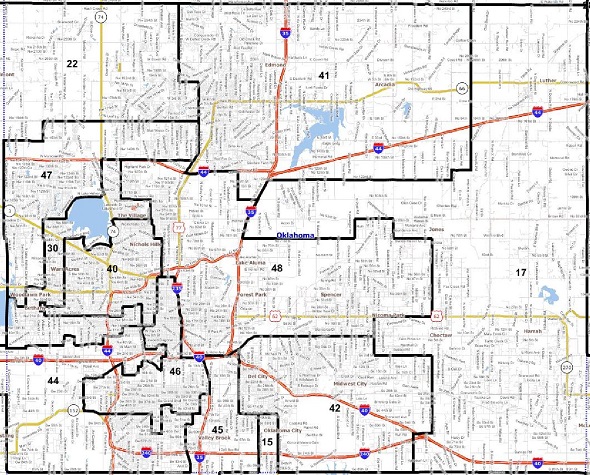
The next several paragraphs – updated since the original – are less exciting. They detail how Senate and House Districts will be established, requirements for running for state office, blah blah blah. 

Our state legislature is limited to meeting from February through May, other than a few housekeeping duties which begin just prior. There are deadlines and limits throughout those four months, presumably designed to not only bring some order to the chaos, but to limit how much damage they can do in a given year. 

So that part could have worked out better.

OK Districts

Section V-33: Revenue bills – Origination – Amendment – Limitations on passage – Effective date – Submission to voters.

A. All bills for raising revenue shall originate in the House of Representatives.  The Senate may propose amendments to revenue bills.

B. No revenue bill shall be passed during the five last days of the session.

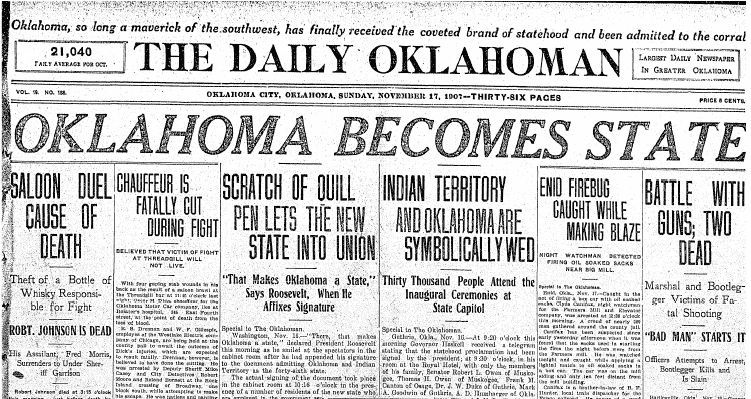
That’s the original language of Article V, Paragraph 33, and it’s still there. The first subsection echoes the U.S. Constitution and the second suggests a concern that lawmakers might ‘sneak in’ unpopular taxes ‘at the last minute’ and then adjourn before anyone could protest. 

This concern was expanded by State Question 640, a citizen-initiated measure of the sort so warmly defended earlier in Article V. It passed by vote of the people in 1992, and added this language: 

C. Any revenue bill originating in the House of Representatives shall not become effective until it has been referred to the people of the state at the next general election held throughout the state…

D. Any revenue bill originating in the House of Representatives may become law without being submitted to a vote of the people of the state if such bill receives the approval of three-fourths (3/4) of the membership of the House of Representatives and three-fourths (3/4) of the membership of the Senate and is submitted to the Governor for appropriate action…

In other words, as of 1992, tax increases can only become law through a direct vote of the people OR by being approved by 3/4 vote of both the House and the Senate before being signed by the Governor. This has happened exactly once in the nearly 25 years since –tobacco taxes were increased in 2004. 

Super AmericanThis has caused untold grief since oil prices crashed. Due to previously passed legislation, the tax cuts for top earners across the state keep waterfalling at preplanned intervals, despite little evidence they’re producing all of that ‘prosperity’ used to justify them in the first place. When anyone suggests perhaps we could slow down on that a bit until we’re no longer feeding on the weak and the young, our legislature cries with hands upraised – “What can we do?! It’s… it’s… AGAINST THE RULES!” 
What they mean is that it’s damn inconvenient for them to do what’s right. That’s not the same thing. 

Starting in Paragraph 37, we start to get to powers of the State Legislature as specifically delineated by the framers. This would be comparable to Article I, Section 8, in the U.S. Constitution. For once, however, there are FEWER specifics than in its federal counterpart.

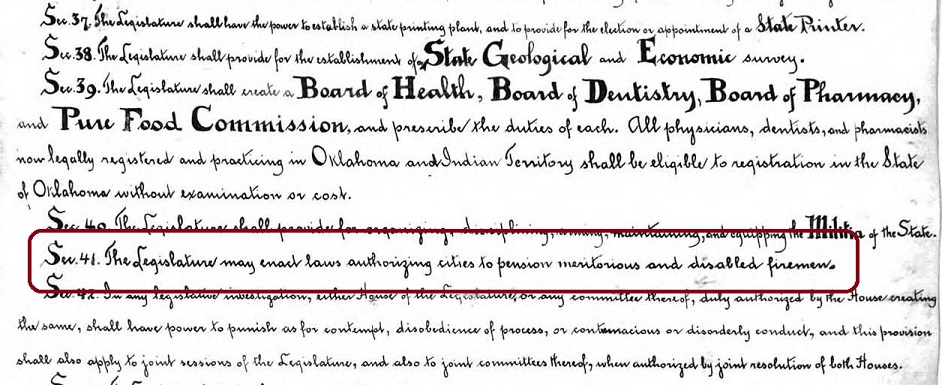
The state can establish a state printing plant and hire a state printer. The state must establish a Geological and Economic Survey. It must create a Board of Health, Board of Dentistry, Board of Pharmacy, and a Pure Food Commission. The Legislature shall provide for organizing, disciplining, arming, maintaining, and equipping the Militia of the State. It may also enact laws authorizing cities to pension meritorious and disabled firemen.

Um… I’m in NO WAY anti-firemen, but isn’t that a strangely specific provision? That’s not something added later to appease an influential Congressman or honor a special interest group. It’s in the original. 

Firemen Provision

There follows a long list of things the State Legislature CAN’T do – this one LONGER than its counterpart in the U.S. Constitution (Article I, Section 9). Most of them pertain to local vs. state control on particular issues. I’m not familiar enough with things like adoption law or polling regulations to know if any of these are unusual.

On the other hand, here’s one I’ve learned to hate:

Section V-58: Time of taking effect of statutes – Emergency measures. 

No act shall take effect until ninety days after the adjournment of the session at which it was passed… unless, in case of emergency, to be expressed in the act, the Legislature, by a vote of two-thirds of all members elected to each House, so directs.  An emergency measure shall include only such measures as are immediately necessary for the preservation of the public peace, health, or safety…

If you’ve ever researched proposed legislation, you’ve discovered that the vast majority of bills conclude with a declaration of emergency as described above. 

Emergency!We’d like to tweak the A-F School District Shaming System by juggling a few phrases, and ohyeahbytheway – THIS IS AN EMERGENCY AND IMMEDIATELY NECESSARY FOR THE PRESERVATION OF THE PUBLIC PEACE, HEALTH, AND SAFETY.
We should put the alternative certification process for Oklahoma teachers under the purview of the “Office of Educational Quality and Accountability”, which of course MUST BE AN EMERGENCY AND IMMEDIATELY NECESSARY FOR THE PRESERVATION OF THE PUBLIC PEACE, HEALTH, AND SAFETY.

I’d like to modify the reporting procedures for districts complying with such and such obscure statutes and no one knows why we’re doing it anyway except that THIS IS AN EMERGENCY AND IMMEDIATELY NECESSARY FOR THE PRESERVATION OF THE PUBLIC PEACE, HEALTH, AND SAFETY.

Here’s why this bugs me so much. 

Common usage of this ‘EMERGENCY’ clause means that, as a matter of course, legislators are practically required to cynically manipulate the language of everything they propose or support – in clear contrast to the intent of the Constitution – just to get stuff done. In other words, it’s a given that they can’t really mean everything they’re saying or passing. We just kinda have to do it this way because… the system.

Maybe that’s a small thing, like not reading User Agreements before you ‘Accept’ them, or signing off on paperwork from meetings you didn’t even attend, but it seems to me an unfortunate symbol of cynicism and dishonesty becoming normalized. Banal, even. 

No matter how idealistic a new legislator may be, they first time she writes a bill or casts a vote, she’s agreeing to a ‘wink wink nudge nudge’ bit of game-playing of the sort we all say we hate in politics. He’s calling something what it is NOT in order to get what he wants. 

It’s only a little leaven, of course. Just a small manipulation – a pragmatic lie. But the storybooks tell us those initial compromises start us down a path which never ends well.

I fear history agrees.

RELATED LINK: The Oklahoma Constitution (Part One)

RELATED LINK: The Oklahoma Constitution (Part Two)

RELATED LINK: The Oklahoma Constitution (Part Four)

RELATED LINK: The Blaine Game (Updated)

The Oklahoma Constitution (Part Two)

OK Newspaper

In my previous post, I briefly introduced the Oklahoma Constitution.

Well, briefly for me

Now let’s see what it actually says. If I can squeeze in, say, a dozen pages per post, it should only take, um… twenty entries or so. 

So maybe we’ll just hit a few highlights.

To the best of my knowledge, everything cited here refers to the current language of the document unless otherwise noted. Please let me know if you believe I’m mistaken.

Section I-1: Supreme law of land.

The State of Oklahoma is an inseparable part of the Federal Union, and the Constitution of the United States is the supreme law of the land.

It should go without saying that this naturally includes any Amendments to that U.S. Constitution, like… the 14th, for example. Or the 1st. And yes, the 2nd as well. 

It should go without saying.

Section I-2: Religious liberty – Polygamous or plural marriages.

Perfect toleration of religious sentiment shall be secured, and no inhabitant of the State shall ever be molested in person or property on account of his or her mode of religious worship; and no religious test shall be required for the exercise of civil or political rights.  Polygamous or plural marriages are forever prohibited.

We’ll start with that last part, since it sometimes surprises people.

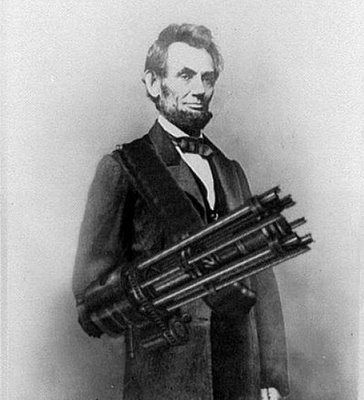
Lincoln Machine GunWhen the Republican Party became a thing in the 1850s, it pushed two basic tenets: (1) Slavery is bad, and (2) Polygamy is bad. The second was clearly in response to the Latter Day Saints. 
The Utah Mormon War was a thing that happened in 1857-58, so it was fresh on everyone’s mind. It wasn’t until a generation later that the LDS traded away polygamy for a better shot at being left alone.  

Apparently even in 1906, some wanted to make sure there was no misunderstanding. In that context, it makes some sense that this was tacked on to the protection of religious freedoms. They wanted to get in an ‘except for THAT’ clause. 

The first 2/3 of this one is worth closer attention, however. Oklahoma’s Framers wanted to make sure the very first thing they established after Federal Supremacy (ironic, isn’t it?) was absolute religious freedom. Not only would the government not establish or prohibit anything, citizens were specifically guaranteed “the exercise of civil {and} political rights.”

Do we still believe that today? We absolutely should, but I’m not at all convinced we do. 

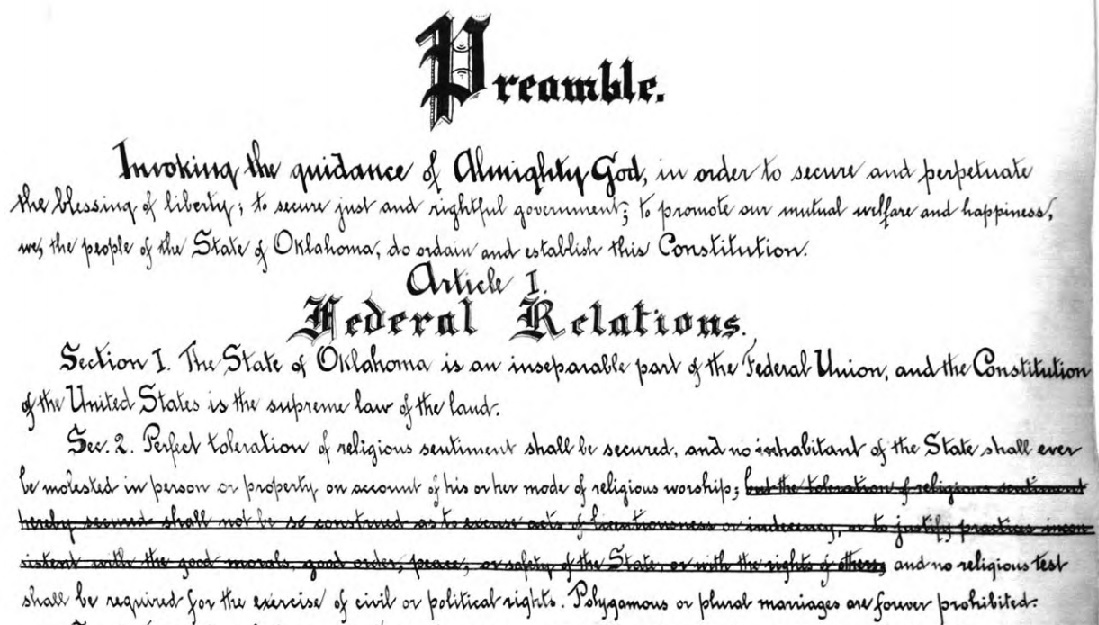
Check out the same section in the hand-written original submitted by William ‘Alfalfa Bill’ Murray to Congress for approval:

OK Constitution Excerpt

For you youngsters out there, those double-strikethrough lines are what counted back in the day as a ‘Delete’ key. The last-minute revision took out this phrase:

but the toleration of religious sentiment hereby secured shall not be so construed as to excuse acts of licentiousness or indecency, or to justify practices inconsistent with the good morals, good order, peace, and safety of the State, or with the rights of others,

Dang. How would THAT have changed the whole conversation over, um… any number of issues these past few years? 

But here’s the critical point to remember: it was struck before being sent to Congress. Our State’s Framers took it OUT. They didn’t just leave it out, or not think of it. They considered it, included it, then decided it had to go

No one sworn to uphold the language OR original intent of this document can fight to put this phrase back in – even by implication – without resolving the inherent hypocrisy of such an effort.

Section I-5: Public schools – Separate schools.

Provisions shall be made for the establishment and maintenance of a system of public schools, which shall be open to all the children of the state and free from sectarian control; and said schools shall always be conducted in English: Provided, that nothing herein shall preclude the teaching of other languages in said public schools.

We’re going to need to come back to the stuff on schools. They come up a LOT. 

Section I-6: Right of suffrage.

The State shall never enact any law restricting or abridging the right of suffrage on account of race, color, or previous condition of servitude.

MIBLook at that. We DID know about the Reconstruction Amendments way back then. Wonder how we lost THAT collective awareness…
Unlike the U.S. Constitution, to which the Bill of Rights was added in order to secure ratification, the Oklahoma Constitution put its ‘Bill of Rights’ in Article II, right after the foundational stuff and before even discussing the Legislative, Executive, or Judicial Branches. There were originally 33 of them; there are currently 34, although a few have been tweaked over the years and term limits slid into the middle. 

Section II-1: Political power – Purpose of government – Alteration or reformation.

All political power is inherent in the people; and government is instituted for their protection, security, and benefit, and to promote their general welfare; and they have the right to alter or reform the same whenever the public good may require it: Provided, such change be not repugnant to the Constitution of the United States.

Revolutionary though this sounds, it’s entirely consistent with the values expressed in the Declaration of Independence.

Although… that’s what’s odd about it being included here. The Declaration is a statement of revolution, and of ideals. The Constitution is a codification of laws intended to support those ideals. One seeks higher truths, the other provides a scaffold for technicalities. 

The Declaration proclaims that “all men are created equal” and “endowed by their creator with certain unalienable rights.” The Constitution explains that “No Person shall be a Representative who shall not have attained to the Age of twenty five Years… and who shall not, when elected, be an Inhabitant of that State in which he shall be chosen.”

The Declaration insists that we rely on “the protection of divine Providence” and “mutually pledge to each other our Lives, our Fortunes and our sacred Honor.” The Constitution explains that “In all Cases affecting Ambassadors, other public Ministers and Consuls, and those in which a State shall be Party, the supreme Court shall have original Jurisdiction.”

Both are necessary, and they’re more or less consistent with one another. But they’re quite different. 

Section II-2: Inherent rights.

All persons have the inherent right to life, liberty, the pursuit of happiness, and the enjoyment of the gains of their own industry.

Hmmm… more Declarationing. But look at that last bit – “the enjoyment of the gains of their own industry.”

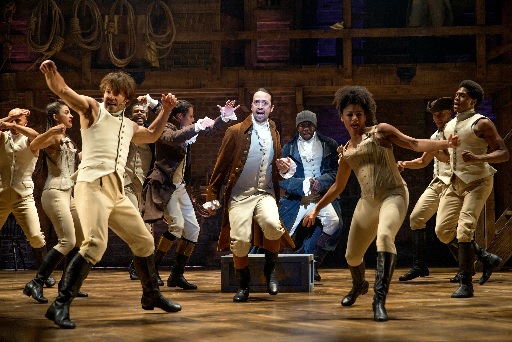
Hamilton MusicalThat’s perfectly consistent with American ideals. Jefferson may have changed “life, liberty, and property” to “life, liberty, and the pursuit of happiness,” but the original phrase is used often enough elsewhere to leave little doubt regarding intent.

It’s just a funny clarification – the right to the fruits of your own labor, essentially. If I didn’t know better, I’d think it was an statement against Jim Crow laws and such, still common throughout the South at the time and codified in Oklahoma as soon as the first Legislature could find their desks. 

But I do know better. It’s not.

It’s probably intended as a protection of workers’ rights, given the times and priorities of those putting the document together. A common complaint of labor unions – still relatively new on the scene – was that the folks doing all the work were being consumed by the system, while factory owners and investors were living lives of conspicuous ease, built upon their breaking backs. 

Still, it’s phrased in such a way you’d never mistake it for a line from Marx, would you? 

Section II-11: Officers – Personal attention to duties – Intoxication.

Every person elected or appointed to any office or employment of trust or profit under the laws of the State, or under any ordinance of any municipality thereof, shall give personal attention to the duties of the office to which he is elected or appointed. Drunkenness and the excessive use of intoxicating liquors while in office shall constitute sufficient cause for impeachment or removal therefrom.

No comment. *cough*Doerflinger*cough*

Most of the rest echo rights already guaranteed on a national level. While the process of gradually applying the Bill of Rights and subsequent protections to the states via the 14th Amendment had certainly begun, it was by no means complete. In 1906, it was perfectly appropriate for the state to guarantee those rights locally. 

There are a few which deserve further attention, however. 

Section II-26: Bearing arms – Carrying weapons.

The right of a citizen to keep and bear arms in defense of his home, person, or property, or in aid of the civil power, when thereunto legally summoned, shall never be prohibited; but nothing herein contained shall prevent the Legislature from regulating the carrying of weapons.

Section II-28: Corporate records, books and files.

The records, books, and files of all corporations shall be, at all times, liable and subject to the full visitorial and inquisitorial powers of the State, notwithstanding the immunities and privileges in this Bill of Rights secured to the persons, inhabitants, and citizens thereof.

I think that’s about – 

Teacher At Board

Oh. Yeah. Um… there is ONE more.

Section II-5: Public money or property – Use for sectarian purposes.

No public money or property shall ever be appropriated, applied, donated, or used, directly or indirectly, for the use, benefit, or support of any sect, church, denomination, or system of religion, or for the use, benefit, or support of any priest, preacher, minister, or other religious teacher or dignitary, or sectarian institution as such.

We’re gonna need extra time for that one.

RELATED LINK: The Oklahoma Constitution (Part One)

RELATED LINK: The Oklahoma Constitution (Part Three)

RELATED LINK: The Oklahoma Constitution (Part Four)

RELATED LINK: The Blaine Game (Updated)

The Oklahoma Constitution (Part One)

U.S. ConstitutionThe U.S. Constitution, including all 27 Amendments, takes up less than 14 pages as a Word document with normal fonts and margins. The Oklahoma Constitution, in contrast, takes 221 pages.

So already you can see a problem.

The first effort to craft a state constitution – a necessary precursor to being admitted into the Union AS a state – came in Muskogee in 1905. The ‘Sequoyah Constitution’ foreshadowed many of the elements which would eventually become part of our state’s semi-supreme law, but assumed separate admission for Oklahoma Territory and Indian Territory, a ‘two-state solution.’ Given the likelihood both would be staunchly pro-Democrat, the Republicans in control of Washington shut that idea down immediately.

“Alfalfa Bill” Murray, a delegate to that convention and subsequent Representative and OK Governor, shared his recollections 25 years later:

We knew that it must stand before Congress above ridicule; and in harmony with the best modern thought for the protection of life, liberty, property, and the citizens’ highest estimate of intelligence and progress. 

Alfalfa Bill MurrayIf you know anything about Alfalfa Bill, this is either painfully ironic or ridiculously amusing. Even if you don’t, the founding of Oklahoma on ‘modern thought’ and the ‘highest estimate of intelligence and progress’ should produce some sort of reaction. Perhaps even involuntary regurgitation. 

For this reason, neither {Charles} Haskell nor I left the Convention or Committees for a moment, and we were the only persons there every moment. For days at a time, we alone were present. He lived at the Hotel in an apartment and I boarded there. 

And a century later we’re terrified of who might be in the next bathroom stall.

Day and night we were on the bridge, and at the wheel, looking for icebergs, the shoals, and shallows of an uncharted sea. I have never regretted it, for without this experience the work so well done in the Guthrie Convention later, would have been impossible. The Sequoyah Convention gave us the outlines of an organization. 

Oklahomans love our maritime metaphors.

State of SequoyahIn 1906, the U.S. Congress passed the “Oklahoma Enabling Act,” providing for a single state to be formed from Oklahoma and Indian Territories. Each half sent delegates – mostly Democrats – and William H. Murray was – big shocker here – elected president of this new Constitutional Convention. 

This was a time not far removed from the Populist Party’s dominance across the Great Plains and not long before the Progressive Era would bring dramatic reforms in how elections were run and how many different things the federal government was willing to regulate. It should be no surprise, then, that while in 2016 Oklahoma is considered ‘red’ for its staunch Republican leanings, a century ago it was brought into the Union as close to ‘red’ in the ‘OMG Socialists!’ sense of the term as it could be and still secure Congressional approval.

OK Const Conv

I use excerpts from the Oklahoma Historical Society when we introduce the State Constitution in class:

The drafters recognized the importance of separation of powers by creating the legislative, executive, and judicial departments… They also recognized the state as a part of the Union, giving a constitutional nod to the notion of federalism. They also explicitly recognized (unlike the framers of the U.S. Constitution) the power of Oklahoma courts to exercise judicial review. 

OKHSEarly in the document (Article II), the drafters enumerated thirty-three rights in the Bill of Rights Article. This was followed by the article on suffrage. The right to vote, except in school board elections, was restricted to males. (The constitution was amended giving women the right to vote in 1918, two years before the U.S. Constitution was amended giving women the right to vote.) 

The legislative article describes the branch (House members have two-year terms; Senators have four-year terms) and gives the power of the legislature. The influence of the Progressive Movement can be seen in the numerous restrictions placed on that body. 

The article on the executive branch was similar to that found in most other states. The governor was given a four-year term and was prohibited from being elected twice successively (amended in 1966, in the Governors Consecutive Terms Amendment, so that a governor could be elected to two successive terms). Numerous executive offices and boards were created, all mostly elected positions. 

OK Constitution Reference GuideThat thing where so many positions are elected rather than appointed is creating headaches even today. It was an age of ‘let the people decide’, creating rules not conducive to our love of ‘voting the party ticket’ for everything from Governor to Dog Catcher to Insurance Commissioner. 

The judicial article provided for the election of judges (changed years later to appointment with retention elections) and stipulated that juries of fewer than twelve members could be used in some cases.

Several provisions of the constitution were included for the regulation of certain interests. Entire articles were devoted to corporations (IX), revenue and taxation (X), education (XIII), and banks and banking (XIV). The details of these articles display the drafters’ distrust of legislatures and a concern for problems occurring during territorial days. 

Imagine a time in which you couldn’t trust your own legislature to do the right thing when it came to revenue and taxation, big money interests, or public education! That must have been difficult for them, way back then.

The progressive spirit was also evident in the provisions permitting the initiative and referendum. Only four other states (of the forty-six states in 1907) included these provisions in their constitutions. Provisions were also included for amending the constitution, including allowing the voters themselves to initiate and approve amendments (only the second state to allow this method, called initiative and referendum). 

Populist Party Banner

One of the issues not often discussed when we celebrate all this power in the hands of the common man is how easily manipulated by fear and ignorance they tend to be. I mean, there’s a reason they’re the ‘common man’, right?

Oklahoma’s constitution of about fifty thousand words, one of the nation’s longest, has been made longer by the relatively frequent use of the amending process (although the document has never been completely rewritten).

Amending has also resulted in a number of significant changes. Following a 1941 amendment the legislature has been required to balance the state’s budget. In 1966 an amendment allowed annual legislative sessions (although in 1989 the voters approved an amendment mandating short legislative sessions). In 1990 Oklahoma became the first state (through amending) to place term limits on members of the state legislature, in the Term Limits Amendment. In 1992 voters approved an amendment stipulating that no bill passed by the legislature raising taxes would go into effect unless passed by a two-thirds vote of both houses.

Men in HatsThat last part is what’s been so-often cited to explain why we simply CAN’T slow down the almost complete elimination of taxes for anyone wearing expensive suits and smoking cigars in darkened back rooms. Once the process is begun, the argument goes, any reduction of the destruction amounts to a ‘tax increase’.

Yeah, I know – it’s shaky reasoning, but it’s a large part of why we’re going after single moms and old people rather than so much as slow down the feeding of our children to the wealthy and powerful. 

WJBWilliam Jennings Bryan told the members of the Oklahoma Constitutional Convention that they had borrowed the best provisions of the existing state and national constitutions and had, in the process, created the best constitution ever written. Scholars who believe that brief constitutions devoid of policy make the best constitutions would disagree with Bryan’s assessment.

No doubt.

I’m going to do my best to unravel some of that Constitution and see if it does indeed, as so many of our elected leaders insist, cry out for the elimination of virtually all public services while glorifying gun fetishism and mandating evangelicalism throughout all public institutions – because… Obama!

If it does, I owe several sitting legislators an apology. 

RELATED POST: The Oklahoma Constitution (Part Two)

RELATED POST: The Oklahoma Constitution (Part Three)

RELATED POST: The Oklahoma Constitution (Part Four)

RELATED POST: The Blaine Game (Updated)

Test Anxiety is Real (Guest Blog, Barbie Jackson)

Stress ChildOur 3rd grade OCCT high stakes test starts Monday. This test, due to RSA and our Oklahoma legislature, requires our 8-year-old students to pass the test or being retained in 3rd grade (unless ridiculous and out of reach exemptions are met). 

After cramming a year (or two, or three – depending on the child and circumstances) of learning into 6 months, and devoting the past six weeks to “test prep” across all of 3rd grade, our stress levels are beyond measure. Our students, their parents, teachers, administrators – it’s taken over our worlds, both at school and at home.

I left school yesterday, headed to the store, bought even more nutritional snacks for my class, trying to give that extra boost in hopes it might mean answering ONE MORE QUESTION correctly. I dropped them off at school and headed home to “relax and enjoy my weekend” as suggested by my principal. She knows me so well, we both laughed as she said it.

Mentally exhausted, I was asleep by 7. When I woke up to go to bed, I just lay there – for close to two hours – with my mind and heart racing. After drifting off to sleep, the nightmares started. 

From dreaming about grades, being forced to eat mouthfuls of fat and gristle, fighting with staff members about the demands of our new reading curriculum, crawling on my hands and knees on the hallways at the state department begging to find out our scores that just came in and finding out all my students failed the test, and crying and screaming with my administrators as they were trying to calm me, my husband woke me up and asked what in the world was wrong because I kept moaning and crying in my sleep. 

Waking up from a nightmare normally is a relief because you know it isn’t real. I didn’t feel relief this morning. Instead, my tongue, jaw, neck, and shoulders are sore from the pressure, my mind continues to race, and my heart is broken for my kids. They are my kids. I spend nearly every day with them. I know their fears, their worries, their joys, and their little quirks that make them who they are. They will always be my kids. 

Test anxiety is real. If it were just me, I’d adapt. But can you imagine what my 8, 9, and 10 year-olds are dealing with? I pray for them – regularly. I ask for you to pray for them, too. Thank you.

Do you know what it’s like to look a child in the eyes while they ask if they are going to pass the test or not, and you don’t want to answer? When you’ve told them from day one that you’ll always be honest with them, but you also you know that because of their mental or physical disability, or their circumstances, or other realities beyond their control, their chances aren’t good?

It doesn’t matter that they’ve made such great gains, or that they’re now able to read words and books that they couldn’t before. It doesn’t matter that they’re becoming eager readers, finding excitement in books and gaining confidence in themselves. It doesn’t matter that they have so many gifts and so much potential. All that matters is a score on a one-time test that will decide if they’re “smart enough” or “good enough”. 

So you say things like, “Just try your best. I’m proud of you. You’ve worked so hard, etc.” But deep down you know they will fail the test and that information will be shared with them by their parents, and their self esteem, their confidence will plummet–because of a high stakes test. 

Sometimes it’s not about learning difficulties. By this time of year, many of our ‘regular’ students are beyond done. “Stick a fork in me,” their expressions say – “I’m D. O. N. E. Done duh-done done DONE.”

By the time they finish reading long pages of passage after passages, comparing poems to recipes to dictionary pages to newspaper articles to plays, by the time they’ve explained when to use a thesaurus vs. an encyclopedia vs. an almanac, glossary, or index – by that time they’ve sat for over an hour, completely still and completely quiet. 

By that time they could care less about going back to paragraph 7 to compare the main idea to stanza 4 of the previous poem. They start filling in bubbles just to finish. 

I can’t say that I blame them one bit. My 8-year-old mind probably would have done the same thing. Honestly, my 37-year-old brain would too. 

There’s that kid who hurries and starts guessing because her classmates are starting to finish and she doesn’t want to be last and thought of as “dumb” by her classmates. She doesn’t want them staring at her in frustration because they can’t talk, read, or move until she’s done.

There’s that kid who raises her hand within 10 minutes saying she has finished the test. So by law, you have to turn it in. 

There’s that creative soul who starts to see some type of pattern or picture in the answers and finishes coloring in the bubbles to create that dragon. 

There’s that kid who’s being neglected, probably sidetracked about where they’ll be going after school, what they’ll find to eat for dinner, or worried about mom that was hit by her boyfriend the night before. That kid that fills your thoughts every evening, whose name is well-known by your spouse, and who you cry over and pray for. That kid’s taking the same test. 

There are several of them who are doing great, but simply progress at a slower rate. They’re not Pop Tarts. Some require “bake” time.

Our legislators presume to know what’s best for our kids. I beg them to come visit while I monitor my kids during testing. I want them to see first-hand what it’s like.  I beg them to come throughout the year, on that first day of school, when my kids are asking when the state test is, or sit with me during conferences when parents are crying and asking me how they can help their child get ready for the test.  The test is federal law, but the high stakes portion of it is the sole fault of our Oklahoma legislators.

I didn’t really understand the damage the wrong sorts of testing can do until I started teaching 3rd grade. It’s not good for kids and accomplishes nothing for educators. You can argue it’s a necessary evil but I assure you, that’s only half-true.

It’s not at all necessary.