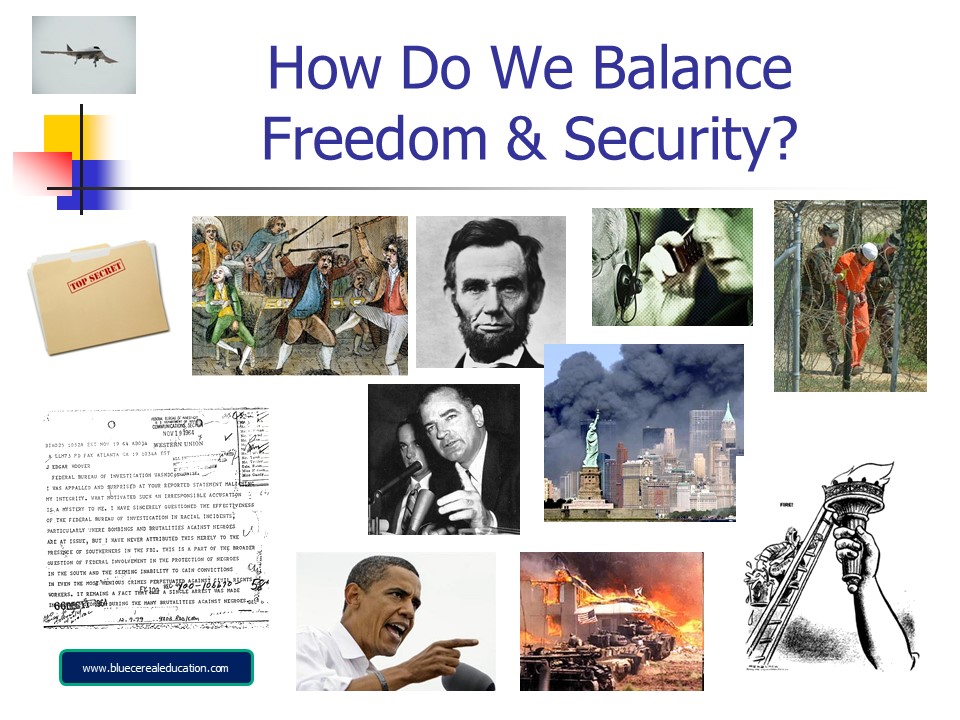
Blue Cereal is hosting this week’s #OklaEd Twitter Chat, Sunday (7/3/16) from 8:00 – 9:00 CST. All decent human beings or marginally attractive substitutes are welcome, whatever your role in the edu-madness.
You don’t have to prepare, but for those of you who just can’t resist looking ahead, here are the anticipated questions…
I hate any moment in any training that begins with some variation of “Here’s the old stupid way to do things that you’re probably all doing but thank god I’m here now to set you straight.” Only slightly less offensive are over-simplified flow charts of what you could be doing in your classroom, as if teaching were little more than a 3-stage Rube Goldberg machine.
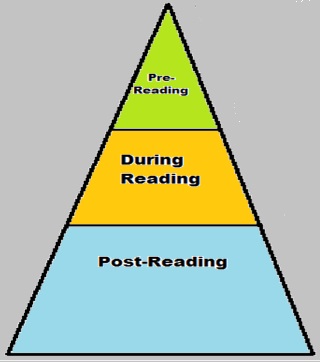
And yet, I present… triangles:
This is how things can go if we’re not careful.
Pre-Reading: We start a new unit or topic with minimal introduction – “When you’re done with your quiz over Chapter 13, turn it in and start reading Chapter 14.” If we’re feeling particularly pedagogical that day, we might even add, “It’s about Greece.”
During Reading: Students hunt for the answers to the assigned questions at the end of the chapter or check their text messages to see if anyone from the previous hour has posted their completed assignment yet. (Hopefully it’s that kid whose answers never make any sense but half the class copies them anyway.)
Post-Reading: The teacher tries to discuss the material the next day, or gives a short quiz, or assigns a group project based on the content, etc. Big shocker, though – no one knows anything they’re supposed to! So, the teacher spends most of their time trying to remediate or spoon-feed or berate their little brains into learning.
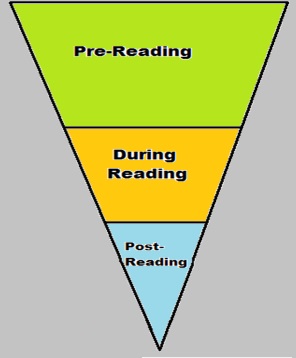
But here’s something closer to what most of us try to do these days:
Pre-Reading: The total time available hasn’t changed, but we try to “pre-load” more – we preview vocabulary, or take time to establish connections to what’s already known, or to students’ lives. We scaffold the crap out of these darn lessons, in hopes of minimizing repair time later on.
During Reading: Ideally, time spent actually reading or watching or otherwise “learning” the content is more effective thanks to this brilliant scaffolding. Plus, students are now fascinated and hungry to learn more because we’ve stimulated their interest in the subject matter with our nimble pedagogicalizing.
Post-Reading: Hopefully this now consists of either a brief assessment to verify understanding or some sort of enrichment or connection to other subject matter. From time to time, something artsy-fartsy is involved.
Why Pre-Read, Pre-View, Pre-Think, Pre-Whatever?
Keep in mind that while you may teach the same basic subject all day, every day, students have an annoying habit of leaving our room after an hour or so to go to, say… math class. There, they do MATH for an hour, which helps your efforts very little. From there it’s English or Science or P.E. or Art, all fine in and of themselves, but none of which directly support YOUR content on a regular basis.
They go home at some point, often with the solitary goal of blocking out any thoughts related to their day in school. Even if they do a bit of homework, they SLEEP afterwards – effectively rebooting the entire machine before rolling back into your room 23 hours later!
No wonder they have no idea from day to day what’s going on. It’s maddening.
Time spent making connections, previewing vocabulary, or building interest (or helping them fake it, at least), doesn’t necessarily add to the total time you spend on a unit. Even if it does, I respectfully suggest it’s better to anchor and help students retain less information than to blow through some impressive quantity they’ll never recall or know how to apply if they do.
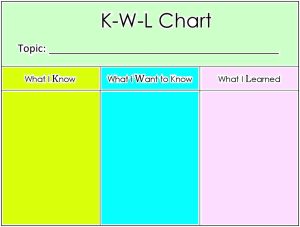
KWL Charts
You know this one – it’s been in every teacher training curriculum since Horace Mann first required your Normal School Certificate be hung on the wall before presenting you with the Teacher’s Edition of that McGuffey’s Reader.
When introducing a new subject, we start with what students already Know. Then, what do they Want to know? After the unit – or lesson, or chapter, or whatever – what did they Learn? Some add a ‘Q’ for further Questions.
There’s nothing wrong with going old school. Just because something’s vintage doesn’t mean it’s not useful. Classic rock commands at least one station in every market for a reason, right?
I prefer a variation of this which I think I stole from someone along the way, but have no idea when, where, or who. Sorry if took your rectangle.
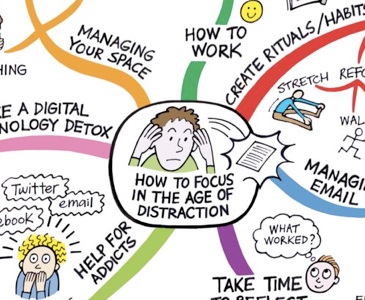
The TOPIC being introduced goes in the center.
The top left section is for what students already know, just like with a KWL chart. Whether we’re practicing this together, doing them in small groups, or occasionally working individually, I insist this be filled one way or the other. They know SOMETHING – and usually more than they think or will admit. We will just keep coming up with stuff we know until it’s full – no matter how long it takes. This is a ‘mindset’ thing that’s a pain in the learning but pays off down the road.
Spoiler Alert: Sometimes it’s a bit further down the road than we’d like.
The top right section is somewhat dysfunctional in nature – and that’s OK. In this section we write any feelings or opinions we have about the upcoming subject, OR things we think we might know but aren’t entirely sure of. If we’re doing the rain forest, for example, this is where the good little activist children tell us that we must save the rain forest and that every time man cuts down a tree, the fairies cry. It’s also where the kid whose parents insist there are more square miles of forest now than ever before in history gets his say.
Students may not have strong preconceptions or feelings about, say, major geographical formations – but they can guess which are found where, for example, or even how many there might be. This is very much a ‘safe to be wrong’ box. Fill it up.
Lower left is for what they WANT to know about the subject. I taught 9th grade forever, and I can tell you the most common response to this without further prodding: “Nothing. We’re good. Can we move on?” So, as always when learning new skills, we’re gonna overdo this baby and fake it. Legit-sounding question after probing inquiry until even WE believe we care deeply. As Aristotle said, “Fake it, ‘til you make it.”
Lower right COULD be the one you come back to with what you learned. I don’t do that, because I’m not organized enough. More often than not, by the time we get to the ‘end’ of a unit, I’ve forgotten I have their three-quarters-completed squares in a file somewhere waiting for this moment. Or, I’ve let them hang on to them and half of them have no idea where they are. So I do pictures.
In the lower right section, draw a picture of something you believe represents the topic in the middle circle. Sometimes I’ll give further guidance – when we do ‘Oil Boom’, they’re not allowed to draw an oil well, for example. Otherwise, it’s all fair game.
Once they know how to do these and expectations have been established, these can be done individually, in pairs or small groups, or as a class. They make good bell-ringers, or you can easily check them merely by walking around the room as they work.
As a bonus, prep time is minimal and grading is easy for these. That should never be our primary concern, but there’s nothing inherently evil about it. Don’t worry – you’ll still find yourself overwhelmed by the endless hours spent on some other element of your teaching.
These are some of the primary sources I’ve stumbled across over the years of which I just can’t seem to get enough. I realize this is weird and perhaps a bit sad, but I’m going to share them anyway so you can be strangely fixated as well.
When I know where I got them, I’ve credited or linked or some such thing. Some I’ve had in electronic form for so long I don’t actually know where I got them. I have no desire to violate anyone’s copyright or take anyone’s credit, so if you’re pretty sure this is YOUR Federalist Essay #18 or whatever, let me know.
In an effort to give some rough illusion of organization, I’ve added my own shorthand at the end of each description. DA=Document Analysis (primarily for learning/practicing), EA = Early American (1491 – Civil War), US = U.S. History (Post-Civil War), WH=World History, AG = American Government, OK = Oklahoma History, TX = Texas History.
I know – brilliant, right?
DaVinci & Elvis Apply for Jobs– One way to promote close reading and document analysis is to give students a document with identifying information removed. Without the name of the Author, Place & Time, etc., they must use internal clues to infer the relevant information. This is a pair I used to use regularly. They’d analyze each one – usually with APARTY – then do a Venn to Compare & Contrast them. Neither are overly difficult and both contain plenty of internal clues, but they’re not overly easy for kids born in the 2000’s either. These make for a nice C&C to wrap up the process. (DA)
Ben Franklin & Charles Darwin Talk About Sex – Not with each other. This is another pairing of documents with identifying information removed. I haven’t used the Franklin letter in class, but it’s very popular with teachers – especially the tawdry ones. These C&C well also. (DA)
Alexis de Tocqueville, from Democracy in America (1835) – There’s an unwritten rule that you must include something from Tocqueville any time you compile documents, write an article, or even think about 19th century America. I’m not sure what happens to you if you don’t, but I believe it’s similar to violating the Unbreakable Vow from those Harry Potter books. (EA/AG)
Horace Mann Pleads for Public Libraries (1840) – Everyone’s favorite 19th Century education reformer argues the value of libraries with many words and much aplomb. I use an excerpt of this with the Workingman’s Committee document above, but this longer version is pretty sweet if you can get through the verbage. (EA/AG)
Chattel Slavery vs. Wage Slavery (Orestes A. Brownson, 1840) – Brownson argues that whatever the criticisms of slavery in the South, wage workers in the North had it worse. Stinging critique of factory owners and the factory system. (EA/AG)
Henry David Thoreau – Life Without Principles (1863) – Excerpt from everyone’s favorite Transcendentalist. Turns out those students who are destined to do nothing but sit and stare blankly may be more enlightened than the rest of us. Huh. (EA)
Jourdon Anderson Letter (1865) – This Reconstruction-era letter is a rich source of both content and structure-related discussion. I won’t tell you what to love about it, but I like it better every time I work through it with students. Tone, and inference, and race, and society, and faith, and finance, and… you get the idea. (EA/US/AG)
Edward Bellamy – Looking Backward (1888) – When did novelists start thinking they were supposed to be doing allegory or making social commentary? This excerpt suggests folks in the future (the year 2000, to be precise) will be horrified by the way people used to treat one another socially and economically in the primitive past. Now if he just commanded a starship… (US/AG)
William Jennings Bryan – The Cross of Gold Speech (1896) – Excerpts from the roaring lion of Populism. “There are those who believe that if you just legislate to make the well-to-do prosperous, that their prosperity will leak through on those below. The Democratic idea has been that if you legislate to make the masses prosperous their prosperity will find its way up and through every class that rests upon it.” So… that’s not topical or anything. (OK/US)
MLK and Malcolm X Excerpts (1963/1965) – Excerpts of the letter from those silly clergy who prompted MLK’s famous “Letter from a Birmingham Jail,” sections of the Birmingham letter itself, and one of my favorite Malcolm X speeches from his post-Mecca life, one week before his death. Good C&C if you’re into that sort of thing. (US/AG)
These are just some of my favorites. Below are some links to various websites heavy on Primary Sources. If you have others you like as well or better, please let me know!
The Gilder Lehrman Institute of American History – A gold mine of legit primary sources, historian podcasts, and other goodies. You may have to register at some point, but it’s free and they send very little unsolicited email. They also do some pretty impressive Teacher Workshops I hear.
Stanford History Education Group – This one is pretty new to me, but it’s been recommended to me by several other teachers and looks pretty impressive so far. It’s also got a pretty sweet wine-colored background… or is it magenta? No – ruby! Hmmm…
The Library of Congress Online – They seem to have tried to reorganize this to make it a bit more useful when you’re looking for something specific. In years past, I’ve found it most entertaining when just kinda… browsing. In any case, as the name suggests, there’s a mother lode of documenty goodnees here.
The National Archives – Our government isn’t known for using our tax dollars usefully, but this is one of their better efforts. Musta been an accident. More than primary sources, there are all kinds of things here.
EyeWitness to History – This is one of my favorites. “History through the eyes of those who lived it.” Or at least through their words.
Digital History – This is first and foremost a kind of online textbook for American History, Pre-Columbus to Present. It’s a nice summary of major eras and issues, although there are some organizational and navigational elements with which I’d quibble if anyone asked my opinion (they haven’t). BUT, most of the “Eras” have a number of documents linked to them, and they’ve tried to do some interesting thematic things as well, so check it out.
Best of History Websites – You’ll never guess what this one is about! What, you guessed already? Well, damn.
If you haven’t read my explanation of the “Mr. Miyagi” approach to document analysis, you might want to check that out first – otherwise this page probably won’t make as much sense.
I change songs from time to time just to keep myself interested, but here’s one I used successfully off and on for years – “re: Your Brains” by Jonathan Coulton.
I don’t have any particular rights to use this one any more than I do anything else, but Coulton is that modern troubadour sort who’s generally pretty cool about his music being used as long as properly credited. If you decide to use this or any of his stuff (he has several that work) in class, you should cough up your 99 cents or whatever and buy your own copy. It’s the right thing to do.
Here’s an audio only video of the song from YouTube followed by the full lyrics…
re: Your Brains
Heya Tom, it’s Bob from the office down the hall. Good to see you buddy, how’ve you been? Things have been OK for me, except that I’m a zombie now – I really wish you’d let us in.
I think I speak for all of us when I say I understand why you folks might hesitate to submit to our demands. But here’s an FYI: you’re all gonna die screaming…
All we want to do is eat your brains – we’re not unreasonable, I mean, no one’s gonna eat your eyes. All we want to do is eat your brains – we’re at an impasse here, maybe we should compromise: if you open up the doors, we’ll all come inside and eat your brains.
I don’t want to nitpick, Tom, but is this really your plan? Spend your whole life locked inside a mall? Maybe that’s OK for now, but someday you’ll be out of food and guns… and then you’ll have to make the call.
I’m not surprised to see you haven’t thought it through enough; you never had the head for all that “bigger picture” stuff. But Tom, that’s what I do, and I plan on eating you slowly…
All we want to do is eat your brains – we’re not unreasonable, I mean, no one’s gonna eat your eyes. All we want to do is eat your brains – we’re at an impasse here, maybe we should compromise: if you open up the doors, we’ll all come inside and eat your brains.
I’d like to help you Tom, in any way I can. I sure appreciate the way you’re working with me. I’m not a monster, Tom – well, technically I am… I guess I am.
I’ve got another meeting Tom, maybe we could wrap it up. I know we’ll get to common ground somehow. Meanwhile I’ll report back to my colleagues who were chewing on the doors – I guess we’ll table this for now.
I’m glad to see you take constructive criticism well. Thank you for your time I know we’re all busy as hell. And we’ll put this thing to bed when I bash your head open…
All we want to do is eat your brains – we’re not unreasonable, I mean, no one’s gonna eat your eyes. All we want to do is eat your brains – we’re at an impasse here, maybe we should compromise: if you open up the doors, we’ll all come inside and eat your brains.
There’s no script for how this discussion unfolds, although I summarized the basic steps previously. The overall approach we’re modeling is one of unpacking the whole by starting with the pieces.
I play the song once for general overview, then again while students identify words or phrases which might be important but which not everyone might know. When it ends the second time, I ask for word or phrase that might be important but unfamiliar, and we build from there.
Often someone mentions “impasse” as a term not everyone might know, so we discuss it – what is an ‘impasse’? What’s the impasse in this document? Maybe the next term brought up is “compromise”, so we discuss.
This particular document has some interesting phrases usually thought of as cliches of the business world – “table this for now” and such. We discuss denotation as well as connotation, and at some point I transition to asking questions that will lead me into introducing APARTY or SOAPSTone, or whatever other document analysis acronym I want to use. Here I’ll use APARTY elements (Author, Place & Time, Audience, Reason, The Main Idea, Yeah – So What?)
“What can we tell about the Author based on this document?” Because we’re treating this as a legit document, I don’t mean Jonathan Coulton – I mean the ‘narrator’. If I’m not already recording information on the board, It’s important to start doing so with this step. A common first response is that he’s a zombie. “How do you know?” “Show me.” Students will point out lines from the document in which he admits he’s a zombie, and that he wants to eat brains, etc. I ask for other specifics from the document which support or refute this interpretation, and eventually ask how strong our inference is that the author is a zombie. In this case, it’s pretty strong.
What else? (His name is Bob, he works with Tom, he likes brains, he’s a bit condescending, he seems to be the spokesman or leader of the other zombies, etc.) The important pattern to be established here is the “show me” element – why do you think so?. Justify it. What evidence supports or refutes this inference? How strong is our inference here?
It’s OK to have weaker inferences as long as we recognize them as such. A case can be made that Bob is a former underling of Tom’s now parroting back snarky things Tom used to say or do, now that he’s in a position of some power (as a monster and all). This is a plausible and reasonable inference, but without more information it’s a much weaker inference than, say, the idea that Tom is the spokesmen for humans in a mall with locked doors, food, and guns.
We work through the other elements in similar fashion – what can you tell me about the Audience for this document? How do you know? What clues are there as to Place & Time? What’s the Reason this was written? (It’s intended to persuade.)
You remember how crazy it used to make you when your math teacher would make you show your work? Part of why they do this, even when the problem being solved is relatively easy and you don’t really need to, is they want you to become comfortable with the process. They know eventually the problems will grow much more difficult, and it’s important you be comfortable with the steps most likely to help you solve them. That’s all we’re doing here – practicing an approach. Don’t worry – the documents will get much more difficult very quickly.
This is also a chance in class to model and become more comfortable with productive, professional disagreement. One student may infer that Tom is clearly trapped in an office of some sort, and point to lines which seem to indicate that to be the case. Another student may then argue that while they know each other from the office, they’re clearly in a mall of some sort, and point to evidence supporting this understanding instead. That’s exactly what we want to happen, and for students to be comfortable being wrong, or disagreeing, without it ever becoming personal.
NOTE:I find that both students and teachers have trouble with The Main Idea. This should be a one sentence summary of the what the document SAYS. Most students and teachers want to tell me what it’s ABOUT – which is not the same thing. I respectfully suggest it’s worth the extra time spent in small groups and as a class wrestling with and refining The Main Idea – this will pay off later. FWIW, my Main Idea for this particular document would be something along the lines of, “Tom, this is Bob and I’m a zombie now; I get why you want to resist this, but we’re going to eat your brains and it would make things better for everyone if you’d just accept this and open up.” There are probably better ones and shorter ones, but this one at least conveys the guts of the document in a single sentence.
As we transition into doing an APARTY (or SOAPSTone) over real primary sources, I suggest students shoot for one full side of one page for their analysis. This requires more than some shallow scribbling, but still keeps things at a concise, manageable length for both them and you
If your kids are like mine, you’ll have to push them a bit the first few times. Don’t tell me “Publius” was the author and stop there – tell me that really James Madison wrote it, and who he was, and why HIS opinions about the new Constitution might matter, etc. Don’t tell me the cartoon was created in 1978 and move on – tell me about the energy crisis and public perceptions of President Carter and why their are peanuts and that scary rabbit in the foreground, etc. (The exception is The Main Idea segment, which should – as the term suggests – be simply the main idea, most likely a sentence or two at most.)
I’ll leave you with several other songs I’ve used over the years to introduce basic document analysis. I sometimes use lyrics videos, but don’t generally use actual music videos since a large part of the exercise is about pulling meaning from text. If there are visuals, students will naturally be drawn to those first and that kinda misses the point of this particular activity.
For purposes of sharing online with other educators, however, linking to YouTube is simply too convenient to pass up. Obviously if you use a song in class, you should legally purchase an actual download so you can sleep at night.
Most of us are assigned some fragment of curriculum to teach with far too little time to cover it adequately. It’s the nature of public education, perhaps even a necessary evil. I’m not sure what a class would look like that claimed in a fluid whole to cover all of known history, everywhere in the world, since we first wiggled forth from the primordial ooze.
The textbook would be huge – even without ancillaries.
We should take intentional time, however, to step back from the specifics of whatever we’re covering and make sure we’re connecting those specifics to parts of a ‘bigger picture’. Done regularly and well, this does several things:
(1) It makes history more meaningful and provides context, connecting various subjects under the ‘Social Studies’ umbrella all the way through today. Think of your favorite episodic TV show (’24’, ‘House of Cards’, ‘Game of Thrones’, etc.) Any given episode may have individual meaning and value, but that meaning and value increase dramatically if you understand the overall story arch.
(2) It makes content ‘stickier’ by giving it a place in an overall theme. Most information is much harder to retain in fragments; we can recall gigabytes of crap if it’s part of a story, a larger idea, or an album we loved in the 1970’s.
(3) It helps students see Cause & Effect, Change Over Time, and all those other ‘Big Picture’ relationships. Here I’m referring to something more specific than in the first point. For example, the desire to reform or improve society is recurring in American History. The Progressive Movement has things in common with the Age of Reform in the 1820’s and 1830’s, but also traits which were different. In some ways it led to the New Deal, in other ways FDR was dealing with very different problems.
Even a general awareness of these connections and relationships makes the specifics of each event richer and more meaningful. That in turn makes information easier to understand, recall, and apply. Any kid who’s played a ‘series’ of video games like Halo, Fallout, Assassin’s Creed, etc., can appreciate this connectivity.
Step back a bit further, and gamers easily recognize similarities and differences between these series as well. We’ve come a long way from Mario jumping on mushrooms, but there’s still almost always a ‘Big Boss’ at the end of each ‘story’ or ‘level’ who must be defeated to save whoever or whatever it is we’re saving this time.
All rock’n’roll is the same but different, as are all buildings, all chain restaurants, or all game shows. It’s all about making the connections.
So, ‘essential questions’…
There is much written on this topic, and several rather involved and grandiose schema of exactly which questions are or should be ‘Essential’. I’m not that fancy, so I’m going to share and briefly discuss the Five Big Questions I’ve used in class for years. It’s up to you to choose them, adapt them, or replace them as you see fit. I’ve also shared my favorite article on the topic on the Classroom Resources version of this post.
I keep these posted on all four walls and refer to them regularly throughout the year, whether we’re in American History, American Government, or even the strange wonderland of Oklahoma History. My personal rule is that if I don’t connect what we’re discussing to one or more of the questions, students may ask at any time which of the Five are relevant to the topic at hand. If I can’t respond and explain the connections without having to think about it, they don’t have to do it or know it.
But that’s just me.
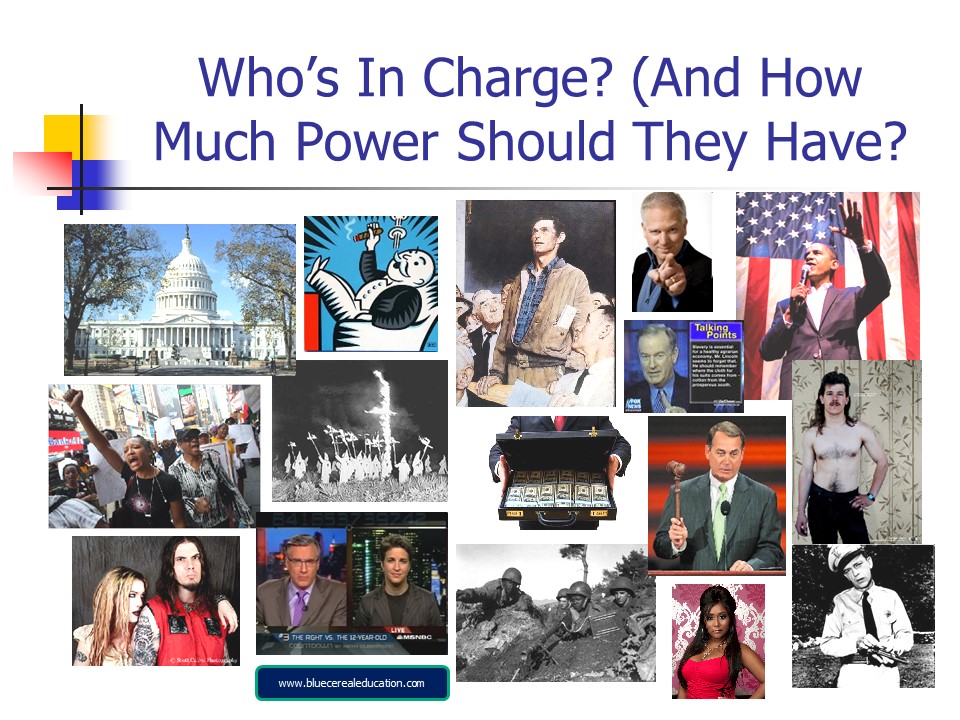
This is one of the easiest to see in action – any time period, any topic, on any scale.
In any given family – who makes the decisions? If there’s an effort to share that responsibility, who really makes the call when there’s an impasse?
In any school – who’s really running the place? Is it the building principal? The secretary? The math department? The teachers’ union? The angriest parents? How much sway do each of them really have?
In any classroom – who’s in charge, and how in charge are they? How much power should classroom teachers have? How much should they exercise, and in what circumstances? Which less-obvious sources of power and influence are in play in some classrooms, and how can you tell?
Early American History – who’s in charge, the Colonies or England? The Federalists or the Anti-Federalists? The States or the Central Government? The Executive, the Legislative, or the Judicial – and in what mixture?
The Civil War was all about this question. Eventually it became a world issue.
In the 21st century we’re still arguing over the powers of the President vs. Congress vs. the Courts. How much power should money give you? Fame? Family name? Your religion? When is a crime or a conflict a local matter? A state issue? Time for the federal govenrnment to step in?
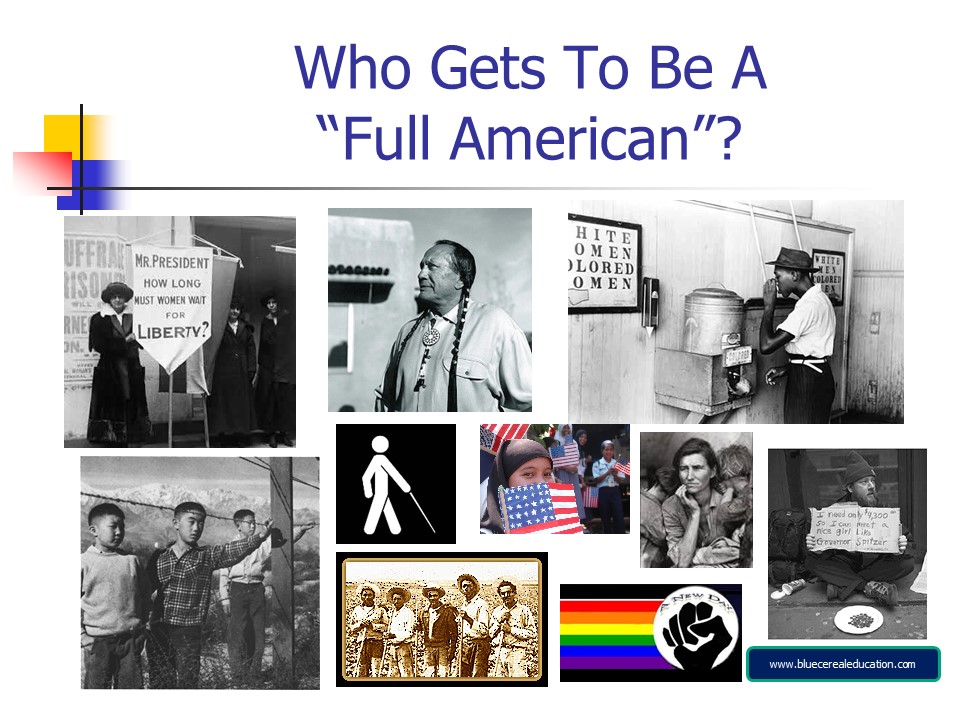
When Jefferson first wrote that “all men are created equal, and are endowed by their Creator with certain unalienable rights,” it was widely assumed that “all men” actually meant “all wealthy, educated, white, actually born-as-males-and-still-males men.”
Over time, that definition has evolved to include those who aren’t so wealthy or aren’t so educated. After the Civil War, they no longer had to be white – although the rights on paper came much sooner than the realities in practice. Eventually they no longer had to be men – “all men” was read to mean “all of mankind.”
Most of the historical examples of this question in action are obvious – slavery, women’s rights, the Civil Rights movement, A.I.M., Japanese-American Internment Camps, etc.
But we’re still trying to figure out today who “all men” are. Many don’t believe that “all men” created by that Creator with a big ‘C’ deserve unalienable rights – although if Jefferson was correct, that may not be up to us. (The real question might be whether or not we’re regularly violating rights they unalienably have but we refuse to acknowledge – ironic, right?)
Are undocumented immigrants “all men”? To which rights should they be entitled? If we educate their kids, what are the pros and cons? What if we don’t? If we provide emergency medical care or basic health services, what are the results, good and bad? What are the results if we don’t?
Do black people deserve due process even if they’ve committed some sort of crime? Should white athletes with SO much potential be held to the same legal standards as people who can’t swim as fast?
What about same sex marriage? What about Muslims – are they “all men” endowed by their Creator with certain “unalienable rights”?
What about people who aren’t American citizens at all? Should it be OK to torture or hold without trial as long as we do it off-shore? Perhaps Jefferson meant “all men within a certain latitude and longitude”?
This one’s HUGE. We’ve argued about it a great deal and fought about it more than almost any other issue.
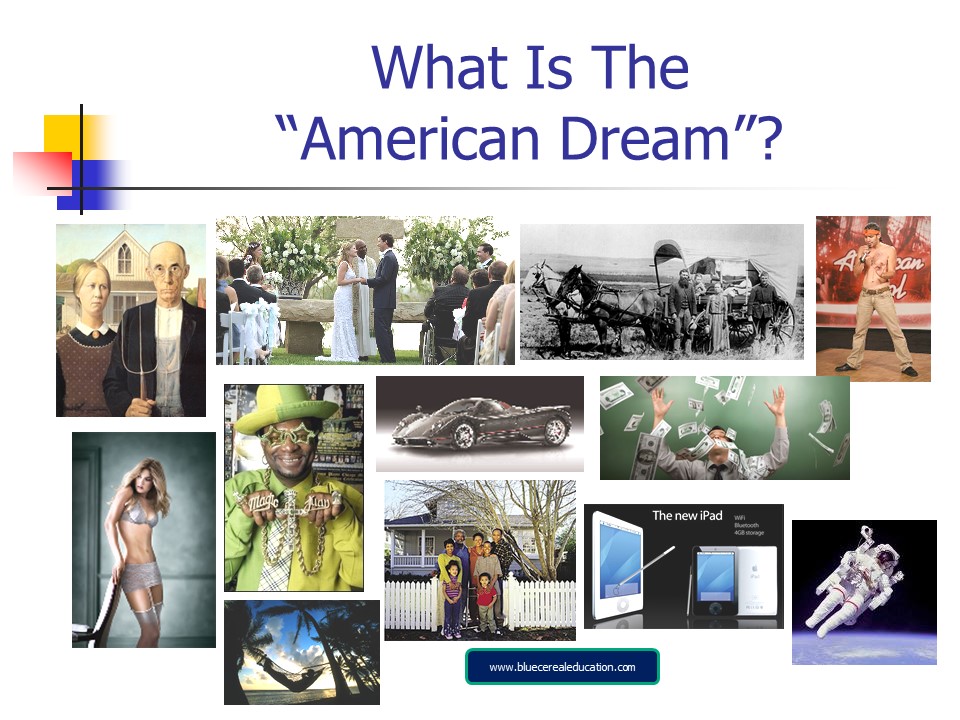
Americans have always had a sense of purpose or calling, something beyond a paycheck and clean water to which they aspire. But what is it, and how has it changed?
Is it about a set of ideals by which men should live – a chance to prove that a government founded on the proposition that all men are created equal can, in fact, long endure?
Is it about land and opportunity? Westward expansion? 40 Acres and a Mule?
Is it about freedom or other basic protections? Access to health care, education, or personal safety?
Is it about power? Fame? Wealth? Notoriety? Striking oil? Winning the lottery?
Maybe just a little 3-bedroom house with a dog and a white picket fence? Love? Netflix? Being the first to own the iPhone13?
Is the guy who jumps up and down behind the local reporter and waves his arms claiming his little slice of the American Dream? The people who try out on American Idol or other ‘talent competitions’? Or is it being lived out by everyone able to walk into a pretentious little coffee shop and order a $10 cup of something hot they can’t pronounce, changing at least one of the ingredients as they order just to prove they can?
This one matters because we pass a lot of laws claiming to promote the ‘American Dream’, and we devote a great deal of personal time and energy into pursuing it. Both might be more productive if we could first figure out exactly what it is.
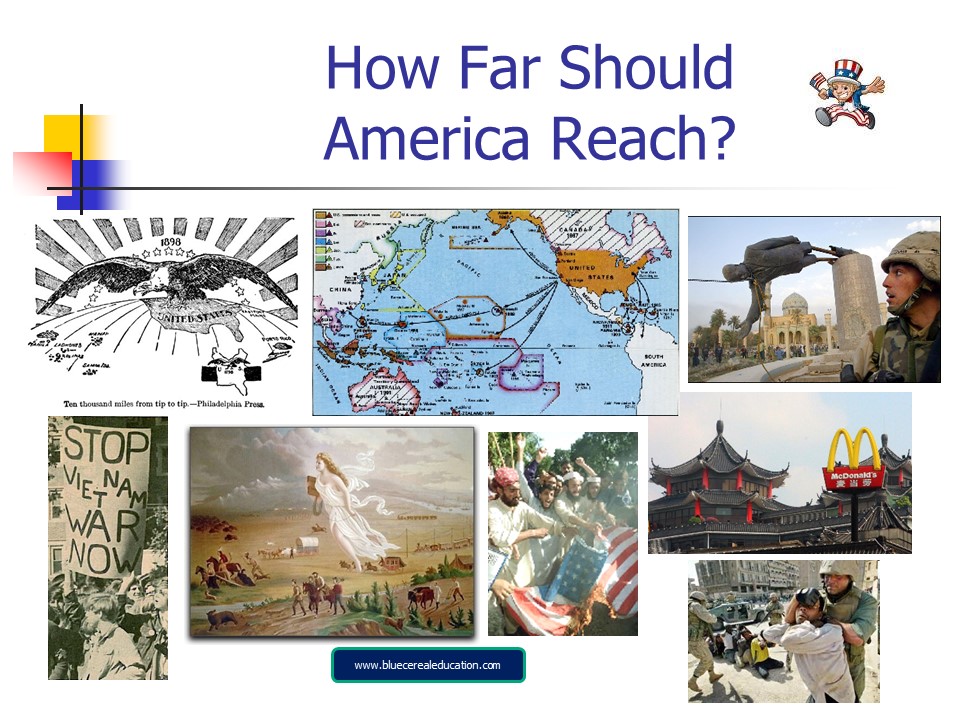
This was an issue from the beginning. There were a number of irritants leading to the American Revolution, but the Proclamation of 1763 – “Don’t you dare go past those mountains!” – was certainly among the most important.
What about Manifest Destiny? Indian Removal? War with Mexico?
What about Imperialism? Walking softly but carrying a big stick? The Monroe Doctrine or the Roosevelt Corollary?
What about Isolationism, WWI, WWII?
What about the Cold War, and fighting communism in Korea, then Vietnam?
What about the ‘War in Terror’? How much should we be involved in the Middle East or anywhere else, fighting who and for what purposes?
How far should we go to recreate other cultures and other governments in our own image, or else?
This is one of the easiest for my kids to grasp when we’re talking literal freedom and physical security. I respectfully sugggest, however, that in reality this one is just as important socially, and economically, as it is militarily or legally.
If you have a cat or a dog, you have to decide whether to keep it safe or give it some freedom. Inside, it’s less likely to get weird diseases or get hit by a car. Outside, though, it’s able to do the kinds of stuff cats and dogs actually like to do. Even inside the house they’re not completely safe – not telling what sorts of trouble they’ll get into when you’re not home. The safest place for them is a small kennel, placed in the tub, inside a central bathroom with the door closed, 24/7. There is a small trade-off in terms of their happiness, however.
Most of my kids’ parents are trying to find this balance with their little darlings – how much freedom do they give their student to decide when or how to do homework? How to handle a problem at school? Do they have curfews? Bedtimes? Do you try to limit who their friends are? How long can they go without calling? Helicopter too much, and your kid grows up useless and either afraid or confrontational; give them too much leeway, and they might fail a class or fall in the wrong crowd. You don’t want to tell them who to fall in love with, but you’re also hoping to prevent pre-marital spawning if at all possible – probably because of your outdated and oppressive morals.
The safest place for them is a small kennel, placed in the tub, inside a central bathroom with the door closed, 24/7. You’ll want something to muffle sound so your neighbors don’t call the police, however.
Teachers wrestle with similar concerns, although along a narrower spectrum – to what extent do I let students choose what to read? Whether or not to do homework? When to turn stuff in? Too much guidance, and we kill any joy in learning; too little, and there’s no learning to begin with.
We see it easily throughout American History:
The Articles of Confederation – lots of state and local freedom / insufficient national security or coherence to hold the nation together.
The Alien & Sedition Acts – largely a political maneuver, but still asking valid questions about how far free speech and acceptance of “foreigners” should go if national security appears at risk. We’re still asking this one.
Martial Law during the Civil War. Free speech during the ‘Red Scare’ and various War Protests. And pretty much everything related to Edward Snowden and the so-called “War on Terror.”
Because if the feds can’t turn on your daughter’s laptop camera while she’s changing without a warrant and without her knowing, the terrorists have won.
But it’s equally difficult when we talk social issues.The Scarlet Letter condemned society’s judgmentalism over adultery, but does it benefit society to promote loose sexual morals? Can we both discourage single motherhood and support single mothers? Can we accomodate poor choices and bad behavior without encouraging more of the same?
There are pros and cons to sexual freedom, to legalizing drugs, to letting people eat, smoke, or drink whatever they want. Rare is the situation in which your choices simply will not impact me in the least, however personal they may be.
If I’m standing in the middle of your neighborhood street naked, pleasuring myself, I can SAY you simply shouldn’t look if you don’t like it – and I’m truly NOT hurting you or anyone else – but you could still argue that you have some right to inflict your uptight outdated morality on me for reasons beyond physical or fiscal harm. What I smoke or eat or drink shouldn’t be up to you either, but if you’re responsible for my health care or other public services, maybe you should have a voice. Domestic violence impacts all of us, as does how well you raise your child. Maybe people who wish to get married or reproduce should be required to seek community support first – after all, what they do will impact those around them dramatically for the next two decades at least, right?
It’s complicated, and if reasonable balances can be found, they’re still likely to change regularly based on societal norms and circumstances.
I’d love to know which Essential Questions you use or would consider for your class, and why. You’re welcome to them if you like them, or you can modify them as you see fit. If you don’t have ANY, however, I’d encourage you to think about trying to come up with some. After all, if there are no guiding themes for whatever you’re teaching, why exactly are we bothering to begin with?




 You know this one – it’s been in every teacher training curriculum since Horace Mann first required your Normal School Certificate be hung on the wall before presenting you with the Teacher’s Edition of that McGuffey’s Reader.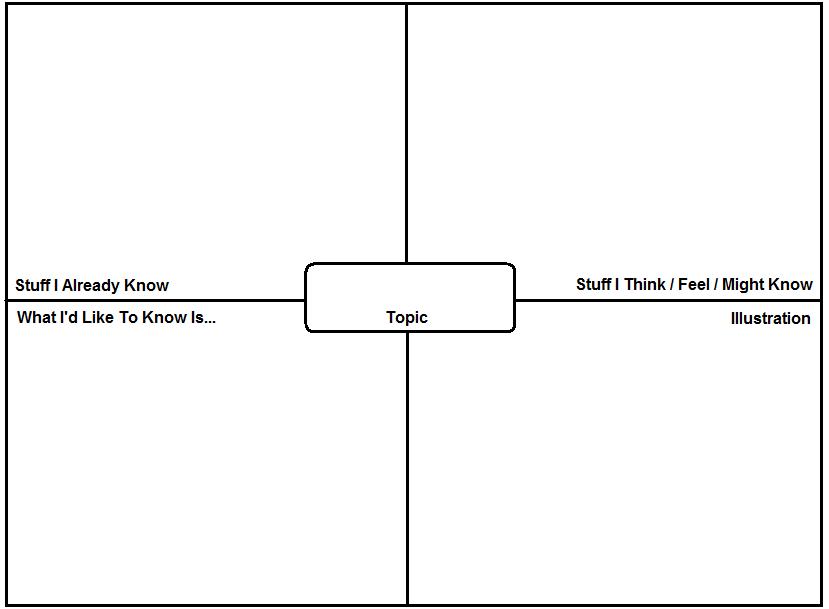

 These are some of the primary sources I’ve stumbled across over the years of which I just can’t seem to get enough. I realize this is weird and perhaps a bit sad, but I’m going to share them anyway so you can be strangely fixated as well.
 You remember how crazy it used to make you when your math teacher would make you show your work? Part of why they do this, even when the problem being solved is relatively easy and you don’t really need to, is they want you to become comfortable with the process. They know eventually the problems will grow much more difficult, and it’s important you be comfortable with the steps most likely to help you solve them. That’s all we’re doing here – practicing an approach. Don’t worry – the documents will get much more difficult very quickly.
 (1) It makes history more meaningful and provides context, connecting various subjects under the ‘Social Studies’ umbrella all the way through today. Think of your favorite episodic TV show (’24’, ‘House of Cards’, ‘Game of Thrones’, etc.) Any given episode may have individual meaning and value, but that meaning and value increase dramatically if you understand the overall story arch.
  Even a general awareness of these connections and relationships makes the specifics of each event richer and more meaningful. That in turn makes information easier to understand, recall, and apply. Any kid who’s played a ‘series’ of video games like Halo, Fallout, Assassin’s Creed, etc., can appreciate this connectivity.