
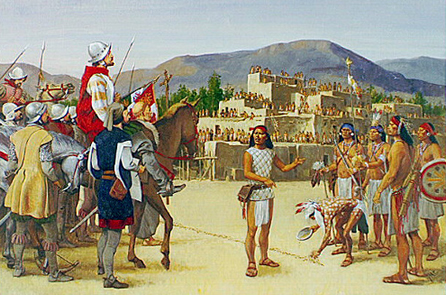
 I previously asserted that History is, by definition, a written record of the past. By that definition, the history of Oklahoma began in 1540 and Francisco Vásquez de Coronado was its first historian.
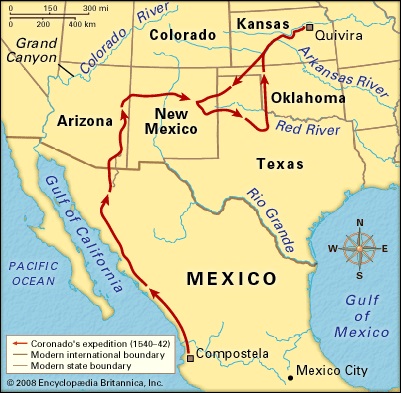
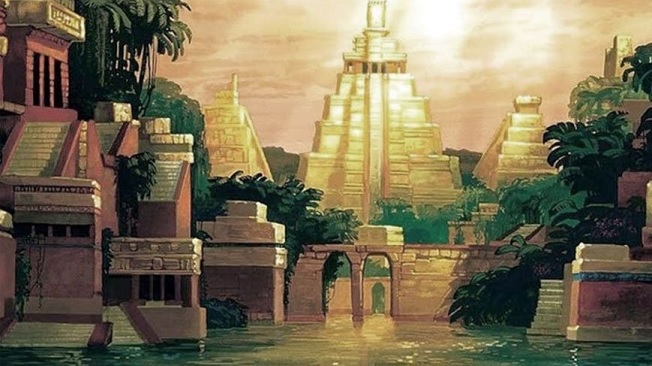
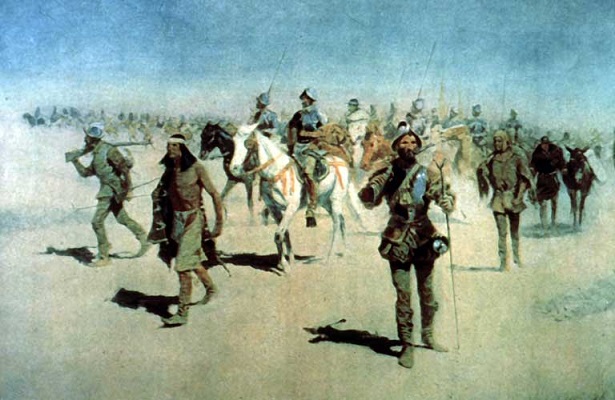
He set out to find untold riches by following rumors of lavish cities inhabited by wondrous people. His exact route is debatable, but he seems to have started north from what is now Mexico and traveled into New Mexico and/or Arizona in search of these “Seven Cities of Cibola.”
He got into a few scraps with the locals, but his journey was otherwise unexciting until he encountered a young man the Spanish quickly nicknamed “The Turk.”
The Turk, most likely a Wichita or Pawnee, assured Coronado that the real treasures were to be found in “Quivira,” far to the east. He offered to lead them there, and each time they encountered other tribes the Turk would communicate with them briefly before they, too, would eagerly insist that “Quivira” was totally the place to be and begin using signs and making other vigorous efforts at communication to indicate that the riches there were impressive indeed – in a no-sense-waiting-‘round-here-you-prolly-wanna-get-going kinda way.
What follows is a fairly accurate transcription of my total guesswork as to what these conversations must have been like – never before published on a major education blog.
Turk (to NewTribeGuys): Hey, I guess you probably noticed the, um, conquistadors and hundreds of soldiers and thousands of ‘allies’ just behind me here…
NewTribeGuys (to Turk): Why are you pointing? Are you trying to trick us into looking behind us? That’s completely lame.
Turk (to NewTribeGuys): I realize you don’t know me, but you’re gonna want to trust me on this. These guys are looking for Quivira, a city of gold and other untold riches and topless virgins and whatnot. Now, turn and point the same direction I am so it looks convincing. Maybe nod a bit and tell me with enthusiasm that we’re on the right track.
NewTribeGuys (to Turk): The hell are you talking about? There’s no ‘city of gold’ or whatever in that direction, or any other for that matter. Why did you bring these people here?!
Turk (to Cornado): He says we’re on the right track and honors the great Coronado on his amazing journey!
Turk (to NewTribeGuys): Look, you see how many tense foreign-looking fellows are behind me? Think about them eating your food. Taking your goods. Forcing themselves on your women. It’s not pretty, brother – I’ve seen it. Several times, actually. Now either get all excited about how close we are to Quivira or go ahead and bring out your daughters and stew because they’re starting to get restless.
NewTribeGuys (look at Coronado and his men, back at Turk, at Coronado and his men, back at Turk, and murmur briefly to one another)
NewTribeGuys (loudly, to Turk, Coronado, the rest of their tribe, and most of the neighbors): Ooohh, yes – Quivira! The one (gesturing dramatically) way over that way! Yes, yes – you’re very close! We thought you’d said you were looking for, um… Chi Berra, the famous atlatl maker. He, of course, is the other direction entirely. But not Quivira – nope, that crazy city and its golden virgins or whatever are ACTUALLY RATHER NEAR! (more gesturing)
Turk (to Coronado): They say it’s this way.
 This worked for a ridiculously long time, despite being a rather obvious ploy. Unfortunately, it relied heavily on the cooperation of strangers. Eventually, one of the tribes they encountered – the Teyas, an intriguing name later given to a future state whose name escapes me at the moment – started letting Coronado know that they had no idea what this Turk lad was talking about, and that he wasn’t even translating properly.
Despite his suspicions, Coronado let “The Turk” lead him all the way to what is now Wichita, Kansas, where they found Quivira. That part, at least was true.
It was not a city of gold, however, so much as a village of farmers living in grass huts. They were alarmingly tall for Indians, and very close to naked most of the time. Untold riches, though? Not so much.
Coronado spent several weeks hoping perhaps they were, somehow, close to some cities of gold if only he’d poke around a bit more, but finally reconciled himself to the truth – he’d been had.
 Coronado ordered that the Turk be garroted – the thing you see in action movies when they strangle someone with wire. To be fair, he had fibbed rather extensively and wasted months of their time, not to mention substantial resources. His sacrifice had not been in vain, at least – he’d led Coronado and crew far, far from his own people and their homes.
Coronado took a different route back to Tiguex in what is now New Mexico, where he wrote a letter to the King of Spain, dated October 20, 1541. It’s arguably the first written record of Oklahoma, and rich in both tone and detail. As primary sources go, it’s golden.
Unlike, say… Quivira.
Coronado went home frustrated and weakened after several armed conflicts and a serious fall from his horse along the way. He lost his fortune and much of his honor and died in 1554 – which I get is a total downer.
But while he’d hardly draw much comfort from it, he was the first Oklahoma Historian and a generally fine observer and record-keeper of much of the geography, the people, the wildlife, and the tribulations of the American Southwest in the 16th century.
There’s no record whether he ever got back that nifty copper necklace.
RELATED POST: Coronado (Why Don’t You Come To Your Senses)
RELATED POST: Coronado’s Letter (“What I AM Sure Of Is This…”)
 History, by definition, is written down. This is not an knock against archeology, anthropology, oral histories, or any other efforts to unravel the past – it’s just a definition.
  The first Land Run (1889) is certainly one of the more colorful events in our collective past, and far less depressing than most – at least if you don’t look too closely. This is when the first ‘Oklahoma’ lands were legally opened to white settlement, so claiming it as our “day of birth” has a certain logic to it. Then again, that would mean coming to peace with the suggestion it’s not really history until white people show up.
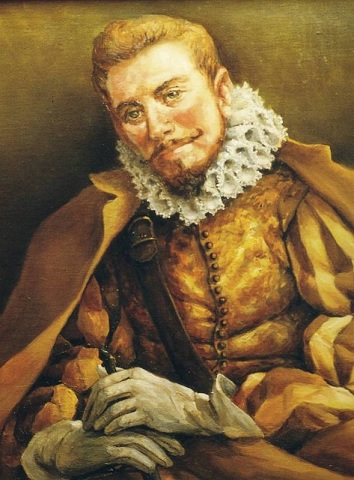 So I choose to be literal and insist that the History of Oklahoma began in 1540 with the arrival of a conquistador by the name of Francisco Vásquez de Coronado. He led an expedition which wandered through part of what is now far-western Oklahoma. Significantly, for our purposes, he and some of those with him left written records of their thoughts and experiences as they traveled – the first recorded “history” of the area.

 One way to highlight the role of the Color Commentary Voice is to model it with students – both what it sounds like when it’s MISBEHAVING and what it might sound like when its’ COOPERATING. To do this, I ask for a volunteer with a strong reading voice to read aloud from something educational I want to cover anyway. I explain that they’ll be the Play-By-Play Voice, and should pause when I interrupt. When I shut up, the Play-By-Play should pick up where it left off.
 I’ll ask the room to tell me, without looking down at the passage, what my volunteer Play-By-Play Voice has just read. Usually they can tell me little or nothing. Maybe just the general subject? Anything jump out?
  “In the American republics the activity of the central Government has never as yet been extended beyond a limited number of objects sufficiently prominent to call forth its attention-“
  Now it’s time for the most awkward thing I’m going to ask them to do all year. We’re going to practice the process in pairs.
 Let’s talk about the voices in our heads.
  If you watch sports at all, you know there’s a minimum number of announcers necessary to properly call any event, match, or game. Sometimes you’ll get a half-dozen or so in the studio, and another three or four in the booth, but they’re extra. Look past the fluff, and at the core you’ll almost always find two main roles – Play-By-Play and Color Commentary.
 Then the whistle blows, or the buzzer sounds, and the action is momentarily paused. This is where the Color Commentator guy jumps in to discuss the strategies recently employed in the contest – in the action just called. He talks about the players involved, their backgrounds, recent injuries, etc. He’ll explain what the coach is hoping to accomplish by whatever decisions he’s made, or otherwise fill in context and personality to the actual play occurring before and after his interpretations and insights.
 The ‘reading voice’ we hear is usually our own. If you’re reading a book by Oprah Winfrey, you probably ‘hear’ it in her voice. When I re-read Harry Potter, I tend to ‘hear’ the characters from the movies when their antecedents have dialogue in the text. But most of the time we’re our own Play-By-Play voice – we read to ourselves without consciously recognizing it.
 Readers who struggle with Play-By-Play need specific reading instruction and assistance. We do our best to prop them up with vocabulary previews, anticipation guides, or whatever, but our bang-for-the-buck is going to be limited with them. We’ll keep doing what we can, but the Play-By-Play skill is a long time developing and only gets harder to ‘fix’ as we get older – especially without willing application.