I Don’t Care Who You Vote For (For President)

3 Candidates

This year’s Presidential Elections demonstrate historic clusterfoolery, no doubt. Passions run high on all sides, and while your options are certainly not similar, all are severely flawed. 

I’m asking you to look past that for a moment. Something more important needs your attention. 

In Oklahoma, as in most states, every single seat in the State House of Representatives is up for grabs. There are even fewer incumbents than usual due to term limits instituted 24 years ago which restrict individuals to 12 total years in the state legislature. 
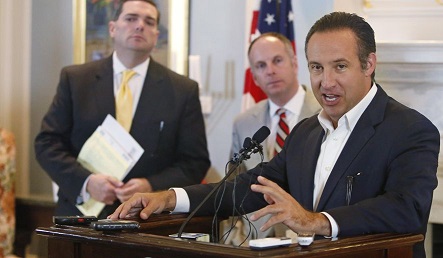
Doerflinger

Unless you’re Preston Doerflinger, the math is obvious. 

Half of the State Senate seats are being decided as well. In Oklahoma, Senators serve four years, with half up for election every two. That means this November 8th, somewhere in the area of 125 legislative positions across Oklahoma will be decided. 

That matters. 

It matters to you, your kids, your communities, your pocketbook, your workplace, and your state’s reputation across the rest of the globe. 

Most of you are unhappy with the way our state is being run. We’re not all unhappy for the same reasons, and we don’t share the same ideas as to solutions, but I meet very few people who think the economy is rolling along just swimmingly, that earthquakes are awesome, public schools are doing great, overall health and happiness is hitting a zenith, and they wouldn’t so much as tweak it if they could. 

I know of virtually no one hoping our legislators ignore the economy even better this coming session, or roll out even more legislation clearly designed to burn through hundreds of thousands of dollars in legal challenges before being overthrown due to blatant unconstitutionality. Again, I realize we don’t agree on the solutions. We may not even see the problems the same way. But most you recognize things aren’t going well.

That’s why I need you to vote. 

Go to the Oklahoma State Election Board website and make sure you’re registered. If not, you have until Friday, October 14th to GET REGISTERED. And dammit, get registered. Quit crybabying about the system – or worse, ignoring it altogether – and do your part. 
OK Voting

A few simple clicks will tell you your State House District and your State Senate District, as well as your Polling Place – the location at which you will vote on November 8th. 

If Sample Ballots aren’t posted, they will be soon – usually about two weeks before the actual elections. That means you can preview them online or print them out so you can research or clarify anything of which you’re not certain ahead of time. 

I promise you this is time well spent. However cynically you may be feeling about politics, wondering if you actually influence anything or whether or not your voice can possibly matter, please understand that – at the state level – YOU DO and IT DOES. I do not accept that most Oklahomans want things to be going this way. I contend that we have irresponsible, ideology-driven government because of voter ignorance and voter apathy. My solution is not to tell you what to think or how to vote, but to insist that you DO think and DO vote. 

If democracy works even a little, that should improve things considerably. 

Take 15 minutes to research your options for the state legislature. The Facebook Group “Oklahoma Parents and Educators for Public Education” has a complete list of races and their recommendations on Facebook. On days the interwebs are happy, you can even access it directly with this link: https://drive.google.com/file/d/0BxK1BFvY6f0KM1YtWDFUMFVqSHc/view

I’m covering as many races and issues as I can at #OKElections16. And of course you can always visit candidates’ campaign websites and Facebook pages or Google them all by your lil’ self. 
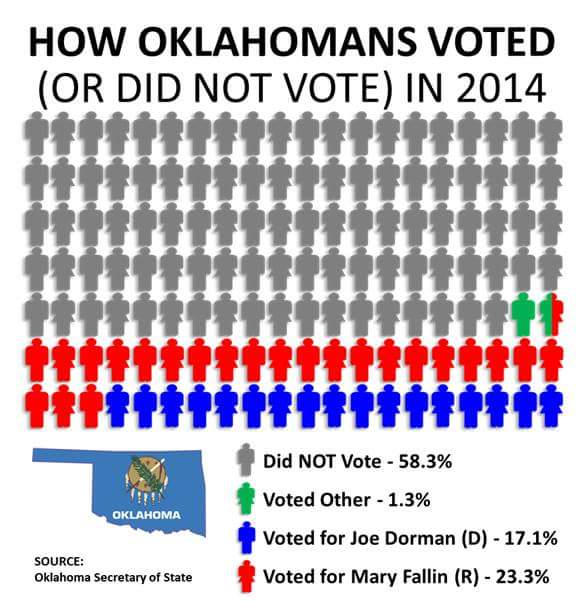
Oklahomans Don't Vote

If public education isn’t your main priority, search for information on each candidate related to whatever is. If they don’t address your issues, that by itself probably tells you something. And don’t forget YouTube as an option. Not every candidate has a speech or a promo video posted, but you’d be surprised what you come across searching local politics there. Good times, to be sure.

By which I mean hours of boring hell broken up by moments of great insight or entertainment. 

If you’re still feeling a bit overwhelmed by it all, that only means you’re paying attention even though you maybe haven’t so much before. Welcome – we need you, and we’re glad you’re here now. For serious. Have a cookie. 

There are, of course, many other things on whatever ballot you’ll see on November 8th. They won’t look the same in every district, but you can get a very good idea what to expect with this 2016 Oklahoma Voter Guide, put together by the League of Women Voters and a variety of other informative entities across the state. It’s non-partisan and full color!

Voting Line

PLEASE DO NOT VOTE STRAIGHT PARTY TICKET when it’s time to fill out your ballot. I’d not presume to tell you who to vote for nationally (well, I would – but not right this second), but PLEASE PLEASE PLEASE pay attention to individual races and individual names at home. 

Politics in Oklahoma aren’t the same as politics everywhere else. An Oklahoma Democrat isn’t necessarily the same creature as a California Democrat or a Massachusetts Democrat. Our ‘lefties’ often have strong approval ratings from the NRA, conservative social values, or other traits which would count as ‘crazy right-winger’ in other parts of the country.

Even Oklahoma Republicans cover quite a range. Some of them are the sorts of bile-spewing demagogues who brand the entire party as haters and nut-jobs, but many are smart people genuinely trying to guide the state along the right path as they see it. I’ve been hard on the state GOP, but I like more Republicans than I don’t. You may feel differently, but that’s the whole point – you simply must educate yourself a bit ahead of time.

If you’re voting for Trump in November, please be thoughtful and educated about the rest of your options on the ballot. It’s not always safe to assume everything will have an (R) or a (D) next to it, or that everything with an (R) will automatically support what you support.

If you’re voting for Clinton in November, please be thoughtful and educated about the rest of your options on the ballot. It’s not always safe to assume everything will have a (D) or an (R) next to it, or that everything with a (D) will automatically support what you support.

If you’re voting for Johnson in November, please be thoughtful and educated about the rest of your options on the ballot. Few of your remaining choices will have an (L) or an (I), so you’ll have to know who and what comes closest to the positions you support. 

Vote TodayFinally – and this is a biggie – you may not be planning to vote for President at all come November 8th. You may be one of those so disgusted with the system or your choices that you’ve chosen “a pox on all their houses.” That’s fine – I won’t argue with you about that right now. 

Please register, show up, and vote on the other things. Just leave the Presidential part blank. If you write anything in on that part, it will invalidate your entire ballot – a crap law, to be sure, and one I vigorously abhor, but that’s the current reality. 

You CAN, however, just not choose a Presidential candidate, and skip to the stuff that matters – the State Questions, your State Legislators, etc. Those races matter, and in those races, every vote matters. For realsies. 

Please. 

I Read The News Today, Oh Boy… (10/9/16)

Oil Jesus

Well, we’re making the national news again. 

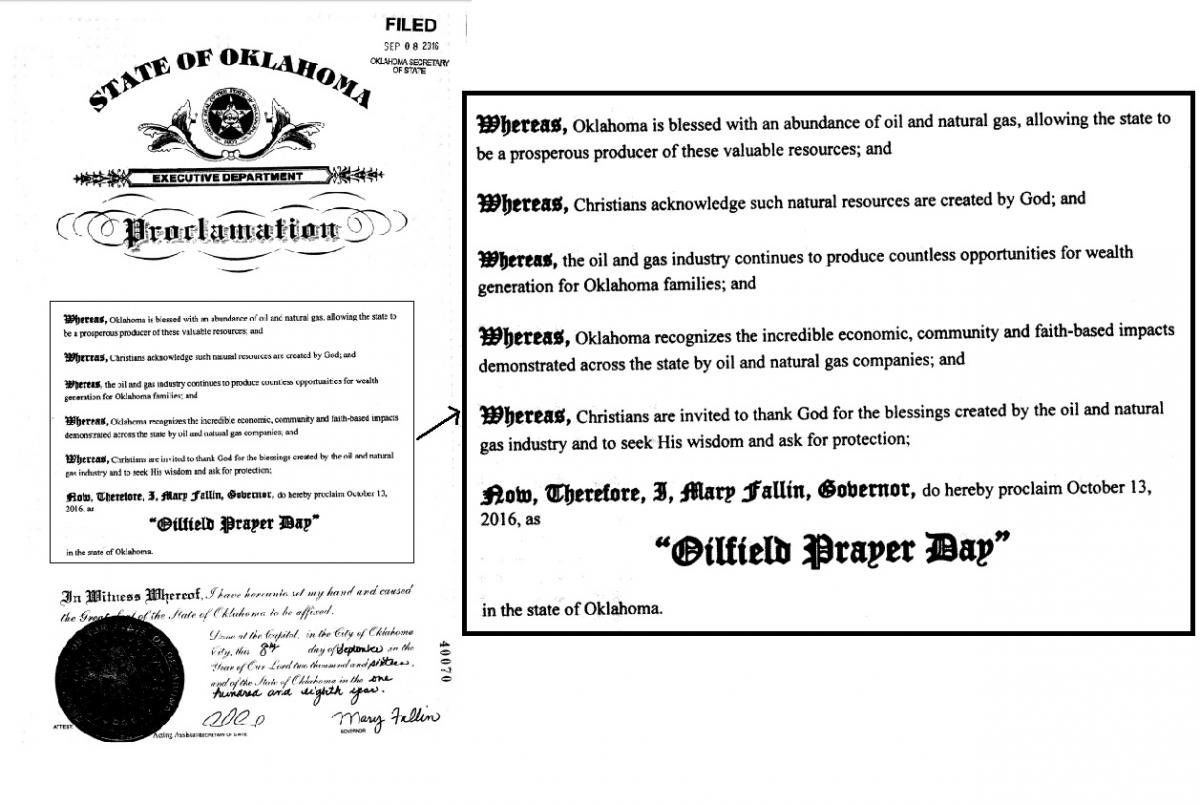
Oklahoma Governor Mary Fallin has officially proclaimed Oct. 13 “Oilfield Prayer Day” to raise awareness for the state’s declining oil industry. Here’s her official signed proclamation:

Oilfield Prayer Day

I’m not actually all that horrified by a 21st century government executive issuing a call for strictly denominational prayer on behalf of private industry. Using the power of the state on behalf of a narrow band of acceptable theology and sacrificing all else on the altar of our fiscal overlords is alarmingly normal in Oklahoma these days. 

I find it more interesting all the things that HAVEN’T merited a call for prayer on her part.

Our public schools are under enormous strain as a result of years of budget cuts and inane legislation. Teachers are fleeing Oklahoma en masse. Kids are suffering, and the entire system faces catastrophic failure soon if nothing changes. 

No prayer for any of that. 

We’ve all but eliminated mental health care throughout the state. DHS is operating at below skeleton-crew status, and health care in general is a fetish exclusive to the upper middle class. 

No prayer for any of those people, either. 

Our racial issues were recently exposed yet again, and while Tulsans prayed, none of it came at the behest of the Governor. 

I didn’t really expect us to ask God’s thoughts on calls from sitting legislators to round up Muslims or prevent gay kids from using the bathroom. I’d be surprised if we had a statewide day of prayer over the implications of our collective gun fetish, despite the rather predictable results nation-wide. 

One might hope, however, that we’d at least muster a token effort to pray for children in poverty, or widows without families to provide for them. Maybe pretend for just 24 hours that there’s some concern about our overflowing prison population, our pregnancy rates, or our lingering drug problems. 

But no.

There’s only one thing deserving of a collective cry to the Almighty. As Tom Beddow, coordinator of the Baptist General Convention of Oklahoma’s Oil Patch Chaplains ministry, explains:

The greatest need of the faith community is to develop a broken-hearted compassion for the oilfield and related industries. This is the type of compassion described in Neh. 1:1-5.

Make sure you look up that passage. It will leave you even more confused.

In other news, something called the “Baptist General Convention of Oklahoma’s Oil Patch Chaplains” apparently exists. Who knew?

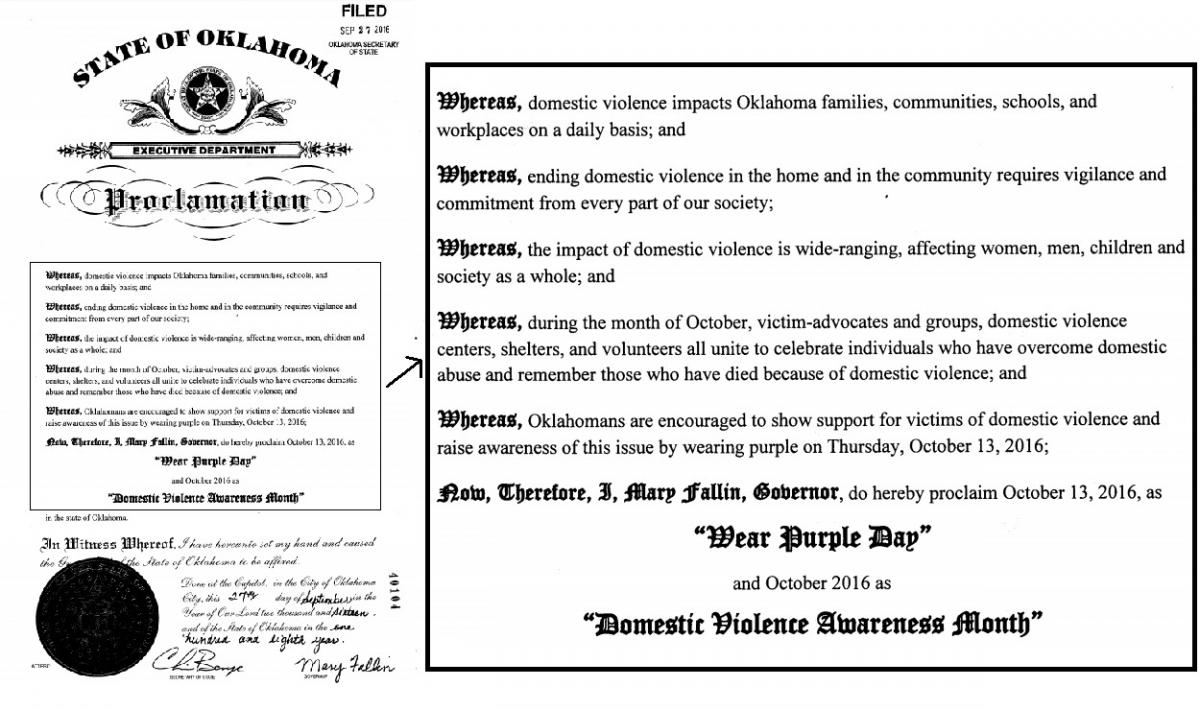
October 13th is going to be a busy day. It’s hot on the heels of Sleep Apnea Awareness Day, and already part of Plasma Awareness Week AND Domestic Violence Awareness Month, all per Gov. Fallin’s proclamations. It’s additionally designated by Fallin as “Wear Purple” Day, which I guess is something you do when you kinda care, but not enough to, say… pray for those involved.

Wear Purple

So come Thursday, make sure you’ve worn your CPAP mask overnight and get up early to spend some time being aware of plasma before putting on your best purple outfit and heading to that pancake breakfast where you’ll “Pray for the Patch.” If you notice any widows or orphans along the way, or run into any overworked educators or social workers, cross over to the other side of the road so as not to be distracted on your most holy journey. 

Our Father, which art into petroleum, recomplete be Thy Name. Thy gusher come, Thy well deepen, in Ellis as it is in Texas…

Also in Oklahoma news this week, The Oklahoman reports this week that “Most Oklahomans who drop out of school do so for two surprising reasons.”

“Surprising,” as it’s used here, means “melodramatic, fabricated nonsense.” 

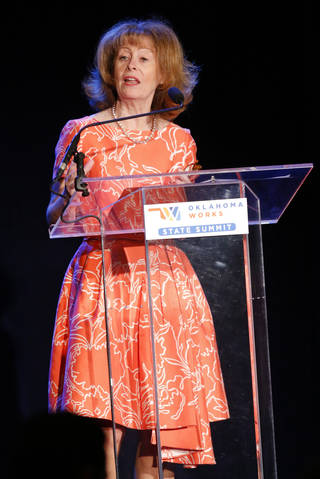
Natalie ShirelyNatalie Shirley, who The Oklahoman calls our “Oklahoma secretary of education and workforce development,” but who the internet thinks is currently President of OSU-OKC, spoke at something called the Oklahoma Works State Summit (surely a future winner of the coveted “Most Ironically Named Conventions” Award) in OKC this past week. 

Shirley told summiteers that “many students drop out of high school because of bullying and never return. She urged Oklahoma public schools to recognize the significance of the problem and do more to solve it.”

That sound you hear is your intuitive “b.s. detector” going off. 

I’m not trivializing the impact of actual school bullying any more than I’d mock the power of actual prayer, but the suggestion that most kids who drop out of school do so because they’re being bullied is about as plausible as the suggestion that God’s number one concern in reference to Oklahoma is how those oil fields are doing. 

It’s contrary to all personal experience as well as any other study along similar lines of which I’m aware. There’s little information about this “study,” but it sounds like someone merely contacted a few hundred high school dropouts and asked why they bailed. 

Surprisingly, most don’t seem to have identified anything they could have done differently as a factor. It wasn’t laziness or drugs or pregnancy or family dysfunction. It wasn’t even lack of a relevant curriculum, bad teachers, or any of the other usual excuses for why kids aren’t sufficiently amused by education. 

Nope. They were all victims. There’s shocker number two – there’s a correlation between people who quit and people who are pretty sure it’s all someone else’s fault. 

No doubt you see the appeal of this faux trauma for The Oklahoman – it’s one more thing public schools are doing wrong. One more thing that sucks about those stupid Oklahoma teachers. Those poor children… all bullied and uncared for. 

If only they’d had access to vouchers, maybe we could have saved a few of them…

“We’ve got to do a better job of stopping bullying, whether it’s in schools or online,” Shirley said. “Common education, you must double down on this issue to resolve it.”

I don’t even know what that would look like. Harsher punishments for bullies? (Irony, anyone?) Or maybe just more “Care-Ins” held in the gymnasium instead of all those silly core subjects? 

[[{“type”:”media”,”view_mode”:”media_original”,”fid”:”2430″,”attributes”:{“alt”:””,”class”:”media-image”,”typeof”:”foaf:Image”}}]]

The reason evolves by post-secondary. THOSE kids “drop out because of a family emergency or crisis of some kind, the study also found.”

A crisis, like, say… yet another study cranking out clickbait bullsh*t to be spread joyfully by people in power who should know better? That would certainly derail me

Again – of course there are real tragedies. Unavoidable circumstances. But are those at the top of the list for why not everyone finishes college or trade school?

Seriously?

And again, it’s the school’s fault. They’re not doing enough to call those students. To make them feel noticed. To treat them like they’re still in high school – which, come to think of it, wouldn’t be such a good thing after all – what with all the bullying and everything. 

Finally, the Whole Stupid Clown Thing…

Which I’m not going to even talk about. Because it’s that stupid. 

It did, however, remind me of a mediocre Bill Murray movie with some great moments. There’s some overlap in the clips, and some R-rated language, but I assure you they’re still more fulfilling than praying for oil or blaming bullies for why kids drop out. 

[[{“type”:”media”,”view_mode”:”media_small”,”fid”:”2432″,”attributes”:{“alt”:””,”class”:”media-image”,”typeof”:”foaf:Image”}}]]

[[{“type”:”media”,”view_mode”:”media_small”,”fid”:”2433″,”attributes”:{“alt”:””,”class”:”media-image”,”typeof”:”foaf:Image”}}]]

Be strong, my beloved. If I snap, one of you will have to pick up the blog and press on! More Blue Serials next weekend. 

A Wall of Separation – Agostini v. Felton (1997)

After School Satan Clubs

In 1985, the Supreme Court heard a case from NYC in which public school teachers were being sent into parochial schools to provide remedial education to disadvantaged students. It was decided in Aguilar v. Felton (1985) that this created an excessive entanglement of church and state, violating the Establishment Clause of the First Amendment as applied to the states via the Fourteenth. 

Twelve years later, the Court changed its mind. 

Prior to Aguilar in 1985, NYC was already going to great lengths in their effort to reconcile seemingly incongruent obligations. State law required them to provide remediation for Title I students, wherever they went to school, while established case law barred them from “entanglement” with sectarian efforts. 

First they tried having the students come to the public schools at the end of the regular school day. That didn’t work – too difficult to maintain consistency. These weren’t students for whom transportation and out-of-school support systems were generally reliable. 

Next they tried sending the teachers to the private schools at the end of the day. Constitutional safeguards were put into place in an attempt to avoid “excessive entanglement.” Teachers were given special training and written instructions on how to stay secular. Equipment or supplies from each school or devoted to different functions were not allowed to mix – no using Catholic chalk to show that remedial math problem, or leaving your secular legal pads behind and risk Baptist note-taking on them the next day. 

ABC JesusNo team teaching. No mixed activities. One wonders if perhaps eye contact with anyone wearing an angel pin was discouraged. Remedial instruction could only take place in rooms bereft of religious symbols or imagery, despite the fact that students had been surrounded by sectarian materials the entire day leading up to these lessons. 

Teachers were randomly assigned to different sites. In some cases, care was taken to send teachers of one faith to schools of another. Can you imagine that team meeting? “Now, Dakota – you’re getting more and more Baptist every day from what I can tell from your Facebook posts. Let’s send you to Mother of Grace Cathedral. And Gary – you’re still pretty much unbearably Unitarian, yes? Alright – off to Word of Faith of Power Academy with you then!” 

I’m, um… speculating, of course. Gary might have been agnostic. 

Finally, supervisors were required to make multiple, unannounced visits to ensure no Establishing or Free-Exercise-Limiting was accidentally occurring. “Are you SURE they sneezed right before you snuck in that ‘Bless You’?!?”

Even with all of that, the Court decided in 1985 that these efforts were insufficient. So the Board of Education of NYC tried adding to their “wall of separation.” 

They spent millions leasing neutral property and buying separate equipment to be used in remedial instruction, including vans which were essentially converted into ‘mobile classrooms’ to be parked near the sectarian schools, but not on “sectarian property.”

In short, complying with both the dictates of the Court and the demands of effective remediation turned into an expensive sort of ridiculous. 

School Van

Agostini v. Felton (1997) began when the district filed several motions in Federal District Court seeking exemptions from the rules established by Aguilar. Their argument was threefold:

1. The costs involved were undermining the entire purpose of their efforts – and were well-beyond what could have been anticipated when Aguilar was decided. Legally, this constituted a “change of fact” – one reason the Court sometimes reverses itself. In other words, the situation was different, so perhaps the decision should be, too.

2. In the decade since Aguilar, multiple written opinions – both majority and dissenting – in other cases heard by the Court had expressed a desire to reconsider this decision.  

3. Decisions in related cases over that same time period were already moving towards overturning Aguilar. If the precedent was already crumbling, it was time to re-evaluate. 

The Court was not particularly swayed by either of the first two arguments, but that last one won the day. Agostini v. Felton (1997) overturned Aguilar v. Felton (1985) in a 5-4 split decision. It was no longer considered a violation of the Establishment Clause for a state-sponsored education initiative to send public school teachers into religious schools, so long as reasonable steps were taken to minimize “entanglement.” 

Lemon TestThe majority opinion, written by Justice Sandra Day O’Connor, revisits the reasoning used to decide Aguilar twelve years before, including – once again – our famous “Lemon Test.” She also discusses numerous other cases whose outcomes shape the Court’s reasoning in current circumstances. 

For those of you new to jurisprudence, that’s how the Court works – they interpret laws, of course, and they’re tasked with determining the constitutionality of what’s before them based on both original intent and evolving circumstances. One of the primary tools used to do this is the Court’s own history. 

Stare Decisis is the principle that the Court will generally abide by its own previous decisions unless there’s very good reason to do otherwise. It’s a critical element of the system if lower courts, institutions, and impacted citizens are to have any idea what’s considered acceptable in the eyes of the law. 

If we are to be a nation of laws, rather than men (a high ideal, to be sure), then some degree of predictability in that law is essential. 

O’Connor explains the Court’s change of thinking step by step:

As we have repeatedly recognized, government inculcation of religious beliefs has the impermissible effect of advancing religion. Our cases subsequent to Aguilar have, however, modified in two significant respects the approach we use to assess indoctrination. 

First, we have abandoned the presumption… that the placement of public employees on parochial school grounds inevitably results in the impermissible effect of state sponsored indoctrination or constitutes a symbolic union between government and religion…

The Court cites Zobrest v. Catalina Foothills School District (1993) by way of example, including this bit:

Zobrest therefore expressly rejected the notion… that, solely because of her presence on private school property, a public employee will be presumed to inculcate religion in the students. Zobrest also implicitly repudiated another assumption… that the presence of a public employee on private school property creates an impermissible “symbolic link” between government and religion…

The next basis for the Aguilar decision was essentially overturned by Witters v. Washington Department of Services for the Blind (1986)

Second, we have departed from the rule… that all government aid that directly aids the educational function of religious schools is invalid… Even though the grant recipient clearly would use the money to obtain religious education, we observed that the tuition grants were “made available generally without regard to the sectarian nonsectarian, or public nonpublic nature of the institution benefited”…

JehovahNotice that the argument is as much about professionalism and practicality as it is the finer points of constitutional law:
Indeed, each of the premises upon which we relied {previously} to reach a contrary conclusion is no longer valid. First, there is no reason to presume that, simply because she enters a parochial school classroom, a full time public employee such as a Title I teacher will depart from her assigned duties and instructions and embark on religious indoctrination, any more than there was a reason in Zobrest to think an interpreter would inculcate religion by altering her translation of classroom lectures. 

Certainly, no evidence has ever shown that any New York City Title I instructor teaching on parochial school premises attempted to inculcate religion in students. Thus, both our precedent and our experience require us to reject respondents’ remarkable argument that we must presume Title I instructors to be “uncontrollable and sometimes very unprofessional.” 

As to the question of impact – does the effect of the legislation inhibit or promote religion – the Court adapts a line of thinking similar to that in Mueller v. Allen (1983). The opportunity is neutral towards religion, even if the results benefit one group more than another. 

A number of our Establishment Clause cases have found that the criteria used for identifying beneficiaries are relevant in a second respect, apart from enabling a court to evaluate whether the program subsidizes religion. Specifically, the criteria might themselves have the effect of advancing religion by creating a financial incentive to undertake religious indoctrination… 

This incentive is not present, however, where the aid is allocated on the basis of neutral, secular criteria that neither favor nor disfavor religion, and is made available to both religious and secular beneficiaries on a nondiscriminatory basis. Under such circumstances, the aid is less likely to have the effect of advancing religion…

The Court then turns to the question of “entanglement”:

Not all entanglements, of course, have the effect of advancing or inhibiting religion. Interaction between church and state is inevitable, and we have always tolerated some level of involvement between the two. Entanglement must be “excessive” before it runs afoul of the Establishment Clause… 

Since we have abandoned the assumption that properly instructed public employees will fail to discharge their duties faithfully, we must also discard the assumption that pervasive monitoring of Title I teachers is required. There is no suggestion in the record before us that unannounced monthly visits of public supervisors are insufficient to prevent or to detect inculcation of religion by public employees…

Just in case there’s any misunderstanding, O’Connor brings it home with great clarity:

To summarize, New York City’s Title I program does not run afoul of any of three primary criteria we currently use to evaluate whether government aid has the effect of advancing religion: it does not result in governmental indoctrination; define its recipients by reference to religion; or create an excessive entanglement… 

Holyman MovieJustice Souter wrote a fascinating dissent, which several of the other justices joined. His argument is less pragmatic and more big picture. I particularly like this part:


As I will indicate as I go along, I believe Aguilar was a correct and sensible decision…

As is explained elsewhere, the flat ban on subsidization {he means the public support for sectarian institutions} antedates the Bill of Rights and has been an unwavering rule in Establishment Clause cases… The rule expresses the hard lesson learned over and over again in the American past and in the experiences of the countries from which we have come, that religions supported by governments are compromised just as surely as the religious freedom of dissenters is burdened when the government supports religion. 

This echoes sentiments expressed in Engel v. Vitale (1962), and later in Lee v. Weisman (1992). 

When the government favors a particular religion or sect, the disadvantage to all others is obvious, but even the favored religion may fear being taint{ed} . . . with corrosive secularism. The favored religion may be compromised as political figures reshape the religion’s beliefs for their own purposes; it may be reformed as government largesse brings government regulation.

(That last bit included quotes from quotes within other quotes, which made punctuation and citation a bit of a mess – so I just cut everything but the substance. Look it up if you care.)

Souter goes on to quote extensively from various other cases and authorities on the danger of any hint of “establishment” not to dissenters or the state, but to the faith being thus “established.” It’s a question we too easily ignore today when discussing such things. 

He delineates several critical differences between the cases cited in the majority opinion and the specifics before the Court here, but concluded rather poetically – at least in my opinion:

That is not to deny that the facts just recited are regrettable; the object of Title I is worthy without doubt, and the cost of compliance is high. In the short run there is much that is genuinely unfortunate about the administration of the scheme under Aguilar’s rule. 

But constitutional lines have to be drawn, and on one side of every one of them is an otherwise sympathetic case that provokes impatience with the Constitution and with the line. But constitutional lines are the price of constitutional government.

 I’m not sure there’s anything I can say to top that.

Collaboration: Popular Buzz Word, Under-Utilized (Guest Blogger: Lisa Hunt)

I’ve issued an open call for guest bloggers for the month of October. Partly this is just to break things up, and partly it’s because I’ll be doing my best to finish strong on #OKElections16. 

There are few if any limits on topic or length – I merely ask for basic decency and sincerity. It’s ideal if you disagree with me about something, but given how difficult that is to do once basking in Blue, it’s not a requirement. I’m looking for other voices – whatever the angle or passion in play.  

This post comes from Lisa Hunt, Library Media Specialist and NBCT for Moore Public Schools.  

Teacher Collaboration

Collaboration is a popular buzz word, and like most buzz words it has been losing its power. As humans we enjoy working together – as the old proverb (or Bible verse, depending on your preference) explains, “many hands make light work.” Collaboration, though, is not easily achieved. I’m an elementary school media specialist, and one of the things that drew me to my work is the opportunity for collaboration. I’ve engaged in strong collaborative efforts with teachers, students and parents throughout my career.

We have been hearing for the past generation from researchers like Keith Curry Lance that school library media specialists promote higher tests scores through collaboration, and as I said, I’ve been engaged in strong collaborative practices. Are our words ignorantly empty, though? Collaboration is just not that easily achieved.

“Collaboration is a ubiquitous term that has been defined in numerous ways across diverse fields.” This is a quote from linguist and professor Vera John-Steiner mentioned in her ALA position paper on collaboration. She suggests that we need training and a framework to achieve successful collaboration. Wait, ain’t nobody got time for that! More training?!? Who are we kidding? I see my role as that of in house trainer, and that is worth gold to administrators in this time of budget cuts to Professional Development.

I enjoy the opportunity of longevity in my job. This is miraculous or boring according to your side of the fence. I’ve been in my position for 20+ years in the same building. It is miraculous because school librarians are an endangered species in education. This is true in some parts of Oklahoma, and in large districts across our country. The fact that I work for a school district with a strong commitment to effective school library programs in a bonus for me and my school community. The fact that I’ve been in this space so long might be sad because it begs the question “Couldn’t I find something else, something better to grow into during my career?” Well, no. One of the biggest reasons I am still here is my love of the job and the challenge to collaborate!

Working in public education is a challenge in and of itself these days, but to be a collaborator means I must have a stable group of collaboratees. Is that a word? Well, it is today. I collaborate with teachers, students and parents. The latter two are always coming and going; and, that is as it should be. The teachers, though… well, that is part of the problem. We have an ever growing teacher shortage, and that means constant turn over. It means that each year I have many new people to work with in my school. I enjoy that because it keeps me fresh and helps me learn new skills. It makes collaboration tough, though. 

Collaboration more than anything is based upon trusting relationships, and that takes time. As a collaborator I am a partner. A big part of my job is building partnerships. Time for teaching is valuable, and my role is to engage with educators and teach with them. Is a lesson with me in the library worth sacrificing classroom time? You bet because I want to collaborate, embrace classroom objectives and reinforce what teachers are teaching. How can that be achieved if you are new? It takes time and I will work with you to build a relationship.

We keep hearing that schools should be run like businesses, and usually that means producing a product. The learning of children is not a product, so this doesn’t correlate directly when it comes to product; but, some practices are found in both schools and businesses.

Collaboration is one of those practices. Google has been promoting it for years, Go To Meeting is an entire industry based upon collaborative effort in the workplace, and advertising, science and medicine have embraced these practices for generations. Why are schools coming slowly to the game? It might be the punitive structures in place such as teacher evaluations, testing, and constant turnover! As national leaders have tried to improve educational practices they have inadvertently put barriers in place that impede growth in practice.

As the library media specialist I provide direct instruction, instructional support, collection and resource management as well as technology integration. My job description includes providing professional development, and I do that every year. I collaborate, identify needs and address those needs through instruction. I teach students, teachers and patrons in my role. My greatest success comes from strong relationships.

This year I have 8 new certified teachers in my building, and another 8 or 9 that I have taught with less than 3 years at my school. That is high turnover! Building a collaborative team takes a minimum of 3 years and can only grow given time and opportunity. Notice I haven’t even discussed teaching skill levels. What if the teachers are Rookies? What if the principal is new? What if the librarian is not only new to the building but in the first year of running a library media program?

I am a champion of collaborative teaching. I embrace it, throw my library doors open (or even join the teacher in classroom or computer lab) and engage is some of the most powerful teaching I have seen. It comes at a price though. Teachers need to be given time to learn collaborative instruction techniques (I train them as part of my job!), develop collaborative lessons, and then time to deliver these types of lessons. Ain’t nobody got time for that! 

This is my perspective as the library media specialist, but there are other collaborators within our schools. Title 1 teachers, special education teachers who push-in with co-teaching, counselors and speech pathologists, as well as Music, Art and PE teachers can all bring collaboration to learning. How can we promote more collaboration within our schools? 

Collaboration might be a powerful buzz word, but effective implementation is more powerful. That implementation requires a stable teaching force, a commitment to supporting effective teaching practices, and the opportunity to build the trusting relationships that collaboration requires of us.

A Calling Or A Paycheck… Why Not Both? (Guest Blogger: Travis Sloat)

I’ve issued an open call for guest bloggers for the month of October. Partly this is just to break things up, and partly it’s because I’ll be doing my best to finish strong on #OKElections16.

There are few if any limits on topic or length – I merely ask for basic decency and sincerity. It’s ideal if you disagree with me about something, but given how difficult that is to do once basking in Blue, it’s not a requirement. I’m looking for other voices – whatever the angle or passion in play. 

This post comes from Travis Sloat, an English teacher at Okay High School, where he graduated in 2001 and where he once hit a game winning shot for the high school basketball team. He is a freelance journalist and photographer, a father of three, a college basketball junkie, and a lover of fine Mexican food from Taco Bell. In his minimal free time he can be found patrolling the galaxy in Destiny on his Xbox, or tweeting The Rock to try to get famous.

Travis Sloat

I was standing in front of two assistant managers, both barely five years older than I, and the words rolled off my tongue like I’d been selling used cars for twenty years.

“It doesn’t matter if I make five-fifteen or five-sixty-five, I’m going to push carts to the best of my ability.” 

I wanted a merit raise, an extra fifty cents an hour, and my dad had told me to come in and ask for one, because that’s what people in the workplace did when they wanted more money. I had done exactly that, and then delivered the above answer when asked, “Will more money help you push carts better?” 

The senior assistant manager—who I’d literally known my entire life—stared at me, eyes widening in surprise. 

“Wow! Did you take a class on asking for a raise before you came in?” he asked. 

I laughed and said, “No. That’s just how I was raised.” 

I got the raise. 

***

If the truth were to be told on that spring day in 1999, I was, in fact, raised that way. However, the words I spoke were hollow; empty palaver meant to please the bosses’ ears and get me an extra fifty cents an hour for slugging scalding scraps of steel shaped into shopping carts through the summer sun. Looking back, I wouldn’t change a thing; but the shoe is definitely on the other foot now. 

Now I am a junior high English teacher, English I teacher, Yearbook Advisor, Webmaster, Bus Driver, and Proofreader of All the Things for Okay High School in the booming metropolis of Okay, Oklahoma. That’s right, Oklahoma – as in, “that state who’s 49th in the nation for lowest average teacher pay.” 

I should add, I love what I do. I love my kids, and I love this town. I say this often, and I say it proudly: I will die here or I will retire here. There are no in-betweens. 

I have taken this job knowing at no point in time will I ever sit in my principal’s office and say, “I’d like a raise please.” I am all too familiar with the economic climate of our state, and the horrendous mismanagement of funding at the state level. It’s not that I wouldn’t mind a raise, shoot, I could always spring for the bigger iPad, or buy my kids Lunchables so they don’t feel as though they are the most mistreated children in the world. 

However, to rephrase a timeless quote from great actor JaRule in the first Fast and Furious movie: “Everyone happens to know a few things, and one of the things that we knows is: teachers don’t get (big) raises.”

So why then, am I here? Why do I walk into this building every day and choose to stand in front of junior high kids who smell like hormones and weird dreams? Why do I choose to teach them how to speak properly, but remind them it’s perfectly okay to slip a “y’all” in sometimes? Why do I make your kid put their phone away and listen to Romeo and Juliet even though they already know the ending (“We know, Mr. Sloat. They all die at the end. Wait. She was fourteen?”)? 

The answer is simple and complicated at the same time, like Nicolas Cage’s success in film, and hopefully you have a similar one for why you are where you are: I had a calling. 

A few years ago, I was sitting pretty at Northeastern State University, with a fantastic (mediocre) GPA and an academic plan which led to a degree in Computer Science. I wanted to be a computer engineer, sitting at a desk and making $100k a year for typing lines of code onto a screen. I wanted to wear weird socks every day, and funny, clever ties with quasi-geeky meanings and joke with my coding buddies at the water cooler about the latest in Game of Thrones Reddit threads. It seemed easy enough, and it seemed like a salary that could afford my family and I all of life’s little delicacies, like large screen iPads and Lunchables and real Mountain Dew instead of “Mountain Lightning.” 

You might be asking why I gave up a potential luxurious life of name brand soda and premium cuts of deli ham with buttery crackers all packaged conveniently into one box for a life where two grown adults with college degrees and professional careers still qualify for free and reduced lunches, and I’ll tell you. 

One Sunday morning I was sitting in church and I heard a sermon preached on the detriments of chasing wealth. The pastor advised us that if we chose money over our passions, we’d ultimately regret our career and we’d never truly be happy. While listening to him break down the scripture backing up the points, I realized a few things. 

The most notable were that all of a sudden sitting a desk typing lines of code for forty hours a week seemed interminably boring, and that I could wear weird socks to school just as easily as to the office. So the next week I strolled into the office of a slightly annoyed registrar and changed my degree plan to Secondary English Education. To date, it’s been one of the best decisions of my life. 

In a few short weeks, Oklahoma will decide whether or not to give myself and my compatriots a $5,000 raise. If they are gracious, my paycheck will still rank in the bottom half of the national average for teacher pay, but it’ll be nice surprise, mostly because my wife is a teacher too, and we’ll be doubling up on it (hello Premium Lunchables!). I’m not one of those teachers who likes to gripe about how much we do and how little we get paid to do it. That said, we need this raise. 

If you’re on the fence, consider what you’re giving and what you’re getting in return. It means highly qualified teachers staying put for a few years. It means dedicated rookie teachers like me not having to worry about picking up side jobs or summer jobs. That in turn puts us in the classroom more, because as any educator can tell you, it’s not a “pack up and leave when the bell rings” job. 

If enough voters decide they simply can’t be asked to fork up an extra penny here and there, that raise won’t happen. The state will then hem and haw and try to pass some other legislation that glances our way and has the appearance of trying to solve the problem, but in reality is just subterfuge and planning to get reelected. It’ll be a mess. 

But you know what? I’m fine either way. I’ll show up on November 9 with a smile on my face, and I’ll teach your kids what a gerund is, how to properly use a semicolon, and I’ll even throw in an extra bit about the Oxford comma although that’s not in the state standards yet (I’m looking at you, Flores). Because it doesn’t matter if I’m making five-fifteen or five-sixty-five, I’m going to teach your kids to the best of my ability. 

I love what I do. I love these kids, and I love this school. I’ll die here or retire here. There is no in between.