Let’s Talk About Vouchers, Part Two (Zelman v. Simmons-Harris, 2002)

Utah Voucher Cartoon

Zelman v. Simmons-Harris (2002) – The Syllabus 

The first section of most Supreme Court decisions is the “syllabus” of the case. It lays out the basic facts and the Court’s decision before presenting the more detailed and sometimes disparate written opinions. 

Ohio’s Pilot Project Scholarship Program gives educational choices to families in any Ohio school district that is under state control pursuant to a federal-court order. 

Circumstances in Cleveland were dire by any measure. The Court’s opinion recognized the decades of prior efforts to improve or reform Cleveland Public Schools. Vouchers here were not a long-sought goal looking for justification; they were a last-ditch effort when all else had failed. 

Ohio had been spending more and more on these schools in an effort to address dramatic disparities and fatal flaws – not cutting their resources and options repeatedly over the years in order to better blame them for poor performance.  

The program provides tuition aid for certain students in the Cleveland City School District, the only covered district, to attend participating public or private schools of their parent’s choosing and tutorial aid for students who choose to remain enrolled in public school. 

Both religious and nonreligious schools in the district may participate, as may public schools in adjacent school districts. 

The Cleveland program allowed parents to take a percentage of what would otherwise be spent on their behalf in their local public school and use that money to offset tuition at a private school – religious or otherwise. But they also developed numerous “magnet” and “community” schools with intensive state funding and alternative approaches of their own. Or, if parents wished, the money could be applied to intensive tutoring while the child remained in their community school. 

In other words, Cleveland’s constitutional voucher program expanded options both public and private for parents and students, and made those options genuinely viable. Oklahoma has made a few token efforts along these lines, but no one could accuse the state of pouring resources and creativity into bettering education for all. 

Tuition aid is distributed to parents according to financial need, and where the aid is spent depends solely upon where parents choose to enroll their children. 

That parental choice element is what keeps the program constitutional. 

The number of tutorial assistance grants provided to students remaining in public school must equal the number of tuition aid scholarships. 

This is an interesting provision. I’d like to learn more about how this part worked.

At first glance, it seems to ensure a general sort of equity between funds sent to private institutions and additional funds poured into students remaining in public schools. I’ll have to do more reading to clarify. 

Cleveland schoolchildren also have the option of enrolling in community schools, which are funded under state law but run by their own school boards and receive twice the per-student funding as participating private schools, or magnet schools, which are public schools emphasizing a particular subject area, teaching method, or service, and for which the school district receives the same amount per student as it does for a student enrolled at a traditional public school. 

As mentioned above, this is one of the most important distinctions between what Cleveland did and most popular plans in Oklahoma. Ohio provided massive additional support to impoverished and underperforming districts, and incentivized public schools to try a variety of ways to better serve their populations.

Voucher Cartoon  

Oklahoma, by contrast, wants to use part of the shrinking budget of an over-regulated public education system and divert it to private options. I don’t know if that makes it unconstitutional, but it makes it very, very different from what was tried in Cleveland. 

Respondents, Ohio taxpayers, sought to enjoin the program on the ground that it violated the Establishment Clause. The Federal District Court granted them summary judgment, and the Sixth Circuit affirmed. 

Held: The program does not offend the Establishment Clause.

So the Supreme Court, in a 5-4 split decision, agreed with the lower courts that this voucher plan was constitutionally sound. 

(a) Because the program was enacted for the valid secular purpose of providing educational assistance to poor children in a demonstrably failing public school system, the question is whether the program nonetheless has the forbidden effect of advancing or inhibiting religion…

Citing Agostini v. Felton (1997) and Mueller v. Allen (1983), the Court decided it did not. It’s the parents who choose the school, not the state. There is no bonus or penalty for choosing a religious school over a non-religious school, or vice versa.  

Although the Court doesn’t reference it by name here, this corresponds to the first prong of the “Lemon Test.”  

(b) {This voucher program} is neutral in all respects towards religion, and is part of Ohio’s general and multifaceted undertaking to provide educational opportunities to children in a failed school district. It confers educational assistance directly to a broad class of individuals defined without reference to religion and permits participation of all district schools–religious or nonreligious–and adjacent public schools. The only preference in the program is for low-income families, who receive greater assistance and have priority for admission.

Lemon TestThis addresses the second prong of the “Lemon Test” – legislation must not have the primary effect of either advancing or hindering religion. 

Rather than creating financial incentives that skew it towards religious schools, the program creates financial disincentives: Private schools receive only half the government assistance given to community schools and one-third that given to magnet schools, and adjacent public schools would receive two to three times that given to private schools. 

Families too have a financial disincentive, for they have to copay a portion of private school tuition, but pay nothing at a community, magnet, or traditional public school. No reasonable observer would think that such a neutral private choice program carries with it the imprimatur of government endorsement.

This is a tricky area. The Cleveland program would pay up to 90% of private school tuition, depending on family income, but the Court seems to suggest that not quite paying all of it is part of what keeps this from wandering into government promotion of religion. At the same time, a voucher program that doesn’t pay enough towards a high quality alternative to public ed isn’t really offering choice to parents. They can want whatever they like, but if it’s not financially possible, they’re just as stuck as they were before. 

Here’s an excerpt from the Majority Opinion which goes into greater fiscal detail:

Tuition aid is distributed to parents according to financial need. Families with incomes below 200% of the poverty line are given priority and are eligible to receive 90% of private school tuition up to $2,250… For these lowest-income families, participating private schools may not charge a parental co-payment greater than $250… For all other families, the program pays 75% of tuition costs, up to $1,875, with no co-payment cap… 

That, combined with the wide variety of well-financed public school options supported by the program, is much, MUCH closer to offering “parent choice” than ANYTHING I’ve seen proposed locally so far. 

MF Quote Parent Choice

The other barrier to true choice is allowing private schools to pick and choose from applicants as they wish. Here’s a passage from the Majority Opinion which addresses that element:

Participating private schools must agree not to discriminate on the basis of race, religion, or ethnic background, or to “advocate or foster unlawful behavior or teach hatred of any person or group on the basis of race, ethnicity, national origin, or religion.” 

That’s already problematic in Oklahoma, since those attitudes seem to largely motivate our voucher efforts in the first place. 

Any public school located in a school district adjacent to the covered district may also participate in the program… Adjacent public schools are eligible to receive a $2,250 tuition grant for each program student accepted in addition to the full amount of per-pupil state funding attributable to each additional student… 

All participating schools, whether public or private, are required to accept students in accordance with rules and procedures established by the state superintendent.

White Team

In other words, none of the participating schools can pick and choose who they do and don’t want. The practice of skimming the cream, cashing the checks, then booting out any undesirables who slipped through just before evaluation time (to be absorbed back into their local public schools who can then be blamed for their low achievement) would prove much more difficult under this system. 

As it turns out, a substantial number of Cleveland’s many Catholic schools were perfectly ready and willing to admit students from diverse racial, economic, and academic backgrounds. The same “missionary zeal” some claimed might make vouchers unconstitutional proved to be a benefit in practice, as these parochial schools considered it their “calling” to serve the population most in need of “better options.” 

I confess to a certain skepticism as to whether Oklahoma’s many private academies are anxious to fill their rooms with similar diversity. 

Nor is there evidence that the program fails to provide genuine opportunities for Cleveland parents to select secular educational options: Their children may remain in public school as before, remain in public school with funded tutoring aid, obtain a scholarship and choose to attend a religious school, obtain a scholarship and choose to attend a nonreligious private school, enroll in a community school, or enroll in a magnet school… 

I’m curious to what extent this scenario is essential to the constitutionality of similar voucher programs. There’s nothing remotely comparable in the various Oklahoma proposals of which I’m aware. 

Next time we’ll look at excerpts from the actual opinions written in both support and dissent of the Court’s decision. Should be good times!

Oh, and I haven’t forgotten to keep things festive: 

Cup Bunnies

RELATED POST: Let’s Talk About Vouchers, Part One (What Happened In Cleveland?)

RELATED POST: Let’s Talk About Vouchers, Part Three (The Majority Opinion in Zelman)

RELATED POST: A Wall of Separation – Vouchers Approacheth

RELATED POST: I’ll Support Vouchers (If You’ll Support Parent Choice)

RELATED POST: Better Basketball Through Vouchers

Let’s Talk About Vouchers, Part One (What Happened In Cleveland?)

Angry ElephantThe Oklahoma GOP has for some time now held unchecked control of both the State Legislature and the Governor’s chair. Voters have handed them the keys, a 12-pack of Keystone, and encouraged them to have their way with the state. You’ve no doubt noticed the resulting prosperity trickling down all around you.

Each legislative season in recent years has seen a variety of proposals for some form of school vouchers, most recently called “Educational Savings Accounts” – a strange term for something which isn’t in an account and was never intended to be saved. Then again, neither clarity nor accuracy are real priorities of our current leadership. These are the same folks who believe “freedom of religion” means giving them the power to crush the infidel under their giant statue of Old Testament law, and who threatened to defund advanced history courses if we didn’t stop teaching about stuff that happened in the past. 

Now that voters have made it clear how they feel about public education and the so-called “teacher caucus” which received so much attention this past election cycle, one has to assume the day of the voucher has arrived. We probably can’t stop it, but we can at least try to educate ourselves about it. 

This is tedious stuff, folks. I’m sorry – I try to keep things festive here (at least when I’m not working myself towards a stroke during my almost daily fits of outrage and bewilderment), but I’m not sure that’s happening with this one. 

Still, I’ll do my best. I guess I could throw in some bunnies or something. 

Bunnies or Something

There are two major issues with voucher programs. The first is whether or not they’re constitutional. That discussion has so far focused on a single question: Do vouchers violate the Establishment Clause by funneling public funds towards religious institutions? The short answer is no, they don’t – at least not in the cases addressed by the courts to date.

I’m not certain that should be the only question about their constitutionality, but I’m also just a humble classroom teacher with a blog, so what do I know?

The second issue is whether they’re a good idea. Unfortunately, there’s some disagreement about what this would even mean. I’m going to go with “are they good for kids?”

School VoucherActually, this being Oklahoma, I should clarify further. “Are vouchers an effective way to provide a better education for a greater variety of students in a fiscally realistic way?” That’s how they’re promoted ‘round these parts, but I’m not at all convinced that’s the actual goal. (See earlier disclaimer about the humble guy with a blog.) 

The definitive Supreme Court case regarding “parent choice” and voucher programs is Zelman v. Simmons-Harris (2002). There have been others, but this seems to be the biggie. We’ll start by laying out the basics of this case, explain what the Supremes decided, and examine some highlights of the Court’s written opinions. Once that’s eliminated my last few readers, we’ll try to figure out if extant voucher programs in other states have actually made anything better, and if so, how. I hope to have this series concluded by Easter of 2019 or thereabouts. 

If you haven’t read up on the origins of our proverbial “Wall of Separation,” how it came to apply to the states, or the major cases laying the foundation for school vouchers, you might want to start with those. 

The devil, as they say, is in the details when it comes to constitutionality. On the other hand, details are boring. Let’s see if we can strike a workable balance – keep things readable while not making it too obvious that I’m not exactly a legal scholar. 

Did I just say that out loud?

Voucher Cartoon

Cleveland schools were a mess. To be fair, Cleveland in general was a mess. 

Area residents were still fighting desegregation as late as the 1980s. There were lawsuits and legislation and emotions were high all ‘round. In many cases, school segregation reflected community segregation – the poor Black folks lived in their parts of town, and middle and upper class whites lived in theirs. There were special committees, government-appointed directors and superintendents, and all sorts of bureaucratic efforts to equalize – at least in form. 

Kids were bussed from their neighborhoods to schools across town, teachers were re-assigned with or without their druthers, reading and other remedial programs were mandated – and during it all, resentments remained well-stirred. 

On paper there were positive signs. Schools became more integrated than they were before. There were more services theoretically available to high needs students. Districts offered targeted trainings for staff and teachers about dealing with students different than themselves. Many right things were said. 

Heck, there were even a few structural and academic improvements documented. 

X-Men School DestroyedBut you can’t legislate community buy-in, and you can’t mandate teacher satisfaction or require people to stay in the profession. The public wouldn’t pass bonds to pay for stuff, and district school boards wouldn’t make hard choices about cuts. Add school-board drama, conflicts over school closings and program cuts, and the ever-looming issue of racial equity, and despite many good people mostly pursuing what they thought was right, it just… they couldn’t… 

*sigh*

Per-pupil costs soared while effectiveness again fell (there’s one for you “can’t just throw money at a problem” folks). By the early 1980s, the schools were still largely segregated, teacher strikes were becoming far too common, and academic achievement was simply… not happening. 

In 1985, the Superintendent of Cleveland Public Schools committed suicide in his office, leaving behind a note indicating his despair about ever fixing the problems around him or resolving the bitterness complicating it all. He was found by a student before school the following Monday, yet another poignant reminder of who exactly was suffering most from the personal and political fallout. 

The drama and conflict continued. 

By the 1990s there was talk of state take-over and redistribution of state funding so that wealthier school districts could be tapped to help prop up poorer ones. It was as part of this discussion that vouchers seriously came into play. Right around that same time, state courts found that Cleveland Schools couldn’t account for all of their state funding. They ordered 14 schools closed to help slow swelling deficits. 

I share all of this because the second half of the 1990s saw the introduction of vouchers in a big way into Cleveland. This produced resistance from teachers and other organizations, and the issue ended up in the Supreme Court. Cleveland’s vouchers plan was declared constitutional, and nearly fifteen years later remains the law of the land in regards to such programs. 

Why Does The Background Matter? Good question. It might not. 

But this was a pretty specific set of circumstances, and details can make all the difference when it comes to constitutionality. It’s also worth remembering that just because something is technically constitutional, that doesn’t mean it’s a great idea. What might have made sense for Cleveland twenty years ago isn’t automatically ideal for Oklahoma (or anywhere else) today. 

What Are You Doing Wrong?

I confess a certain amount of paranoia when it comes to Oklahoma’s entrenched elite. It’s not inconceivable that a legislature hoping – for reasons of their own – to push through a voucher plan able to pass constitutional muster might do their best to establish similar circumstances to those in the marquee case legitimizing their use. One might even argue that years of slashing funding and shaming educators is part of an overall push towards privatization – that state leaders have been creating a crisis to justify their solution, not seeking a solution to their crisis. 

You know, if you were cynical or something. 

In any case, it’s worth taking a close look at how the Supreme Court framed the issues in Cleveland, and not only what they decided, but why

RELATED POST: Let’s Talk About Vouchers, Part Two (Zelman v. Simmons, 2002)

RELATED POST: Let’s Talk About Vouchers, Part Three (The Majority Opinion in Zelman)

RELATED POST: A Wall of Separation – Vouchers Approacheth

RELATED POST: I’ll Support Vouchers (If You’ll Support Parent Choice)

RELATED POST: Better Basketball Through Vouchers

Bunnies in Glasses

Ten Truths For The Overwhelmed Student

Miyagi I hear you’re feeling a bit overwhelmed with school – and maybe with life, too. Fortunately, I’m old and wise, and maybe I can help. 

Normally I’d start by asking you what’s on your mind, or what you think is causing your difficulties. Being as how this is a blog, however, and a bit… one-directional, I’ll just skip to the wisdom and insight. It applies most of the time anyway. 

Breathe RightOne. You have GOT to BREATHE.

Long and deep, in through the nose… out through the mouth – good. A few more times…

No, don’t just read on – this stuff doesn’t work if you don’t do it. DO THE BREATHING, then listen to me.

Feeling StupidTwo. You’re not stupid.

I don’t know if you’re a genius or not, but genius isn’t necessary here. I assure you, if you were stupid, your teacher would be nicer to you. He or she would have called you aside long ago and had a conversation something like this:

“Hey, um… Marcia. Look, I have some bad news. You’re too stupid for this class. It’s OK – it’s not your fault, Probably some combination of genetics and upbringing. BUT, we’re gonna need to get you into a slow kids class, OK?”

If that didn’t happen, you’re good.

Besides, here’s the crazy thing – feeling stupid usually indicates that you’re not.

There are studies and science for this, but if you were great at researching stuff we wouldn’t be having this conversation, so I’ll skip them. The short version is that smart people are far more aware of how much they don’t know and can’t do; ignorant people feel pretty good about their insights and expertise in every possible area. Sometimes they even win high political office on moxy alone.

Another part of the issue is that you’re one of the “good kids.” You mostly hang out with other “good kids,” so brilliant seems normal and above average seems dumb. In any NBA locker room, there’s one guy who’s shorter than the rest of the team. They’re all 6’8″ or 7’2″ or whatever, and he’s 6’4″ – still freakishly tall, but perpetually feeling like a midget. You’re not a midget – you just have good tastes in friends. 

So do they, by the way. 

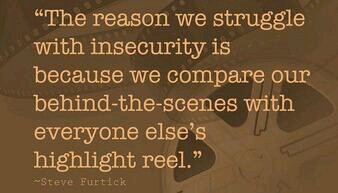
Insecurity

Three. You’re not alone.

Sure, there are a number of your peers for whom school is much easier than it is for you. That’s OK – everyone’s different. Most of the folks around you, though, are just putting up a good front – many just as panicked as you.

I know because I’ve had this same conversation often enough to make a blog post out of it. No offense, but I wouldn’t do this for just you. Too much work.

DevilAngelShoulderFour. Shut yourself up.

I suppose you could take this literally, as in “find a quiet place” – which is also good advice. But here I mean inner-dialogue-wise.

Remember the old cartoons with the AngelYou and the DevilYou on opposite shoulders? Contrary to what you might think, DevilYou isn’t primarily focused on trying to get you to rob banks or do crack. Those aren’t legitimate temptations for you – you’re a “good kid,” remember?

It IS, however, willing to maintain a constant stream of deprecation and frustration, running in the background of everything you think, feel, say, or do. Details vary with personal insecurities, but whether it’s despair, rage, detached cynicism, or simple self-doubt, it usually begins with tearing off little strips of you and pretending that’s the cost of being “honest” with yourself.

It’s lying to you. 

You can’t kill it or completely mute it – it’s you, after all – but you can recognize it and turn it down. Assign AngelYou to keep it in check. Quietly if possible, but out loud if necessary. Seriously – talk to yourself, realistically but positively. It’s good for you. 

You can be honest about your strengths and weaknesses without so much self-loathing. I promise. 

PlannersFive. Get a planner or agenda of some sort.

Mundane, right?

They work, but you have to use them. Starting TODAY, every hour, jot down what you did in class and what’s assigned and when it’s due. I know you think you’ll remember, but we’re having this conversation, so obviously…

Set your phone alarm to remind you at least twice each day – once around the time you get home from school and once several hours before you go to bed – to look at your planner. Read through it even if you don’t stop and do everything right then.

Anything that doesn’t get done gets copied onto the next day, and so on, until you do it. Continue this system even when you don’t think you need to – new habits take time.

Cross it OffSix. Choose a few things that won’t take long, do them, and cross them off.

If you do something that needs doing but wasn’t on the list, write it down, then cross it off. I realize it might sound silly, but – just trust me on this. It’s a “track record of success” thing. And it helps.

This next one is huge. Are you still with me?

The IsolatorSeven. When you’re doing a thing, do that thing.

If you decide to read an assigned book for twenty minutes, set aside that voice panicking about chemistry homework. While you’re doing your math, stop getting on your phone to “collaborate” on that English project. Pick something, and do it. No second-guessing.

One task at a time. That’s the most you can do, ever.

It’s easy to run from worry to worry until you end up exhausted and frustrated without actually getting much done. One of the greatest hindrances to completing anything is worrying about all the other stuff you suddenly fear you should be doing instead.

That’s a trap and a lie. Shut it off and choose something – right or wrong. Do it exclusively, and as well as possible. 

JugglingEight. When you’re working, work.

When you’re reading, read.

When you’re thinking, think.

Put the phone far, far away. Whatever amazing things unfold in the 20 minutes it takes to finish your calculus will still be there waiting for you when you take a break.

When you’re taking a break, take a break. Set a time limit and don’t keep finding reasons to go past it, but don’t keep worrying about what you’re not getting done.

And move around a little – it’s good for you emotionally and mentally as much as physically.

Side Note: Social power never comes from being perpetually or instantly available. Even if it’s not your intention to dangle your approval over others, delayed response time raises your standing in direct correlation to how long you let them wait.

Think of the times you’ve waited for someone to respond to you. Who holds the power in those situations? 

All Nighter

Nine. Start the big hard stuff early.

Even if you do something else first, do the bad thing next. Leave time to be confused, ask questions, or start wrong.

Human nature is to put off the stuff we don’t fully understand and to avoid thinking about that which we most dread. Suddenly it’s midnight and everything is due and you’re so totally screwed and it all breaks down.

Again.

What’s wrong with you? WHY ARE YOU SO STUPID?

That’s DevilYou, by the way. Didn’t you assign AngelYou to reign her in?

Adult BabyTen. Do the parts you can do.

Do everything you can do, even if you’re not sure of all of it. Then ask for help with what you can’t.

Read the directions – for real, this time. Call a friend. Actually read the material, take the notes, watch the videos, or try the activities. You’d be surprised how often a student thinks they’re confused when really they just haven’t done the work.

I mean, ideally there’s a reason we assign it. If you knew how to do it already, we’d just be wasting your time. It’s supposed to be hard.

When you’ve done the parts you can, THEN email or visit with your teacher. Otherwise we get this:

“I don’t get this.”

(What part don’t you get?)

“Any of it.”

(*sigh*)

Not effective. This, on the other hand…

“Mrs. _____, I have a question. I read this thing here and did this part here, and I notice in your example you indicate such and such. When I tried that, I had trouble figuring out ______________”

That I can work with. Makes it sound like you’re not just wandering around in a daze, waiting for a miracle.

Conclusion: It’s OK that it’s hard sometimes. Other times, it’s not nearly as hard as you make it. Try to separate your emotions from your thoughts from your abilities, and don’t get so derailed by what you WISH your teachers said or did differently. They didn’t, and they probably won’t, so work with what you’ve got. 

I promise you, you can do this. If I can understand it, ANYBODY can.

Kicking and Screaming

{This Post is Recycled – Reworked from a Previous Version and Reposted In It’s Updated Glory}

RELATED POST: Happy New Mirrors!

RELATED POST: Absoution (Bring Me My Crosier)


The Other

{This Post is Recycled – Reworked from a Previous Version and Reposted In It’s Updated Glory}

Rest Rooms White Colored

What’s wrong with segregation?

I ask my students this when we talk about the underlying causes of the Tulsa Race Riots – the ongoing circumstances in place just waiting for something to trigger them. Dick Rowland stumbling into Sarah Page might have been an incident all by itself, but it wouldn’t have burned Greenwood to the ground without combustibles already in place.  There were causes – one of which, most historians agree, was segregation.

If they’ve paid attention when we discuss Indian Removal, or Reconstruction, or Immigration, they should have an idea where I’m going with the question. Otherwise, they stumble through the clichés on which they were raised. Segregation is bad because everyone’s the same… we’re all equal… it’s wrong because it’s bad…

Black Girl What GirlTo their credit, some variation of ‘separate is inherently unequal’ eventually surfaces, whether they know Brown v. Board or not. They understand intuitively that when two groups are persistently kept apart, one will likely get a better deal than the other.

But what if it COULD be equal? We have Men’s bathrooms and Women’s bathrooms – separate, but similar. What if we could guarantee consistent quality, and equal value? Would segregation still be bad?

They’re sure it would, but aren’t often able to express why. Maybe they’re going on gut conviction; perhaps they’re simply THAT indoctrinated. Either way, we must discuss ‘The Other’.

When we lack relationships with people different from us, or when those relationships are so strictly defined as to preclude true interaction, we can’t help but see them as fundamentally unlike ourselves. We can’t know who we don’t know.

I don’t claim my district has eliminated all conceivable racial issues, but we’re a fairly diverse bunch – racially, economically, and to some extent culturally. We have lots of interesting colors, religions, a few very vocal non-traditional sexualities, and enough different home languages to keep things challenging.

GraduationI, on the other hand, graduated from a nearby suburban school 30 years ago with a senior class of around 700. Exactly two of my peers were Black – both guys, and both of whom played football and thus nowhere near my social circle. There was one Vietnamese kid – Truyen Nguyen – and he was really good at math. That was it in terms of diversity.

Well, there was one gay kid. We all kinda knew he was gay, but he didn’t seem to be aware of it, so we just let it slide. He knows now, and we’re all Facebook friends, so that seems to have worked out.

I had a strong, albeit largely subconscious, sense of ‘The Other’. My students don’t – at least not to such an extent.

I wasn’t particularly racist or sexist by the standards of my peers, but I walked in the sort of conviction and clarity only possible with limited knowledge, and in the peace of truncated understanding. Separate is inherently unequal, but also inherently obscuring. You can’t love, accept, or even properly argue with what you don’t know and can’t see. You don’t even know what questions to ask.

When anything involving other cultures or races comes up in class, my kids are well-armed with polite clichés and politically correct worldviews. They may even think they mean them.

But they lack depth because, for so many of my students, the idea of a world in which culture or race are a deep divide, capable not only of circumscribing what you do, but how you think, feel, or function – shaping reality itself… it’s just not real to most of them. At best it’s abstract and distant.

SelfieIn their defense, that’s true of 90% of anything we talk about – they’re Freshmen. They live in a perpetual ‘now’ with themselves, themselves, and those who amuse or arouse them this exact instant.

And themselves. 

They’ve been hearing the same handful of safe racial, religious, and sexual platitudes their whole lives, along with Stranger Danger and anti-bullying campaigns, but most have neither overtly experienced nor consciously perpetrated any of things being warned against. It can’t be real to them, any more than feudalism, factory labor, or war.

Most are simply unable to consciously fathom ‘THE OTHER’. If only we could add an odor to it, like with natural gas, we’d at least be warned when it begins to affect us…

History is full of ‘Them’. It’s fundamental throughout time and place. Babies gradually learn to distinguish ‘Me’ from ‘Not Me’. ‘Family’ is different than ‘Not Family’. In some bucolic regions, ‘Neighbor’ is still different than ‘Not Neighbor’.

As an evolutionary or historical approach, it’s not such an evil thing. As the earliest hegemonies or social contracts developed, they would inevitably involve ‘Us’ and ‘Them’ moments – over food, over land, over women. 

Much like ‘all snakes are poisonous’ or ‘reality TV is fake’, universals are a practical necessity when life is otherwise nasty, brutish, and short. The benefit of attentive discernment is outweighed by the risk. You may find a few exceptions to your rules, but the payoff is too small to justify the energy invested. “Look! A non-poisonous snake! I’ve devoted precious time and mental capacity to identifying it so I can… have absolutely no use for it. And if I’m wrong I’ll die painfully!” 

SnakesUnless you happened to be in a Disney Movie or After-School Special, the chances of making a new bestie when you reached out your Capulet arms to embrace a Montague stranger were slim compared to likelihood you’d become someone’s slave or lose your teeth so they could make a nice necklace. ‘The Other’ was scary. Dangerous. 

And to be fair, evolving from ‘All against All’ into ‘Us’ vs. ‘Them’ was actually a huge improvement socially and politically. At least you had an ‘Us’ instead of simply an ‘I’. At least societies could be built. 

Separately. 

But the world has changed. We are safer, healthier, better educated, and more entertained and entertaining than at any other point in human history. In the U.S. in particular, we celebrate ‘diversity’ in its ever-multiplying forms, and speak of being a great ‘melting pot’. Our foundational ideals, in fact, proclaim unequivocally that “all men are created equal, and are endowed by their Creator with certain unalienable Rights.”

Apparently this was unclear to some, so we added a 14th Amendment which explicitly states that a people is a people is a people. There are no gradients or levels of personhood or value in the eyes of the law or in the ideals of the United States.

Period.

That’s led to a number of kerfuffles as various individuals and groups seek to be part of ‘Us’ rather than being content in their roles as ‘Them’. They wished to be less ‘Other’. 

Some wanted to attend the same schools, ride the same busses, eat the same places, and live in the same neighborhoods as ‘Us’. Others wanted to form different sorts of families, promote different types of faith, or live some very different lifestyles, but with the same rights and respect as ‘Us’. 

Mutant Rights

It can get rather complicated. To our Founders’ credit, though, we’re mostly still trying to make it work. Contrary to how it sometimes seems, we’re getting closer and closer.

Or… we were, until a few short weeks ago. Whether or not we’ve changed our minds entirely remains to be seen. In any case, the tensions between our ideals (which most of us believe we believe) and our deepest convictions (which often run contrary to those same ideals) are just… well, it’s weird. Sometimes in a scary dark way. 

A towering sense of ‘The Other’ persists. At times it seems there are more ‘Them’ than there are ‘Us’, even 225 years after those ideals were so effectively used to birth a country whose primary task was to prove them workable. We can fight it, we can embrace it, or we can merely stumble along in ignorance of it – none of which changes that it’s there. 

If we could at least confess it, and confront it, though, we might be able to pull it into the light while we decide what to do with it. It’s shaping and changing us either way. It’s driving us to rattle our little tails and flatten our hoodie necks and spew our scary venom. There’s nothing inherently wrong with defending yourself, your “US,” or even your way of life. 

But let’s take a moment to make sure we’re not becoming the “THEM” we so fear. Let’s at least try not to become the snakes of which we’re all so afraid.

BCE #11FF Lunchbox Giveaway

Two Littles Demonstrate Wisdom

We’ll keep fighting over politics, and arguing about policies, and – if things go particularly well – debating the relative merits of fake news over the merely slanted. Whatever else this coming year will bring, it is unlikely to be predictable. Or boring. Or even remotely in keeping with the ideals envisioned by the Framers. 

BUT (and I have a big BUT), in the meantime, we have kids to teach, jobs to do, and blogging to promote. With that in mind, I bring you…

The Blue Cereal #11FF Lunchbox Giveaway Extravaganza!!!

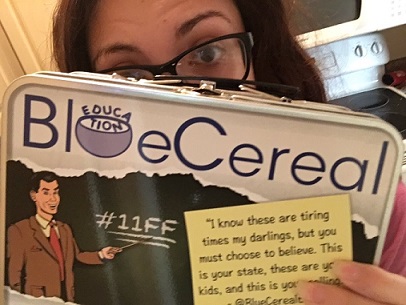
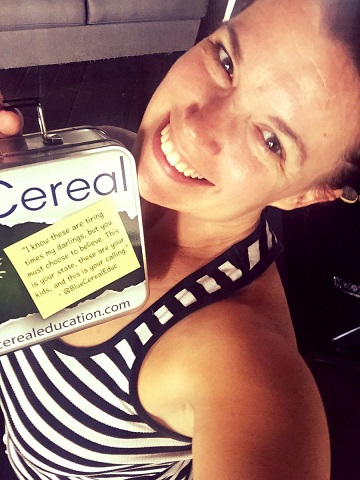
Meghan Loyd Lunchbox

Between now and January 1st, 2017, I’ll be giving away two of these coveted rarities each week to qualifying #11FF.

What’s #11FF? It’s a hashtag referencing my ‘Eleven Faithful Followers’ – a term coined in the early days of this blog when I hoped to someday reach up to a dozen or so readers. It’s now used to more generally refer to anyone joining the cause, in part or in whole.

Swisher Goes To Lunch

What do you have to do?

Share a link to something you find interesting or useful on Blue Cereal Education. Blog posts, new or old. Classroom strategies. Document Activities. Reading Lists. The initial chapters to that book I’ll never write, Well, OK Then… Anything you think might demonstrate your wisdom and insight for having shared it. Tweet the link with an appropriate comment from you, or post it to your Facebook wall with similar framing. Tag me or contact me to let me know, and you go into the potential winners’ cyberpot. 

Preference will be given to those who personalize the tweet or FB post rather than simply retweeting or sharing – although retweets and shares are appreciated as well. Self-promotion requires sacrifice, kids – on your part, I mean. I don’t personally like to be troubled with such things. 

BCE Lunchbox Angie Taylor

Each weekend I’ll randomly select two winners. You’ll be announced, contacted, and your #11FF Special Edition Lunch Receptacle will soon be on the way! Once you’ve received it and taken the appropriate pics (at least some of which should be clothes ON), you’ll be added to the #11FF page and have official #11FF Elitist status to flaunt in front of your friends or to justify that condescending tone you take with people who just don’t get it. 

It will be GREAT!

KB Looking Good For Lunch

There will be no giveaways in January. Very likely none in February. You want lunch bling, the time is NOW. 

What are you waiting for?

Looking Simply Too Good