Teachers Are Delusional

Teacher QuotesTeachers Are Delusional.

I don’t necessarily mean this in a bad way, although it does have a few downsides. 

As you probably know, public education in general and teachers in particular were thoroughly rebuked in the recent state elections. SQ779 went down in flames after polling rather well only weeks before, largely due to the efforts of mysterious groups who appeared out of nowhere and began panicking on our behalf over the sad, if well-intentioned, error we were all clearly about to make.

They embraced the new, “reality-optional” approach so popular these days with an effective, two-pronged strategy. First, make up a bunch of stuff people could easily refute if they bothered to read the actual question but didn’t. Second, treat this 1% tax as a misguided starting point for growthful discussions rather than a desperate, if flawed, last-ditch effort to overcome a decade of one-party rule and overt hostility towards the idea that every kid deserves committed, effective educators dragging them towards enlightenment. 

They promised a “better way,” which apparently involves disbanding and vanishing as soon as the votes were tallied.

Then again, I guess they didn’t say exactly who it was better for

Smirking legislators quickly joined the chorus of assurances that of course they’d immediately be doing everything they possibly could to give teachers huge raises, first thing! For totes realsies this time! Why would we doubt them? They’re our government – they live to serve! 

In their defense, legislators have no real reason to do anything about teacher pay or school funding in general. Incumbents responsible for draconian tax cuts and vocal belittling of all things government-financed were re-elected almost universally, often by landslide margins. They’d be silly to change course now – it’s working. 

For them, I mean. 
Batman On PhoneStubborn advocates insist they’ll be calling their elected officials weekly, demanding they do something about school funding – which, let’s face it, is adorable! I can hear the conversation now: “If you don’t do something this session, next time we’re only re-electing you back into office by a twenty percent margin! And the time after that could dip as low as a fifteen! Also, you should come visit my class! I made muffins! We’re forming relationships!”

No doubt legis find this hopeful yapping amusing, if not exactly endearing – at least until tiny pedagogists pee on their leg in excitement.

Many teachers have already left, or changed professions. Many more are looking to go. We’ve always lost a percentage of edu-graduates to surrounding states, but now we’re having trouble keeping any of them. You know things are bad when we’re not as civic-minded as, say… Texas. 

Texas. We’re not as focused on equity and the social contract and the value of modern education as TEXAS

What’s more shocking, though, is how many teachers are staying. Doubling down. Resolving to do everything they can to make this the “best year yet”! Holding assemblies, bake sales, and smothering Donate.org with requests. Personally, I find this to be the worst sort of enabling – of protecting and encouraging bad behaviour. As several of my therapists over the years were fond of saying, “They won’t change until you stop making THEIR problems YOUR problems, and let THEIR problems be THEIR problems.” 

Pet PsychicOr maybe that was Dr. Phil. They all kinda blur together.

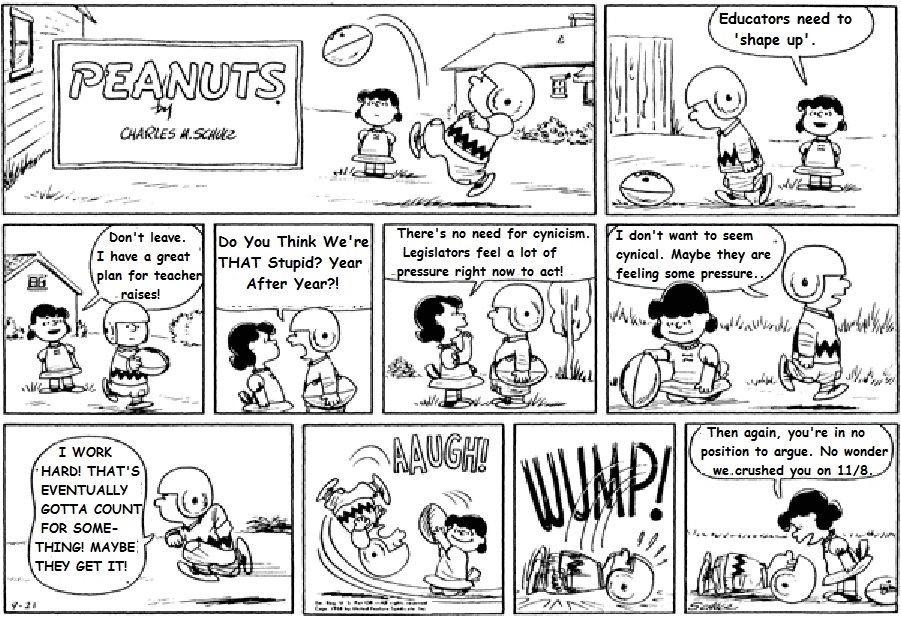
So why is it that teachers and other educators are so quick to believe that this time Lucy really will hold that football until it’s kicked? Why are we so quick to embrace the mantra that we can change our elected abusers with our love – and that if we’d only put a little more makeup on that bruise, maybe this time they’ll love us back?

It’s the nature of the profession. You can’t be a successful public school teacher for any length of time unless you embrace a certain amount of denial and delusion. You don’t expect musicians to be on time. You don’t expect surgeons to be humble and self-effacing. No way you can expect teachers to be bound by reality. They’d never last.  

Why?

1. We spend our day chasing the idea that we’re somehow reaching 150 very different kids with very different backgrounds, needs, and abilities. We utilize our personal skill sets as best we can (while always on the lookout for better ideas), but in the end it’s just us flinging possibilities around and hoping some of them take. 

Making this work requires a healthy dose of self-delusion. What’s really crazy is how often it does succeed, and so much better than it should. 

2. We embrace curriculums and guidelines not usually of our own design, circumscribed by rules and procedures certainly not of our own making. We take whatever we’re assigned and decide it will be meaningful, and engaging, and good for kids – their druthers and ours be damned. 

This isn’t as entirely misguided as it sounds. Most any subject or skill has merit, depth, and meaning if you dig enough – but it does require a certain degree of inner adjustment. Selling yourself and your kids on, say, the academic value and personal fulfilment of analyzing the Battle of Honey Springs takes a bit of imagination. It demands taming a few chimeras. And if you don’t believe it, they’ll never buy into it.

Although, if you think about it, that particular battle really did have some fascinating elements that – 

You know what? Never mind. 

Boring Training3. Surviving in the world of public education requires an ability to go through the motions of countless state and district-mandated trainings, reports, and meetings about what you teach and how you teach it and what we’re calling it this year – all without ending up under your desk in a fetal position, clutching a shiv made out of dry erase markers, daring anyone to say “flipped classroom” to you ONE MORE TIME. 

It requires embracing and adapting to ever-shifting evaluations of your kids and of what you do – a bedlam of rotating standards and priorities and trends and buzzwords. Usually without Dramamine. 

You want to flourish in that alternate reality? Unleash the ignis fatuus.

4. Finally, a career in education requires looking beyond the tangible, the visible, the measureable, with an almost religious faith. Maybe fanaticism. 

Of course the numbers matter. Of course the data has its uses. We’re delusional – not ignorant. 

But if faith is the substance of things hoped for, and the evidence of things not seen, then teaching requires a great deal of it. If you ARE doing any good, you’re unlikely to see the most important results during the nine months those kids are yours. If you ARE making a difference, in that silly, idealistic way you signed up for back-in-the-day when choosing between this or veterinary school, you’ll never actually KNOW that for a fact. 

It’s not that kind of difference. 

So yeah, we’re a bit quick to believe, even when we know better. And I do get annoyed by the naiveté shown by those who so easily and repeatedly trust elected leadership, wealthy reformers, or anything cloaked in lofty ideals.

But that’s the trade-off, I guess. If we were realists, we’d all be selling shoes or doing your taxes or something. 

So delusional it is. 
#Oklaed Football

Why Don’t You Just MAKE Them?

Mean Teacher Snape

“Why don’t you just make them ______?”

The most adorable befuddlement comes over non-educators when the subject of student learning or behavior is brought up.  

It’s completely understandable. Many of them have rose-damaged memories of their own school years – teachers wielding yardsticks, parents spanking and grounding, and a pervasive respect/terror of any and all authority figures. It’s a wonder we haven’t raised an entire generation of serial killers if even half these recollections are true. 

Mean Teacher Math

Then again, it would explain a great deal about Trump’s rise to power. A wider tie and some day-old stubble and he’s everyone’s caricature of “terrifying-but-largely-incoherent principal.” Generally avoided at all cost, he was just what you needed when schoolyard bullies were about to pummel you. It restored order to your universe to see his furies periodically directed at your oppressors… however similar his tactics were to theirs in retrospect. 

Nowadays, though, it seems educators and pedagogical trend-setters are more interested in wooing impressionable young squirrels to daintily learn-out-of-their-hands, instead of putting on their big-teacher panties and really educating those little turds – right up a tree if need be! My god, no wonder we have a nation of wimps – we used to learn reading, writing, and arithmetic; now we just share our feelings, learn about evolution and why everyone should be gay, then go back to talking about our feelings again. 

Restorative justice, expanded support services, all manner of training over different learning styles and emotional needs – it must seem ridiculous compared to hazy constructs of our own past. 

Whatever the reality of your own “dear old Golden Rule days,” brute force is not merely an ethically questionable classroom strategy in the 21st century – it simply doesn’t work. We can debate it on principle, but realistically… it’s just not realistic. 

Mean Teacher Old Man

Consider the things you think you found motivating as a child. Were you afraid of what your parents would say if your grades dropped or you got in trouble at school? That’s certainly a factor for some students today, but not all of them. Not always even most of them. I’ll spare you the sob stories – they tend to be outliers anyway – but life is complicated enough that “wait until your parents find out” simply isn’t a Top Five Concern for many kids. Thus, it’s not a big motivator.  

So bust their little butts at school, right? Detention? In-School Suspension? Trapped in a small room with a handful of other offenders, working in dead silence all day? It’s surprising how many students actually prefer this to a normal classroom environment. That’s bad, because we can’t possibly manage that sort of student-teacher ratio throughout the school, even if we wanted to reduce education to a few worksheets and copying down a page of school policies. Besides, kids don’t really learn that way – which is supposed to be the whole point of them being there. 

Of course, if they don’t do their work or cooperate at least part of the time, they’ll FAIL! That will teach them! That 13-year-old in front of you had better be making wise, mature, long-term decisions about his future. When his attention starts to wonder or his frustrations boil over, he needs to think big picture! Otherwise he’ll have a rude awakening six years from now when he can’t get into college or trade school, and then… ha! We’ll have won!

Again, not so much the goal.

So we do our best to make lessons engaging, and to adjust them each year, each week, each hour based on the students in front of us. You rarely pull them all in at the same time in the same way – turns out kids are a diverse bunch, inconvenient though that may be. Still, most of them are pretty decent people if you take the time to get to know them. Most want to do well, at something, by some standard, although what that means varies as widely as everything else about them. 

Mean Teacher Spanking

It helps if you like them, although I’m not sure it’s essential. It’s useful if they like you as well, although once again the correlation isn’t as strong as you’d think – kids can adore you all year long without it dramatically impacting their willingness to take the content seriously or complete a single assignment outside of class. Maybe not even during.

Call me a conspiracy theorist, but I’m positive there’s some sort of memory-erasing demagnetizer mounted in every classroom doorway which wipes each child clean of everything we’ve discussed and all they’ve sworn to do thereafter, then returns only the foggiest versions of those same memories when they re-enter 23 hours later.

Some of them are ridiculously energetic, and while we don’t want to dampen their zest for life, we desperately need them to calm down a bit so we can have class. Others barely stay conscious if left to their own devices for more than a few minutes, so we try to keep them moving and talking. Lectures get a bad rap, but a good one with enough visuals and some genuine interaction can cover tons of important information in a short amount of time – at least for the three-quarters of them who learn well that way. 

Group work can mean just about anything. Results regularly range from ‘shameful disaster’ to ‘best-learning ever’ – and that’s during the same class period on the same day, involving groups a mere two or three feet apart. Reading is ideal for those who, um… can read. It’s less ideal for those who can’t. Most are somewhere in between. 

Mean Teacher EarsSo you keep trying things, trying to gauge what works the most often for the most kids. It’s an imperfect science. 

If you want kids to cooperate, maybe even learn, you absolutely must know your content. On other days, though, far more important that you understand the kids – or at least be able roll with their ever-changing bizarro-worlds. You have to care about them, but not too much or it will render you useless. Well, that or kill you. 

You should of course adhere to district requirements and state standards, except if you do that too often, you’ll neglect the most useful, meaningful parts about your job – the stuff that make it tolerable, even in Oklahoma. You must establish that you’re confident and in control of each class, while leaving students a sense of freedom as individuals that doesn’t give them reason to resist you or deteriorate into a power struggle – which you then must win.

It’s unceasingly weird, I assure you.

Mean Teacher ManYou teach the kids in front of you, not just that year but that day. You woo them, you cajole them, you scold them, and yes – sometimes you threaten them. With appropriate school-ish consequences, I mean. Never with, like, painful physical mutations or twisted psychological destruction or anything. Not usually. And certainly not that anyone can prove. 

Because that would be wrong, probably. 

There’s a pedagogy to it, and there are better and worse classroom management techniques. But none of them – none with any value, at least – are “just make them do what you say.” I wish it were so simple.

Actually, that’s not true. 

I’m really, really glad that it’s not.

You Will Learn 

RELATED POST: Why Kids Learn (a.k.a ‘The Seven Reasons Every Teacher Must Know WHY Kids Learn!’)

RELATED POST: Tips For Parents (To Defeat Your Child’s Teacher)

RELATED POST: Classroom Management, 1920’s Style (Part One)

RELATED POST: Classroom Management, 1920’s Style (Part Two)

Let’s Talk About Vouchers, Part Four (The Story So Far)

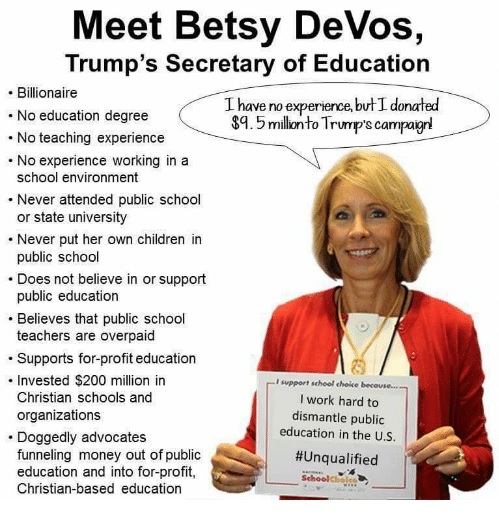
Meet Betsy DeVos

With President-Elect Trump’s selection of Betsy DeVos as Executioner of Public Education, talk of vouchers and their variations are once again filling the crispy winter air. If you’re not already following and reading the #OklaEd Trinity, you should begin by seeing what OKEducation Truths, Fourth Generation Teacher, and A View From The Edge have been saying on the subject. 

Actually, Miller (A View From The Edge) has been on a bit of a roll on this topic lately. I may add unnecessary sentences just so I can embed additional links without them seeming forced. 

How did I do?

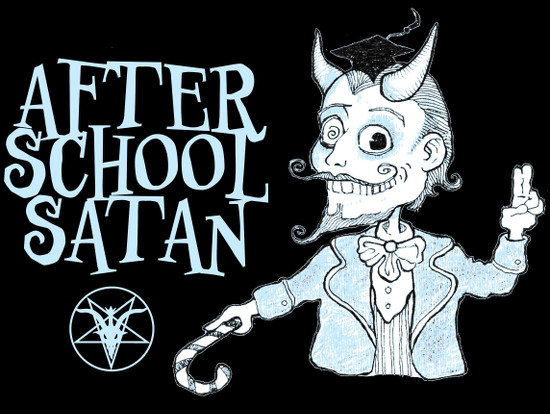
After School Satan ClubAs to yours truly, I’m working my way through Supreme Court cases related to “separation of church and state” as it impacts public education. Most of these involved prayer or religious instruction, although I’d hoped to get into some of the more interesting stuff like the Amish pulling their kids out of school after 8th grade or “After School Satan Clubs.” 

Yes, really. It’s fascinating stuff. 

As part of that, I became absorbed by Zelmer v. Simmons-Harris (2002) – a case which seemed to come up repeatedly when researching vouchers. The Court declared an Ohio program which included vouchers did NOT violate the Establishment Clause of the First Amendment, making lots of #edreform groups and big money types very happy. 

Here’s the basic reasoning that allows a voucher program potentially benefiting religious institutions to nonetheless remain constitutional:  

First, the goal is secular. Sectarian schools may benefit, or more kids go to religious schools as a result, but promoting quality education for all kids is a valid government function and religiously neutral in and of itself. 

One Nation Under God

Second, the vouchers can’t be designed to favor religious schools or reward parents for choosing them. Even with more “choice,” public options should remain less burdensome than private alternatives. 

Third, it’s the parents making the choice – not the government. This is critical. The vouchers (tangible or not) go from the state to the parent, who then makes the decision where or how to utilize them. 

In legal terms, this is comparable to a government employee receiving a paycheck and choosing to tithe or donate to a sectarian cause. That’s why voucher supporters are so devout in their rhetoric about money “belonging to parents.” That framing is critical to the constitutionality of the system. 

There are problems with this blurring of public and private funds, and it slights the foundational “social contract” which allows civilization to exist. But those aren’t constitutional arguments. In terms of separation of church and state, the Supremes have decided that this whole “parent choice” thing is key. 

There are, however, several critical differences between Ohio’s program and anything I’ve seen proposed in Oklahoma so far.

First, Cleveland schools were an absolute disaster by any measure, and decades of pouring extensive resources into efforts to improve them had failed. This is the exact opposite of Oklahoma’s approach – take decent schools and starve them into submission so you can declare them incompetent and justify taking away the remaining resources. 

Innovative SchoolingSecond, Ohio vouchers were part of a larger, heavily-funded series of educational efforts and innovations which included a variety of “community schools” and “magnet schools” (all part of the public school system) as well as additional funding for after-school tutoring and other forms of support for students who wished to remain in their traditional local public school. Oklahoma has a few token alternatives along these lines, but nothing like what Ohio was doing, and with such limited funding as to allow no real comparison. 
Third, schools participating in Ohio’s voucher programs were not allowed to pick and choose who they’d accept. Admission policies were regulated by legislation. All involved institutions were required to meet the same basic requirements as public schools, including state assessments. The program was specifically designed to serve low-income and low-performing students, not screen them out. It mandated student diversity, so that participating schools had to reflect rather than deflect the communities around them. 

Finally, Ohio put a tight cap on how much parents could be required to pay over and above the amount covered by the state, so that middle and lower income families could actually participate. Oklahoma’s proposals to date seem designed to subsidize those already likely to send their kids to private schools, effectively screening out the sorts of students those private school parents are trying to get their immaculately achromatic darlings away from

Taken together, it leaves me wondering if any version of vouchers or ESAs which Oklahoma is likely to pass could withstand similar constitutional scrutiny. Then again, daring the courts to overturn them is a point of pride with OK Legis. They love playing legal “chicken” with the third branch, whatever the extensive – and quite literal – costs to the rest of us. 

Since Zelmer, there have been several other significant voucher cases decided at various levels. I hope to write about some of them at greater length, but for now… a few highlights.

Arizona MapArizona Christian School Tuition Organization v. Winn (2011) – United States Supreme Court 
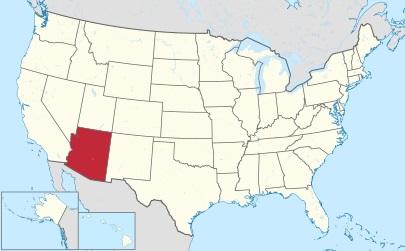
A group of Arizona taxpayers filed a lawsuit challenging tax credits given to individuals or organizations who donated to “school tuition organizations” (see “Oklahoma Equal Opportunity Education Scholarship”). The Court held that the plaintiffs lacked standing, and thus couldn’t sue. The connection between state-level budget decisions and their possible impact on any one taxpayer, the Court explained, was too tenuous to establish specific individual harm. 

However sweeping the constitutional issues in play, courts generally avoid taking cases based on theoretical damages or larger principles. They want to know if there’s a victim – in part or in whole. If not, they usually won’t act.

So that complicates things. 

The Court also acknowledged the State’s argument that the program was intended to save money in the long run, thus actually providing a benefit to taxpayers. Whether it actually worked out that way was not immediately relevant, since the lawsuit was founded on potential outcomes to begin with. Your Rube Goldberg forecast vs. mine, as it were. 

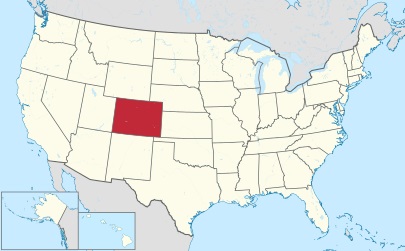
Colorado MapLaRue v. Colorado Board of Education (2016) – Colorado Supreme Court
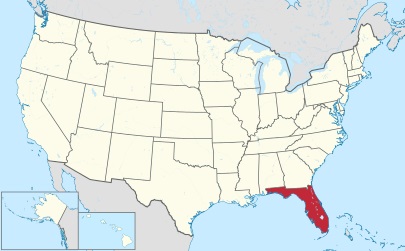
Colorado’s “school choice” program violated the constitution of the State of Nevada by giving public school money to religious institutions. This one is being appealed to the Supreme Court, some say with hopes the Court will negate or weaken the Blaine Amendment in many state constitutions. I don’t know if that’s a real possibility, but it would be… unfortunate. 

Blaine aside, this case has all sorts of fun little quirks I hope to explore soon. 

Florida MapCitizens for Strong Schools v. Florida State Board of Education (2016) – 2nd Judicial Court of Florida
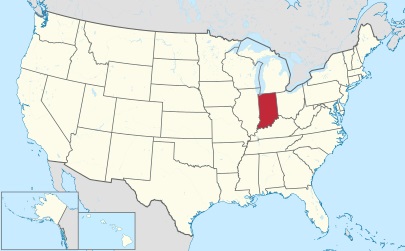
Parents complained that the state was diverting money to voucher programs at the expense of public education. State standards and assessments, furthermore, were constantly-moving-but-high-stakes targets, and legislation repeatedly punished schools via unfunded mandates.

Tell me this sounds familiar. 

Florida argued that educators with packed classrooms in high poverty areas simply needed to be more efficient. They spotlighted a smattering of special needs kids finding success through vouchers so that anyone opposed to general implementation must hate handicapped kids. 

The judge acknowledged some problems in the system, but didn’t find a violation of the Florida constitution. The case is currently being appealed.

Indiana MapMeredith v. Daniels (2013) – Indiana Supreme Court
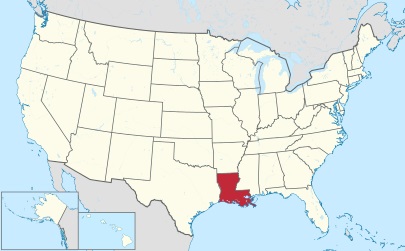
The Court determined that Indiana’s “Choice Scholarship” Program (vouchers) did not violate the state constitution, but took care to clarify in their written opinion that their ruling should not be misconstrued as validating the effectiveness or appropriateness of this legislation.

Louisiana MapLouisiana Federation of Teachers v. State of Louisiana (2013) – Louisiana Supreme Court
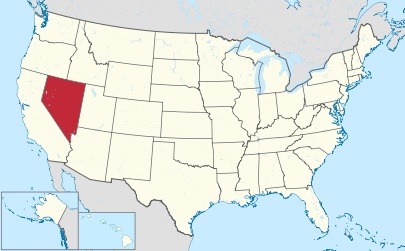
The Court determined that the “Louisiana Scholarship Program” violated the state’s own school funding formula and was thus unconstitutional. The Louisiana State Legislature got around this by passing a budget the next session which funded the program outside of that formula.

This is a solution I’ve had proposed to me off-the-record several times by legislators looking for palatable compromise. It strikes me as a distinction without a difference. In a time of ever-changing budgets, how we label which money at what stage is mere semantics. Bureaucratic sophistry. 

Still, it does allow a thin façade of principled concern, so keep your eyes open for something like this from OKC. 

Nevada MapLopez v. Schwartz (2016) – Nevada Supreme Court 
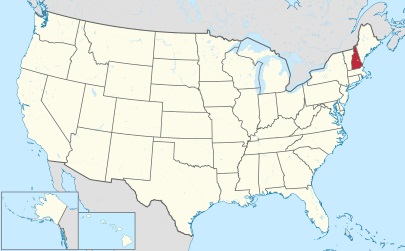
Nevada’s Education Savings Account (ESA) program violates the constitution of the State of Nevada by taking money out of public education and using it for something other than public schools. In this case, that means funding private schools, including religious schools. 

Nevada’s ESA system sounds VERY much like what’s been proposed in Oklahoma repeatedly. This is hardly a surprise, since state legislators take their cue from the same fiscal overlords who hand them the same pre-written legislation but have them write their own names at the top in big brown crayon so they feel like they’ve participated in some way. 

The Court did NOT base their decision on any “church and state” problems with the program, but with the specifics of Nevada law which require public education money to be spent on public education. However self-evident that seems like it should be, Oklahoma law may not read the same. I’ll be looking into this further. 

New Hampshire MapDuncan v. State of New Hampshire (2014) – New Hampshire Supreme Court… 
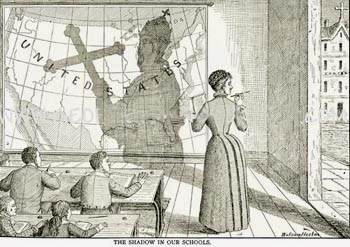
In 2012, New Hampshire passed legislation allowing businesses to receive tax credits for donations to “scholarship organizations,” who would in turn establish scholarships for students attending religious schools. (Refer again to the “Oklahoma Equal Opportunity Education Scholarship” and the note above about state legislation coming from the same few suzerains.)

This system allows the state to essentially pay for private schooling through means indirect enough to avoid constitutional challenge. It also frees up religious schools from having to deal with questions of diversity, equity, etc., since they’re not receiving funds directly from the state. 

The trial court which first heard the case determined the tax credit program violated the state constitution by allowing public money to be “granted or applied for the use of the schools or institutions of any religious sect or denomination.” The New Hampshire Supreme Court heard the case on appeal and determined that the state taxpayers who brought the suit lacked standing to sue – as in Winn, individual citizens couldn’t demonstrate they were being specifically and directly harmed by the program. 

Outcome-wise, that means this case counts as a victory for “school choice.” In reality, it was lost on a subjective, and someone questionable, judgement call regarding the plaintiff’s standing. 

Summary

The First Amendment “separation of church and state” argument has limited traction in voucher arguments at this point. It’s not without potential, especially if a state program is set up with substantially fewer public options receiving less funding, but it’s an uphill climb. 

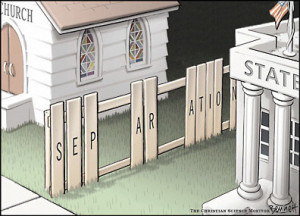
Blaine CartoonState constitutions containing a Blaine Amendment – like, say… Oklahoma’s – offer somewhat stouter potential resistance to lopsided “school choice” legislation. The bar is a bit higher if the state has to establish they’re funding public schools sufficiently and separately from whatever they wish to contribute to their church of choice via state purse strings. 

Finally, state constitutional guarantees regarding funding and support for common ed may be the most foundational source of resistance to any legislation further depleting public ed in service of elite demographics.

Public Education Advocates might keep in mind that the goal is not to quash genuine choice or belittle alternative routes to a well-rounded education. Our priority, I respectfully suggest, is to guarantee all students legitimate access to reasonably high-quality school experience, as part of what it means to be a civilized people – as part of the fundamental social contract that allows peace, prosperity, and progress to exist. 

We don’t need others to suffer for us to prosper, or for other pedagogical roads to be closed for ours to remain open and well-maintained. We’re just asking that our kids not be further marginalized and our teachers blamed for not being able to overcome problems far larger than a good lesson plan or a clever district program. We’re trying to remind Oklahoma and its leadership not only of the “rules,” but of why those “rules” – and  the ideals behind them – were such a good idea to begin with. 

RELATED LINK: The Blasphemy of Vouchers (from Dad Gone Wild) 

RELATED LINK: Who Really Benefits From Vouchers And Choice? (from Dad Gone Wild)

RELATED LINK: Top 10 Reasons School Choice Is No Choice (from Gadfly On The Wall Blog)

RELATED LINK: The Essential Selfishness Of School Choice (from Gadfly On The Wall Blog)

RELATED LINK: In Current Form, ESA Proposal Would Widen Inequality (from Oklahoma Policy Institute) 

The Wrong Enemies

Plethora ProblemFellow public school educator-types, we have a problem. 

OK, we have a plethora of problems currently, both locally and nationally, but in this case I’m talking about something we can actually control. I’ll confess up front that I’ve been one of the worst offenders. And I’m sorry. 

We’ve been choosing the wrong enemies. 

We’ve been falling into the same sorts of traps so easy to recognize when others do it, and categorizing our entire edu-world into an “US” column and a “THEM” column. 

US is, of course… US. The “good guys.” The public school educators, or at least the ones who seem to agree with us about most things. Mostly teachers, and maybe a few administrators we like. Those supportive parents who advocate for us on Twitter. And those eleven legislators out of 150ish that we kinda trust. 

Kinda. 

For now. 

Hostile StewEveryone else is suspect. Everyone else is “THEM.” And while most of us gladly make exceptions on a case-by-case basis, we too often throw them all together into one giant, hostile stew, and start passing out social media spoons. 
If we had real power, we might get away with that approach. It would still be wrong, of course, but it could still work because that’s how power is – you say and do whatever you want and the masses simply have to adapt. 

And boy, do they adapt. 

But we don’t have that sort of power, and we won’t anytime soon. This is going to be a brutal legislative year both nationally and here at home, and we’ll have little voice, if any. We lost on a grand scale, and the best we can hope is that the winners will throw some lip service our way. 

Thrown Under Bus

Oklahoma voters threw us and our kids under the overcrowded school bus last month, but most of them still want to feel like they care about public education. They want to be short-sighted and ignorant, but they don’t want to feel short-sighted and ignorant. 

Our elected officials recognize this. It still doesn’t give us much to work with, because the folks who won everything know they won everything. The vouchers and consolidation and re-segregation and teacher-shaming that’ve been barely restrained over the past decade of one-party rule will now be fully unleashed – but with a thin veneer of caring deeply about kids and education. 

Stay Puft Marshmallow ManWe may even be asked to choose the form of our destructor. “Zuul days, Zuul days, self-righteously cold and cruel days…” 

In the midst of this, my Eleven Faithful Followers, I respectfully suggest that if public education is to go down swinging, let’s at least swing the right direction. Let’s stop targeting the wrong entities and ideologies. 

It’s counterproductive, and it tarnishes those martyr complexes of which we’re so proud. 

I thus offer my top five “wrong enemies” for your consideration. If you are, in fact, a member of any of these groups, please take this as my apology for anything I’ve said to malign you in the past. 

Unless you deserved it.  

1. Private Schools / Parents / Educators 

Private School LadsPublic educators often feel backed into the corner by the recurring accusation we’ve somehow seized enough power and influence to force unwilling parents and children into our government-loving, reality-free, brainwashing machine. How can we continue to shamelessly strip parents of their most basic desire to protect their young, casting aside their desperate pleas as we leap away like hell-spiders, clutching their children in two arms and their tax dollars in another four?
Usually we try to explain how civilization works, and about the social contract, and how parents in Oklahoma already have choices, and about public money being public, and how equity serves the whole, and… 

At that point, the frustrations of trying to reason in a post-reality world often reduce us to lashing out at anything in the vicinity. 

There are numerous valid private school options across Oklahoma. Some are academically amazing, others meet needs beyond the four cores in their own unique ways. Many private school teachers make less than those of us in public ed, making what they do even more of a labor of love. And there are all sorts of reasons parents choose to send their kids to those schools. That’s a choice they have, and should have, and which we’re all better off for them having. 

They’re not the problem. They’re really not. If you’re afraid some other school or teacher is doing something better than you, then (a) thank them for what they do for kids, and (b) get better. 

I remain hostile and critical, however, of legislative efforts to further undermine public education in order to subsidize unbalanced systems or sectarian choices. A quality education for all is a valid government goal; taxpayer support of white flight and pedagogical cherry-picking is not. 

2. Charters / Magnets / Other Public School Formats 

Charter School ClassroomThere are so many varieties of what these terms can mean that it’s not practical to even attempt to cover them here. So, I’ll generalize:

If you’re a parent trying to do what’s best for your kid, I support you.

If you’re an educator trying to do what’s best for your students, I adore you. That applies whether you’re traditional or alternative, full-time or part, TFA or career. If you strive for similar goals, we’re on the same side.

If you’re a businessman trying to figure out how to siphon money from the system, using loopholes and lofty rhetoric to rationalize your fiscal priorities, then go to hell. Like, literally – I’m pretty sure you’re going to hell for that sort of thing. 

Jesus – the old-school, classic version, at least – loved kids (red and yellow, black and white, etc.) He hates the crap you’re pulling, and He knows the Bearded Old One. 

3. Homeschoolers 

HomeschoolingAny public school teacher can tell you there are two types of kids who show up in your class from a homeschool background. About 2/3 of them are amazingly well-rounded, inquisitive, with solid character and usually in good shape. They may be stronger in some areas than others – but aren’t we all? 
The other 1/3 have clearly been either playing video games or binge-watching Netflix for several years and know virtually nothing on which we can even begin to build. Their mothers are inevitably excited to tell you how much their child enjoyed some History Channel special about the pyramids and so she just KNOWS he’ll love your class. 

Your American Government class. With all the thinking, and writing, and questioning. And no pyramids. 

Homeschooling is neither good nor bad in and of itself. Like any other type of education, it’s all about who’s doing it and how they choose to make it happen. 

4. Politicians 

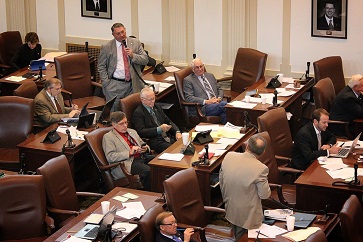
OK LegislatureWell, not all of them, at least. Not even all Republicans. 
And yes, that hurts a bit to say. 

There are a handful of office-holders at the state level who aren’t set on destroying all that is holy and good about America’s potential or our Judeo-Christian-ish ideals. Some of them even want to use their positions to serve the state and its people.

They’ll lose, of course – they’re far too outnumbered. But that doesn’t mean we have to sweep them up in our diatribes as we plunge into our own pits of despair.  

5. Other Public Employees and Professionals

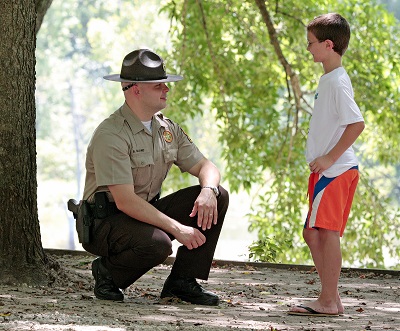
Park RangerThis periodic conflict is largely manufactured by those creating many of the state’s difficulties to begin with. Rather than address the reality that increasingly generous tax cuts in the service of their fiscal overlords and radical ideologies have not, in fact, resulted in a waterfall of prosperity, those in power deflect every request for educational resources as some sort of attack on DHS, or Law Enforcement, or Health Care. 
“What makes you deserve it more than them, hmmm?!” 

“Hey, did you guys hear what the teachers said about you?” 

“WHY DO YOU HATE FIREMEN AND PARK RANGERS?!?”

And really, that’s not so different from the problem in all of these cases – misdirection, or at least a general misunderstanding of the real issues. It’s rarely other people in comparable situations, doing their best with the resources at their disposal to accomplish whatever it is they’re called and hired to do. They don’t have the time or energy to be the real problem. 

Distraction SignSometimes there are fundamental issues about which we disagree. We rarely get to them, however, because of the obfuscation and misinformation slung about to distract us (and, more significantly, the general public) from the very tangible truths and preventable problems we currently collectively face.

From power corrupting. From money dictating. From inner ugliness clinging desperately to patriotic or spiritual gilding. 

I’m not interested in a general “kumbaya” or “why can’t we all just get along?” I’m just tired of somehow picking fights with folks who aren’t part of the principalities and powers pulling the strings. I’m resolving to do a better job of maintaining focus on the real issues in play and the underlying values in dispute.

I respectfully suggest that many of us could do a better job of insisting on clarity, and honesty, and saving the right outrage for the right time. 

I’m certain I won’t do a very good job of this at first, having practiced so many bad habits for so very long, but I also can’t think of a better time or place to start. Feel free to let me know when you think I’ve strayed.  

Die Hard

Let’s Talk About Vouchers, Part Three (The Majority Opinion in Zelman)

Voucher BoyWe’ve been looking at Zelman v. Simmons-Harris (2002), the case most often cited when I’m researching vouchers and their constitutionality. 

If you haven’t been with me on this lil’ journey so far, you might want to check out Part One or Part Two of this series. Or you might not. You might decide to consult other bloggers or experienced voices instead – it’s completely your choice. 

And as it turns out, “choice” is central to the Court’s 5-to-4 determination that Ohio’s voucher program was, in fact, constitutional. 

Chief Justice Rehnquist delivered the opinion of the Court. 

The State of Ohio has established a pilot program designed to provide educational choices to families with children who reside in the Cleveland City School District. The question presented is whether this program offends the Establishment Clause of the United States Constitution. We hold that it does not.

It’s worth noting that the question before the Court was about separation of church and state, and involved this specific program. The Court did NOT decide that all voucher programs everywhere were constitutional, and it certainly did not proclaim that they were equitable, justifiable, or in any way a good idea. 

Perhaps most significantly, this decision does nothing to address the question of whether vouchers worked.  

Rehnquist goes on to lay out the severity of the situation in Cleveland and to describe state efforts to address it before getting to the legislation in question. 

It is against this backdrop that Ohio enacted, among other initiatives, its Pilot Project Scholarship Program… The program provides financial assistance to families in any Ohio school district that is or has been “under federal court order requiring supervision and operational management of the district by the state superintendent” … 

The program provides two basic kinds of assistance to parents of children in a covered district. First, the program provides tuition aid for students in kindergarten through third grade, expanding each year through eighth grade, to attend a participating public or private school of their parent’s choosing…  Second, the program provides tutorial aid for students who choose to remain enrolled in public school… 

The tuition aid portion of the program is designed to provide educational choices to parents who reside in a covered district. Any private school, whether religious or nonreligious, may participate in the program and accept program students so long as the school is located within the boundaries of a covered district and meets statewide educational standards. 

Meets statewide educational standards? So that’s already different than anything proposed in Oklahoma.

Participating private schools must agree not to discriminate on the basis of race, religion, or ethnic background, or to “advocate or foster unlawful behavior or teach hatred of any person or group on the basis of race, ethnicity, national origin, or religion.” 

White White AcademyHere’s a fun little game. Go to Google Images and type the name of any private school – religious or not – in your area, and the word “students.” Look at all the wonderful photos which come up in your search results. Notice anything they all have in common?

I’ll give you a minute…

I’m not suggesting any of these institutions are consciously screening out students of color, or overtly shunning lower socio-economic segments of the community. I doubt they even see themselves as “white” or “affluent” or “privileged.”

They’re “normal.” It’s just that so many other people, well… aren’t. 

Aren’t you curious as to how many of these places would agree to some sort of racial equity in order to participate in a state voucher program? That’s not the specific issue being considered by the Court in Zelman, but it’s certainly a potential snag in any variation Oklahoma is likely to offer. 

Any public school located in a school district adjacent to the covered district may also participate in the program. Adjacent public schools are eligible to receive a $2,250 tuition grant for each program student accepted in addition to the full amount of per-pupil state funding attributable to each additional student. 

As discussed last time, this is a critical element of Ohio’s program – there are vouchers, yes, but they arrive with substantial additional support for public schools as well. 

All participating schools, whether public or private, are required to accept students in accordance with rules and procedures established by the state superintendent.

Voucher Insufficiency

I can’t hammer this point enough. It makes all the difference in the world not that there simply be choice, but who is making that choice. If schools get to pick and choose, that’s not parent choice. If parents can’t send their kid to the school they prefer, whatever its costs, expectations, or cultural norms, then by definition that’s NOT. PARENT. CHOICE. 

Tuition aid is distributed to parents according to financial need. Families with incomes below 200% of the poverty line are given priority and are eligible to receive 90% of private school tuition up to $2,250. For these lowest-income families, participating private schools may not charge a parental co-payment greater than $250. 

Private institutions who choose to participate cannot charge the neediest parents a significant amount beyond the value of the voucher. Period. (See previous point.) 

For all other families, the program pays 75% of tuition costs, up to $1,875, with no co-payment cap. These families receive tuition aid only if the number of available scholarships exceeds the number of low-income children who choose to participate. 

In other words, parents who qualify for that 90% deal above are prioritized when allocating resources. 

Where tuition aid is spent depends solely upon where parents who receive tuition aid choose to enroll their child. If parents choose a private school, checks are made payable to the parents who then endorse the checks over to the chosen school.

Sep Ar Atio NAs discussed last time, this is a big part of what makes the program constitutional from a “wall of separation” standpoint. 

The tutorial aid portion of the program provides tutorial assistance through grants to any student in a covered district who chooses to remain in public school. Parents arrange for registered tutors to provide assistance to their children and then submit bills for those services to the State for payment… 

You want choice, Oklahoma? Let’s add something like this to the mix. I’d even open it up to students themselves to tutor other students for money, if that proves beneficial. 

There are a few more financial details we’ll skip. 

The program is part of a broader undertaking by the State to enhance the educational options of Cleveland’s schoolchildren in response to the 1995 takeover. That undertaking includes programs governing community and magnet schools. Community schools are funded under state law but are run by their own school boards, not by local school districts. These schools enjoy academic independence to hire their own teachers and to determine their own curriculum. They can have no religious affiliation and are required to accept students by lottery…

When Oklahoma wants to do something like this, they try to remove things like minimum salary schedules and criminal background checks during times of deep budget cuts so that “empowered schools” can have “flexibility.” 

Somehow it doesn’t seem as freeing that way. 

For each child enrolled in a community school, the school receives state funding of $4,518, twice the funding a participating program school may receive.

Community schools – a subset of public schools – received twice what vouchers were worth to private schools, in order to better innovate and serve high-needs populations. That’s much different than “we’re cutting your budget again because we’re hoping the top ten percent of your student body bails on you.” 

Magnet schools are public schools operated by a local school board that emphasize a particular subject area, teaching method, or service to students… These schools provide specialized teaching methods, such as Montessori, or a particularized curriculum focus, such as foreign language, computers, or the arts…

Choices

Again with the variety and innovation and such, all within a public school context. Schools stepping up are supported, rather than expected to hunt down their own resources from the community or philanthropic businesses in the area. 

The decision then addresses the “separation of church and state” issue at some length. Their focus is on the distinction between direct aid to sectarian institutions and aid to parents who then choose from a variety of options, public or private, secular or religious. The former would be unconstitutional, the latter is not. 

I’ve done my best to wax pithy that issue before, and there’s nothing new here in that regard. But the Court keeps coming back to the issue of just how many choices parents were being offered in Cleveland. 

We believe that the program challenged here is a program of true private choice… and thus constitutional. As was true in those cases, the Ohio program is neutral in all respects toward religion. It is part of a general and multifaceted undertaking by the State of Ohio to provide educational opportunities to the children of a failed school district. It confers educational assistance directly to a broad class of individuals defined without reference to religion… The program permits the participation of all schools within the district, religious or nonreligious.

Adjacent public schools also may participate and have a financial incentive to do so. Program benefits are available to participating families on neutral terms, with no reference to religion. The only preference stated anywhere in the program is a preference for low-income families, who receive greater assistance and are given priority for admission at participating schools…

Not ChoicesThis is where I wonder if the lack of actual parent choice in previous Oklahoma proposals might play a role. I’m not sure that takes us all the way to the other side, but I suspect it could be a factor. 

The program here in fact creates financial disincentives for religious schools, with private schools receiving only half the government assistance given to community schools and one-third the assistance given to magnet schools.

I’m sorry, I zoned out for a moment – could you repeat that part?

The program here in fact creates financial disincentives for religious schools, with private schools receiving only half the government assistance given to community schools and one-third the assistance given to magnet schools…

Huh. That seems significant to me. Or have I mentioned that before? 

The Court notes that not every detail included is a deal-breaker in terms of constitutionality, but that collectively these specifics help distinguish between what Ohio was doing and alternatives potentially violating the Establishment Clause by pushing parents or students towards sectarian options. 

And then there’s this:

There also is no evidence that the program fails to provide genuine opportunities for Cleveland parents to select secular educational options for their school-age children. Cleveland schoolchildren enjoy a range of educational choices: They may remain in public school as before, remain in public school with publicly funded tutoring aid, obtain a scholarship and choose a religious school, obtain a scholarship and choose a nonreligious private school, enroll in a community school, or enroll in a magnet school. 

There it is again. Genuine, varied, financially supported public options – all over the place. The state was apparently awash in them. 

That 46 of the 56 private schools now participating in the program are religious schools does not condemn it as a violation of the Establishment Clause. The Establishment Clause question is whether Ohio is coercing parents into sending their children to religious schools, and that question must be answered by evaluating all options Ohio provides Cleveland schoolchildren, only one of which is to obtain a program scholarship and then choose a religious school.

I know it gets tedious, but the number of times Rehnquist returns to this theme strikes me as significant.  

Domination Of ChurchOhio’s program is constitutional because of all of the non-religious alternatives promoted by the state. If parental choice means a majority of kids end up in religious schools, that’s fine – as long as it’s the result of true choice. That means a variety of accessible options, both religious and non, public and private. 

So just how many choices beyond one’s typical public school need be available, and to what actual percentage of parents, for this to hold true? If the Court is suggesting this program steers clear of Establishment violations because of this plethora of possibilities, what’s the “cut-off” for that to remain constitutional?

In sum, the Ohio program is entirely neutral with respect to religion. It provides benefits directly to a wide spectrum of individuals, defined only by financial need and residence in a particular school district. It permits such individuals to exercise genuine choice among options public and private, secular and religious. The program is therefore a program of true private choice. In keeping with an unbroken line of decisions rejecting challenges to similar programs, we hold that the program does not offend the Establishment Clause.

There are a few related cases we should look at, as well as some concurring and dissenting opinions in this one. At some point, too, I’m curious how things are going in Cleveland these days. 

Looks like I’ll be coming back to this topic a few more times before we’re done. Thank god there are bunnies.

Bunny and Carrot

Curious Bunny

Anya Bunnies

RELATED POST: Let’s Talk About Vouchers, Part One (What Happened In Cleveland?)

RELATED POST: Let’s Talk About Vouchers, Part Two (Zelman v. Simmons, 2002)

RELATED POST: A Wall of Separation – Vouchers Approacheth