Bills, Bills, Bills (Silver Lining Edition)

I’m not known for the sunshine I spread or my rainbow-themed unicorn farm. I’m surrounded by edu-bloggers in Oklahoma and beyond who are both smarter and more experienced than myself, and I’m under no illusions about the role I play.

But I do believe in being pragmatic. Having spent most of 2016 burning energy I didn’t have promoting the so-called ‘Teacher Caucus’ and related issues in #OKElections16, and having had slightly less than zero impact (the pro-education newbies who won were the handful I’d never gotten around to writing about), I’d like to try to find approaches that might, you know… work. Or at the very least, play against type – like Daniel Radcliffe.

I don’t want to be naked horse guy, though – but it’s like I’ve been naked horse guy and now I want to be a wizard…

This has gone way off course, hasn’t it?

The 2017 Oklahoma Legislature officially convenes on February 6th. The rules vary between houses, but for the most part bills have to be submitted a couple of weeks ahead of time.

Which is now.

OK Legislature

Should you go poking around on oklegislature.gov or openstates.org/ok, you’ll discover a wide variety of bills and resolutions and thinly veiled cries for help. A few warnings should you decide to venture forth unprepared…

“Shell Bills” are a thing. Because State Representatives have to submit bills ahead of time, and have a limited number allowed, it’s not uncommon for them to throw together something filled with essentially meaningless language as a placeholder of sorts. Sometimes these end up being fleshed out with details related to their working title, other times they simply wither on the statutory vine. Occasionally they end up being bills about entirely different things altogether. It’s a misleading quirk of the system.

Every year brings a ridiculous number of bills fetishizing guns, proposing draconian punishments for abortion, fighting back against perceived abuses by the federal government, etc. Most of these never make it through a committee – they’re just there so demagogues can appease angry and/or ignorant voters in their respective districts. These are sometimes referred to as “red meat” bills.

Bills aren’t automatically put before the entire House or Senate. Some die right there in their sponsor’s arms, like buried flowers. Others are assigned to a related committee, where they may or may not be discussed, may or may not be approved, and may or may not continue their journey “I’m Just A Bill” style.  House versions are reconciled with Senate versions, etc., until a small handful go to the Governor to sign – or not.

Just because something’s listed here doesn’t mean it’s going to be a thing. Don’t get your hopes up or expect your legislator to have the slightest idea what you’re talking about should you call and ask them to support one of these.

And yet, that’s largely why I’ve gathered them here – so you can call, and email, and bring them up at meetings. So we can have things to support and not just things to oppose. So we can bring solutions and not just –

Oh god, maybe I DO have a unicorn farm. Is that Celine Dion playing in the background? Has Meghan Loyd hacked my account?!

Unicorn Farm

Whatever my frustrations – and they are legion – I think we can do a better job this session of starting off positive. Of demonstrating that we can be informed and rational and not all racist thugs like Rick Cobb.

Sorry – inside joke. Rick is not a racist thug. See, what happened was…

I’m off course again. Sorry. Legislation is boring.

Here are a few things worth looking at, asking about, and possibly promoting as we march boldly into the fray. Please feel free to add anything I’ve overlooked in the comments, or email me. Heck, write a guest blog about some of them if you like.

Light is all we have.

Pay Raise Bills

The Tulsa World recently did a nice slideshow highlighting some bills which caught their attention, including a variety of teacher raise proposals. Because I’m still rather skeptical of the chances of ANY of these passing, I’ll just share the highlights here:

Proposed Teacher Pay Raises

HB 1115 – Representative Avery Frix (R), HD 13

This would prohibit the state legislature from passing new mandates on public schools unless they’re willing to fund them as well. Crazy kid – clearly Frix is new here!

HB 1279 – Representative Jason Dunnington (D), HD88

This would return income tax rates to what they were a little over a decade ago for the state’s highest earners. It would also remove the Oklahoma Capital Gains Deduction which was enacted in 2004 and benefits the top sliver of Oklahoma’s wealthiest almost exclusively.

Dunnington argues this would generate more than $500 million in recurring revenue – recurring revenue, not the kind you get by selling grandma’s car at the auction. He’s quick to mention teacher pay as something that revenue might be useful to fund.

It strikes me as a long-shot – it will be smeared as a “tax increase” – but for the first time in a while, legis seem to be talking seriously about meaningful ways to get un-broke, so who knows? Two of the bill’s three sections simply close existing tax loopholes – and that’s something we all at least claim to support.

In any case, this is a good one to get behind and call YOUR representative in support of.

HB 1351 – Representative Monroe Nichols (D), HD72

Currently, the Oklahoma Higher Learning Access Program (aka “Oklahoma’s Promise”) helps pay for college for students who meet basic requirements in High School and who fall below a certain income level. There’s an exception made for military families (who tend to move around a great deal) – their kids qualify regardless. This would add a similar exception for teachers’ kids.

It would be a simple, almost revenue-neutral way to show some love to educators. I’m just saying.

HB 1352 – Representative Monroe Nichols (D), HD72

Since 2011, Oklahoma has had the “Oklahoma Equal Opportunity Education Scholarship Act.” Essentially this allows individuals or businesses to donate money to a ‘scholarship fund’ which is disbursed as a sort of voucher (i.e., “scholarship”) to parents who’d like their child in private school. These individuals and businesses get a substantial tax break on moneys so donated.

This bill would add the option of donating money under similar conditions with the same limits and tax benefits to an endowment to fund the salaries of public school teachers. I’m not clear on how this works in terms of disbursement, but the idea amuses me to no end. It’s brilliant.

HB 1760 – Representative Katie Henke (R), HD71

Students in Kindergarten through Third Grade are monitored regularly for reading proficiency. Students in Third Grade take a reading exam (often referenced as the RSA – Reading Sufficiency Act) to determine whether or not they’ll advance to Fourth Grade.

Currently, students who do not pass this exam are not automatically promoted to Fourth Grade. A small team of the child’s parent(s), teacher, and a school reading specialist or similar professional meet to decide whether it makes more sense to retain the child another year or move them to Fourth Grade with additional reading support. The idea is that some kids just need more time to marinate where they are, while others should progress but with increased support.

This compromise ends this year and retention could become mandatory (no discretion left to the parents and teachers) unless this or something like it passes this session.

This bill is very similar to HB 2158 sponsored by Representative Jadine Nollan (R), HD66, and SB 123 sponsored by Senator J.J. Dossett (D), SD34. That’s neither unusual nor bad; it suggests widespread interest in making this happen. They can work out any minor differences once things are rolling.

HB 2154 – Representative Jadine Nollan (R) – HD66

This would continue altering the rubrics and algorithms of the Oklahoma A-F School Shaming System. It has lots of words in it and bunches of stuff in current law which it would cut, so I make no promises about my full understanding, but the gist of it seems to be to dial back the more abusive elements of A-F, citing the flexibility allowed by the ESSA. 

It retains the A-F report itself, which I despise, but the innards seem to be gradually reworked in order to make the package less loathsome. I’d speculate this is a pragmatic compromise on the part of pro-education leadership with those who simply insist on looking tough on those damn teachers. The fact that no one will go on record with me to confirm this pretty much convinces me that’s the case. But, that’s just me – speculating.

HB 2158 – Representative Jadine Nollan (R), HD66

See HB 1760 above.

SB 2 – Senator J.J. Dossett (D) – SD34

This eliminates the U.S. History state test currently required of all high school students in Oklahoma. Now, we all know what’s going to happen. We cry out that there’s too much testing and it doesn’t do what proponents claim it does and why can’t we have fewer tests OMG OMG OMG! Then, someone suggests eliminating a test from the pantheon and we panic in reverse – ARE YOU SAYING MY SUBJECT ISN’T IMPORTANT ENOUGH TO TEST?! WHY DO YOU HATE AMERICA?!

This doesn’t remove U.S. History from the “stuff schools are required to teach” pile. Like Oklahoma History and American Government, it’s still a requirement – just not a state test. Calm the hell down.

On a side note, I think this one has at least some potential to erupt into the most fascinating patriotism-pissing contest if someone decides to go after it as anti-American or some such nonsense. Not saying it will – certainly not suggesting it should – but we have a weird relationship with history in this state. We don’t like it really, but we like it in theory and want to pretend we care about it deeply. It’s our arm-candy third wife, as it were.

SB 9 – Senator J.J. Dossett (D) – SD34

This would eliminate the straight-party voting option from Oklahoma ballots. That’s not directly related to public education, but it would do education a huge favor if voters were expected to at least look at the names before them and consider whether or not they know anything about that person’s positions or record before checking that box.

I know taking ten minutes to get informed before voting sucks, but we can try.

Voters elected and re-elected by substantial margins legislators openly hostile to public education in November 2016. They then turned around and told pollsters that their NUMBER ONE CONCERN for the upcoming legislature is supporting public education. They’re either lying or ignorant. I assume they’re lying – they want to sound like good people when polled, so they pretend they give a damn. This bill presumes they’re merely ignorant, and don’t see the connection. It doesn’t promise they won’t still vote straight ticket, but they have to take a few more tiny steps suggesting they mean it.

SB 123 – Senator J.J. Dossett (D) – SD34

See HB 1760 above.

SB 124 – Senator J.J. Dossett (D) – SD34

This would prohibit public money from being used, directly or indirectly, to support private schools (w/ the Lindsey Nicole Henry Scholarships for Students with Disabilities being a specific exception). This is obviously an effort to erect a roadblock to future voucher bills, and difficult to argue with it as a matter of principle.

SJR 32 – Senator J.J. Dossett (D) – SD34

This would put to a vote of the people a change in the Oklahoma Constitution which would require appropriates for public education to be made separately from general appropriations, and first. Man, give a guy an unexpected special election win and a year later he’s getting all saucy!

I’m sure there are some I’ve missed, and I know there are several I didn’t miss but am not sure how to explain (since I barely understand them myself). Feel free to add those you come across in the Comments below.

I’m still skeptical anything good is coming, but that doesn’t change our obligation to try. Be prepared, be firm but polite, and for golly gosh jeepers – BE INVOLVED.
The Civil War in I.T. (From “Well, OK Then…”)

The time between Indian Removal in the 1830s and the outbreak of the American Civil War in 1861 was a comparatively peaceful – almost prosperous – era for the Five Civilized Tribes (5CT). 

Then again, when you have a century of suck on either side of a generation, the bar for “Golden Age” status isn’t particularly high. 

Historical Divisions

Despite our tendency to speak of the 5CT as a single entity, they were different tribes composed of individual people – and people never quite fit the generalizations we impose in retrospect. Within each tribe there were mixed-bloods and full-bloods, progressives and conservatives, slave-owners and those with little interest in the practice. Every society has those resistant to change and those quick to rebuke their own culture and the ways of their forebears. Every community has outspoken members and those who simply wish to be left alone. The details may vary, but the same was true of the relocated tribes. 

The full-bloods tended to be conservative and – having no desire for cash crops – had little interest in owning slaves. The mixed-bloods tended to speak more English and interact with whites – being family and all – and were more likely to participate in the larger economy. They were far more likely to own slaves, although many did not. 

There were exceptions to these generalizations, the most obvious of which was John Ross – a mixed-blood Cherokee who spoke perfect English and had been educated in white-run schools. He was nevertheless considered overall “Chief” of the Cherokee, with his most loyal followers being the older, full-blood members of the tribe. 

The greatest bitterness, though, came from divisions during Indian Removal. The “Western Cherokee” who’d moved in 1817 had largely embraced the New Echota group, led by Stand Watie and others, upon their arrival in the early 1830s. Those arriving on “Trail of Tears” several years later felt betrayed on the deepest level by those who’d signed the treaties trading away their homelands. Several “Treaty Party” leaders had been assassinated in response.

The Creek experienced a similar split, aggravating issues predating removal. They emigrated to I.T. in waves, beginning with supporters of William McIntosh – another leader executed for his compromises. The Choctaw and Chickasaw had their own struggles with removal, but they stayed largely united during the experience. And the Seminole…

The Seminole are just always hard to pin down in regards to anything. They fought removal and never actually lost, even though many moved. They had “slaves” that weren’t quite actually “slaves” – just… not quite new additions to the tribe. And they… 

I’m not really sure what to tell you about the Seminole. 

Nevertheless, the Tribes largely rebuilt their worlds in the generation after removal. They established new schools, churches, communities, and in some cases even printed their own newspapers. What would later be named “Oklahoma” was, for a generation, truly a “Land of the Red Man,” although it was largely a “Land of the Black Man” as well. Slavery among the Tribes was still slavery, but it was rarely as brutal or dehumanizing as it was in the South. In some cases it was essentially independent living in exchange for a share of whatever they’d grown or produced. 

And then the white people got into a war. With themselves. 

Bringing I.T. Into the War

By and large, the 5CT were more than happy to learn that white people were shooting at one another. This was a win-win for them. They weren’t in a geographically essential location – that was part of the reason it was chosen, after all – and had little interest in involving themselves in the white man’s war, at least at first.

Until Albert Pike arrived. 

Pike was a Hagrid-looking character, a southerner who’d been born and raised in the north. He began his professional life as a reporter in Arkansas, then a lawyer, and became a strong advocate for various southeastern tribes over the years – minus time in the military fighting in the Mexican-American war. A staunch defender of slavery, he became a loyal Confederate when sides were chosen. 

Pike was an ideal choice of ambassador to the 5CT. He was familiar and trusted, and he made compelling arguments why they should support the South in this war.  

The Choctaw and Chickasaw signed up with little debate. They were already more like the American South than the remaining tribes, more agricultural and owning more slaves than the rest. The remaining tribes split over the issue – often along lines lingering from previous disputes. While officially all Five of the “Civilized Tribes” joined the Confederacy, substantial minorities of the Cherokee, Creek, and Seminole fought for the Union. That whole “brother against brother” thing was brutal for everyone involved, but in some ways it hurt the 5CT most. 

At first gander, the preponderance of support for the South seems surprising – the Tribes had been ejected from the south, and harassed by southern states prior to that. But that’s not how most viewed the situation. It’s almost certainly not how Pike framed it. 

So why join the Confederacy?

First and foremost, the Tribes owned slaves. Most individuals did not, but that was true of the American South as well. The culture supported it, and the same folks who tended to be fiscally ambitious enough to need slaves tended to be politically active as well. Leaders who weren’t slave-owners weren’t exactly abolitionists either, so there was little in the way of a “balancing viewpoint.” There were pro-slavery voices, and there were those who had other concerns instead.  

Second, Indian Removal was remembered as a betrayal of the “Great White Father” in Washington, D.C. – not so much as a conflict with individual states. Their treaties had been made with federal power, and either enforced or broken by federal soldiers taking federal orders. It didn’t help that the same federal government wasn’t particularly consistent following through with promised supplies and other resources. 

Third, the Union soldiers who’d been stationed in and around I.T. as part of the Tribes’ latest treaties with the U.S. had been pulled and reassigned as soon as it became clear war was coming. It’s not that the Tribes were such great buddies with the soldiers, but plenty of Plains Indians who hadn’t earned the sobriquet “Civilized” were still active in the region, and the U.S. military provided a decent buffer against their brutality. 

Fourth, the 5CT had more in common with Americans in the south than they did those in the north. Friends or not, many Amerindians practiced agriculture – none owned factories. Many lived on farms or in what white culture would see as ‘semi-rural’ settings – none lived in tenements. Many relied on themselves and their traditions to guide them – few saw value in reform movements, technological progress, or ‘Great Awakenings.’ While the federal government had let them down repeatedly, the largely sympathetic ‘Indian Agents’ with whom they dealt and through whom they processed white society were mostly from the south. 

Finally, with no way to predict the outcome of the conflict, the South offered them a better deal. The North – in the form of the federal government – had already lost whatever credibility they might have had, while the South promised the Tribes more protections, greater autonomy, and all those “states’ rights” kinds of things that would become so prominently recalled after the war. The South also promised to assume commitments made under previous treaties with the U.S., including the annuities the North had ceased as soon as distracted by conflict with the South. The North and their President Lincoln, meanwhile, were aggressively promoting westward expansion. If you don’t see an immediate problem for the tribes in that, look at any map. 

So, despite the splits described previously, the Confederacy it was.

It wasn’t going to work out as well as they’d hoped. 

Red, White, and War 

Like anything in history – especially when that anything is a war – the depths into one might plunge are limitless. I generally limit myself to four key events when covering the Civil War in I.T. 

1. Opothleyahola

Opothleyahola – or “Opie” as we end up calling him in class if we ever wish to get past the ongoing struggle to pronounce his name comfortably – was a Creek leader who’d been fighting the federal government and white encroachment as far back as the War of 1812. He was a wealthy landowner, a Baptist, and a Freemason (all the cool kids were back then). 

By the time the Civil War came to I.T., Opie was so over white guys and their talent for disrupting and diminishing the Tribes. He was unwilling to join the Confederacy, but no fan of the Union. Others of similar mind found their way to his plantation in fits and starts, and he soon found himself the default leader of several thousand Creek, Chickasaw, Seminole – even some runaway slaves and other miscellany. The unifying characteristic was their desire to stay out of this war. 

Opie received permission from President Lincoln to lead this amalgam to Kansas. There were fewer than 2,000 warriors, but they hoped to avoid conflict with either side. The majority of their band were women, children, old men, and livestock – little threat to anyone. 

It didn’t work out that way, and troops were sent by the Confederacy to persuade them to change their mind. The first “Red on Red violence” of the war took place against a group trying to do what they’d all wanted to do initially – just stay out of it. 

Opothleyahola began his trek with somewhere in the area of 9,000 wanderers, and arrived in Kansas with less than 2,000 by most estimates. War, winter, hunger, and disease did their damage just as they had a generation before. The Union encampment there was completely unprepared for even these diminished numbers, and were of little help. After doing what he could to secure assistance for his people, Opie led those still able to fight back into I.T. to war against the Confederacy. He’d die in one of the Kansas refugee camps before the war was over. 

2. The Battle of Pea Ridge (March 1862)

Early 1962 was not going well for the Confederacy in the Western Theater. Ulysses S. Grant was making a name for himself and captured Ft. Henry and Ft. Donelson along the Mississippi River, nearly cutting the South in two and enabling the Union to squeeze the secesh into submission. The Confederacy saw St. Louis – right there where the Mississippi and Missouri Rivers converge – as the key to reversing this trend. 

General Albert Pike was called to I.T. to take command of Amerindian troops there, primarily Cherokee. They were poorly supplied and barely organized, and many weren’t enthused about supporting the Confederacy. Nevertheless, Pike led them into Arkansas (despite initial guarantees they would fight only to defend I.T.) where they joined in the Battle of Pea Ridge in March of 1862. 

The Battle of Pea Ridge could fill an entire History Channel special. For our purposes, there are three things worth remembering. 

First, this was the first time Cherokee troops fought on this scale in a white man’s battle. The Amerindian ways of fighting were dramatically different than white guys’ methods – the goals, the strategies, and especially the command structure. The U.S. and Confederate militaries were organized along a strict hierarchy. While not as loosely organized as the Plains Tribes, the Cherokee simply didn’t work that way – not socially, not politically, and certainly not militarily. By white military standards, they were a mess. 

Second, most of Pike’s Amerindian troops fought with bows and arrows, or with tomahawks. That’s what they had, and what they knew how to use proficiently. Unfortunately, against somewhat trained soldiers with guns, they were of limited impact in this situation. 

Third, and most importantly, the Cherokee were accused of scalping some of their Union victims. While this apparently did actually happen, the details are a bit vague. What is certain is that knowledge of this spread widely and quickly, growing and distorting in ways you wouldn’t think possible before Facebook. White soldiers on both sides were horrified – that is NOT how civilized men behaved! Kill and maim one another PROPERLY! 

Pike was outraged at the treatment of the Amerindian troops in his command and excoriated in press and popular opinion for “allowing” scalping and general savagery to take place. He was the only white commander on either side to so vigorously advocate for them, albeit unsuccessfully, and he paid the social and political price for doing so. His Cherokee withdrew to I.T. where they were left unsupported and unprotected. 

Oh, and by the way – the Union won. 

3. The Weer Expedition 

The Union had two goals for I.T. in 1862 – push back against Confederate advances in the region, and restore the pro-Union Amerindian refugees to their homes. Seemed simple enough, and the goals certainly complimented one another. 

Colonel William Weer was appointed to command several white and two “Indian Regiments” along with supporting artillery. Pike was so annoyed at this point he refused to even lead the Confederate opposition, although Weer would face sporadic resistance along the way, especially from Cherokee forces led by Stand Watie.

They got as far as Locust Grove, about halfway between modern Tulsa and the Arkansas border. There they defeated some Missouri rebels and captured their supplies, but decided to wait for their own supply train to catch up as well. (It’s not like an army can forage its way through Oklahoma – if the land were that rich, we’d never have sent the Indians here.)

During the wait, Union forces fell apart all on their own, without the Secesh having to do much to help. It was July by then, and hot. Really hot. Too hot. Supplies were running low again, and soldiers with nothing to do and no real fortifications had plenty of time to worry about Confederate counterstrikes. To top it all off, Weer was apparently quite a drinker. Like, crazy useless drunk pretty much full-time by this point. Underlings swore he’d genuinely lost his mind as a result and was no longer fit to lead even when he was sober. 

His second-in-command arrested him and took over, ordering a withdrawal of the white troops but leaving the Amerindians behind without orders. Had the Confederates been in a position to take advantage of this, it could have shifted the balance of power in I.T. back in their favor. But they weren’t, so it didn’t. Those locals who’d been “resettled” were nevertheless nervous about the withdrawal and complete lack of a Union strategy, and most began heading to Kansas yet again, where they spent another winter in refugee camps, suffering from cold, hunger, and disease. 

Overall, the expedition was not considered a huge success. 

4. The Battle of Honey Springs

July of 1863 was arguably THE turning point of the entire Civil War. In the Eastern Theater, Lee’s second and final effort to bring the war to the North was thwarted at the three-day Battle of Gettysburg. In the Western Theater, the nearly two-month-long Siege of Vicksburg perpetrated by U.S. Grant finally ended, securing control of the Mississippi River for the Union. The ‘Anaconda Plan’ was complete (although Winfield Scott had since passed away and thus missed his opportunity to gloat). 

In the same month, the Massachusetts 54th Infantry – the first substantial use of Black troops in the war – made their dramatic but costly charge on Fort Wagner in South Carolina. While a strategic defeat, the performance of the 54th settled for the remainder of the war the question of whether or not Black troops should be allowed to fight as relative equals. Finally, in Indian Territory, the Battle of Honey Springs – the “Gettysburg of the West” – secured Union control of I.T. for the remainder of the war. 

OK, no one outside of Oklahoma teaches Honey Springs as the “Gettysburg of the West.” Most people inside of Oklahoma don’t either. But when you’re Oklahoma, you grab on to whatever validation you can get, kids. 

Did you know Carrie Underwood is from here? And several astronauts? We matter! Shut up! 

A year after the Weer debacle, Union forces had successfully occupied Fort Gibson and were maintaining a limited military presence in I.T. once again. Being how it was a war and all, the Confederacy hoped to drive them out, and assembled about twenty miles away at Honey Springs Depot. From there they sent out cavalry to harass and attack Union supply lines and take advantage of whatever other opportunities presented themselves without fully engaging. 

Honey Springs had already become an important location to the Secesh in Indian Territory. Troops came there for medical attention, to get whatever limited supplies were available, etc. It was essentially “home base” for the South. General Douglas Cooper, a veteran of the Mexican-American War and former Indian Agent to the Choctaw and Chickasaw, was in command. 

It was hard to keep secrets in wartime, and Colonel Phillips, in command of Union forces at Fort Gibson, was well-aware an attack was imminent. Rather than wait for the Confederates to receive reinforcements, Phillips decided to take the war to them. He was joined by Major General James Blunt from Kansas, who brought additional troops and artillery, and who would thenceforth be in charge. 

As mentioned earlier, war aficionados can stay all tingly for days over the details of this or that battle, strategy, or new bridle design. Here are the key points I consider worth remembering about Honey Springs – other than that “Gettysburg of the West” thing, I mean. 

First, it was arguably the most racially diverse battle of the Civil War. Blunts troops were a mixture of white, Black, and Amerindian forces, while Cooper’s troops were mostly Amerindian with a few white regiments. Whites were in the minority on both sides. 

Second, it rained. In addition to the general unpleasantness of marching and fighting over wet ground, the Confederates discovered their cheap gunpowder had absorbed too much moisture and wouldn’t fire. At the risk of getting all technical, it turns out it’s hard to win battles when you can’t shoot the other guy. 

Third, the battle’s outcome turned on an error – a beneficial blunder, as it were. After several hours of intense battle, including serious cannon action, Blunt (Union) orders the First Kansas Colored Voluntary Infantry Regiment to capture some Confederate artillery which had been giving them trouble. Confederate forces had a decisive advantage in terms of manpower, but the Union had more toys – and they didn’t appreciate the South challenging them when it came to things that go ‘boom.’ 

As the First Kansas Colored pressed towards their goal, a regiment of Union Amerindian troops unintentionally moved between them and Confederate forces. As they realized their error and withdrew, Confederate leaders assumed the Union was falling back in general, and enthusiastically ordered pursuit. 

They ran right into the First Kansas and their fancy Springfield rifles, and bad things ensued. A mix of Black, White, and Red troops drove the Southerners back, but in all the chaos failed to capture those cannons. The Confederates tried to torch Honey Springs in order to keep the goodies there from falling into Union hands, but Northern soldiers managed to extinguish most of the fires and everyone had extra bacon and sorghum biscuits for a few days. 

The First Kansas Colored Volunteers earned high praise for their bravery and composure throughout the battle, news of which made it into the papers right as the Massachusetts 54th was proving a similar point much further east. 

Most of the fighting in I.T. after Honey Springs was hit-and-run, guerilla warfare. Stand Watie and other Amerindian leaders couldn’t turn the tide of the war on their own, but they did make things mighty inconvenient for the Union for its duration. Watie was the last Confederate General to surrender when the war eventually ended. 

Aftermath

The damage to I.T. as a result of the Civil War is difficult to overstate. Like much of the south, the loss of property and destruction of land was dwarfed only by the loss of life. 

As people began to return to their homes rebuild their lives, a Radical Republican Congress was trying to build on this victory to make some major changes across the country. The 13th, 14th, and 15th Amendments were soon passed, ending slavery, giving Freedmen the right to vote, and declaring for the first time ever that a citizen is a citizen is a citizen, and that neither state nor nation can presume otherwise – at least according to written law.  

The South would resist these changes for another century, but there was one group already so beaten and misused by the U.S. that they were in no position to make a similar stand. Besides, they’d officially chosen the wrong side in the recent war. 

The U.S. Congress was about to impose their will yet again on the citizens of Indian Territory, in ways they were unable to do anywhere else. Reconstruction is coming. Hard.

NOTE: A more easily printable version of this post is available on “Well, OK Then…” 

This Land Is Whose Land? (From “Well, OK Then…”)

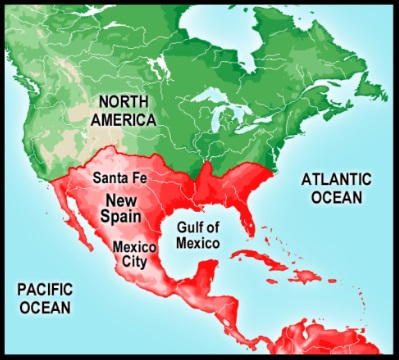
New SpainThe first European nation to lay claim to what is now Oklahoma was Spain, via wanderings sent forth from New Spain – what today is Mexico. 
Other than periodic expeditions hoping perhaps there was more to the Great Plains than met the eye, the Spanish weren’t particularly enamored with the northeastern-most reaches of their claims in the New World. They weren’t looking to colonize or expand on the same scale as their Anglo cousins, and the whole area was just… flat. And hot. And completely bereft of gold, more gold, or all the gold. 

The neglect became permanent after the defeat of the Spanish Armada in 1588 by the English, with substantial assistance from a suddenly very-Protestant God. Spain was already struggling to maintain its role as a major player back home in Europe, and no longer had the energy for shenanigans in the Western Hemisphere – not without a greater payoff. 

Little surprise, then, that the French met with little resistance when they claimed a big ol’ chunk of the New World as “Louisiana Territory” in 1682. The original boundaries looked a little different than they would 121 years later when Jefferson made his famous “Purchase” of the same name, but Oklahoma was included in both versions. 

The French did exactly nothing, near as we can tell, in this part of the Territory while under their purview. Not that we needed them here, getting their… Frenchness all over us. But still – it would have been nice to be wanted, you know?

The area changed hands again at the end of the French and Indian War – the same one most of you remember from American History class. You may recall that it wasn’t the French vs. the Indians; they were allies against the British colonies along the eastern coast of North America. Like most things, it was complicated – part of a larger “Seven Years War” going on in Europe, and mixing itself into pre-existing issues between the colonies and the locals, etc. 

It was at the conclusion of this war in 1763 that the British first got serious about raising taxes on the American colonists to help offset some of the costs of their “protection.” This sparked a whole other series of events more familiar to the average student and leading to seriously overpriced fireworks every summer. 

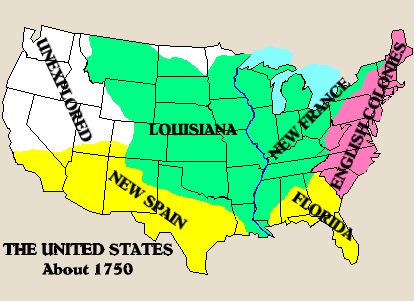
U.S. Map 1750In any case, the Treaty of Paris (1763) transferred proud ownership of all this flat, red dirt to the British, despite a secret agreement handing it over to Spain only a year before. It says something about the status of pre-settlement Oklahoma that Spain didn’t even fuss over this double-dealing; their primary concern involved other territories included in that exchange. 
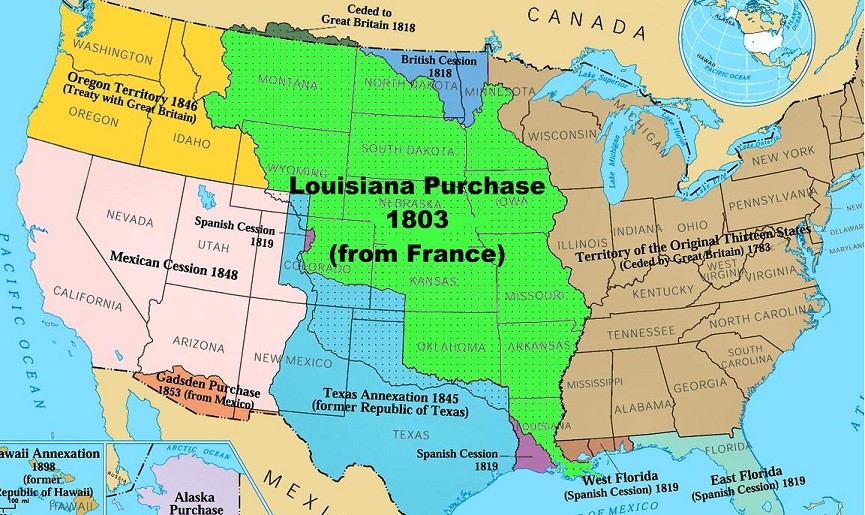
That explains, however, how land arguably belonging to the British could be returned to France by Spain in the year 1800. These were the days of Napoleonic hegemony – the proverbial “little general” who wanted to take over all of the known world.

EXCEPT OKLAHOMA BECAUSE WHY BOTHER AND HEY T.J., WANNA BARGAIN ON SOME BIG, FLAT, USELESS LAND?

Um… hello?! Potential state here! Home of natural resources and flora and fauna and stuff? Wind, sweeping down the plains? Hawks with questionable work ethics circling above? I get that we’re not the prettiest state in the room, but we’re at least… OK, right?

*sigh*

And people wonder why to this day we’re one giant inferiority complex, with a side of paranoid delusion. Texas proudly waves its ‘six flags’ representing various stages of its history. We had three prior to statehood, playing ‘hot potato’ with us like the homely friend of the popular girls they were really looking to – um… settle. 

But finally, a nation that needed us! That could appreciate us! Say what you like about the early U.S., they were some exploring and expanding fools! President Jefferson sent out Lewis and Clark and Co., who began mapping the entire area of – 

Hey! Where are you going? Meriwether! Bill! Down here, big fellas! It’s me, Okla –

*sigh*

Sunnuvabitch. The Dakotas. They’re all hot’n’bothered for Nebraska and the Dakotas. Seriously? 

U.S. Map - TerritoriesFine. We’ll waive our *mumble* wheat for someone *murmur* can appreciate *grouse* land we belong to is grandma’s crusty *obsenitiesandbitterness*.
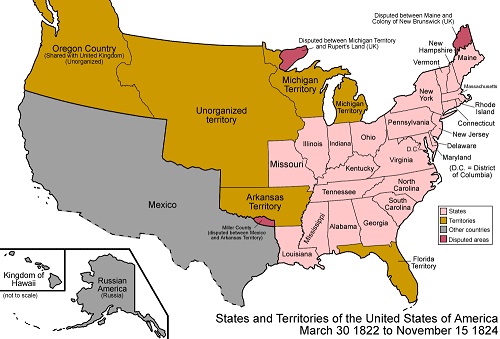
There was thus very little to discuss between our inconspicuous hitchhiking into United States Territorial-ness in 1803 and the involuntary arrival of the Five Civilized Tribes via “Indian Removal” in the 1830s. 

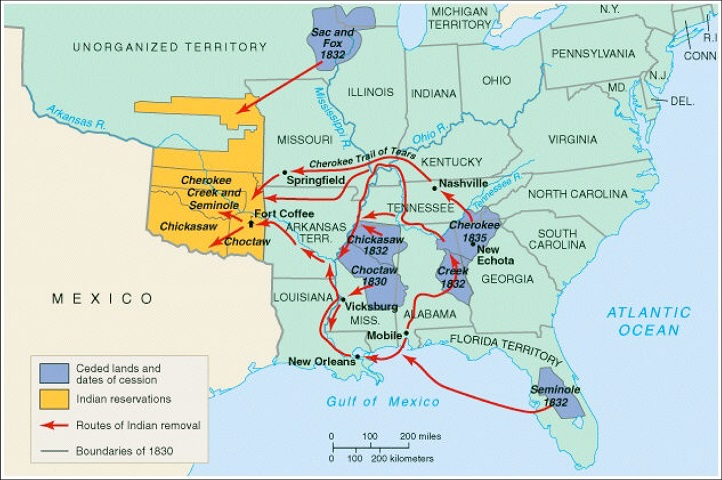
Meanwhile, white America was expanding much more quickly than expected. Immigrants were packing the shores, and those already here were spawning like blind prawn. While encounters with Amerindian natives had been a mixed bag since Columbus first mislabeled them, five tribes in the southeastern part of the country had adapted far better than most, and conflicts had been relatively minimal. 

The Cherokee, Creek, Chickasaw, Choctaw, and Seminole, while distinct peoples in and of themselves, became collectively known as the “Five Civilized Tribes” (5CT). Keep in mind, of course, that this was not a self-selected title – it was bestowed by white Southerners in the area. This use of “civilized” wasn’t drawn from someone’s textbook definition or discerned anthropologically; it meant that these Indians were a lot more like the white folks around them than them other Indians, who were generally considered savage, wild, and dangerous. Decadent, actually. 

Boo, savage Indians!

The 5CT, in contrast, were largely agricultural. They were far less nomadic, more highly educated, and far less likely to practice hit’n’run raids on white neighbors. Many converted to or at least adapted elements of Christianity, even wearing uncomfortable shoes and learning English in order to facilitate good relations.

If the primary cause of conflict with Natives was cultural, as is often asserted, then the 5CT should have had little trouble with the wave of white settlement surrounding them. If it were purely an issue of gold or other mineral wealth, as our textbooks like to emphasize, the problem would have been substantially more localized. 

U.S. Map 1824But the U.S. found it necessary to violate a number of its own fundamental values and laws in order to kick FIVE distinct nations out of an area roughly the size of THREE entire states. They did so at enormous cost to themselves and unforgivable loss of life to those removed. This was driven by something bigger than gold, something fundamental to an expanding nation.  
White homesteaders wanted land. They needed land. They deserved land. 

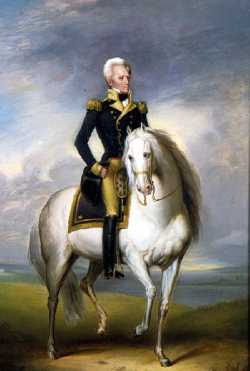
Not that they were likely to come right out and put it that way. From President Andrew Jackson’s First Annual Message to Congress, December 8th, 1829:

The consequences of a speedy removal will be important to the United States, to individual States, and to the Indians themselves. The pecuniary advantages which it promises to the Government are the least of its recommendations… 

“Pecuniary”? He’s been reading Jefferson’s letters again. Not bad for an uneducated orphan kid, actually.

“Pecuniary” means financial, or profitable. Perhaps fiscal growth was the “least” of many reasons to move the Indians, but he sure didn’t waste any time mentioning it.

Like, first. 

It will place a dense and civilized population in large tracts of country now occupied by a few savage hunters. By opening the whole territory between Tennessee on the north and Louisiana on the south to the settlement of the whites it will incalculably strengthen the southwestern frontier and render the adjacent States strong enough to repel future invasions without remote aid… 

See? Not all of our motivation is selfish and monetary. They’ll also make a nice buffer between us and the Apache. Why should we be carved open and burned alive if we can throw a few Chickasaw in the way instead?

It will separate the Indians from immediate contact with settlements of whites; free them from the power of the States; enable them to pursue happiness in their own way and under their own rude institutions; will retard the progress of decay, which is lessening their numbers, and perhaps cause them gradually, under the protection of the Government and through the influence of good counsels, to cast off their savage habits and become an interesting, civilized, and Christian community.

What good man would prefer a country covered with forests and ranged by a few thousand savages to our extensive Republic, studded with cities, towns, and prosperous farms embellished with all the improvements which art can devise or industry execute, occupied by more than 12,000,000 happy people, and filled with all the blessings of liberty, civilization and religion? …

Andrew JacksonThere we go – the “besides, it’s good for them” defense. We used a variation of this to justify slavery, you may recall – saving all those crazy Africans from their ooga-booga religions and cannibalism and such, freeing them up to play banjos around the fire and partake of the finest Christian civilization. 
It’s quite a mix of values, though, isn’t it? Removal will leave them alone to do their own thing, but it will also force them to become more like us – which is the opposite of being left alone and doing their own thing. Besides, Jackson explains, what good is a bunch of trees and land when we could pack in cities and industry and corporate-style farming?

Maybe he hadn’t been reading Jefferson after all. 

The tribes which occupied the countries now constituting the Eastern States were annihilated or have melted away to make room for the whites. The waves of population and civilization are rolling to the westward, and we now propose to acquire the countries occupied by the red men of the South and West by a fair exchange, and, at the expense of the United States, to send them to land where their existence may be prolonged and perhaps made perpetual. 

The term ‘Manifest Destiny’ hadn’t been coined yet, but the ideology permeates Jackson’s language. There are no individuals making choices, or cultures colliding – merely inevitable progress “rolling to the westward.” 

Doubtless it will be painful to leave the graves of their fathers; but what do they more than our ancestors did or than our children are now doing? … {White settlers} remove hundreds and almost thousands of miles at their own expense, purchase the lands they occupy, and support themselves at their new homes from the moment of their arrival. 

Can it be cruel in this Government when, by events which it cannot control, the Indian is made discontented in his ancient home to purchase his lands, to give him a new and extensive territory, to pay the expense of his removal, and support him a year in his new abode? How many thousands of our own people would gladly embrace the opportunity of removing to the West on such conditions! If the offers made to the Indians were extended to them, they would be hailed with gratitude and joy.

IR MapJackson may be overdoing it a bit, even by the standards of the day. His primary purpose was most likely not to convert anyone adamantly opposed, but to assuage any guilt on the part of those already looking for an excuse. That’s why we talk about “audience” and “reason” when we do document analysis, kids – dead white guys can be sneaky.  
Whatever else Jackson was, he was a genuine champion of the “common man.” As a creature of his times, that rarely included the 5CT or anyone else with meaningful pigmentation – it meant white homesteaders. 

Like the generation of Founders on whose shoulders he consciously stood, he recognized the connection between land and opportunity, land and character, land and democracy. 

He was generally plainspoken, but that didn’t mean he had no understanding of human nature. He knew that sometimes lofty goals and hard decisions required… framing. He was no diplomat, but he was certainly willing to play the demagogue here and there if he believed his cause was deserving. 

And there was no higher cause than this American nation. These people. This potential. He may have hated Indians, or he may have not. It didn’t matter. America had a destiny, and that destiny needed more land. 

That chunk of Louisiana Territory that kept getting tossed around and ignored is about to become useful. 

NOTE: A more easily printable version of this post is available on “Well, OK Then…” 

Stop Learning To Read!

Anyone remember this lady?

[[{“type”:”media”,”view_mode”:”media_small”,”fid”:”2643″,”attributes”:{“alt”:””,”class”:”media-image”,”typeof”:”foaf:Image”}}]]

Former State Superintendent of Education Janet Barresi, who served from 2011 to 2015 before being defeated by Joy Hofmeister in the Republican primaries. Ah, those were the days! Barresi hated us all with a passion. It was weird. 

What was that cute thing she loved to say so much…?

[[{“type”:”media”,”view_mode”:”media_small”,”fid”:”449″,”attributes”:{“alt”:””,”class”:”media-image”,”typeof”:”foaf:Image”}}]]

It’s right on the tip of my tongue… Maybe this will help:

[[{“type”:”media”,”view_mode”:”media_small”,”fid”:”2645″,”attributes”:{“alt”:””,”class”:”media-image”,”typeof”:”foaf:Image”}}]]

Wait – I remember. Here it is…

[[{“type”:”media”,”view_mode”:”media_small”,”fid”:”2650″,”attributes”:{“alt”:””,”class”:”media-image”,”typeof”:”foaf:Image”}}]]

No, dammit – that’s not it. Oh well, it will come to me. 

[[{“type”:”media”,”view_mode”:”media_small”,”fid”:”2644″,”attributes”:{“alt”:””,”class”:”media-image”,”typeof”:”foaf:Image”}}]]

That’s IT!

Ha! That Barresi was a card! That “reading to learn” bit always cracks me up.

The reason I bring this up is not to go after Barresi after all these years for nostalgic kicks, or because I have so many of these clips edited and saved but nothing to do with them now that she’s gone. I’m FAR too artistically developed and pithily legit at this stage to give in to such vulgar urges. It would be tacky.

Unless, of course, something ELSE brought up the issues for which she’s best remembered. Then… THEN I can finally reuse the darn clips!

[[{“type”:”media”,”view_mode”:”media_small”,”fid”:”2651″,”attributes”:{“alt”:””,”class”:”media-image”,”typeof”:”foaf:Image”}}]]

Reading IS good and 3rd grade CAN be tough. I’ve been thinking about Barresi recently as discussions of Oklahoma’s 3rd Grade Reading Test and the associated retention policies have begun anew. If you’re looking for a wonderfully concise, yet oh-so-word-up-truth-yo argument for ditching mandatory retention altogether, you might start with this piece by Rob Miller on A View From The Edge. He’s… *sniff*… he’s kind of my hero. 

It’s not about lowering standards or coddling those dumb little kids who need to suck it up and READ TO LEARN, DAMMIT! It’s just that sometimes our thirst for “accountability” and “standards” outstrips our ability to demonstrate that anything we’re proposing actually works. We end up making policy not because it improves anything, but just so we feel like we’re cracking down on teachers and whiny 8-year olds: 

[[{“type”:”media”,”view_mode”:”media_small”,”fid”:”2642″,”attributes”:{“alt”:””,”class”:”media-image”,”typeof”:”foaf:Image”}}]]

No more letting this lazy, no-good eight-year-olds milk the system! Those little $#%&ers are going to READ on OUR schedule, or there will be CONSEQUENCES:

[[{“type”:”media”,”view_mode”:”media_small”,”fid”:”2646″,”attributes”:{“alt”:””,”class”:”media-image”,”typeof”:”foaf:Image”}}]] 

Reading IS important. How and why we read changes as we develop, or with circumstances. And yeah, there are even strategies and methods to help different kinds of kids improve and enjoy reading as they grow. 

But the suggestion that on some state-mandated date – presumably around July 1st between a child’s 3rd & 4th grade years – they hit a cold, hard stop on that “learning to read” stuff. No more of that, Junior! You’re almost in 4th grade, and that’s no place for more learning to read! You think middle schoolers are still learning to read?! You think high schoolers are still LEARNING TO READ?!

Of course not! Don’t be stupid! Starting on August 14th, you’ll be reading to learn – period. Because THAT’S what will justify these weird policies we’ve passed and THAT will create an atmosphere of accountability towards kids too young to defend themselves or understand that it’s not actually about them to begin with. *maniacal chuckle* 

So we’re going to hold you back, despite there being almost NO evidence that fixes anything most of the time. Oh sure, between your parents and teacher they could probably figure out if that’s the best solution for you, but that sounds SO “low expectations” and “power-hungry teachers union.” Far better to leave it up to 150 strangers halfway across the state who need to look tough on education to appease their venomous constituents – very successful folks who, by the way, are DEFINITELY NOT still learning to read! It’s not clear most of them are still learning anything at all.

[[{“type”:”media”,”view_mode”:”media_small”,”fid”:”2649″,”attributes”:{“alt”:””,”class”:”media-image”,”typeof”:”foaf:Image”}}]]

If you don’t read well, you’ll probably drop out of school and go on welfare before ending up in jail. Guess you shoulda gotten Hooked on Phonics so you wouldn’t have ended up hooked on meth, huh? 

Thank god that correlation is always causation, otherwise we’d have to wonder if things like reading ability and incarceration rates are actually connected through some third factor like, say… poverty, or parents’ education levels, or the availability of medical care and mental health services growing up. But no – easier just to blame one for the other directly. People who own more pairs of shoes tend to be more physically fit, therefore we should require every child to own at least 12 pairs so that they’ll live longer, healthier lives – stuff like that. 

Besides, you can cure learning disabilities by cracking down on 8-year olds. What a relief! Makes you wonder instead of curing people, Jesus actually just went around whispering to the lame, “I know you’re just lazy, so get your *** up before I ‘religious freedom’ you straight into that wall over there.” 

Ah, Janet – she sure as heck made life easy for bloggers, I’ll tell you that. Joy isn’t half this entertaining. She just keeps trying to help kids learn and give teachers hope. Boooorrriiing.  

What’s odd is that I think Barresi sometimes meant what she was saying… that she periodically believed herself. I was particularly struck by a personal story she told about her own son’s struggles in elementary school:

[[{“type”:”media”,”view_mode”:”media_small”,”fid”:”2647″,”attributes”:{“alt”:””,”class”:”media-image”,”typeof”:”foaf:Image”}}]]

You think you know where this is going, right? What a mistake it was to allow “social promotion” of her own child – how he would end up dropping out and going on welfare before ending up in jail? How she wishes they’d held him back over and over and over and over until he realized they meant business and gave in?

But she throws in a twist – that thanks to unbelievable luck (probably divine intervention), they somehow got a GOOD teacher who used this radical new system called “give him a little extra help and encouragement” – and WHOAH!! 

[[{“type”:”media”,”view_mode”:”media_small”,”fid”:”2648″,”attributes”:{“alt”:””,”class”:”media-image”,”typeof”:”foaf:Image”}}]]

The moral of the story is that many times with enough support students catch up and start reading “on level” at some point around Middle School. Therefore, logically, we should hold them back indefinitely in 3rd grade because we DIDN’T do that with my kid and it all worked out just fine. 

For the record, that’s the quality of reasoning that’s been running Oklahoma for years now, and not just in education. You should hear this amazing bit they do about tax cuts stimulating the economy – it’s classic!

Lankford School Choice

Our elected leaders don’t seem to make many connections between rhetoric and real life. Like Janet, they know what sounds good when they say it, and feel no particular compunction about their lexicons remaining completely untethered to reality.

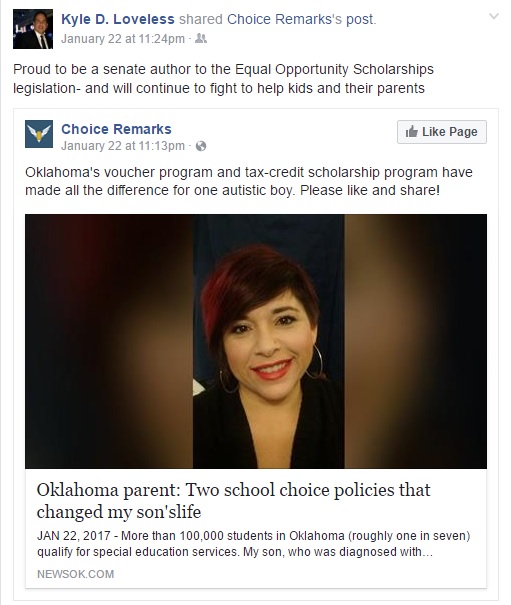
But we don’t teach fluffy, theoretical kids or work in a miasmic unicorn rainbow stream. Words matter, and policies do things. Reality is still a factor – no matter how desperately Baghdad Bob, Sean Spicer, Kyle Loveless, or James Lankford wish otherwise. They’ll keep spouting the rhetoric assigned them by their socio-economic overlords and preternatural paradigms, and that’s fine – it’s what they do. But the rest of us will keep throwing a fit every time calling them out on it. 

Loveless FB Post

None of us mind disagreement over policy. That’s not why we seem pissy so much of the time. What we’re fighting for is clarity. If their policies are so good, they shouldn’t have to obfuscate them with all that gilding and glitter. If they’re so well-intentioned, why isn’t the truth sufficient to set their ideologies free?

Or maybe they believe what they say and just don’t make the leap to application. Maybe they need to learn to read their own rhetoric more carefully before they run with it.

Too bad that’s impossible after 3rd grade. Can we send them back?

Stupid, Lazy Third Graders

Watching bits and pieces of the DeVos confirmation hearings this past week, I couldn’t help but feel a bit nostalgic. While most semi-rational viewers were wondering how one could even consider putting someone in charge of education who understands so little about it, openly despises those involved in it, and shows no interest in learning more (and who will certainly not tolerate informed dissent), those of us in #OklaEd were wondering how it took the rest of the country so long to try it.

[[{“type”:”media”,”view_mode”:”media_small”,”fid”:”2642″,”attributes”:{“alt”:””,”class”:”media-image”,”typeof”:”foaf:Image”}}]]

Ah, Janet. How we’ve missed thee. What was that cute thing you used to always say…?

[[{“type”:”media”,”view_mode”:”media_small”,”fid”:”449″,”attributes”:{“alt”:””,”class”:”media-image”,”typeof”:”foaf:Image”}}]]

That’s it! Ha – I love that one. “Whatchoo talkin’ ’bout, Willis?” “Up Your Nose With A Rubber Hose!” “In 4th Grade Kids Stop Learning To Read and Start Reading to Learn.” LOLZ.