
 You ever across something while browsing online, and wish you hadn’t? I believe it was Tosh.0 that did a segment called “Things You Can’t Unsee.” Sometimes they just gross you out, or cause emotional distress, and sometimes they’re just inappropriately violent or pornographic or just plain wrong.
This one is none of those, except perhaps ‘just plain wrong.’ It’s from the OKSDE website, and of course it’s about Data-Tracking, and Value Added Measurement, and all sorts of other bureaucratic verbiage designed to disguise a much simpler phrase, “blame everything on teachers whatever it takes.” It’s also the death knell of my efforts to focus on the positives in education.
Here is what the State of Oklahoma – and the State Department of Education in particular – thinks of you, the teacher, represented here by dear Ms. Bullen:
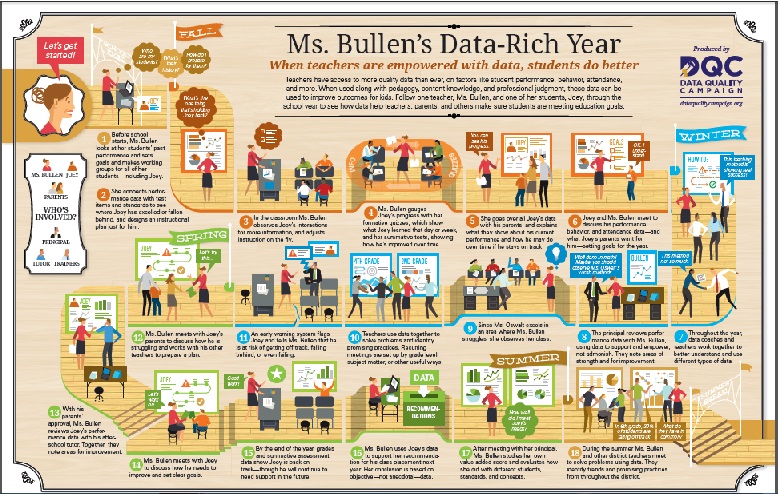
I know you can’t read the small print yet, but already a few things are clear:
(1) VAM / TLE / State Data in General is designed to consciously require a giant graphic full of small print to even begin to understand.
(2) The OK SDE / State Legislature is glad you’re not married and thus presumably lack any sort of a family, otherwise you’d never be able to put in the kind of time outside the school day we’re expecting. So much for a pay scale based on having a spouse with a real job! [Confused Reader: “But, married women can use the ‘Ms.’ – it’s marital status neutral, that’s the whole point.” Me: “Clearly you’ve never been to Oklahoma.”]
(3) The OK SDE / State Legislature is under the impression you are approximately nine years old. (In which case I suppose it’s just as well you’re not married.) On the other hand, if you can find Waldo in this picture, you may get a sticker!
Let’s take a closer look at a few parts of this wonderful chart:

(4) On zooming in, I think we have a much better idea why Ms. Bullen is not married. Elective cosmetic surgery is such a risky venture – just ask Kenny Rogers, Bruce Jenner, or Ms. Bullen. Yikes!
(5) How wonderful that Ms. Bullen is able to use one of those pesky PD days before school begins for something so unlikely to develop her as a professional. Instead, she can spend her time labeling, tracking, and otherwise pre-judging her students based on how they did last year. Given that she’ll have approximately 170 of them, this might take several days, comfortably cut off from her department, administration, or other professionals. But all the best educational studies show, of course, that the ideal way to tap into a child’s full potential is to form judgments about their abilities and potential before you’ve even met them!
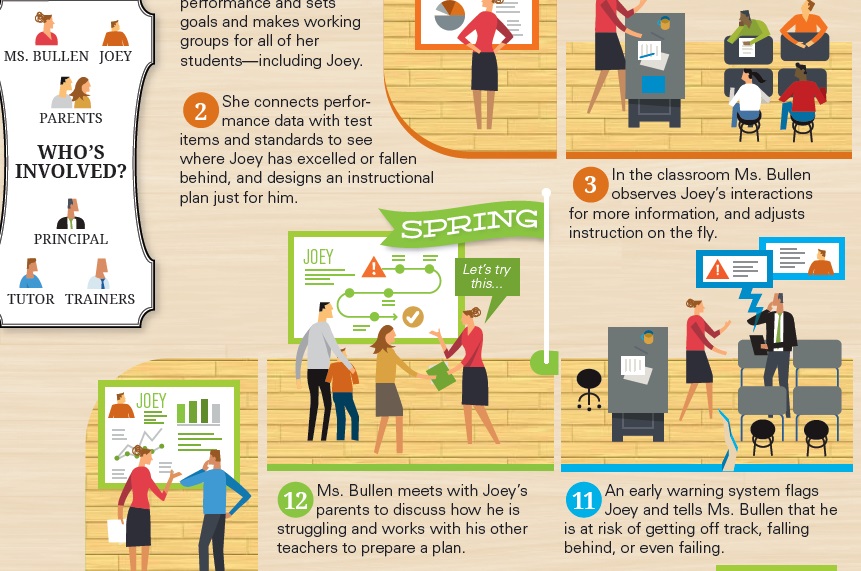
(6) It seems I’ve been a little unfair in assuming this will all be on Ms. Bullen, as Joey apparently comes from a very involved two-parent family. Plus, Ms. Bullen’s principal has nothing but time to help design IEPs for all 1,246 students in the building, so that’s not really a problem – unless he or she also wishes to complete all 73 levels of the required Teacher Leader Evaluation System for every adult in the building as well. But, some of the burden can be shared by the many Tutors and Trainers in the building.
Hey, you know what would be fun? Let’s each stop for a moment and see if we can remember the name(s) of the Tutor(s) and Trainer(s) in our buildings who will help us with all of this when it’s our turn…

How did you do? If you came up with “none of these positions even exist,” you get another sticker, just like they do in Tennessee!
(7) You are expected to create an IEP for each and every one of your students before school even begins! (Step Two) Setting aside the fact that this is insane, it’s still nine full steps before Step Eleven, where an ‘early warning system’ (which appears to be an iPad app) will send an alert to a strange man in the room that Joey is off-track, or failing. Presumably the strange man will tell Ms. Bullen, who can call Joey’s very involved parents in to look at the full-sized mural she’s devoted to the Chutes & Ladders version of Joey’s educational journey. Thank god there’s finally a way to know when students are failing – other than the fact that they’re, for example, failing.
(8) You are expected to immediately discard the approximately 170 IEP’s you’ve spent weeks creating so you can “adjust instruction on the fly” (Step Three) based solely and exclusively on the perceived reactions of Joey. We can only hope the 34 other students in the room are not offended at the impact this must have on their individualized learning experience. At the same time, this is a great moment – it’s the only point in All 18 Steps that assumes for even an instant that you (represented here by Ms. Bullen) have any idea what you’re doing without consulting a few dozen spreadsheets of data. But don’t worry – you won’t be stuck teaching ‘on the fly’ for long!
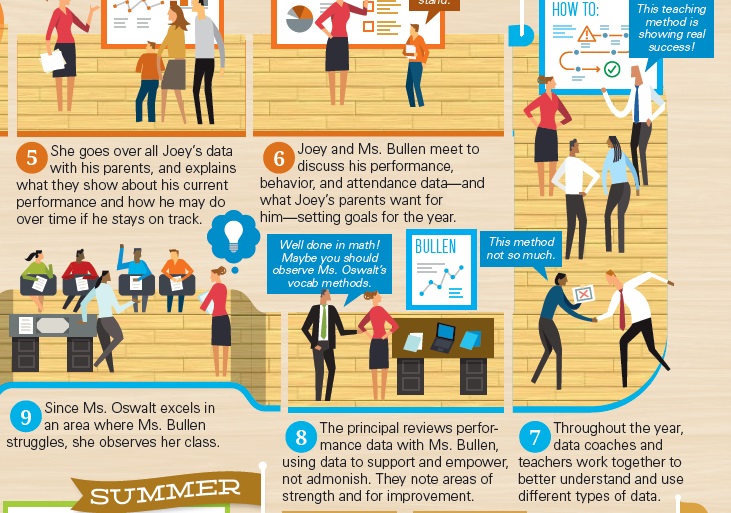
(9) You will have plenty of time to meet one on one with each of your students (Step Six) to discuss their behavior, attendance data (which is different from attendance… how?), and performance, as well as what Joey’s parents want for him – during the one moment in which is overly involved parents are conspicuously absent. You’ll set some individualized goals for the year to replace that IEP you developed before you met him, then threw out in Step Three.
Assuming you have approximately 168 students, and that each of these meetings take about 10 minutes, that’s only about… 28 hours each week. Or is it each month? I’m not sure how often this one is supposed to happen. Let’s assume it’s just once – it’s not like Joey’s performance, behavior, goals, or attendance are likely to change throughout the year. So we’ll just use that extra 28 hours floating around during, say… October. Nothing that important happens in October anyway.
(10) I’m not sure what “Data Coaches” are (Step Seven), although each school apparently has several (they must share office space with all the Tutors and Trainers – no wonder Oklahoma schools are so darned inefficient with how they spend district money!) Apparently while teachers celebrate their one collective decent idea, the Data Coaches do some sort of ceremonial handshake – or perhaps it’s a dance. I’m not familiar with that culture, but I’d really like to see that. There simply aren’t enough dances based on hard educational data.
(11) The Building Principal, on the other hand, reviews “performance data” with Ms. Bullen, but don’t worry – he does it to “support and empower,” not “admonish” (Step Eight). You have to remember that Ms. Bullen is nine years old and unlikely to marry due to a botched elective cosmetic procedure – she cannot be treated like an adult and simply discuss how things are going with her class. Wait! I mean… with Joey. Just how things are going with Joey.
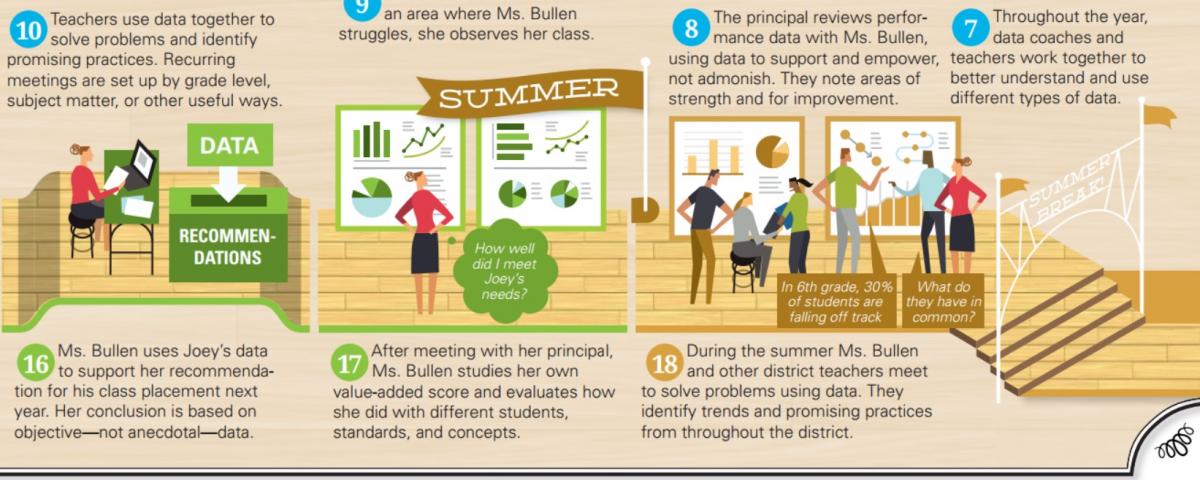
(12) We’ll skip ahead a few steps to where you can’t leave for the summer until you make sure Joey and each of your other 167 students are properly tracked and categorized for the next school year (Step Sixteen). It’s important Joey not have any input on what he might be interested in or challenge himself by taking advanced coursework. We don’t want to risk student engagement in a way that might threaten the data! It would actually be more efficient to simply divide the classes by socio-economic status, race, or educational level of whatever parental units happen to be in the picture, but we might miss a few outliers that way. So, we stick to DATA.
(13) Because you haven’t spent nearly enough time in data meetings for Steps One through Sixteen, and are assumed to have no idea how the year went based on the formal and informal assessments you give throughout the year, your relationship with each student, or anything else that might indicate you have a pulse, you’ll meet with your principal some more and work on your own Value Added Measurement numbers (Step Seventeen).
(14) This would be a great time for Ms. Bullen to lower than neckline a bit and talk to that building principal about making sure she doesn’t have any ELL, Integrated, or otherwise low-performing classes next year. Although she has a heart for struggling students like Joey, they’re totally killing her VAM scores. As Roster Verification and Teacher Linkage become dominant, she’s growing rather resentful of any little turd that hurts her scores and means she’s not getting the merit pay those Pre-AP teachers probably will. I suggest some aggressive accessorizing to distract from those rectangular lips.
(15) You and the other district teachers will spend your summers looking at data on your own time (Step Eighteen), although you’re barely paid for the required 180 days you’ve already spent at school. Only when you pass through the gate painted to look like that trip to Six Flags you can never afford are you free to begin tracking and prejudging next year’s students based on their test scores.
Of course, you’re not in this profession for the summers, or the money, or the remnants of hope you had only a few years ago – that’s not what teaching is about. You have something better than a sense of purpose to what you do, or remnants of self-respect, or even the resources to take your family on even a modest trip – you have data.
Congrats Ms. Bullen! You may have low VAM scores, endless meetings, no summers to yourself, and no money to try to fix that botched surgery, but you’ve had a data-rich year!
 Teachers who also coach – or coaches who also teach ‘real’ subjects – get a bad rap. When you see a teacher on TV or in movies who’s being played for laughs, it’s almost always a coach (and a history teacher at that). I’ve several times been at the front of the room leading brief introductions at the beginning of a workshop when some well-intentioned dear lady will give her name, and where she’s from, and lament that besides herself and maybe the new teacher next door, her department is all coaches, so…
 I don’t coach myself, nor am I qualified to do so, but I have seen Remember the Titans about 19 times. I thus consider myself supremely qualified to make some confident statements about coaches who teach, and teachers who coach (and come to think of it, I’m pretty sure these are the same thing). I’ll number them to lend artificial authority to each statement.
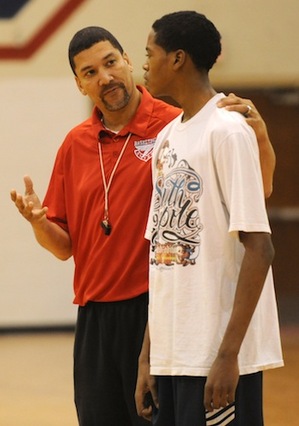 (3) Coaches are evaluated publicly and often by the performance of students who may or may not be demonstrating what they’ve actually been taught. Annoyed by those good ol’ boys who are obviously given classes during the day simply to fill the slot and justify their position? Frustrated at how impossible it is to push a coach with mediocre classroom skills aside to make room for a ‘real’ teacher? If your tenure and paycheck (the one used to buy your kids clothes and food and such) relied largely on how things go Friday night, I suspect you’d be easily distracted from that flipped-model inquiry-based cross-curricular collaborative journey you were trying to scaffold. You might even make a few calls to your staff and revisit some plays or other logistics. This is not a ‘coach’ problem – this is a structuring problem.
 (6) Coaches will mess with you by playing to your preconceptions. I see it all the time in workshops – the self-deprecating humor, the inside jokes. Maybe this is merely a ploy to lower expectations (especially on those required in-district days), but I suspect it’s usually just amusing to watch the rest of us be all smug without admitting it to ourselves.

 The implications in terms of women’s issues, social class expectations, the tensions between faith and fancy, are all enormous, and too complex to even begin to tackle here (by which I mean, I have no idea what half the things I just said actually mean). Most often, fiction was compared to alcohol – fine in moderation, and if it were of the highest sort, but quick to overtake one’s tastes and one’s good sense until everything of value was destroyed by the devil in paperback.
 I was warned in my youth about my demonic rock’n’roll albums (I burned more classic vinyl in good faith than I can afford to replace on a public school teacher’s salary), the perils of playing Dungeons & Dragons (yeah, yeah – bring it on, ye envious trolls), and later the violence promoted by video games (if aliens ever line up suicidally to drop down on me one at a time, I am SO ready), movies, the interweb, the ‘rap’ music, etc.