
 I’m not much of a conspiracy guy. I’m confident that Lee Harvey Oswald acted alone in killing JFK, and that the ‘magic bullet’ behaved unpredictably because that’s what bullets do. I don’t think 9/11 was an inside job, and I’m 99.3% certain Buzz Aldrin and Neil Armstrong landed on the moon in 1969 no matter what the shadows prove or how wavy the flag might be. Ronald Reagan did not invent AIDS to kill black people, and Obama is not a sleeper cell Muslim from Kenya with a nefarious plan he just keeps… not unfolding.
I always wince when Fox Mulder or Buffy Summers or any Marvel character enters the ginormous underground facility where thousands of people work in TOP SECRET. In a world where Kim Kardashian can’t fart without a week of coverage over the implications and 24/7 news is desperate for breaking scandal in every political stumble, I just find most large-scale paranoia implausible.
But if I WERE a conspiracy theorist… here are a few things I’d wonder about in relation to our public schools and the current buzz surrounding ‘reform’ and ‘higher standards’ and whatever other rhetoric we’re throwing around at the moment. And I wouldn’t just wonder about these – I’d worry about them with a very serious, concerned look on my face.
 (1) Are we actually trying to break the current cycle of poverty, failure, crime, and dysfunction plaguing large segments of our pre-adult population? Are those in political power both locally and nationally – and those who vote for them – genuinely interested in what happens to a bunch of poor kids who look, you know, black? Or Mexican? Or dirty? Or otherwise unpleasant?
A paranoid, unreasonable person might think our current approach looks very much like what we’re really wanting is political and moral cover – some sound and fury about raising standards, a supposed focus on teacher quality, and a pretty good rhetorical dog’n’pony show, but without substantive institutional change or funded application of stuff that might actually work. Yeah, communities tend to resist change, but so do teachers. And governors. And legislatures. And white people.
Not judging, just speaking in general historical terms.
(2) Do we really believe the root problems are systemic? Socio-economic? Maybe some lingering form of institutional racism? If I were a conspiracy guy I’d suspect instead that there’s a subliminal thread running through many current ‘reform’ debates that includes terms like ‘those people’ and suspicions that – while we’re not really allowed to come out and say it – a lot of it’s kinda “their” own fault. If they’d just X, Y, or Z… it’s not like the opportunity isn’t there. It’s not like I haven’t had a few struggles myself. Have they tried, you know… trying?
A cynical person might think we’re actually fine with failure as long as we can keep assigning blame to those most deeply mired in the cycle.
 (3) Is most of what we do in the name of “higher standards” and “reform” just a cynical ploy to channel public funds and more power to a handful of textbook companies and corporate entities? This one, sadly, isn’t even all that conspiratorial anymore. It’s been addressed by so many people so much better than I could that it would be redundant to elaborate on that part of the equation here. There’s a second layer to it, though, that I don’t see discussed often, and which to me is just as horrifying.
(4) Public education needs major changes. Systemic changes. Dramatic changes. We’re trapped in a 19th century factory model that we know to be dysfunctional and doomed, but can’t seem to find the solution using current resources, or apply it in some homogenously massive scale if we could. Real innovation is required – risk and radicalism, minus the Damoclesian testing and fatuous evals so joyfully legislated over every teacher’s comfy chair.
If I were a conspiracy guy, I’d think the very concepts of ‘charters’ or ‘choice’ or even ‘reform’ itself has been consciously co-opted by moneyed interests who use their powers for short-term evil rather than long-term good. How brilliantly profitable – exploit the status quo by laying claim to vast portions of limited public resources in the name of change. It’s like mobsters selling ‘insurance’ to local merchants to protect them from ‘accidents’ – complete and total betrayal, while none dare call it treason. Forget Marzano – we should have been reading Crane Brinton.
If something like this were remotely plausible, those of us most interested in improvement might have found ourselves expending our energies resisting the ‘worse’ at the expense of all potential ‘betters’. We could have lost the ‘forward’ path altogether as we burned ourselves out holding ground we don’t even want – the current model. I’m particularly glad THIS vile scenario is just TOO CRAZY to consider.
 (5) Finally, as long as we’re talking crazy talk, do those in power have any real interest in an educated populace? What, exactly, would be their motivation for such? Allotting time, energy, and resources to public education of any quality is generally a short-term loser politically. It’s expensive, and the results are long-deferred if they happen at all. There’s little consensus, and great political cost. Plus, there’s a very real danger that committed focus and resources and leadership on this subject could lead to… a much more educated, enlightened voting pool.
I realize this sounds particularly cynical, and I’m thus super extra thankful I’m not, you know… paranoid. If I were, though, I’d push the issue of what political leadership gains from a population which is harder to persuade with platitudes or emotionalism, or which demands a higher level of discussion in the decision-making process.
Why would the oligarchy want to sacrifice their power, their purses, and their children’s hegemony when it’s so very easy to simply maintain the facade of vigorous debate and struggle with one another? The major players are already quite gifted at maintaining the illusion they’re locked in passionate battles of principle, reality-TV levels of emotionalism, quality demagoguery, and rhetoric that sounds very founding-documentsy.
 But what if they’re like the shampoo aisle at the drugstore – packed with dozens of brands, each of which is broken into a half-dozen hair-types, fragrances, sizes, etc.? It’s almost overwhelming, all the different products available; what a miracle of American capitalism – too damn many shampoos.
Except that entire aisle represents maybe two actual corporations making every one of those shampoos – most of which aren’t all that different. The varieties are there to make you feel better, and to push aside real competitors. If there must be competition, compete with yourself – it works for fast food, bottled beverages, media outlets, and education movements. If you were a conspiracy theorist, you might start to feel a bit manipulated – like you’re being played, and not actually making informed choices at all.
You might even consider that perhaps those in power economically and politically would actually benefit from an even less-enlightened populace. Educated enough for the demands of the economy, of course, but not so much they question the nature of that economy – or its corresponding social and political structures. Educated enough to enjoy the circus – not so much they start wanting different bread.
That would be silly, of course. Probably a bit over-the-top. It’s at least completely unrealistic, and SO easy to rebut. I’m not sure why I even brought all of this up – I’m not a big conspiracy guy or anything.
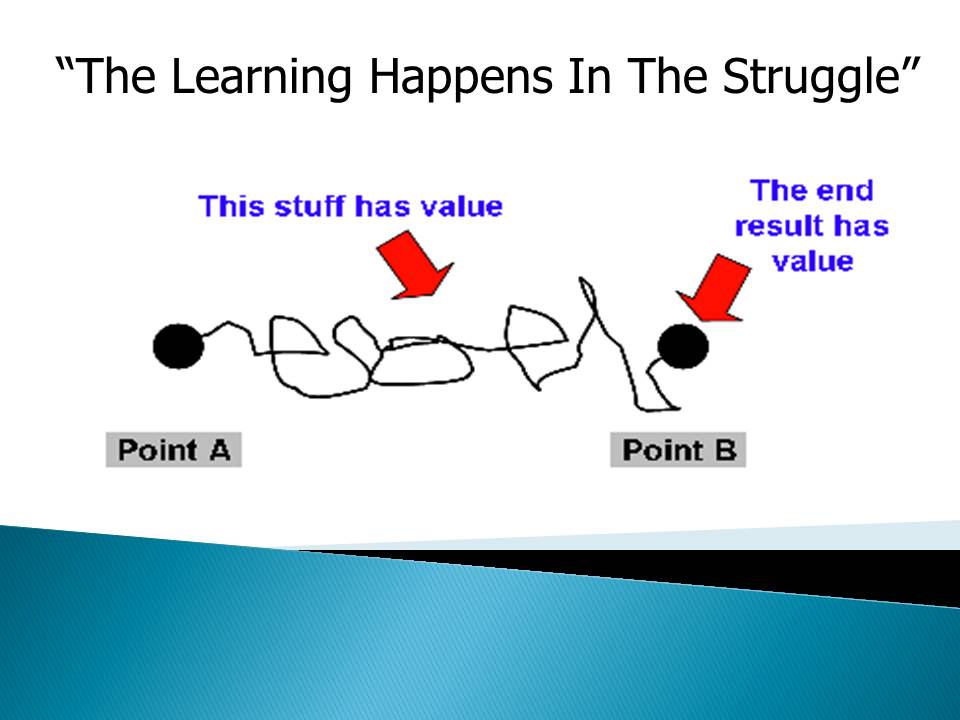
 One of my personal goals for this blog and this website
 Most of you remember Groundhog Day, a movie I felt like I’d seen a dozen times before I was even through my first box of Milk Duds. The basic premise – that something is causing a person, group, or starship, to repeatedly jump back in time to relive a set of experiences with only minor variations – was sci-fi trope long before Bill Murray had those extra pancakes.
 Workshop leaders or edu-bloggers rarely “open” with this grand bit of modern wisdom – it’s saved for the ‘impact’ moment of the autobiographical anecdote demonstrating both connection with the audience and touching vulnerability – the kind that makes you trust someone enough to buy their book.
 I’m sorry you had that one boring teacher in high school all those years ago, I really am. I got sick on chocolate chip pancakes when I was 17 and projectile-vomited all over the hall bathroom, but I’m 47 now and don’t carefully construct each week’s menu around the dangers of Bisquick. Get over it.
 The funny thing about history is that most of it cannot, in fact, be effectively understood without some knowledge of specifics. Yeah, it’s the big picture stuff that often matters most, and connects us to the past, and teaches us those grand lessons and such, but it’s all built out of particulars. History generally happens to people in places at certain times.
  I’ve had the blessing of spending an absurd amount of time and emotional energy navigating airports and airlines and flights to and from various conferences. I’m not the hardened traveler some of you are, but before I enter that category and lose all touch with ‘normal’ flyers (there’s a joke about administrators waiting to be made here, but I’m all High Road about that kind of thing) I thought it might prove helpful to compile a brief list of tips for the first-time or periodic air traveler. This is a bit outside what I normally write about here, and also – I confess – a bit self-serving, because…
 (2) Airports are built to be bewildering. The amount of walking random directions, going through scary doors with big warning signs, changing levels, etc., is surreal by design. You know that half-hour of taxiing you did before they let you off the $#%&ing plane? That’s so you can be deplaned as far from baggage claim or public transport as possible. Keep in mind these sorts of projects are built by local politicians and organized crime, and the more miles of tunnels, doors, escalators, and decorative tile they use, the more profitable for Uncle Lenny’s “people.”
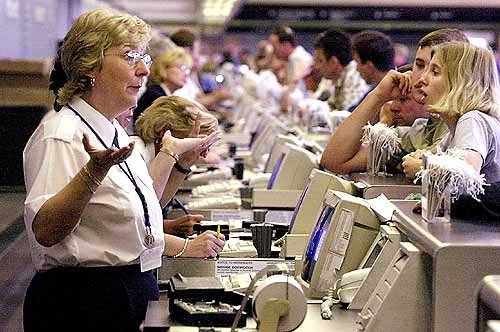 (4) People who work at the airport are unlikely to be nice to you, so change your expectations. I’m not saying there aren’t some very friendly people working for various airlines or for TSA or whatever, or that there aren’t pretty good reasons they hate all of us most days. I’m saying it’s irrelevant – it doesn’t matter – so don’t expect it. Warm-fuzzies don’t get you seated and in the air.
 At least if you do the wrong thing, you’ll be doing it with lots of other people – and isn’t that one of the fundamental lessons we try to teach our kids?
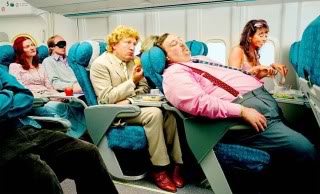 AND UNDER NO CIRCUMSTANCES SHOULD YOU RECLINE YOUR SEAT in coach (the section that’s not First Class) on a flight shorter than 8 hours. Yes, I know the seats are made to recline – but if you were in the front passenger seat of a small car, with people sitting behind you, would you move your seat back and recline, just because it’s mechanically possible? No – because Wheaton’s Law, brother.
 If they bury themselves in their newspaper, book, or other interest as soon as their seatbelt is fastened, that’s a clue. Feel free to say a few polite words, smile, etc., but if they merely return them in kind and go back to their reading or work – that’s code for “I’m reading my newspaper, book, or involved in this other interest.” Not everyone is as desperately lonely and in dire need of approval as you. I fathom the joy of bonding with strangers and becoming besties for life, I really do. But understand that statistically this is unlikely to happen every time you fly. With some of you it’s unlikely to happen, you know… ever.
  On April 27th, 2014, the Dallas Stars were only a few game minutes away from an improbable 4-2 home victory over the conference-leading Anaheim Ducks. It had been a storybook game with glorious hits, highlight reel scoring, and the sort of scrap and grit that made the Stars (rather than their opponents) the Disney-movie-ready heroes – IF they could tie up this best-of-seven series and force their way back to Anaheim for a final brouhaha.
 By what should one measure success in professional hockey? It’s so relative, and it matters deeply where you started, what adversities you’ve faced, how much support you’ve had, how much talent you have to work with, Finances matter, and sometimes there’s a fair amount of luck involved.
 I’ll go back to my hockey analogy, mostly because it’s easier to find supporting visuals that way. How do we measure success in a specific game? Not just for the team, but for the individual stu– er… players? What do we measure and thus value in hockey?
 But the other team is trying to score also. Huh. OK, OK… if you’re on the ice when your team scores a goal, that’s +1 for you. If you’re on the ice when the other team scores on you, that’s -1. Keep a running total, and it’s clear: the higher your +/-, the better player you are. So, like, Sidney Crosby finished the season at +18. That’s pretty good. Down from +26 last season, but there were other factors, because –
 Wait – that can’t be right. Alex Ovechkin is one of the best-known and most valuable players in the league. Is that a typo? And Seth Jones – he’s going to be great. Young kid out of Dallas, playing for Nashville – I mean, what he DID this year for his age and background!
 You have a goalie with a great save percentage. That’s awesome – that is, in fact, their primary job. How many games is that percentage based on? In what circumstances did he play? He may be on a team that could pretty much leave their net empty and have no worries because their defensive play is so strong. On the other end of the ice, though, is a goalie working miracles but losing games because the team sucks. So save percentage is an important number, but not nearly as simple as it first appears.
 I believe it was Winston Churchill who said that our current grading system is the worst one there is except for all of the other systems that have been tried (I might have the details a little fuzzy). The thing is, we haven’t really tried that many others. And yes, I realize as soon as we open that door, there are huge arguments to be had about what we should measure and how and yada yada yada.