
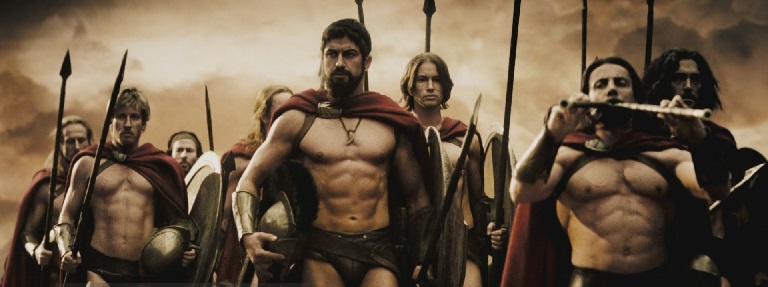
My 300 Epiphany

300 On The March

Several years ago, in what seems like a very different place and time, I had a horrible school year. Some of you know how it can go – I was trying new things, and they weren’t working. Or, if they were, they weren’t being supported, and had to be abandoned, whatever prior promises. The stuff that used to work wasn’t working either, and the student rapport to which I was accustomed just wasn’t there – at least not to the extent on which I’d grown reliant.

Then the parent calls started. I’m not a teacher who gets that many upset parents, or – if I do – has trouble resolving them.

Usually.

But that year… that year they just DID NOT LIKE ME.

It took on a life of its own as little cliques began talking to each other, and as students became aware I was anathema to mom and dad, oh god it just spiraled. In retrospect, I should have found better ways to anticipate, nip, resolve – but I didn’t, and it grew.

Courtney 300Introducing… Courtney. Of course her name wasn’t really Courtney, but for purposes of this blog she’s Courtney. Her real name was Alisha, but I’d never use it – it would be unprofessional.**

Courtney was popular and pretty and a straight ‘A’ student. Her father coached and her mother taught at another building. All of my superiors knew and loved her parents – and her mother hated me with the fire of a thousand suns.

Neither Courtney nor her primary progenitor cared for the way I taught, the skills in which I found value, or the policies I implemented. By Labor Day they more or less resented the oxygen I was breathing which would have been better inhaled by worthier beings.

Courtney often left school just before my class to go with dad to athletic events – which is, you know, fine in and of itself. But that’s when I really stepped in it. I followed the school policy guide regarding missed days and make-up work – a procedure which, as it turned out, was completely unacceptable. The entire Courtney family was soon convinced I had it in for their daughter, and mom began copying people way above my pay grade on every email – of which there were many.

Now, you might think the inclusion of the people who write and approve the policies would bring some sanity to the discussion. You know, if they ever replied, or acknowledged, or joined the conversation in any way – even when I begged.

Which they didn’t, although I did. So it didn’t.

I’d never felt so… angry?  Wounded?  Humiliated?  Worse, I felt foolish for being so blindsided.  I’m hardly an idealist – what made me feel immune from the realities of bureaucracy and cronyism?
Am I Stupid?I was young enough to still cling to a FEW ideals and principles – should I give in so easily when I didn’t think it was best for classroom dynamics and expectations, best for me, or even best for Courtney?  Did we want to teach her that sufficient complaining could solve any problem?

It probably didn’t help that I was myself outraged on a weekly – sometimes daily – basis by some district policy or building decision or the other. I didn’t see the irony at the time, of course – and it probably wouldn’t have helped if I had.

Everything I tried to do to improve the situation just made things worse and embarrassed me further. In hindsight, I probably could have done better – but I just kept rolling down that hill of broken glass. On fire. Without shoes.

By summer I was looking for other employment. At the very least I wanted another building (different administrators), maybe even another district.  I had a good shot at a curriculum coordinator position in a district closer to home, but… I mean, I still wanted to be in the classroom…

That was the summer the movie 300 came out. For those of you who haven’t seen it, it’s a rather elastic take on the Spartans at Thermopylae. It’s not a great movie by any definition, but it’s very entertaining. I was home alone for a few weeks (my wife has a real job) and Netflixed it.

And in the two hours I spent immersed in some very bizarre choices regarding nudity and testosterone-laden CGI violence, I had an epiphany. A paradigm shift, if you will. One whose impact has lasted for a number of years.

I was trying to fix things – the student, the parents, the situation. More than that, I was trying to fix the system, the district, the underlying assumptions and realities of public education. I wanted – I NEEDED – agreement, support, understanding, validation, and action by others to make this happen.  I could understand resistance, but not inertia, or apathy, or complete denial of things which were to me so glaringly clear.

I knew odds were slim and the task was great and the fields were ripe for harvest, but I still carried a faith from my evangelical days that we could win.

We could save them. We could change the system. We could make a measurable difference.  If only a few key people would ‘get it’, would listen, would cooperate… we could win.

None of those things were delusions of the Spartans as they prepared to face the Persian hoards storming their shores. They positioned themselves at the narrowest pass between the oceans and their homeland, and determined to hold it as long as possible – but with little illusion what that would mean.

“Come back with your shield, or on it.”  The parting words of a good Spartan mother to her son, or wife to her husband, as he left for battle.  One did not flee under any circumstances.  The glory of the moment was far more important, and the price of failure too high.

The Spartans didn’t do much well in terms of variety, but they were tough sons-of-bee-hatches.  It was always a good day to die.

I found myself running through edu-quivalents of the more dramatic phrases uttered at Thermopylae – reshaping the content while attempting to maintain the testosterone:

(Annoying Persians) – “We will fill the air with arrows of bureaucratic nonsense!”

(Classroom Teachers) – “Then we will teach… in the SHADE!”

Yeah, it didn’t sound much better in my head, but I kept trying.

(The Hoards of Ignorance) – “Lay down your lesson plans!”

(Classroom Teachers) – “Come and GET THEM!”

So that part didn’t work. At all. Even then. But the larger paradigm shift did stick.

It wasn’t about winning. Winning would have been fine, and is often worth striving for, but that focus could often lead to frustration and poor strategy.
300 ChargeWhat mattered was the fight. Going down gloriously. Holding the pass for as long as you might, no matter the cost. Standing in the gap full of idealistic defiance for as long as you can before you are inevitably overrun.

Don’t get sidetracked by history, or home, or hope – focus on this pass, this moment, the tiny pieces of success. Claim them and don’t let go.

Well, until the part where you’re slaughtered in futility.  But not until then at least.

Most of my students – even the high maintenance examples like Courtney – lack literal swords, but the battle is a draining one. The variety of pressures from within and without have been covered extensively by those far more gifted than myself.

And yeah, teaching can be a noble profession and all that.  I mean, we don’t do it for the money or the glory or the clarity of expectations from above.  We do it because on some naïve, idealistic, melodramatic level, we want to change the world.

I don’t think of it that way anymore.  I have found great freedom and comfort, actually – and I share this without cynicism or sarcasm – in the fact that I’m pretty sure we’re going to lose.

300The bureaucrats have more bullsh*t than we have shovels, and the hordes of ignorance are legion. Those who are with us are far, far fewer than those who are against us, and whether you use Common Core math or give up and figure it the old way, we are totally and completely screwed.

But it is a good day to teach.

OK, yeah, that phrase didn’t work either, but that’s the thing – I’m going to just keep at it because I don’t have a better plan. This is it. This is the better plan.

I’ve shared this with a few people in person, and with a few important exceptions they don’t find it encouraging AT ALL.  Several have found it rather the opposite, actually – and I apologize if that’s its impact on you, my Eleven Faithful Followers, here and now.

300 DefendingBut try, just for a moment, to taste the glory of wildly doing what you do best without recourse to future progress or past circumstances. Imagine knowing you’re not alone, and that if you’re going down, you’re going down doing all you know how to do – insufficiently, to be sure, but leaving it all in the fields.

Teach like a rock star, a badass, or whatever other silly name you choose – because it all comes out the same.

Of course, maybe – and I hesitate to even consider – maybe our collapse will buy enough time for someone else far behind us to gather their – no, never mind. No time for such distractions. Here they come.

And I, for one, feel great.

**In case you’re worried, of course her name’s not Alisha, either. I just said that to be funny, and perhaps a bit shocking. Her real name was Shannon.

Freedom, Choice, and Culpability

{This Post is Recycled – Reworked from a Previous Version and Reposted In It’s Updated Glory}

As if the cutting-edge special effects and thespian excellence weren’t enough, Devo ushered in the 1980’s with rather high expectations of their listening audience. It wasn’t enough for us to merely whip it – we were expected to whip it good. On the title track of the same album, they scolded us for demanding “freedom of choice,” while in the same breath accusing us of not even wanting it – not really.

We were still getting over disco and they hit us with this philosophical barrage? No wonder they couldn’t get no satisfaction.

Too Many ChoicesBut they had a point. Freedom is a terrifying thing. There’s great comfort in structure – even confinement. I’ve seen this dramatically demonstrated in recent years as I’ve watched students navigate my decision to give them greater leeway in what they research, how they demonstrate it, and how they wish to be assessed. Some have flourished with the sudden reduction in boundaries, but many find themselves… hindered by too much freedom – especially if it comes with too little scaffolding, given too suddenly.

And that’s the academic version – the relatively easy one to fathom, and to fix.  Trickier are historical, social-political happenings. You know – the “real world” stuff.

One of the things about growing up around Tulsa is that you become rather familiar with people of faith and the variety of ways in which they interpret and express that faith. There are some complexities to being People of a Book, not least of which are sorting out which values and practices captured in one’s holy text are eternal, or literal, and which are temporal, or illustrative – important, but shaped by the time and place in which they were written.

Some are fairly easy. The “don’t kill each other over stupid stuff” tends to transcend time and place, and specific cultures or faiths, as does “don’t steal,” “don’t lie (at least not for selfish reasons)” and “don’t boink your neighbor’s wife on any sort of regular basis.” At the opposite end of the scale we find the other kind of “easy” – things few contemporary believers feel compelled to apply in a literal, ongoing way: “don’t eat shrimp,” “don’t wear mixed fabrics,” “keep the women quiet” (seriously – did that EVER work?), or “have fun with snakes and poison – you’ll be fine.”

Opinions SignIt’s not always so clear, however. Some stuff is tricky. Obeying your parents certainly has practical, cultural, and maybe spiritual value even today, but to what extent and in what circumstances? It’s easy to become dogmatic about something like hair length or tattoos (it wasn’t that long ago these were deal-breakers) while warnings against too much planning, or saving, are set aside quickly – often without even bothering to come up with good reasons. The modern Christian simply is NOT going to forsake ALL ELSE to follow Him – we’ll come up with the theology afterwards, if we must, but dude – seriously?

We deal with this all the time in history as well. Yes, slavery was evil, but to what extent was each and every slave owner twisted and maniacal? (Frederick Douglass and Solomon Northup both seem to suggest that the institution of slavery created evil men as much as evil men created the institution.) Religious persecution was brutal by today’s standards – the same Puritans who so famously came to the New World to escape the yokes of others quickly imposed their own harsh punishments on those in their communities who failed to fall in line. (Poker through the tongue, anyone?) But surely community standards as a general concept are not inherently… awful?

How do we balance a modern appraisal of not only the accomplishments and failures of our progenitors, but of their motivations and culpability as well? Whatever we come up with will be imperfect at best, and probably nowhere near THAT good.

Added to the complications of time and place is the fact that most cultural norms and the laws enforcing them have trade-offs we don’t like to acknowledge. The roles of women, for example, even a century ago, were rather constrained by today’s standards. There were assumptions and attitudes in play which we find offensive today, perhaps rightly so. I’d never suggest we should roll back the progress made (note the yellow rose on my lapel), but neither should we run from the realities of other cultures (including our own in decades past) which gave context to some of the practices and mindsets we today condemn.

And reality can be a hell of a mitigating circumstance.

Two Girls Two CulturesBy way of example, it may not be inherently evil and oppressive in all times and places for women and men to have had more rigidly defined roles than we’d like to see in modern America. There’s a certain security and stability that comes from carefully defined social structures, and – depending on one’s surroundings – practical benefits as well.

Were those Victorian dances you see in the movies, with fancy moves and complex expectations, limiting? Absolutely. But consider in contrast the awkward terror of stepping out on the dance floor of any modern club and being expected to shake your sober booty with, um… “freedom.” Suddenly some good ol’ western line dancing – where everyone does the same basic thing in the same basic way – makes more sense than you’d have ever accepted watching from your seat.

Pride & Prejudice society certainly comes with its own difficulties, but those cultural and legal structures evolved to protect participants as much as to crush their individual hopes and dreams. It may seem burdensome to seek an introduction by an appropriate mutual acquaintance or follow some basic formalities before openly wooing the opposite sex, but the process is far easier to understand than figuring out whether or not complimenting a co-worker’s shoes is more likely to lead to a first date or a sexual harassment complaint.

It’s a balance – freedom vs. security. Just like the war on terror, but with notes saying “Do you like me? Circle Y/N” instead of drone strikes. The structure that limits also supports. To support, it must limit. That’s the tricky thing.

Also, I think I just compared all of social and legal history to a good bra.

Two Views of the ConstitutionAs times change, or as understanding expands, freedom tends to become more and more of a priority. More choice – more freedom – means less structure. More often than not, at least in recent history, moving that direction means reaching a bit closer to our own ideals. I’m not saying it’s a bad thing.

I AM suggesting that not all historical or contemporary social or moral issues are entirely obvious, unalienable, or easily solved by a little indignation. I’m suggesting not every clash reduces to a morality tale of liberty triumphing over entrenched ethical fascism, or god-fearing decency once again restraining vice. Perhaps we should ride more moderately-sized moral horses as we exclaim over social issues – some of which center around clear violations of all we hold sacred, but others which speak to evolutionary changes more complex than ‘good’ people conquering ‘bad.’

I’m suggesting that it’s valuable to look back in history – whether decades or centuries – and evaluate the motivations and choices of those who came before. A little wrestling with their realities and assumptions can clarify rather than obscure. At the very least it can produce some much-needed uncertainty on our part. Some appreciation for the tension between security/stability and freedom/choice may prove… illuminating.

An appreciation for the gray can make us better historians and better teachers. It might even make us less annoying on Facebook.

RELATED POST: Cognitive Dissonance

RELATED POST: Condemnation Bias

RELATED POST: Liberty, Part One – The Causes Which Impel Them… 

RELATED POST: Liberty, Part Two – On Your Mark, Get Set…

Leave My Teachers Alone

Angry FaceI forget sometimes how fortunate I am to be in a building where my various superiors pretty much want the same things I do.  I’m given a fairly accurate idea up front of what they will and won’t defend me for doing, and it’s not so far from what I’d reasonably hope.

The higher-ups not only tolerate but encourage a certain amount of mutually respectful, productive dissent. They seem to have this belief that we’re all professionals with comparable goals, and that collaboration is not the handing down of clichés to be implemented, but the discussion of goals and methods to be refined.

It’s almost like we’re on the same side.

I forget, but I’ve been reminded quite often lately as I work with other teachers across the region. I’m glad to be of some encouragement, but I hate how common their stories are getting to be. It’s so completely unnecessary that they’re being made to feel the way they do.

“I’m worried,” they say – or scared, or overwhelmed.  They’ve been pressured by their superiors to raise some scores or salvage some program, because they’ve been identified as the ‘go-getters’ or ‘reliable veterans’ or some such. The consequences range from crippling guilt to official removal should they fall short.

“I’m not sure I can do this.”

This is not the healthy self-doubt and perspective of which I’m such a fan, but the opening stage of emotional and professional collapse.

These are the already pretty good and sometimes nearly great teachers who feel an ethical obligation to implement every idea and strategy which might serve their kids, now or in their futures. They feel professionally bound to cover everything in their ever-changing state standards, participate in National History Day, partake in home visits, community outreach, fight AIDS in Africa, establish peace in the Middle East, reduce teen pregnancy, end racial inequity in education and society, and coach not only track and basketball but wrestling – hopefully only this one year since Coach Zephyr had that “situation.”

They don’t like excuses in their students, so they make none themselves. They are needed, so they try.

“I don’t know how to add everything we’re doing this week with everything the rest of my department did in the other workshop last week and still cover the content and how do you do it all for every kid every time perfectly but differentiated and data-driven?”

And I sometimes say things to them that I don’t like to say, but which are nevertheless true.

“You realize no one else is covering all of this all the time, right?”

The nice thing about the state tests being so erratic and poorly designed is you don’t lose much based on what you do or don’t cover. Lots of great teachers have sucky test scores and several pretty crappy teachers have good scores. Don’t get too hung up on them.

The strategies and skills we’re doing this week are great, but they’re not how I spend all day every day. They’re part of what I do, mixed in with stuff that’s fallen out of vogue despite its usefulness – lectures, discussions, reading, some cute little projects. I’m trying to get them READY for college, not require them to complete it THIS YEAR.

And besides, at the risk of committing some sort of sacrilege by saying it aloud… no one else wants this job.

A half-dozen districts within shouting distance can’t fill their positions with warm bodies, let alone qualified applicants. Has no one explained the paradox of this to those-of-the-polished-desks? May I try?

Dear Leadership,

Sorry to tear you away from your Twitter feed or whatever title was hot at FedEx this month (“Hey, Who Licked My Sucker?!”) but you need to re-open your eyes to some realities of teaching.

The people you need are all about to either break or leave, and you’ll be left with a building full of heavily tenured bozos. 

The pay sucks, and the pressure is daunting. The folks who come in with missionary zeal and a heart for kids are being driven out of the profession by the lack of autonomy and the elimination of any sense of purpose they felt when they signed up.  If you can’t or won’t provide extrinsic rewards and insist on crushing intrinsic motivation, what did you think was going to happen?

The current system – the same one trying to desperately to crank kids through a 19th Century factory model for reasons we can no longer agree on – is well on its way to ensuring that the only people likely to remain in the classroom are those either unqualified to do anything else or not motivated enough to move on.

And you want to “raise standards” on those who are left? Or what? You gonna… put them on an “improvement plan”? Fire them? Replace them with…?

No one else wants this job.

But you know this handful care, and try, and so you target them. They already worry they’re not doing all they could to help their kids, and now you’re demanding they “up their game” with a bunch of stuff they had no idea was coming when they signed up to teach. 

I get that you’re frustrated taking the blame for those state scores, but you’re taking it out on the wrong staff.  They love these kids even when it’s sucking the life out of them to watch the system do what the system does.

You can tell they still want to get better and do more and be the kind of teacher they signed up all those years (or weeks) ago to be.  You can tell there are still signs of life in them – unlike that group you’ve pretty much written off until they retire because they quit a long time ago and you can’t do a damn thing about it so you just avoid them.

You can tell the teachers who have that intrinsic sense of responsibility. They carry that weight. They don’t feel particularly strong, or skilled, or heroic, or prepared, but they stand in that gap and wait for the hordes to continue their storm. They didn’t get any of that from me, and they sure didn’t get it from you – it’s just who they are, broken and imperfect as they may be, and you can sense that.

Here’s a crazy idea – why don’t you find some way to make yourself useful?  What can YOU do to help reach those kids about whose scores you seem to be so concerned? What can YOU do to improve the climate in the building that keeps losing its best teachers and where we send the problem teachers in hopes they’ll go away, or at least do the least damage while they remain? What are you contributing to forward momentum other than rhetoric and clichés?

You want us to reach our kids by out-high-expectation-ing them? By “raising the bar”? You know that’s stupid, right?

There’s considerable discussion going on at the moment about what motivates young people, but “high expectations” isn’t the unanimous winner you’d like to think. It doesn’t turn turds to gold for their teachers, either.

What leverage do you think you’re wielding here? You wouldn’t have to be such an ass if you thought you had any real influence on any of this, so leave them the hell alone. If you can’t be useful, just leave them alone.

They’re the best thing you have going for you, and however inadequate they feel, they’re the best thing their students have going for them as well – at least until we manage to make more meaningful systemic changes. Stop grinding them down, and stop pretending you’re inspiring them with every new thing you pile onto their plate.

I get that you feel pressured from above and impotent from within to actually MAKE the changes those clever speakers at the convention say you should. I get that after so long out of the classroom, you reek of illegitimacy when it comes to effective classroom management or practical pedagogy, however desperately you desire to prove you’re a “teacher at heart.”

And yeah, I’d imagine most of the teachers and parents and situations you deal with on a daily basis are like the kids your assistants see day after day – the highest maintenance, least responsive, not-nearly-as-fulfilling bunch.

It’s enough to make anyone grumpy. 

But part of why you’re so unhappy and hating how you feel is because you’re doing this wrong. Stop trying to figure out what everyone under your jurisdiction should be doing differently and focus on what you could be doing to support whatever they’re doing already. If nothing else you’ll start to build a little credibility to cash in when you do have a good idea or essential policy from time to time.

You don’t go to war with the workforce you wish you had, or hope to have someday. You go to war with the teachers you have. Untangle leadership from overseeing and start making yourself useful. If not, then at least stay out of the damn way.

Absolution (Bring Me My Crosier)

My CrosierI’m neither Catholic nor anti-Catholic, and my message here is not a particularly theological one. But you gotta admit, there’s something appealing about the idea of one faith, one authority, one source of rules – and a clear, solitary source of redemption. One place to go if you need a meal, a message, or social mores. Every ritual at every step – birth, marriage, death, and beyond – coordinated and structured for you. Enough room to be yourself, but not so very much room that one’s “self” could stray far enough to get into any real trouble.

I’m not suggesting there weren’t serious problems with the institution, or even the idea. There’s no need to begin nailing things to my metaphorical door. But the unfettered intellectual and spiritual liberty we so justly celebrate comes at some cost. Removing walls, and ceilings, and sometimes entire foundations, is certainly very freeing – but then, so is being launched into space without ship or tether.

Sometimes it’s nice to have a leash. Sometimes fences set us free.

Dostoyevsky wrote “The Grand Inquisitor” through the pen of one of his characters in The Brothers Karamazov. In it, Dostoyevsky wrestles with the inherent conflict between freedom and security in a surreal confrontation between a high Catholic official and a Jesus who comes back before anticipated. The message is that we don’t actually want as much freedom as we think we do. We want rules, customs, structures, even punishments – we crave the clarity a little oppression provides.

I would thus like to borrow something from Catholic tradition. Let’s talk absolution.

Confessional BoxThe traditional Catholic Church did something better than most when it came to confession. They formalized it and structured it so that the old was drained before the new began. The confessional allowed complete emptying of sins and the shortcomings. Just as significantly, the penitent were given acts of contrition to perform. Contrary to caricature, these were not the cleansing themselves, but symbols for the penitent to give them something tangible – some ‘buy in’ – in order to solidify their absolution. The forgiveness meant more and felt more real if the sinner could DO something to demonstrate their change of heart. The confessional, the assigned acts, the beads and even the collar – they’re scaffolds for the intangibles in play. They’re props in the most literal sense – holding up the parts we can’t see.

We need this.

It’s recently been rediscovered that smart people tend to underestimate their intelligence while the ignorant dramatically overestimate theirs. In the same vein, I see dedicated, gifted teachers wrapped in more self-imposed guilt and failure than the bozos think possible. There’s an unfortunate correlation, it seems, between passion and self-loathing.

You may remember the moment in Schindler’s List when our protagonist laments the ring he didn’t sell, the lives he didn’t save, the ‘more’ he didn’t do – when of course he did so very much.  I’m not equating a pretty swell 7th Grade English teacher with a man who risked everything to save a few souls from the Holocaust – that might be a bit of a stretch. I am suggesting, though, that it’s often those who do the most who feel the least accomplished; those who reach the farthest who are most painfully aware of falling short.

If you are that educator, in or around the classroom, carrying that sense of failure or inadequacy, and can’t quite shake it off – at least not easily, or for very long – you need to listen to me. I’m old and wise and have a blog. Come on – you think just anyone can do this?

Coffee ConfessionsConfess your shortcomings – real or perceived – and accept absolution.  This is not mockery of faith; it’s appropriation of a principle powerful enough to extend past the spiritual realm. Sit with someone you trust and say them out loud. If you can’t, email them to me. I won’t tell unless you become REALLY famous someday and have something to gain by it. I swear.

I take up my metaphorical crosier, and I absolve thee.

You are absolved of your inadequacies – real and perceived – during that first year of teaching. OK, part of the second year as well. And that bad month the third year. All of them. You are absolved of how often 1st hour isn’t getting quite the same education 3rd hour is, because by then you’ve worked out the bugs. That period after lunch some days when they’ve become unmanageable wildebeests? Absolved, absolved, absolved.

I absolve thee of those times you didn’t strike a good balance between school and home, and let your relationships drift or even suffer a bit because you were obsessed over grading, or prepping, or figuring something out. Those angry memes about teacher pay make it sound like everyone else is spending 15 hours a day laboring over Prezis and grading essays, but they’re not. Even if they were, you are absolved.

I absolve thee of those conversations in the lounge or hallway which turned a bit bitter towards co-workers, superiors, parents, or – and here we stop to cringe slightly – students. A little blowing off steam is cathartic, but you were frustrated, or worried, or defensive… and you became ‘that teacher’ for a moment. Cut that loose, it doesn’t help. You are absolved.

I absolve thee of the days you gave book work or filler you could barely justify because you just needed them to be quiet and busy for a little while so you could catch up on grading or other school-related paperwork. Let’s not make this a habit, but it happens – and you are absolved.

Whipped TeacherI absolve thee of that horrible video you didn’t really preview but that one teacher said was pretty good. It definitely has to go. You kinda suspected, but… you didn’t know. You are absolved.

I absolve thee of the kids you couldn’t reach, although you saw them slipping away and couldn’t figure out what to do. I understand your hostility towards peers who sounded cavalier towards your kids and insisted on “consequences” for their “choices” – which you knew weren’t choices at all but reactions, or defiance, or angry despair. I absolve you for not knowing what to do, or not doing it better, or not seeing it in time.

I absolve thee for the kids you didn’t reach, although now it seems so obvious what you did wrong – or what you couldn’t do quite right. The signs you should have seen, the things you should have tried, if you’d had more energy, or time, or if you were just a ‘better person.’ I absolve you of your failures – real or perceived – to do more or give more, although at times the consequences were extreme. It wasn’t mostly about you, of course – there’s such a cavernous gap between ‘being part of the problem’ and ‘not being the entire solution’ – but you feel them as one in the same. I understand. Let it go, or at least set it aside – there’s so much left to be done and we just can’t. You are therefore absolved.

I absolve thee of not being enough people, or having enough time, or being smarter, or more energetic, or more creative when you most wish it. I absolve you of not being that one teacher you wish you were more like, or – worse – not being that idealized version of yourself you keep thinking you should have become by now. I absolve you of any miscellaneous foibles or failures, real or perceived, and of eating twice a day and sleeping at night when there’s so much to do.

Your penance is the same regardless of the frequency or degree of your sins:

Rosary BeadsTake that hour before bed to have a family, or watch that show, or do those aerobics you keep meaning to do in the morning but just… can’t. See those friends, have that drink, and speak more positives than negatives about your job, your peers, and especially your kids.

Begin – where you are, who you are. If you’ve made it this far, you’re amazing and getting better. Your foibles and failures feel overwhelming, but they are now behind you. Go teach. Get better. Love your kids and your subject and your job as best you can, and stop carrying that which you cannot bear.

Learn from the past, sure – but let it go as often as necessary to get back to work. As I said, it’s not that I mind you drowning in your own angst, but we simply can’t spare the manpower. Those who’ve gone past are gone past. This season’s fields are ripe, and there are so few laborers, with so few tools. We need you here, giving whatever you have to give. Please.

You are absolved. But don’t touch the crosier.

Related Post: Happy New Mirrors!

Koko the Gorilla

Alice Impossible

Koko the gorilla, now over 40 years old, was taught sign language from the time she was a wee little fuzzball, and has been studied ever since. She understands a surprising amount of spoken English and even more ASL, and she signs extensively in response to either. She’s sometimes referenced when animal rights are discussed, and essential when the evolution and uses of language are being analyzed. Apparently she can sometimes be quite innovative in her communication. 

Koko ReadingOn the other hand, well… she’s somewhat limited by the fact that – and I feel almost cruel saying this…
She’s a monkey.

Yes, I know she’s not technically a monkey. I’ve seen enough Planet of the Apes movies to know they’re touchy about those distinctions. But if she’s more than a monkey, she’s not quite a people either. She’s a gorilla doing the best she can to hear, watch, and express herself to people who are not her – people who are not even gorillas. Koko provokes some interesting questions about what it means to be sentient, whether certain basic civil rights should be extended to animals, and exactly how many different roles Roddy McDowell could play in one franchise before it became self-parody – none of which are why I find her so fascinating.

She is, to me, a hairy metaphor of something more tangible – an appropriated symbol for something near and dear to my innards:

Koko is why the ‘liberal arts’ matter in education.  

I’m all for STEM education, actual future employment, beating the Russians to the moon – all of it. Some of my best friends are math & science teachers (not really, but it seemed like something I should say), and some of my best students are on promising courses to change the world through engineering and biotechnology and Mandelbrot Sets and whatever the hell it is they do once they move into math that doesn’t even use numbers and letters anymore.

Math StuffAs we press into this brave new world, however, I’d like to revisit some reasons non-STEM subjects matter, not just for the sickly pale artistic types, but all students:

1. Right-brain stuff helps you do better left-brain stuff, and vice versa. In practice this means mathematicians are mathier when they also partake of music, science-ish types do better science when they’re stimulated by history or watercolors or e e cummings, etc. The liberal arts and the arts arts are good for the things that aren’t arts.

2. Even people with real jobs (apparently in about ten years this will mean primarily engineers, medical professionals, and iPhone app developers) need to know how to read effectively and communicate clearly in order to do their real job stuff well.

3. Everyone has some magical special gift which must be discovered, nurtured, blah blah blah. In other words, something must keep us in touch with our souls. (Cue violins and rapidly moving clouds.)

4. If we don’t study history, we won’t know how to best manipulate and conquer people while blaming them for the results. 

5. We must recapture – and I don’t know how to say this without being kinda cheezy – we must recapture a mindset of reaching beyond our condition, not merely enduring it.

Teacher: What’s an insult?  Koko: THINK DEVIL DIRTY

Teacher: [spoken only] What’s an injury? Koko: THERE BITE (to a cut on her hand)  

Teacher: What is crazy?  Koko: TROUBLE SURPRISE 

Teacher: When do people say darn?  Koko: WORK OBNOXIOUS

Teacher: What can you think of that’s hard?  Koko: ROCK… WORK. 

Teacher: What’s a smart gorilla?  Koko: ME.  

Technical understanding of language allows us to accurately describe what is, or could be – tangible, literal, objective reality. Very important. But a mature understanding of language allows us to use words built on the literal and reach higher than what we can see, hear, or measure. Here’s a paragraph from one of the studies done on dear Koko:

A conversation with Koko that involved this kind of creativity with the sign ‘rotten’… Koko demonstrated the standard form of the sign in an exchange of insults after her companion called her a ‘stinker.’ Koko then inflected the sign by using two hands (perhaps meaning ‘really rotten’) and in the same sequence, brought the sign off her nose toward her companion, conveying the idea ‘you’re really rotten.’ Koko’s use of rotten in this conversation also demonstrates her grasp of the connotation of a word rather than its denotation or concrete or specific meaning.

The objective value of knowledge matters, but the subjective and symbolic value sometimes matters more. 

These invented signs indicate that the gorillas, like human children, take initiative with language by making up new words and by giving new meanings to old words. On the next level, there is evidence that Koko… can generate novel names by combining two or more familiar words. For instance, Koko signed ‘bottle match’ to refer to a cigarette lighter, ‘white tiger’ for a zebra, and ‘eye hat’ for a mask. Michael has generated similar combinations, such as ‘orange flower sauce’ for nectarine yogurt and ‘bean ball’ for peas. Other examples… are ‘elephant baby’ for a Pinocchio doll and ‘bottle necklace’ for a six-pack soda can holder…

Koko ArtWe should learn all we can learn and know all we can know, but that’s not where it ends. Language and stories and art (yes, she does art) and teachers push Koko – and us – to do more than solve a puzzle to get a banana. Under their influence she strives to understand more than can be understood, and to be more than she is. 

It’s not a technical problem, it is – for lack of better verbage – a spiritual quest, a stretching of the proverbial soul. Lest you think I exaggerate:

Some responses, on the other hand, are quite unexpected. “How did you sleep last night?” (expecting ‘fine’, ‘bad’, or some related response.) ‘FLOOR BLANKET.’ (Koko sleeps on the floor with blankets.) “How do you like your blankets to feel?” ‘HOT KOKO-LOVE.’ “What happened?” (after an earthquake). ‘DARN DARN FLOOR BAD BITE. TROUBLE TROUBLE.’

Wikipedia defines an ‘earthquake’ as ““the result of a sudden release of energy in the Earth’s crust that creates seismic waves. The… seismic activity of an area refers to the frequency, type and size of earthquakes experienced over a period of time… At the Earth’s surface, earthquakes manifest themselves by shaking and sometimes displacement of the ground.” 

That’s a pretty important thing to understand, especially if you live in a world with earthquakes. But what Koko tried to capture was – I’d argue – pretty important as well: 

Darn Darn Floor Bad Bite. Trouble Trouble.

EarthquakeThat’s an earthquake alright. If you’ve experienced or even observed an earthquake, it makes good sense. In some ways, it’s better than the technical definition.

It’s experiential, it’s emotional, it’s loaded with metaphorical implications. By stretching to capture something she technically lacks the intelligence, the language, the experiences, the paradigm to explain, Koko touches important truths that would never have been brushed up against otherwise. Not just nice words, not just pretty ideas, not just nourishment for the soul – implications and realities that matter greatly if you’re ever going to be in an earthquake or live in a universe where earthquakes exist. Maybe even if you don’t. 

That’s what we’re trying to inculcate and nurture in the so-called ‘social studies’ and ‘language arts’ and all those other classes which are too often defended only for their roles in promoting ‘reading and writing’ or ‘critical thinking’ skills. That a subject might have wider utilitarian purpose is great, but that doesn’t mean that should be its exclusive or even its primary purpose. If we believe otherwise, we need to take down all of those ‘reach for the stars’ posters and replace them with ‘more accurately measure and label the stars’, and at least be consistent.

Reach for the StarsObviously it’s important that we be able to solve the technical challenges of coming days, and press forward on scientific, mathematical, and otherwise tangible frontiers we can’t even imagine yet. I’m a big fan of curing diseases, feeding the world through aeroponics, and whatever The Elder Scrolls VII will look like. But what shall it profit us if we gain the whole giga-world, and lose our proverbial souls? 

And yes, that’s cheesy. I’m wincing a bit even as I type it. Like Koko, I lack the words or ability to capture it better, so I’m doing what I can to approximate what I almost conceive. Don’t mock me, or I’ll fling my poo at you.