
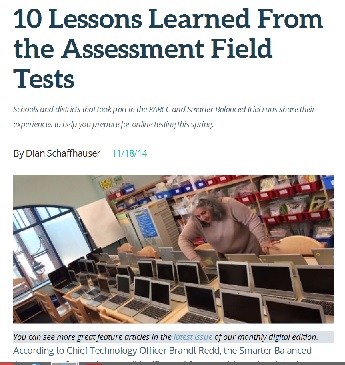
 The Journal, an online periodical dedicated to “transforming education through technology” recently posted a fascinating list: “10 Lessons Learned from the Assessment Field Tests – Schools and districts that took part in the PARCC and Smarter Balanced trial runs share their experiences to help you prepare for online testing this spring.”
If you’re one of my Eleven Faithful Followers, you know I’m not particularly anti-Common Core. Oklahoma’s not even a Common Core state this month. Still, I work enough in surrounding states which ARE that I thought it would be worth perusing.
And… oh my god. The list… it’s… well, irony is dead to say the least.
All ten are the same lesson, repeated without irony or complaint – “Spend More Time and Resources Hyper-Focused on Computer-Based Testing.”
Lesson #1: Prioritize Your Infrastructure
Many school tech directors “talk about the devices first.” That’s the wrong approach… “You have to talk about the infrastructure first. Get that working, get that up to speed, spend the money where you need to there, and then talk about the devices.”
Too many schools are wasting their resources on instructional items or those overpaid tenured classroom teachers. Let’s prioritize, shall we?
Nothing on this list makes even a token effort to suggest “kids knowing stuff” should even be a factor, let alone a priority. Any resources devoted to learning are specifically redirected to things like…
Lesson #2: Do A Dry Run
 Setting aside the unpleasant implications of having dry runs, you should monopolize the manpower and classroom space required for testing well in advance of the ‘real thing’. This carries the additional benefit of eliminating early any lingering sense we should care about anything else. Ever.
…If you’re taking a room that’s normally used for other purposes and dedicating it to testing, you may find that once you’ve packed it with “30 computers and 30 people, the air conditioning isn’t adequate to keep it cool. It’s not the thing you’d think of right off the bat.” Another possible scenario: You find out too late there isn’t enough power to run all the systems…
You might have enough Internet bandwidth coming into the school, but it may be that the access point that serves a particular sector of the school was expecting a dozen devices, and all of a sudden you have 30 or 40, and it’s not built for that much capacity.” There’s no substitute… “for setting up all your computers and getting the equivalent number of people in front of those computers, whether it’s students volunteering to stay after school to play around or a bunch of parents and teachers bringing up a practice test and trying it out and making sure everything works.”
Finally, something to do with all of those teachers and kids always wanting to hang around for hours after school – they can take practice tests online! That way, if there are problems, the school can promptly renovate their technological infrastructure solely to facilitate more testing. Bonus!
Lesson #3: Prepare Staff for New Priorities
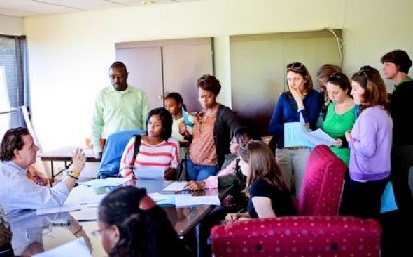 So… what were the old priorities?
The Student Information Office dedicated two months to getting everything ready for the test, including working… to develop a schedule of testing sessions that they kicked back and forth for days on Google Docs…
“I didn’t have much to do at all with standardized testing before… Now we were totally dedicating our time to working on it.” Once the schedule was in place, the IT department dedicated about a month and a half to preparing the devices, “something that normally they wouldn’t have to do.”
It’s difficult to know where to begin mocking something so naturally horrifying and full of self-parody. Keep in mind no one included or quoted is complaining – they’re sharing their keys to success.
Lesson #4: Try a “SWAT” Approach
…There’s no such thing as over-planning when a school is undertaking a major initiative such as the transition to online testing… make sure you have a lot of people to help you out…
If there’s one thing schools have in abundance, it’s helpful people without anything to do. We hardly know what to do with them anymore! Thank goodness testing is here so they won’t be bored or anything.
Lesson #5: Adjust on the Fly
Good news! No matter how much you plan, tons of stuff will go horrible wrong. Be ready to be consumed with dealing.
Clearly the rules for PARCC and Smarter Balance testing are different than other standardized tests in which the slightest wrinkle requires full shut down and execution of all witnesses, including the young.
During the field testing, both the state department of education and Pearson held a daily briefing with district representatives to share problems and possible solutions…
I gotta give these people credit – they sound so enthused over the days spent troubleshooting a variety of devices. I’d be far less giddy over test-software-compatibility-alignment.
 Lesson #6: Get All Hands on Deck
Although teachers acted as proctors during Burlington’s field testing, members of multiple departments were enlisted to provide in-school support… “We brought in as many team members as we possibly could.”
I don’t know about you, but I do get pretty fed up with people in the building wasting their time on stuff other than testing, test-prep, setting up for testing, or pretending to test so the testing tests go testier.
Lesson #7: Try Out Various Scheduling Scenarios
If you’re not sure which approach to scheduling will be best, consider testing different schemes at different schools…
The best part about massive online resource-heavy testing is that there’s no reason every school should do it in the same way or under similar conditions. Variety and personalization are what makes it standardized and therefore such an effective tool.
 Lesson #8: Deal With Keyboards
Both PARCC and Smarter Balanced have mandated the use of external keyboards for their tests, but some districts have discovered that they should probably be optional.
Um… but they’re not. Does anyone involved in this process understand how “standardized” works? Your personal flavor choices aren’t a factor – THAT’S THE WHOLE POINT. It’s why real teachers hate these.
“The students in Burlington don’t use an external keyboard. They like the on-screen keyboard. The fact that PARCC required it was actually a bit of a challenge for the kids who weren’t used to having it.” During the field test, he said, “Many of our kids disconnected the external keyboard and stayed with the on-screen keyboard. We just wanted to make sure they were using it however it was most comfortable for them.”
So maybe it’s not “standardized” causing the confusion so much as “mandated.” Or could we have been using that #3 pencil all along without retribution?
“Our students didn’t like having to sit at stations taking long stupid tests, so they looked up the answers on Wikipedia and then played Candy Crush. We just wanted them to be comfortable.”
Still, given that the districts quoted so far all have 1-to-1 technology, I can see how it might be important that every student have their own personalized test-taking device with which they’re so comfortable – just like every other child who’s ever going to have their worth judged by these assessments. Oh, wait…
Good thing there’s no possible correlation between your technological comfort-level and your ability to demonstrate what you know or are able to do academically.
 Lesson #9: Practice the Sample Tests
Students will need help finding their way around the online assessments. Sample tests provided by both PARCC and Smarter Balanced can give them the introduction they need… “The performance tasks were certainly a new element, and that was probably the biggest change we saw… Part of that was building understanding around which tools the student can use during the assessment, such as dragging and dropping and drawing lines.”
To help students get comfortable… “We wanted all of our sites to have the time to make multiple practice tests before the field tests… so we could do it well in advance of the real test.”
I don’t have to even say it, do I?
Lesson #10: Put Your Communications Experts to Work
Although Smarter Balanced and PARCC have robust informational websites, the amount of content they make available can be overwhelming…
Yeah, lots of content can be. So can the skills required to effectively take ongoing technology-based assessments.
Good thing we seem to have eliminated anything else which might clutter the minds or energies of our kids.

 I should start with a warning that I’m probably going to say the wrong thing. I know this because I often say the wrong thing – not just with you, or with other students of color, but in general. Saying the wrong thing is something of a specialty of mine.
 Note: After
  I don’t even teach a tested subject this year. State law as it stands this week (it’s been rather flaky lately, so who knows what 30 days from now might bring?) says I can pretty much make up my own standards for VAM in my department, while my friends down in the Math & Science halls are tied to tests already taken and cut scores which are determined by random rolls of leftover D&D dice sometime in July.
  This is wrong – this electronic tying of each teacher to each kid based solely on who’s on your grade book at a given point. It doesn’t matter that I have upper middle class white Methodists from two-parent families who only miss school for golf or family vacations to Europe, while the guy next to me has kids suspended so often he has more class admit forms than completed assignments.
  Which is the opposite of what I teach my kids all year. It’s the antithesis of that stuff that helps maintain the thin illusion that anything we’re doing here matters, or has value, or could change anything. “Don’t rock the boat – it won’t help!” That should replace the other posters in my classroom for the last two weeks. Just sit in the back of the damn bus. Just finish the wire transfer from the hidden account. Just ignore the policies that maintain poverty for political gain, or segregation for social stability. Just walk past the problem.
 I have students coming in 15 minutes, and we should be discussing what we’ve read so far in The Grapes of Wrath. I’d meant to talk about “Joe Davis’s boy,” who drives the tractor that’s tearing up their land and down their homes, and I’ll ask them whether he’s part of the problem or not.
 We still hear from time to time that public schools could learn a few things from successful private businesses. If so, why not Chipotle Mexican Grill?
 But what Steve Ells did is pretty amazing. He started small, tried different formats, swapped out a few ingredients, then reproduced the most successful combination on a large scale. All the benefits of sit-down dining and the economies of scale normally found in eating establishments represented by cartoon characters or creepy plastic-headed men. It’s a charter school movement dream come true!
 Employees at Chipotle will be held to higher standards than currently the norm. Customers will undergo regular physicals, including checks of their weight, blood pressure, cholesterol, stamina, heart-rate, and anything else we can think of – including whatever might be trending that year. Locations unable to demonstrate consistent weight-loss and fitness-gain will face staff reductions and reduced ingredients until they improve.
  A percentage of resources currently poured into running the various Chipotle Mexican Grills around the country will be redirected to a bureaucracy responsible for overseeing these things. These sundry minions’ expertise will be based largely on them having eaten at a Chipotle at some point, or if not, having eaten somewhere else at some point in their lives.
 Just before Halloween (probably no connection), bad people (by which I of course mean the Russians) exploited a security hole in –
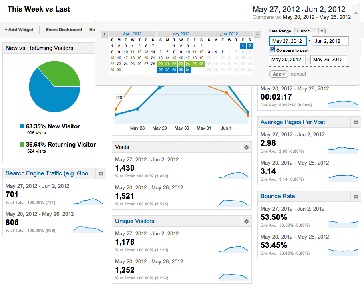 (3) Google Analytics assures me that people were reading the blog – but mostly when I was on a rant about something – usually Dr. Barresi and the OKSDE. The sharper the sarcasm, the higher the views. This isn’t all bad, but it increases my conundrum regarding those posts. On the one hand, she’s all but gone – why invest the time necessary to recreate those posts? On the other, without them I’m rebuilding the blog version of ‘B-sides and Alternate Takes’… a kind of ‘Everything Except the Hits’ boxed set.
 I’ll be reposting many but not all of my past scintillations. As long as I’m having to recreate them from salvage anyway, I’ve been cleaning them up as I go. Some of them are better as a result, and most are at least shorter. The plethora of visuals may or may not be fully reinstituted, but I’m not sure that will break anyone’s heart. Mostly it just lowers the instances of copyright violation for which I’m culpable.