
Cognitive Dissonance

Frustrated TeacherIt’s been a rocky school year. I’ve been doing this for fifteen years now, and thought I had a pretty good handle on how to teach freshmen. But they’re not getting it. It’s not that they can’t – it seems they’re going out of their way to NOT.

This is frustrating, because I like to think I’m a pretty decent teacher. I’ve taught the same subject for several years now, so I’m scrambling less – which is good, because I’m getting a little older and a little tireder.

So what’s the root of the problem?

It matters because what I’m observing, feeling, and experiencing, don’t mesh with what I believe about myself and my chosen profession. This creates cognitive dissonance – it rubs me the wrong way, internally and often subconsciously.

We’re wired to want cohesiveness, patterns, things that make sense and allow us some control over our responses. When things don’t fit, we make them – even if that means adjusting our priorities, our perceptions, or the facts themselves. Otherwise the world is playing out of tune with itself, just a shade sharp and off-tempo – and it’s maddening.

So, what’s up with my students this year?

Maybe it’s me. Maybe I’ve been careless or cocky or I’m just getting tired. Perhaps I haven’t been as focused, or put in as much energy. I could be letting other things take too much of my time – like this blog, for instance. I don’t like that solution, though – it makes me feel like a failure, and I don’t want to spend less time on the other stuff I like.

History DetectiveMaybe it’s this focus on skills. I used to just teach some history, but no – we’re supposed to make them think and analyze and all that. From po’ baby to independent learner in less than a year? When everything else in their world is designed to coddle and entertain them? Impossible! I like this solution better, but… I kinda value the skills thing. And it’s not an entirely new thing, so it can’t completely explain the problem this year.

Maybe it’s this generation of freshmen. I’ve already noticed more helicoptering parents, more coddling by concerned adults, more learned helplessness. I mean, it’s not that they CAN’T do this stuff! They just don’t… listen! Or think! Damn kids – I do all this work, and they go out of their way to be clueless!

THIS satisfies on several fronts. It explains the results I’ve been getting, but without reflecting poorly on me as a teacher. It doesn’t require any major shifts in my personal priorities or beliefs about pedagogy or anything else. It’s easily reinforced as I interact with coworkers – I’ll always find agreement on negatives.

Best of all, the students can’t defend themselves since I’m unlikely to actually explain why I seem so increasingly hostile. They lack the tools or information to make a case for themselves even if I did.

Choosing a PathOnce I’ve unconsciously chosen a path towards resolution (of my cognitive dissonance), I find a trove of evidence supporting my solution. These freshmen really are clueless sometimes. That’s always been true, but that doesn’t matter – it’s true right now and feeds my narrative. There are always a few who go out of their way to be irritating. Again, always – but for now, proof.

“I mean, there’s only so much I can do if they simply refuse to pull their heads out of their behinds!” This really helps build some steam, as it lends emotional intensity to what could still prove an intellectually messy paradigm if confronted consciously. The more emotions in play, the less reason is required – awesome!

I’m unlikely to even question my internal framing – the assumptions behind “they simply refuse” and the disdain implied by “heads up behinds.” I just feel, perceive, and believe

Because I’m not making an argument – I’m resolving an internal conflict. Like breathing, blinking, sweating or swallowing, these inner workings proceed involuntarily and automatically. I’d have to stop and focus to suspend them for even a few moments. To do that, I’d have to be aware of what was happening – which I’m quite contentedly NOT.

Cognitive dissonance results from conflicting attitudes, beliefs or behaviors. It’s uncomfortable, which usually leads to a change in attitudes, beliefs or behaviors to reduce the discomfort and restore balance. 

Cognitive Dilbert 2

It’s so clear in others – the smoker who can rationalize away any health warning or medical problem, the friend whose husband shows every warning sign of cheating but turns on you when you express your concern. It’s a large part of why students with a ‘fixed intelligence’ mindset reject or belittle work they find challenging or confusing. It’s an even larger part of why they don’t “care how much you know” until they “know how much you care” – no one wants to meaningfully learn from someone they don’t like or respect. It creates dissonance.

End of the WorldA small group of believers know the time and date of the Second Coming. In preparation, they sell all they own, forsake jobs and families, and stand ready. It doesn’t happen. What would you expect to come next?

Those who admit they were wrong or deceived are a minority. The truly faithful double down, increase evangelical efforts, refigure times and dates, and become more passionately committed as a result. Facts are adjusted, doubts eliminated.

People with clear opinions about climate change, military spending, or immigration, are provided extensive information which may challenge those opinions. The most common result is greater conviction in their original views, not adjustments to them based on new facts.

Ferguson ProtestComrades of a police officer, soldier, teacher, doctor, or clergyman who takes a questionable turn have a natural sympathy for the position in which that individual finds themselves. They understand better than most how things can be, could have gone, or should be different. They feel the feels, face the challenges, and share the convictions which led them to the profession to begin with.

They face the same daily grinds and the same withering judgment of those on the outside, who simply don’t know…

As that comrade is questioned or criticized, dissonance intensifies. The easiest solutions are to either reject the accused (which creates its own internal conflict) or throw oneself more wholeheartedly into their defense. As commitment solidifies, facts adjust in support. Priorities shift to accommodate.

Militarized Police

It doesn’t make us bad people – it’s the most human of reactions. It does sometimes mean we’re dangerously wrong. It makes it easier to do unforgiveable things to maintain congruence. It allows us to corrupt ourselves and harm others rather than face our dissonance in other ways.

If there’s an ‘other side’, the same thing may be occurring. Grays are washed away as sides are chosen. Moderation is condemned from all angles. While it’s unlikely that both sides are equally right or wrong, an unbalanced equation does not justify the dismissal of all inconvenient variables.

Life is messy, and almost everything important is more complicated than it first appears. Real conviction is impossible without a willingness to dismiss messy details (hence faith’s essential untethering from ‘sight’). We would be crippled by doubt if we properly pondered all information and considered every possible angle before every important decision.

Blinders OnBut let’s not fool ourselves regarding our passions. We value conviction and consistency more than we do content. We prize clarity over breadth of vision. It’s how we’re built, so presumably there are uses and advantages to such inner workings.

In my classroom and in my world, though, I’m going to try to do a better job of stepping back and being aware of how unreasonable my convictions may be. Right or wrong, I’m going to try to recognize my internal paradigm shifts and reality adjustments. I’m going to strive to expand my vision, and increase my clarity.

Besides, that way, I can do a much better job of setting everyone else straight on theirs.

Related Post: Condemnation Bias

A School of Reindeer

It’s the season. Gift-giving and tree-worship and traditional songs reworked yet again. Angry drivers and a strange obsession with snow. And the shows – movies, TV specials, celebrity variety hours with special guest Travis Tritt.

And Santa. Heat Miser. Rudolph. You know – flying reindeer with the red-nose. Turns out the same thing that rendered him a freak made him essential on Xmas Eve. The same authority figure who’d rudely judged his ‘specialness’ came begging for favors. How’d you like THOSE cookies’n’milk, Big Fella?

We love oddballs and underdogs in American culture. The rejects. The outliers. The misfits. Aladdin, Dumbo, the Hunchback, or Stitch. That ugly fairy tale swan-duck. The cast of Glee before it started to suck. William Hung. The Guardians of the Galaxy.

They are Davids to our Goliaths, and we adore them for it. They stand as our proxy in our battle against insignificance or ‘other’-ness.

Then there’s Rudolph, and Hermey – an unfortunately-named elf who wishes to be a dentist. The tale is a familiar one, especially if you grew up in an era of three network channels – only one of which was likely to be showing a proper Christmas special at any given time. The lesson is one we’ve come to expect in a culture celebrating individuality (at least in theory) – it’s our “flaws”, our differences, which make us “special”. 

Rudolph CrewOft-overlooked is the fact that Rudolph proved himself useful – his nose so bright and all. He was an oddball, but that wasn’t sufficient to go down in history. He found a way to take his strange and make it productive. As did Hermey, Yukon Cornelius, and even the Abominable Snow Monster once willing and properly instructed.

But they’re not the only weirdos in the tale. Before our plot can climax, our heroes discover the Island of Misfit Toys – Christmastide’s greatest collection of sentient jetsam. 

Presumably the lessons of the red nose extend to these forgotten darlings as well. They certainly have one of the better songs, and a nice mix of humor and pathos as the various ‘toys’ lament their condition.

But… that’s all that really happens with them. Eventually Santa, now enthralled to the mutant reindeer with the gleaming proboscis, retrieves them for distribution to unwitting victims on Xmas morn, but with no real indication of what they can actually do – what purpose they in fact serve.

A Charlie-in-the-Box is badly-named, but otherwise as useful as any toy based on repeatedly frightening children unable to discern cyclical patterns. Dolly the Doll seems pleasant enough, other than some heavily-veiled emotional issues – but as long as they stay heavily-veiled, who’s to complain? 

Misfit Deadly

But a train with square wheels is useless. It can’t and doesn’t and won’t go anywhere, or carry anything, under any circumstances. There’s no conceivable situation in which a boat that can’t float would be necessary to save the proverbial day. And a squirt gun that shoots jelly merely makes your victims sticky and annoyed before you’re suspended for a mandatory 45 days.

GleeThe kids on Glee are irritating as hell, but they sing rather well. Dumbo learned to fly thanks to the freeing properties of inebriation, and did something useful I can’t recall but seems to have involved scary clown firemen. Hung made records people actually bought, the Guardians saved the Galaxy, and Frodo Baggins destroyed the ring – sort of. Even Nestor, the Long-Eared Donkey, proved himself essential – although in so doing he became part of the most unintentionally creepy nativity claymation ever.

The Island Misfits show no such ambition or skill. Being weird may not deserve condemnation, but neither does it in and of itself merit any particular accolades. There are, in fact, essential elements our lauded bohemians have in common – character traits necessary to actually accomplish anything, even amidst this cultural cult of eccentricity.

(1) Hard work – Rudolph faces many struggles even running away, and more trying to save his family and reindeer love-interest Clarice. Dumbo works hard, as do the X-Men. Those kids on Glee are always preparing for competitions against heavily-funded high schools full of the same twenty performers every time. There’s no slacking with the loser hero. They do not merely lay around the island waiting to be dumped off on someone else. 

(2) Responsibility – When the moment of decision comes, the useful misfit does what he or she can do. Rudolph won’t stay on the Island if his nose endangers even the most useless of toys. Hobbits take journeys. Aquaman organizes fish. Groot is Groot. Some variation of “this is my job” or “I have to do this” is expressed. Often they save everyone at great personal sacrifice.

Rudolph Flying(3) Using Their Skills Effectively – The nose. The ears. The ability to quote the King James while holding a blanket. Music. Humor. Shooting ice from your hands, seeing through walls, or sticking people with your pokey-claws. The skills vary, but they’re all wanted or needed by someone sometime for something. It’s not enough to be different – they’re different in some useful or entertaining way.

(4) Willingness to Learn, Practice, and Grow – An Aladdin or an Ugly Ducking can’t afford to sit back and wait for their moment of speciality to burst forth. They apply themselves to whatever’s in front of them – how to behave like a prince, expertly sweep a fireplace, or properly fill a cavity. Buddy the Elf had some issues, but he’d paid enough attention to help fix Santa’s sleigh when it crashed in Central Park.

Useful Misfits don’t neglect their gifts, but they more than most realize the value of a growth mindset and of playing the cards you’re dealt. They don’t hang out on islands waiting for Santa – they journey through the snow seeking their purpose.

(5) Self-Perspective – “Starlord” Peter Quill has moxy, but he’s aware of how often he’s getting by on bluff and style. Kurt Hummel gives football a shot for one episode – as kicker and lead choreographer – but otherwise devotes his energies to singing and not getting beat up. Misfits need not live in fear, but they recognize what they are and are not, what they do and don’t bring to the table. Reality is their friend.

Climb That Tree Test

I love my students and value their quirks and individuality (mostly). I’m appalled at our efforts to run them through the standardization machine so we can label and letter their worth. I want the freedom to teach them whatever I believe will prove useful or engaging, and to help them learn how to pursue and learn on their own whatever stirs their passions.

Misfits2But as we celebrate the value of diversity, and specialness, and glowing red noses, let’s keep in mind that equally important are the essential skills and mindsets that they’ll need no matter what their individual gifting or choices.
Let’s not run so fast and so far from our terror of “common standards” that we end up producing and validating a generation of choo-choo trains with square wheels but GREAT self-esteem. Let’s not go out of our way to foster island-sitting, or waiting on someone red to sweep down and take them off to be coddled without having to actually do anything.

Let’s celebrate being weird – but doing something with it. To use it to lead, maybe to fly. Something, perhaps, to merit going down in history.

Thanksgiving Perspective

I’m not one to worry overly much about properly targeting my posts or tweets, or appropriate scheduling of posts, etc. I have nothing to sell, and am content to post sporadically about whatever happens to seem of potential interest or amusement to myself and my Eleven Faithful Followers (#11FF) – who I love and appreciate.

Still, I do try to stay in the general realm of education policy or subjects of historical or pedagogical interest. If I think I have so very much to say about hockey, or They Might Be Giants, or superhero movies, it wouldn’t be so difficult to set up another blog.

Oh god – imagine MORE of me carrying on. I just felt the full inanity of that for a moment.

I lack the pressures of a huge following. Normal weeks a few hundred people visit some part of this blog or the associated goodies, and of those a few dozen stay for any real length of time. My Twitter and Facebook accounts have similar numbers – I’m there, but I’m not, you know… a thing.

Still, I couldn’t help but notice this past week – as I melted down a bit over the ongoing public executions of black youth and the subsequent white disparagement of those silly negroes and their uncivilized reactions – that despite the regular ‘New Follower!’ notices, my numbers dipped overall. The likes and shares stopped, even for the traditional stuff. The zany commentary on life in the classroom. The spikey insights on our edu-natures.

Which is fine. But I noticed.

It could simply be that I went way off my usual topic base for long enough people lost interest. It’s also likely that my approach to the entire subject alienated or offended or just annoyed people. I do get going.

I’ll be back on topic after a few days out of town doing holiday stuff and watching some #DallasStars hockey. I’d like to do a post about ‘cognitive dissonance’ and its role in history and in the classroom. I’m sure it’s also a major factor in the ability of otherwise decent, intelligent people to believe that pretty much anytime a black kid is killed by the police, they were probably asking for it. Always. Every time.

That power never corrupts, race never shapes our assumptions, and people never try to cover their shame. That human nature has dramatically changed in recent decades, after centuries of being pretty much the same. That the bell can toll for you all it likes – I haven’t done anything to make it toll for me, so maybe if you’d stop being however you’re being…

But I probably won’t write about it that way when I do the post. I’ll stick with historical examples, or anecdotes with a little emotional distance. I’ll be thinking about Tamir Rice, Michael Brown, Kimani Gray, Kendrec McDade, and others who look a great deal like my students but whose deaths don’t change much for my peer group or many of my friends. But I won’t call it out so much.

Because the real slap-in-the-face by reality this past week is the reminder that nothing I have to say is so powerful or effective that it changes minds or mindsets. I’m simply not that important.

Don’t grab your tissue and start typing fuzzies in the Comments box – my self-esteem is fine. Most of us aren’t that important – not to the extent that a few words of outrage reshape paradigms for all who hear them. Besides, I’ve been reminded of my place in the universe before, and no doubt will be again. The universe is very consistent that way – kindly kicking our lil’ egos back into line when we stray.

I’m sticking with my foundational delusion – that over time, through sheer persistence, monkey and typewriter, I’ll nudge a few people a few small degrees. That something will be amusing at the right time, or helpful, or resonate in some way. Like in class, the results are rarely dramatic – and may be negligible. Hell, they may not exist.

But what else can we do?

What else is there, other than to keep plowing and watering and pulling and hoping you’re not just making it all worse? I assure you, if I saw an opportunity to be more dramatically useful, I’d take it.

Those of you stuck with me in real life will receive no such relief. We’re invested in one another personally and professionally. You’ve earned the right to call me out or laugh me down and I’ve earned mine to wax prosaic. We’ll just have to endure, I suppose.

On an unrelated note, there will be shirts. Like, Blue Cereal Education shirts. You won’t be able to buy them, but you can earn or win them. I know, right? The perfect demure brag on your insider status as one of the #11FF. The perfect gift for that person you’re not actually sure you should buy gifts for but they seem to like, um… not being topless.

Happy thoughts to each of you. Perhaps we see through a glass darkly, but surely between us we can experiment with angles and light and assumptions until there be gleaning. Maybe we can catch a few… useful glimpses.

I am thankful to each of you who share your LEDs at one angle or another. You are treasured. I leave you with me:

Dinosaur Perspective

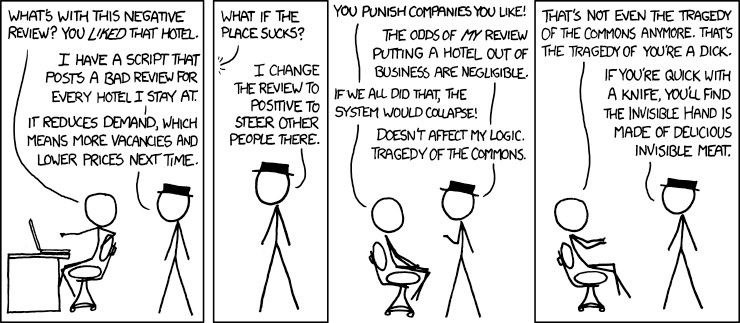
Tragedy of the Commons

Tragedy of You're A Dick

The Tragedy of the Commons is a situation in which reasonable people, acting in their own best interest, use or otherwise exploit resources shared by the whole – leading to negative results for everyone, including themselves. The term was first coined in 1968 by ecologist Garrett Hardin, but the idea can be documented much earlier – all the way back to the Greeks, I’m told, if one looks hard enough.

The classic example involves overgrazing a plot of common land. Each individual benefits substantially and personally from adding cows or sheep or whatever, although in the long-term they suffer when the land is no longer useful due to overgrazing. The bad stuff is shared in common, however, while the benefits are individualized.

Also in play is the awareness that an individual who decides NOT to take advantage – who limits the number of animals they graze, in this case – will (a) not actually solve the problem, since others will still do it, and (b) will suffer as a result of their community-mindedness, since they’ll have fewer cows.

The motivation for NOT being part of the problem is, therefore, nada.

Libertarians cite this as a fundamental case for land ownership and private property protection – one of the few ideals laid out in both the Declaration of Independence AND the Constitution (which don’t generally agree about much else). If each villager owned a small plot of land, to continue this particular example, they’d take better care of it long-term – or so the theory goes.

[[{“type”:”media”,”view_mode”:”media_small”,”fid”:”256″,”attributes”:{“alt”:””,”class”:”media-image”,”typeof”:”foaf:Image”}}]]

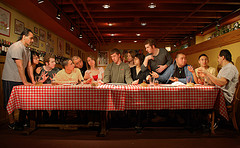
It is not far removed from the so-called ‘Unscrupulous Diner Dilemma’, in which a group of hungry cohorts agree ahead of time to split the cost of their collective meal. For each individual diner, the cost of ordering a more expensive meal and maybe an appetizer or two is thus greatly reduced. Although everyone will pay more as a result, the negative consequence of the choice is not proportional to the benefit.

The obvious solution is for everyone to pay for their own meal. Problem solved. Unless it’s not. Sometimes we want the benefits of collective resources.

[[{“type”:”media”,”view_mode”:”media_small”,”fid”:”255″,”attributes”:{“alt”:””,”class”:”media-image”,”typeof”:”foaf:Image”}}]]

In both cases, something intended as a collective good has negative results based on people being people. No one involved has to be particularly evil – they simply behave as people do rather than as idealized versions of what we wish people would do. In both cases, the solution seems so simple – to each his own. Everyone gets their own plot; everyone buys their own dinner.

But that’s where the proverbial devil enters into the details.

Someone will fail to take care of their land. Or it will turn out to not be very good land, compared to the next field over. Or one landowner will sell his plot to another to pay off debts, or because they wish to move, etc. Or the river will flood on some people’s plots but not others. Or ninjas. Or this, or that, or something else.

Inequality creeps in.

Even if the imbalance begins with human failure, the consequences are handed down to the eldest sons (keep in mind we’re working with the cow grazing example here – the ‘eldest sons’ part may vary in specifics). One way or the other, it doesn’t take many generations before some people have more land than others, or better land than others, and we’re faced with a disparity completely untethered to the individual choices of the landowners in question.

Faux Last SupperIn the more confined example of the Table for Twelve who’ve decided to each pay their own way, inevitably someone will lack sufficient cash to buy their entrée. They may have enough for an appetizer, but as they return to work slightly less-nourished than their peers, they will produce less – and the next visit to the restaurant may find them ordering a glass of water, no lemon, and swiping a few breadsticks from their cohorts.
Maybe some of the others will feel compelled to buy dinner for this poor chap! No one should starve when we have food – so they’ll share, or someone will step up and buy, no big deal. Or perhaps some of those contributing begin to resent the freeloader, or a sense of expectation gradually develops on the part of the recipient of these kindnesses until he no longer even realizes that he could ever be expected to pay his own way.

The point is that there are problems with communal ownership. There are pretty substantial problems with private ownership. The third option – government ownership – is rife with difficulty as well. Like all things smacking of socialism (which I use not as a loaded term but as an effort to approximate government-directed ‘sharing’), what works in theory and what people do in practice rarely cooperate.

If all men were angels…

If there’s no coordination from above, people don’t cooperate on a large scale – at least not in ways large enough to consistently impact the system. If there is coordination, that means rules, and laws – things that inevitably benefit some players more than others. Rules which are by their nature coercive, and often corrupt.

Pie. Just Pie.Add a more explicit financial element, and the impetus for avarice and corruption is almost irresistible. Laws can attempt to herd in certain behaviors, but can never eliminate them – and can certainly never do so equitably or effectively. Prohibition is only the most glaring example of men working the system for personal gain and the unintended consequences of government ‘help’. Think tax code, or health care, or military bases, or college scholarships.

Or think public education.

Like access to that theoretical bit of grazing land, education has become a basic human right. An enormous pool of resources is dedicated to the task, but despite its size, there are always more cows than grass. How do we distribute these quinzillions most effectively? Or should it be most fairly? Most efficiently?

Public School Cows will always need more – none have too much, and many have nowhere near enough. The field is also open to the Sheep of Charter Schools, the Taipar of Virtual, This Reform Bison, That Reform Gopher, the Reform-to-end-all-Reforms Zebra, and the Reform-to-end-all-Reforms New & Improved Zebra w/ Technicolor Stripes. The Textbook and Testing Goats eat way more than their share, as do various Grasshoppers trying to control everything from what kids eat for lunch to how much physical activity they get between classes.

Actually, maybe those should be Locusts.

Sort of a CowThere’s no motivation to take less, you see – the system is in fact weighted to encourage each and every player to get all they can as quickly as they can, or another player will. There’s no such thing as ‘results’ in the Tragedy of the Commons, but if there were, we’d find that what claims to be a measuring sticks turn out to be more like a lawn mower.

None of our solutions are appealing.  People in large numbers simply don’t play nice with any consistency. Governments are horrible at husbandry.  Private ownership is, in this case, loathsomely immoral. Normally this is where I’d unveil the solution – witty, a bit sardonic, but suddenly so very obvious. Normally, this is where we bring this baby home.

Moo.

Condemnation Bias

You may be familiar with the website “Spurious Correlations”:

Cheese & Bedsheets

You knew cheese was bad for you, but maybe not exactly why…

Miss American Steam

Bring on Toddlers & Tiaras – it could save lives.

Disney Mowers

Accio Spinning Blades!

It’s a humorous site which makes a serious and rather important point: 

Correlation Not Causation

We all know this. Most of us can identify it academically, in abstract situations. In ‘real life’, however, it all too often combines with another fascinating bit of human fallibility: ‘confirmation bias’. 

Confirmation bias is the tendency to screen out or forget facts or situations which don’t support our existing beliefs, while remembering with emphasis those which do. The thing where it seems to rain every time you wash your car (or do a ceremonial dance)? Celebrities dying in threes? The way people from certain racial groups or religious faiths seem to always X, Y, or Z? Yeah, that’s largely confirmation bias. 

It’s normal. It’s human. But we could be a little more self-aware while doing it. 

I had a principal several years back who simply could not get enough motivational folderol. The posters, the sayings, the guest speakers who turn a splattered canvas into a rainbow sunrise of starfish dream destiny – the building was inundated in hopeful banality. 

Class RingsEvery year came the ‘ring assembly’. National company, glossy brochures, and a thousand students held captive to their insistence that EVERYONE regardless of background, want, or financial circumstances, could and should go deeply into debt for the unequalled splendor of class ringdom. 

I’d assumed the school received some sort of kickback for the opportunity to apply this fiscal peer-pressure on powerless minors en masse, but I was mistaken. Why, then, did we devote half of a school day – an otherwise potentially instructional school day – to arm-twisting on behalf of some corporation?

This principal explained with energy and enthusiasm that students who purchased a class ring were 68% more likely to graduate. He believed in his spirited core that the connection to school and the commitment to the date engraved on the side were driving students to succeed – to stay in school, working towards graduation, bursting with personal and school pride.

And maybe there’s something to that element.

But far more glaring is the reality he missed – that students who can afford a very optional expense like a class ring are far more likely to graduate than students who can’t. There’s definite correlation, but not because one causes the other. 

He wasn’t alone. This was the same year the district wanted to remove 2 of the 4 microwaves from the upstairs lounge in the name of ‘conservation’. There were 12 of us using those microwaves each day, apparently running up quite the utility bill. If we were to take turns with half the microwaves, well – the savings!

You see the problem. There may have been reduced total usage, but only because on any given day half of us wouldn’t have time to eat before our lunch period was over.

It wasn’t malicious, and it wasn’t particularly stupid – mostly. The powers-that-be went in with preset expectations and assumptions. The solution only made sense because they’d already decided on their preferred course of action.

Confirmation bias can be particularly ugly when a relationship has soured and emotions are high. Positives are viewed with skepticism or noticed not at all, while every slip, tone, or shortcoming “just goes to prove” some unpleasantry or another. Causes are not merely speculated upon – they are ASSIGNED to unfortunate correlations. For those on the periphery, the fallacies may be less emotionally loaded but are no less ubiquitous. 

Reading Spending Stats

Spurious correlations and confirmation bias create quite the salmagundi of doom when it comes to education ‘reform’. Most of us enter those discussions already pretty sure where we’re going to end up. We may even sigh with resignation. Obviously we’re far more experienced and insightful than the other buffoons and schemers in the mix. And – whether we admit it to ourselves or not – most of us have several sacred presets hidden in the back of our motivation which we do NOT want threatened by trivialities like facts, reasoning, or experiences.  

Once we despise a major player – Gates, Rhee, Duncan, etc. – no statement they utter or action they take can be anything less than nefarious. Wendy Kopp (TFA) could lead a team into a blazing inferno at the orphanage, perish saving youth from the flames, and the major blogs the next day would lead with skepticism regarding how many of them were going to become CAREER firefighters. 

Mostly, though, we’re on the receiving end (of, er… spurious correlations and confirmation bias.) We expect it from students – they have their own reasons for seeing and hearing what they wish and discarding the rest. We get it from parents who need to maintain their own narratives regarding their flawless angel-babies. The local media choose their angles based on what’s currently trending, what makes the best story, or perhaps simply how charming the superintendent was last time they were interviewed. In each case, they utilize facts that fit their paradigm.

There’s no need to lie – there are enough versions of the truth to go around. 

Administrators are under a variety of pressures over test scores, discipline, attendance, and a dozen other things – some semi-rational, many nowhere near. Given how little they can directly control, their cause-effect narratives can be… well, just about anything that gives them a button to push or a factor to influence. 

Burgermeister Meisterburger

As to the major “reformers” – in business, in politics, writing books, or leading charters – it’s true there are those willing to consciously fabricate or manipulate to promote their agendas. Some may even be very bad people.

But I think it’s worth considering that they, too, may have their own narratives into which all subsequent input adapts itself. We all know how easily people form “camps” – sometimes over race or religion, sometimes over oblong pigskins. Once formed, party association radically shapes, well… everything. 

It’s a basic human tendency. There’s no fundamental shame. A certain amount of assuming and generalizing may even be efficient, or evolutionarily useful. 

Evaluating Teachers

But we can fight it. We can try to be a LITTLE more aware of our own foibles, and assumptions.

The lack of such introspection is largely why I think so many educators feel rather hostile towards the presumptive “reform” movements in play. That’s why it’s sometimes difficult to “be reasonable,” or acknowledge when those seeking to make changes make a good point or two, or to keep our own emotions in check. 

Because it doesn’t always seem like those driving the so-called “reforms” are actually TRYING to see the complex realities of the fields they seek to overhaul. They too often appear to have their minds made up before they even began looking at me, my kids, my job, or my world. 

My kids. My job. My world. It’s hard not to take some things personally. 

We must call out spurious causation and confirmation bias when we do catch a glimpse – in our opponents, our allies, or ourselves. In the meantime, perhaps a tiny bit of cautionary humility wouldn’t do our classrooms, our reform-based tweets, or our relationships much harm.