“Here’s Your Mule,” Part Three – That Sure Was Sumter

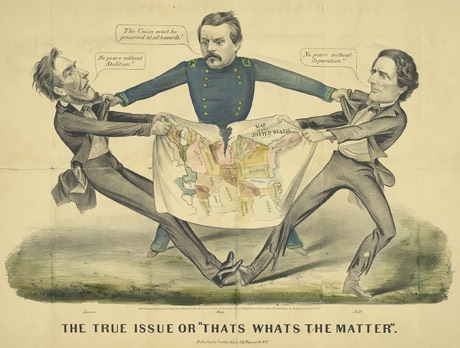
Secession Cartoon

After Lincoln’s election in 1860, a number of Southern states – starting, of course, with South Carolina – began seceding from the Union. Or trying, at least – depending on who you asked.

Soldiers and others who happened to find themselves in the South but remained loyal to the Union began finding their way north in anticipation of the coming conflict. Those in the North who supported the Confederacy did the same in reverse. There seemed to be an unwritten understanding behind it, and no war had been declared yet, so they just kinda… went.

This meant by and large than any arms or other military property in the seceding states defaulted to the control of those siding with the South – them being the only ones left and all.

Except one.
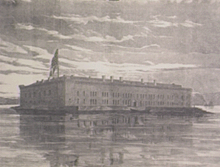
Ft. SumterJust off the shores of South Carolina stood Fort Sumter, one of several installations built to defend the coast from foreign attack by sea. It wasn’t quite finished, but it was already pretty intimidating to view.  In command was Robert Anderson, with 85 men.

He missed the memo about slinking off home, there not actually being one and all. He’d sworn to defend the harbor and to serve the Union and all that, and figured that’s what he should do.

Problem is, he was now surrounded by Secesh – and he was running low on supplies.
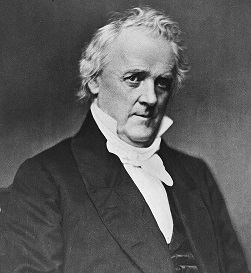
Pres BuchananPresident Buchanan made a few token efforts to resupply the fort, but otherwise followed his famous “stall until it’s Lincoln’s problem” strategy – pretty much his approach to everything between November 1860 and March 1861. Lincoln took office to discover he had less than six weeks to figure out what to do about Sumter.

There are no official documents to this effect, but I have to think at some point Lincoln sighed and wondered why the $#@% Anderson had to play the noble soldier right then and there. Of course the President would back him up, but he hadn’t planned on christening his administration this way.

He wasn’t alone – neither side wanted to be held responsible for actually starting the war, or look weak by making major concessions to prevent it. In the grandest high school tradition, both had prepared their “but he started it!” defenses for posterity, and weren’t about to let a little thing like facts on the ground mess it up.

Anderson exchanged notes with P.G.T. Beauregard, commander of the surrounding Confederate forces and a former colleague, feeling out the situation:
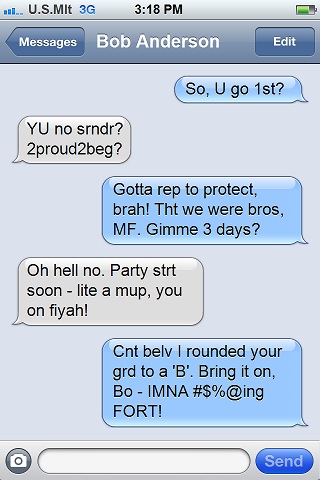
Sumter Texts

Anderson was under no illusion regarding his chances if not reinforced. His language indicates a recognition he’d eventually be leaving – but honor demanded a good show of standing his ground. This wasn’t vanity; it was simply the way things were properly done.

There were conditions under which he could bail with dignity, but they hadn’t arrived yet.

In the wee hours of April 12, 1861, Beauregard began firing on Sumter. Anderson fired back, but not as vigilantly, given his limited ammo and such. Northern ships in the area weren’t built for fighting, and stayed out of range, observing. The battle lasted something like 34 hours.

No one died.
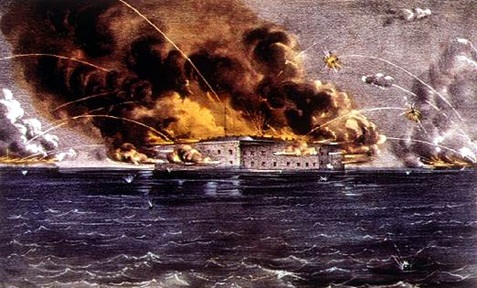
Sumter BattleFort Sumter, as it turns out, was a very forty fort. It was designed to withstand and repulse way cray attacks by sea. The cannons available to the Confederacy, pulled into place by horses and firing balls capable of being loaded by men in a hurry, simply couldn’t do real damage to its walls.

The Rebels WERE able to light some of its internal structures on fire with “hot shots” – cannonballs heated to a glow before firing. These were aimed high to land within. Anderson, unwilling to sacrifice men for what he no doubt saw as a futile, if noble, effort, kept his men inside, on the lower levels. I mean, someone could have gotten hurt!

As for the Yankees, the really big guns at Sumter were intended to sink ships – the kind coming from the OTHER direction. The guns Anderson used were deadly enough at short range, which this wasn’t, and worse, were being fired from the lower levels of the fort.

It was really rather pointless. Helluva show, though, by all accounts – and enough to keep local civilians in a tizzy:

Fort Sumter has been on fire. Anderson has not yet silenced any of our guns. So the aides, still with swords and red sashes by way of uniform, tell us. But the sound of those guns makes regular meals impossible. None of us go to table. Tea-trays pervade the corridors going everywhere.

Some of the anxious hearts lie on their beds and moan in solitary misery. Mrs. Wigfall and I solace ourselves with tea in my room. These women have all a satisfying faith. “God is on our side,” they say. When we are shut in Mrs. Wigfall and I ask “Why?” “Of course, He hates the Yankees, we are told. You’ll think that well of Him.” (Diary of Mary Chesnut, April 13, 1861)
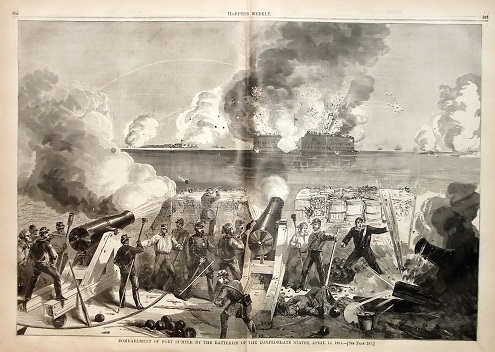
Sumter Battle 2Cannons fired from multiple locations, flames and smoke and explosions – good times. Anderson eventually had remaining munitions dumped to prevent them igniting and blowing up the whole place from the inside. The tides carried the barrels back to the fort walls, where incoming fire ignited them – adding to the fireworks and the distinct impression perhaps Mrs. Chestnut’s friends were correct regarding God’s opinion of the matter.

But no one died.

Perhaps it would have been better if they had. It might have demonstrated at the outset that real lives were at stake – real blood, real limbs, real suffering and death. Instead, the initial action of the war was sound and fury, pomp and circumstance, full of adrenaline and passionate devotion, but none of the true horrors of war – although those would arrive soon enough.

As it was, however, young Confederates engaged in the melee were vocal with their disappointment when Anderson slowed his firing from time to time. They mocked the northern vessels sitting out of range, sometimes rowing within shouting distance to chide them for being so ignoble as to allow their comrades to wage battle without their assistance. They cheered when firing from the fort resumed – perhaps partly from genuine appreciation of Anderson’s resilience, but largely out of the pure joy of video game war.

Which is what it was at this stage – a fantasy and frolic of boys in costume off to play soldier. A few of the older generals had fought Mexico over a decade before, but for most, this was a game.
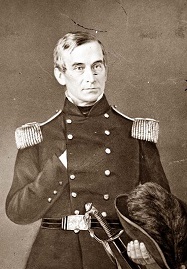
Robert AndersonAnderson surrendered around noon the next day. A cannon misfired during a final ceremonial salute to Old Gory and the resulting explosion killed two young soldiers.

They were the first fatalities of the Civil War – killed not in battle but in the kind of symbolic loyalty which had started this firefight to begin with.

Major ANDERSON stated that he surrendered his sword to Gen. BEAUREGARD as the representative of the Confederate Government. Gen. BEAUREGARD said he would not receive it from so brave a man. He says Major ANDERSON made a staunch fight, and elevated himself in the estimation of every true Carolinian.

During the fire, when Major ANDERSON’S flagstaff was shot away, a boat put off from Morris Island, carrying another American flag for him to fight under — a noteworthy instance of the honor and chivalry of South Carolina Seceders, and their admiration for a brave man.

The scene in the city after the raising of the-flag of truce and the surrender is indescribable; the people were perfectly wild. Men on horseback rode through the streets proclaiming the news, amid the greatest enthusiasm. On the arrival of the officers from the fort they were marched through the streets, followed by an immense crowd, hurrahing, shouting, and yelling with excitement…

Six vessels are reported off the bar, but the utmost indignation is expressed against them for not coming to the assistance of Major ANDERSON when he made signals of distress.

(New York Times, April 15, 1861)

I’m no expert on what makes it ‘war’, but I think they were doing it wrong. They were not enemies, but friends. Though passion may have strained, it had not yet broken their bonds of affection.

It would.
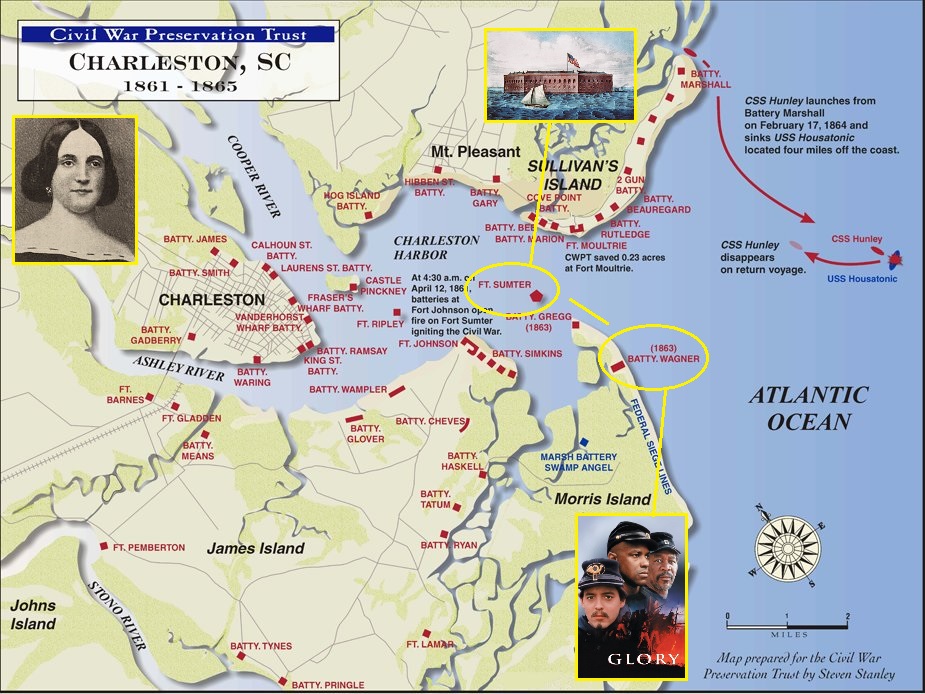
SumterMap

RELATED POST: “Here’s Your Mule,” Part One – North vs. South

RELATED POST: “Here’s Your Mule,” Part Two – Slavery and Sinners

RELATED POST: “Here’s Your Mule,” Part Four – On To Richmond!

RELATED POST: “Here’s Your Mule,” Part Five – Bull Run Goes South

RELATED POST: “Here’s Your Mule,” Part Six – Soiled Armor

RELATED POST: “Here’s Your Mule,” Part Seven – Grant Me This
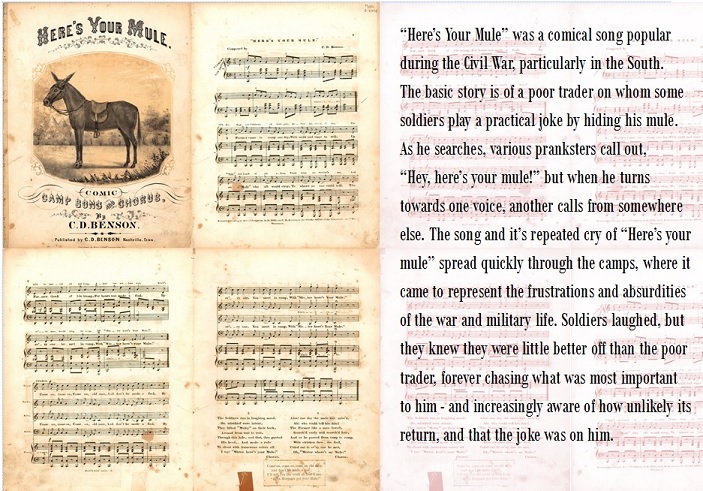
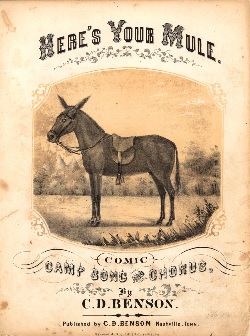
Here's Your Mule

“Here’s Your Mule,” Part Two – Slavery and Sinners

Creating EarthOne of the most bizarre mischaracterizations of history is the idea that in the beginning, when God created the heavens and the earth, the Lord made the North free, and just, without prejudice or malice. He saw the North, and declared that it was ‘good’.

He then made the South, full of slavery and slave-owners, dark of heart and reeking of cheap gin. They were twisted and evil, taking time out of beating slaves and raping children only to drink lemonade on the veranda dressed as Colonel Sanders… rubbing their hands together, cackling maniacally.  

Col SandersIn reality, by the dawn of the 19th century there was slavery pretty much everywhere in the United States. More in some places than others, but it was a thing all over. There were abolitionists as well – pretty much everywhere – carrying on about the evil of the peculiar institution and making everyone unhappy.

It was an onerous institution, even for those not actually slaves. It was expensive and high maintenance and morally suspect, and after a bit the Northern states began realizing they just didn’t need it that badly. Gradually, the practice was phased out and eventually banned – and everyone seemed better off.

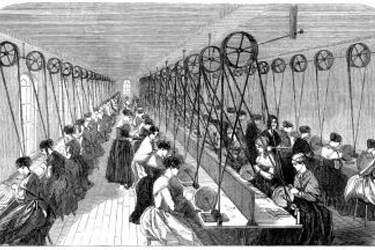
Factory TimeBesides, they already had an entirely different class of not-quite-people to exploit and dehumanize. In the elite world of historiography, we call them the “Irish.”

The South, on the other hand, was going the opposite direction. In the late 18th century a clever fellow named Eli Whitney had invented (or at least improved and marketed) the cotton gin!

See, cotton was CRAZY useful, but a nightmare to pick. The picker had to stoop over 94 hours a day, pulling about 1/zillionth of an ounce of cotton from each boll – which the good Lord had seen fit to make POINTY of all things. You got poked a lot, which hurt – and if you bled, even a little, the #$%&ing cotton stuck to your finger. But, you shook it off into the bag and moved on to the next one. If you did this successfully 480 billion times, you had about one handful of cotton.

So people wore a lot of animal skins and weird scratchy things. It was easier.

Whitney’s little machine made this process much less onerous. Basically you threw everything into the machine and spun a handle until hoodies and socks came out the other side. With the deluxe model you could add an Eskimo Joe’s logo and do t-shirts.

Cotton GinThe cotton gin, as every middle school history teacher can tell you, made cotton production what we historians call ‘way cray’ more profitable – thus cementing slavery as an ‘essential’ institution for decades past its anticipated life span. Unintended consequences suck.

But that’s not what caused the war – at least not entirely.

See, within a generation or so of the last Northern slave passing on, if you asked the average New Yorker or Pennsylvanian why they didn’t have slavery, they would be unlikely to give you a history or geography lesson. Most would let you know – with conviction – that slavery was bad.

To be fair, slavery WAS bad, but that hadn’t stopped their father’s generation from tolerating or even embracing it. Now it was suddenly primitive, backwards – even sinful. Why, then, did their Southern brethren remain so vested in this peculiar institution?

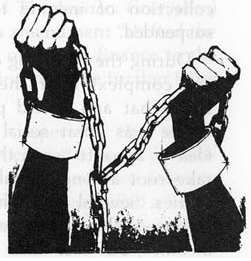
Slavery HandsWell, obviously the south is full of sinners. Not like us – we’re good people. That’s why we abolished it.

Moral superiority. MUCH cooler than a geography or economics lesson.

The North began looking down on the South in newer, uglier ways, and abolition quickly evolved to attack not only the institution but those willingly participating in it as well. The South gave back as well as they received, condemning the ‘wage slavery’ and general self-righteous hypocrisy of the North.

It became personal – much more personal than before.

The abolitionists may have been the ‘good guys’, but their paths weren’t always clear. Some had long, tortured debates regarding the most effective approach to ending slavery without ignoring social, economic, and political realities. Others abhorred compromise, believing righteousness required inflexibility – results coming from divine necessity, not temporal strategy.   

They argued over the inclusion of women, and even over how much voice to give to free blacks. Some of this had to do with their lingering biases, but much of it was calculated based on effectiveness – a professionally dressed, traditionally educated, bespectacled white male had a better chance of changing minds when facing entrenched power and culture.

It was ‘right’ to let women speak on behalf of the enslaved. It was more ‘right’ to let freed blacks speak for themselves. But it was sometimes more effective – based solely on the realities of the day – to not.

You see the dilemma?

At least most abolitionists were aware of the inherent murkiness in their cause and their methods. Lincoln himself famously wrestled with exactly how one limited or ended slavery without creating as many problems as were solved – at least on the white side of things.

I mean, come on… Liberia?

But it was when murkiness vanished and conviction reigned that real sparks flew.

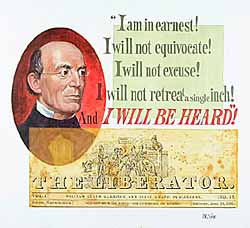
WLGI will be as harsh as truth, and as uncompromising as justice. On this subject, I do not wish to think, or to speak, or write, with moderation. No! no! Tell a man whose house is on fire to give a moderate alarm; tell him to moderately rescue his wife from the hands of the ravisher; tell the mother to gradually extricate her babe from the fire into which it has fallen; — but urge me not to use moderation in a cause like the present. I am in earnest — I will not equivocate — I will not excuse — I will not retreat a single inch — AND I WILL BE HEARD.  (William Lloyd Garrison, 1831)

O BrownsonWages [referring to ‘free’ factory labor in the North] is a cunning device of the devil, for the benefit of tender consciences who would retain all the advantages of the slave system without the expense, trouble, and odium of being slaveholders. (Orestes A. Brownson, 1840)

One might suspect the Universe had a cruel sense of humor: Whitney’s little machine and the diverging development of two interdependent regions based primarily on geography and human nature. Two such different cultures with such similar values, unable to recognize themselves in one another.

Conflict and confusion among the well-intentioned, most of whose names we’ve largely forgotten – was it more important to be effective or to be just? A largely white population coming to violence over a black population rarely consulted as to their views or desires. An unforgiveable sin in our history becoming almost secondary to the vitriol with which it was debated.

CylonThe plot had more holes than Battlestar Galactica, and nearly as many characters we still can’t quite figure out whether to love or despise. (Say what you like about the Cylons, they at least had  moral clarity.)

It should have been no surprise that the resulting war would make even less sense. It will set men free, almost accidentally, and without giving them real freedom. It changed everything, which –

(Oh gosh, I’m getting a bit trite and predictable here, aren’t I? My apologies to The Sphinx.)

It changed everything, which of course stayed way too much the same.

RELATED POST: “Here’s Your Mule,” Part One – North vs. South

RELATED POST: “Here’s Your Mule,” Part Three – That Sure Was Sumter

RELATED POST: “Here’s Your Mule,” Part Four – On To Richmond!

RELATED POST: “Here’s Your Mule,” Part Five – Bull Run Goes South

RELATED POST: “Here’s Your Mule,” Part Six – Soiled Armor

RELATED POST: “Here’s Your Mule,” Part Seven – Grant Me This

Here's Your Mule

“Here’s Your Mule,” Part One – North vs. South

Heres Your Mule

I am often amused at how clear cut so many things are for my students. Not always their ‘real lives’ – although many of them quickly turn indignant when people or events don’t fall in line with their wishes and assumptions – but in confronting history, and politics, and people…  everyone else’s ‘real lives’.

Reality is quite inconvenient, it seems.

Given how unpredictable they themselves are, I can’t fathom where they’ve gained such convictions regarding how other people and events were supposed to have behaved. Nothing is that simple, is it? We love the wrong people, fight questionable wars, focus on the strangest issues, and feel such uncertain feels.

It keeps things interesting.

CWfacetofaceThe American Civil War is one of the most written about, discussed, reenacted, and debated events in all of human history. It was important, of course – major battles and nation-changing outcomes and all – but I’m not sure that’s its primary fascination for us.
Part of its twisted appeal comes from how rarely it made any sense or followed any reasonable course. It was glorious and awful, and probably never should have happened – despite being inevitable.

I mean, look at how much the North and the South had in common:

Am Rev N&SThey’d declared independence together less than a century before and fought the British together – twice. Both extolled the same form of government (even after the South attempted to secede, the ‘nation’ they created for themselves was essentially the same in structure as the one they’d left). They quoted the same Declaration of Independence and revered the same Constitution.

They were almost all Protestants. Whether devout or merely subscribed to the trappings doesn’t really matter – they were of the same basic belief system. They were largely capitalists, they practically worshipped land ownership, and they celebrated the same heroes and events in their history and the history of the world.

Both regions spoke primarily English and couldn’t conceive of doing otherwise.

Paul RyanIn every region of the country, the dominant social, political, and economic class was composed almost entirely of straight white educated land-owning males. Most of them looked down on pretty much everyone else.

They relied on one another economically – the South purchased most of its manufactured goods from the North, which in turn procured cotton and a few other cash crops from the South. The so-called ‘triangle trade’ (molasses, rum, slaves, repeat) was no longer extant, but only the particulars of their fiscal relationship had changed, not the substance.

And, most fundamentally, they were attached. You couldn’t physically separate one from the other. At the very least they were close neighbors. In reality, they were interconnected, intermarried, interbred, and interwound in every conceivable way.

These are not the makings of an inevitable war.

One Big Happy Family

Of course, there were some pretty important differences as well – starting with geography.

The relatively short growing seasons and more challenging topography of the North meant large scale cash crops weren’t a viable option. On the other hand, readily available water and other resources supported industrialization in a way which would have been impractical in the South.

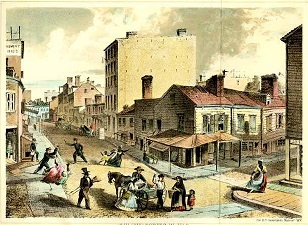
NY1860It’s a mischaracterization, however, to imagine the North was mostly industrialized by 1860. The majority of Northerners lived and worked on small farms or in small businesses, growing food for themselves and their families and perhaps trading or selling surplus for other goods. Most factories were in the North, but most of the North wasn’t factories.

This is going to matter when war breaks out because the North will be able to provide boom sticks AND corn dogs, while the South will struggle to provide either. Just foreshadowing a bit – pardon me.

Elvis ShirtSouthern geography meant agriculture on an entirely different scale. Long growing seasons, flatter lands, different soil – this was God’s way of promoting sugar, tobacco, and most of all, cotton. It was the Elvis of cash crops.

You could only really do one thing with cotton – sell it, to the North or to Europe, who would make it into stuff. You couldn’t eat it (well, I guess you could, but it wasn’t very tasty and didn’t provide much nutrition) or shoot it at people (again, I suppose you could, but…).  If it couldn’t be sold, it was essentially worthless.

GWTW Southy SouthThis will be a problem for the South. That’s more foreshadowing – I hope I don’t ruin the ending for anyone.

Because of the different economies, the North tended to have more cities, and people in general were closer together, geographically speaking. This meant more conflict, more disease, more crime, more everything bad that comes from cities. In turn, this meant more reform, more collective action, more humility, more everything good that comes from collective problem-solving.

Most immigrants poured in up North – that’s where the jobs were, after all, what with the factories and other variety in their economy. They weren’t exactly welcome – racism was rampant back then, unlike today when we love everyone the same regardless of race, creed, or background – but they were there.

Pot Kettle Not liking someone, not hiring them, or even not wanting to live next to them, didn’t mean you didn’t have to deal with them at all. The variety of cultures, languages, foods, beliefs, etc., forced a sort of tolerance and accommodation foreign to the South. At the same time, capitalist ideals and an early sort of ‘Social Darwinism’ largely prevented that accommodation from becoming too ‘kumbaya’.

That whole ‘melting pot’ we’re so fond of referencing? That was in the North.

The South, in contrast, had essentially three social classes – rich white, poor white, and slave. The slaves didn’t get much of a voice, and the poor whites wanted to be rich whites. That meant one small demographic slice pretty much set the tone for everyone – completely unlike today, of course.

Hard to even imagine.

Col. SandersThe South’s concept of honor meant that a traveler could safely expect lodging and food from anyone of comparable social class throughout the region. Slaves with the appropriate permissions could stay with other slaves, anyone else was treated to dinner, drinks, and conversation as a matter of course – however unexpected their arrival. A proper Southerner recoiled with some justification when the North – a cesspool of crass and selfish behavior – openly looked down on THEM!

The North had more people overall, meaning they controlled more of Congress – at least in the House of Representatives. For generations it was a given that any new state in one half of the country would be offset by the admission of a state in the other to maintain balance in the Senate.

The North had more money. More stuff. More focus on business and progress and change and profit and – in the eyes of the South – telling everyone else what to do. They looked westward and forward.

The South had tradition. Honor. They held on to duels as a way to address an offense far longer than their Northern brethren, and had nannies enough without the state filling that role. They looked westward and to tradition, and stability.

All of this stemming largely and logically from geography.

Oh – there was one other little thing that caused a bit of contention. Seems they didn’t see eye-to-eye regarding slavery. That’s next time.

FD Quote 1

RELATED POST: “Here’s Your Mule,” Part Two – Slavery and Sinners

RELATED POST: “Here’s Your Mule,” Part Three – That Sure Was Sumter

RELATED POST: “Here’s Your Mule,” Part Four – On To Richmond!

RELATED POST: “Here’s Your Mule,” Part Five – Bull Run Goes South

RELATED POST: “Here’s Your Mule,” Part Six – Soiled Armor

RELATED POST: “Here’s Your Mule,” Part Seven – Grant Me This

Here's Your Mule

10 Points for the Overwhelmed Student (Director’s Cut)

I hear you’re feeling a bit overwhelmed. I can help – if you’ll let me.

(*cue opening theme and credits*)

Breathe RightOne. You have GOT to BREATHE.

Long and deep, in through the nose… out through the mouth – good. A few more times…

No, don’t just read on – this stuff doesn’t work if you don’t do it. DO THE BREATHING, then listen to me.

Feeling StupidTwo. You’re not stupid.

I don’t know if you’re a genius or not, but genius isn’t necessary here. I assure you, if you were stupid, your teacher would be nicer to you. He or she would have called you aside long ago and had a conversation something like this:

“Hey, um… Angela. Look, I have some bad news. You’re too stupid for this class. It’s OK – it’s not your fault, Probably some combination of genetics and upbringing. BUT, we’re gonna need to get you into a slow kids class, OK?”

If that didn’t happen, you’re good.

DirectorDirector’s Cut:  Feeling stupid usually indicates you’re not.
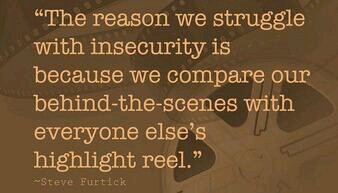

There are studies and science for this, but if you were great at reading up on things we wouldn’t be having this conversation, so I’ll skip them. The short version is that smart people are far more aware of how much they don’t know and can’t do; ignorant people feel pretty good about their insights and expertise.

You’ve probably noted how often they loudly express as much.

As one of the ‘good kids’, you mostly hang out with other ‘good kids’. You’re all amazing, so it seems normal to you. It’s like being 6’8” in the NBA – still freakishly tall, but perpetually feeling like a midget.

Insecurity

Three. You’re not alone.

Sure, there are a number of your peers for whom school is much easier than it is for you. That’s OK – everyone’s different. Most of the folks around you, though, are just putting up a good front – many just as panicked as you.

I know because I’ve had this same conversation often enough to make a blog post out of it. No offense, but I wouldn’t do this for just you. Too much work.

DevilAngelShoulderFour. Shut yourself up.

I suppose you could take this literally, as in “find a quiet place” – which is also good advice. But here I mean inner-dialogue-wise.

Remember the old cartoons with the AngelYou and the DevilYou on opposite shoulders? Contrary to what you might think, DevilYou isn’t primarily focused on trying to get you to rob banks or do crack. Those aren’t legitimate temptations for you – you’re a ‘good kid’, remember?

It IS, however, willing to maintain a constant stream of deprecation and frustration, running in the background of everything you think, feel, say, or do. Details vary with personal insecurities, but whether it’s despair, rage, detached cynicism, or debauchery, it usually begins with tearing off little strips of you and pretending that’s the cost of being ‘honest’ with yourself.

That’s a lie, by the way.

You can’t kill it or completely mute it – it’s you, after all – but you can recognize it and turn it down. Assign AngelYou to keep it in check. Quietly if possible, but out loud if necessary. Seriously – talk to yourself, realistically but positively. It’s good for you.

DirectorDirector’s Cut: You can be realistic about your strengths and weaknesses without so much self-loathing.

That sort of internal immolation is actually a form of being WAY too full of yourself – this idea you somehow manage to suck enough that the universe takes special interest in your awfulness. Bullsh*t. Get back to work and get over yourself.

PlannersFive. Get a planner or agenda of some sort.

Mundane, right?

They work, but you have to use them. Starting TODAY, every hour, jot down what you did in class and what’s assigned and when it’s due. I know you think you’ll remember, but we’re having this conversation, so obviously…

Set your phone alarm to remind you at least twice each day – once around the time you get home from school and once several hours before you go to bed – to look at your planner. Read through it even if you don’t stop and do everything right then.

Anything that doesn’t get done gets copied onto the next day, and so on, until you do it. Continue this system even when you don’t think you need to – new habits take time.

Cross it OffSix. Choose a few things that won’t take long, do them, and cross them off.

If you do something that needs doing but wasn’t on the list, write it down, then cross it off. The reason this is so important is – look, just trust me on this.  Short version – track record of success. Helps.

This next one is huge. Are you still with me?

The IsolatorSeven. When you’re doing a thing, do that thing.

If you decide to read an assigned book for twenty minutes, set aside that voice panicking about chemistry homework. While you’re doing your math, stop getting on your phone to collaborate on that English project. Pick something, and do it. No second-guessing.

One task at a time. That’s the most you can do, ever.

It’s easy to run from worry to worry until you end up exhausted and frustrated without actually getting much done. One of the greatest hindrances to completing anything is worrying about all the other stuff you suddenly fear you should be doing instead.

That’s a trap and a lie. Shut it off and pick something – right or wrong. Do it exclusively.

JugglingEight. When you’re working, work.

When you’re reading, read.

When you’re thinking, think.

Put the phone far, far away. Whatever amazing things unfold in the 20 minutes you’re finishing your calculus, they’ll be there waiting for you when you take a break.

When you’re taking a break, take a break. Set a time limit and don’t keep finding reasons to go past it, but don’t keep worrying about what you’re not getting done.

And move around a little – it’s good for you emotionally and mentally as much as physically.

DirectorDirector’s Cut: Social power never comes from being perpetually or instantly available.

Even if it’s not your intention to dangle your approval over others, delayed response time raises your standing in direct correlation to the hours you let them wait. Think of the times you’ve waited for someone online. Who holds the power in those situations? 

All Nighter

Nine. Start the big hard stuff early.

Even if you do something else first, do the bad thing next. Leave time to be confused, ask questions, or start wrong.

Human nature is to put off the stuff we don’t fully understand and to avoid thinking about that which we most dread. Suddenly it’s midnight and everything is due and you’re so totally screwed and it all breaks down.

Again.

What’s wrong with you? WHY ARE YOU SO STUPID?

That’s DevilYou, by the way. Didn’t you assign AngelYou to reign her in?

Adult BabyTen. Do the parts you can do.

Do everything you can do, even if you’re not sure of all of it. Then ask for help with what you can’t.

Read the directions – for real, this time. Call a friend. Actually read the material, take the notes, watch the videos, or try the activities. You’d be surprised how often a student thinks they’re confused when really they just haven’t done the work yet.

I mean, ideally there’s a reason we assign it. If you knew how to do it already, we’d just be wasting your time. It’s supposed to be hard.

When you’ve done the parts you can, THEN email or visit with your teacher.

DirectorDirector’s Cut:

“I don’t get this.”

(What part don’t you get?)

“Any of it.”

(*sigh*)

Not effective.

“Mrs. _____, I have a question. I read this thing here and did this part here, and I notice in your example you indicate such and such. When I tried that, I had trouble figuring out ______________”

That I can work with. Makes it sound like you’re not just wandering around in a daze, waiting for a miracle.

Conclusion: It’s OK that it’s hard sometimes. Other times, it’s not nearly as hard as you make it. Try to separate your emotions from your thoughts from your abilities, and don’t get so derailed by what you WISH your teachers said or did differently. They didn’t, and they probably won’t, so work with what you’ve got. 

I promise you, you can do this. If I can understand it, ANYBODY can.

Kicking and Screaming

RELATED POST: 10 Points for Overwhelmed Students

RELATED POST: Happy New Mirrors!


10 Points for the Overwhelmed Student

I hear you’re feeling a bit overwhelmed. I can help – if you’ll let me.

(*cue opening theme and credits*)

Breathe RightOne. You have GOT to BREATHE.

Long and deep, in through the nose… out through the mouth – good. A few more times…

No, don’t just read on – this stuff doesn’t work if you don’t do it. DO THE BREATHING, then listen to me.

Feeling StupidTwo. You’re not stupid.

I don’t know if you’re a genius or not, but genius isn’t necessary here. I assure you, if you were stupid, your teacher would be nicer to you. He or she would have called you aside long ago and had a conversation something like this:

“Hey, um… Angela. Look, I have some bad news. You’re too stupid for this class. It’s OK – it’s not your fault, Probably some combination of genetics and upbringing. BUT, we’re gonna need to get you into a slow kids class, OK?”

If that didn’t happen, you’re good.

Insecurity

Three. You’re not alone.

Sure, there are a number of your peers for whom school is much easier than it is for you. That’s OK – everyone’s different. Most of the folks around you, though, are just putting up a good front – many just as panicked as you.

I know because I’ve had this same conversation often enough to make a blog post out of it. No offense, but I wouldn’t do this for just you. Too much work.

DevilAngelShoulderFour. Shut yourself up.

I suppose you could take this literally, as in “find a quiet place” – which is also good advice. But here I mean inner-dialogue-wise.

Remember the old cartoons with the AngelYou and the DevilYou on opposite shoulders? Contrary to what you might think, DevilYou isn’t primarily focused on trying to get you to rob banks or do crack. Those aren’t legitimate temptations for you – you’re a ‘good kid’, remember?

It IS, however, willing to maintain a constant stream of deprecation and frustration, running in the background of everything you think, feel, say, or do. Details vary with personal insecurities, but whether it’s despair, rage, detached cynicism, or debauchery, it usually begins with tearing off little strips of you and pretending that’s the cost of being ‘honest’ with yourself.

That’s a lie, by the way.

You can’t kill it or completely mute it – it’s you, after all – but you can recognize it and turn it down. Assign AngelYou to keep it in check. Quietly if possible, but out loud if necessary. Seriously – talk to yourself, realistically but positively. It’s good for you.

PlannersFive. Get a planner or agenda of some sort.

Mundane, right?

They work, but you have to use them. Starting TODAY, every hour, jot down what you did in class and what’s assigned and when it’s due. I know you think you’ll remember, but we’re having this conversation, so obviously…

Set your phone alarm to remind you at least twice each day – once around the time you get home from school and once several hours before you go to bed – to look at your planner. Read through it even if you don’t stop and do everything right then.

Anything that doesn’t get done gets copied onto the next day, and so on, until you do it. Continue this system even when you don’t think you need to – new habits take time.

Cross it OffSix. Choose a few things that won’t take long, do them, and cross them off.

If you do something that needs doing but wasn’t on the list, write it down, then cross it off. The reason this is so important is – look, just trust me on this.  Short version – track record of success. Helps.

This next one is huge. Are you still with me?

The IsolatorSeven. When you’re doing a thing, do that thing.

If you decide to read an assigned book for twenty minutes, set aside that voice panicking about chemistry homework. While you’re doing your math, stop getting on your phone to collaborate on that English project. Pick something, and do it. No second-guessing.

One task at a time. That’s the most you can do, ever.

It’s easy to run from worry to worry until you end up exhausted and frustrated without actually getting much done. One of the greatest hindrances to completing anything is worrying about all the other stuff you suddenly fear you should be doing instead.

That’s a trap and a lie. Shut it off and pick something – right or wrong. Do it exclusively.

JugglingEight. When you’re working, work.

When you’re reading, read.

When you’re thinking, think.

Put the phone far, far away. Whatever amazing things unfold in the 20 minutes you’re finishing your calculus, they’ll be there waiting for you when you take a break.

When you’re taking a break, take a break. Set a time limit and don’t keep finding reasons to go past it, but don’t keep worrying about what you’re not getting done.

And move around a little – it’s good for you emotionally and mentally as much as physically.

All Nighter

Nine. Start the big hard stuff early.

Even if you do something else first, do the bad thing next. Leave time to be confused, ask questions, or start wrong.

Human nature is to put off the stuff we don’t fully understand and to avoid thinking about that which we most dread. Suddenly it’s midnight and everything is due and you’re so totally screwed and it all breaks down.

Again.

What’s wrong with you? WHY ARE YOU SO STUPID?

That’s DevilYou, by the way. Didn’t you assign AngelYou to reign her in?

Adult BabyTen. Do the parts you can do.

Do everything you can do, even if you’re not sure of all of it. Then ask for help with what you can’t.

Read the directions – for real, this time. Call a friend. Actually read the material, take the notes, watch the videos, or try the activities. You’d be surprised how often a student thinks they’re confused when really they just haven’t done the work yet.

I mean, ideally there’s a reason we assign it. If you knew how to do it already, we’d just be wasting your time. It’s supposed to be hard.

When you’ve done the parts you can, THEN email or visit with your teacher.

Conclusion: It’s OK that it’s hard sometimes. Other times, it’s not nearly as hard as you make it. Try to separate your emotions from your thoughts from your abilities, and don’t get so derailed by what you WISH your teachers said or did differently. They didn’t, and they probably won’t, so work with what you’ve got. 

I promise you, you can do this. If I can understand it, ANYBODY can.

Kicking and Screaming

RELATED POST: 10 Points for Overwhelmed Students (Director’s Cut)

RELATED POST: Happy New Mirrors!