Fact-Free History

Happy AdministratorThere’s nothing more terrifying than finding out your district administrators have just returned from a conference somewhere, and they’re excited about something. You know because they suddenly smile too much, and now they want to come talk to your department or hold a special faculty meeting. It’s enough to ruin your entire 17-minute lunch period.

It’s not because their conferences are always in Vegas or Honolulu or Mount Olympus or some such thing, while teacher workshops are in Moore, or at the Pawhuska Technology and Training Center. No, what’s scary is that they come back all excited about some revolutionary new paradigm-shattering approach to teaching – usually a combination of common sense stuff you’ve been doing for years and a few colorful twists slathered in cutesy rhetoric. They’re sure you’ve never heard of it, and that you’ll be so excited for them to share it with you!

They’d never send you to these sorts of conferences, of course – they’re so far away and expensive, after all. But they think they’ve come upon the Pedagogical Holy Grail – the one which will replace last year’s Silver Classroom Bullet, which superseded the rather durable Brass Teaching Ring, that of course overthrew the Era of Learning Unobtanium (ELU).

So you wait.

The details vary from revolution to revolution, but the need to unendingly build on the ruins of whatever was going to save us all last year remains sadly the same. It drives the world of educational trainery like dilithium crystals power the Enterprise, or infantile narcissism fuels the President. The same few themes do come back around eventually, however, like the Merry-Go-Round of the Damned, and you learn to look for them. Dread them. Fight them. And yet, the very predictability in the process forms a dysfunctional sort of affection for them after a while.

Merry-Go-Damned

My personal favorite is the Periodic Awakening of Fact-Free History.

It’s a Revelation built on a simple truth – one recently discovered by your building principal or curriculum manager or whoever sits before you, eating your bagels this particular Friday morning. “When we were in school,” they always begin, “History was all about memorizing facts – names, dates, places. So many facts.”

Their distress is evident. Damn those facts! And the memorizing of them? Barbaric! Cruel, even. We all pause and reflect on this travesty of our dark past.

“But history isn’t just names, dates, and places! It’s about… ideas! Causes and effects! Opinions and documents and different ways to interpret them! We shouldn’t be spending so much time on stuff kids could just look up on their phones!”

This point always requires the sharer to hold up their own phone momentarily, as if perhaps the rest of us were unfamiliar with this radical new device. The visual distraction helps blur their subconscious leap from “I hated my history teacher in high school” to “you all teach boring, stupid stuff and you’re ruining the future!”

Cell BoysYou know where it’s going from there. It’s time to do more PBL (Project Based Learning). More STEALHAM (Science Technology Engineering Arts Literacy History Athletics Math). More opinions and less reality – because if we teach the way we were taught in the past we’ll create the future we dreaded in our former present! We’re preparing kids for jobs that don’t exist yet, so we need to light more fires and fill fewer buckets if we’re going to fail forward…

It’s a frightening proposition, this fact-free history – if for no other reason than how difficult it would be to insist that such a thing doesn’t actually prepare students to function in modern society. It might, actually – but that’s not a good thing.

It has traction because – like most powerful deceptions – it’s mixed with valuable truths, even if they’ve been shaken to the bottom during delivery… Cracker Jack prizes smudged by poison peanuts. We don’t need to memorize names and dates and stats in the manner of centuries gone by in order to be considered fairly enlightened; Google or some variation thereof seems to be here to stay. If Sherlock Holmes is correct and our minds hold a finite amount of information, like that flash drive stamped “Pawhuska TTC” you got for free at your last workshop, it’s probably not a good use of mental space to drill ourselves on who led Confederate forces at Chancellorsville, or chronologically list every Vice President and their state of origin.

Cracker JackageOn the other hand, it’s a shame to think any civilized young person would be set loose on the world without a pretty good idea of what the Civil War was, roughly when it occurred, and some of the major changes it brought about. It’s unforgiveable if we don’t at least try to ensure that same youth understands the three branches of government and has a general grasp of how each is supposed to work.

You know – facts.

As to the sacred teachings of whoever keynoted the Honolulu Retreat, it’s nearly impossible to make a passionate case for something social studies-ish without drawing on those anathematic details – names, dates, etc. “To what extent was slavery the cause of the Civil War?” is certainly a valid debate to have, and opens itself to a wide variety of approaches and responses. An effective argument in any direction, however, inevitably requires substantial background knowledge at one’s proverbial fingertips – a comfortable familiarity with the issue of slavery over the three centuries prior, the dozen or so precursors to the war occurring in the 1850s, the extant documents from various players indicating their values and viewpoints, etc.

Yes, those things can be “looked up.” No, one needn’t have memorized the details of the Kansas-Nebraska Act or know the precise origins of the “lost cause” mythology in the postbellum South. But neither can you start from scratch and throw something together after a few internet searches – at least not anything viable. Those names, dates, and stats so reviled in our collective memory are the grammar of history, the multiplication tables (or maybe even the numerals) of critiquing culture. They’re not the goal – they never have been. But they’re essential for reaching most worthy goals. They’re often precursors to even defining them.

Sherlock & WatsonAnd it’s even more essential that we emphasize data and details when addressing contemporary issues. I’m a believer in everyone being entitled to their own opinion, but I’d rather not cement my students’ ignorance by encouraging them to wax emphatic on topics about which they know little.

“How can the size and expense of the federal government be reduced without compromising our national security?”

“Should parents have more choice in where their children go to school?”

“Did the Russians interfere in our elections on behalf of the Trump campaign? Did Obama ‘tapp’ Trump’s tower?”

“Should businesses be allowed to refuse service to someone if they don’t approve of their lifestyle, their religion, their race, or their politics?”

If you’re sitting around having beer and burgers with friends, you can spout any opinion on any topic you wish – especially if you bought the beer. Anyone who knows me primarily through social media would never believe how receptive and balanced I can be when confronted with the most bizarre opinions or interpretations of current events from my students.
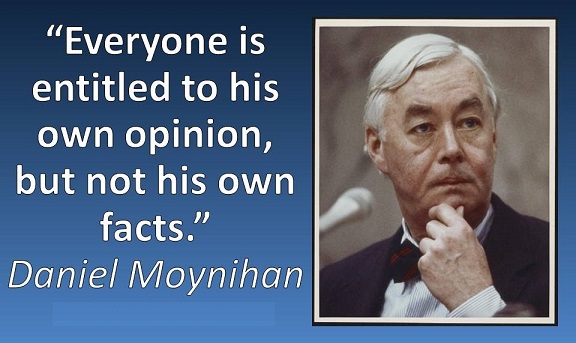
Moynihan QuoteBut if you’re in an academic setting, on academic time, pursuing academic goals, we should INSIST on statistics, data, experts, and records. We should at least TRY to be precise about names, dates, and other onerous “facts” before spewing our precious individuality about pretty much anything.

It won’t be perfect. My students are 15, and we’re rather limited as to time and resources. We’re not working on our doctoral theses this semester and none of them are writing books on trends in jurisprudence at the moment.

But we can at least model the process – we can acknowledge the ideal pursuit of better-expanded versions of our efforts and discuss how they might differ.

I’m not against “individual learning journeys,” and I’m certainly not suggesting we go back to the Trivial Pursuit version of American History, Drill-and-Kill Edition. My little darlings are all individuals with their own experiences, opinions, emotions, and ideals. Kumbaya!

It’s just that most of the stuff worth exploring in history happened to people with names, on dates, in places. It often happened in order. If we’re going to understand it – heck, if we’re going to learn from it, or improve it – we’ll need those pesky facts.

NEXT TIME: Facts-Only History

RELATED POST: Just Teach The Curriculum (Leave That Other Stuff At Home)

RELATED POST: Why Kids Learn (a.k.a ‘The Seven Reasons Every Teacher Must Know WHY Kids Learn!’)

RELATED POST: Hole In The Wall Education

Seven Reasons You Probably Don’t Suck (For Teachers)

Anya Fights

Well, it’s that time of year. Spring Break has passed – the last landmark of rebootage and rejuvenation. 

Many of us are returning without much idea what we’ll be doing in class this week. Maybe you feel behind again, and have big plans for getting things ‘back on track.’ Or maybe all that stuff you were gonna do better this year has already kinda fizzled, and you’re just hanging on until term ends. Some of you are excited about seeing your kids again – which is weird. Don’t get me wrong, I’m happy for you… but it’s still seriously weird. 

So maybe you’re optimistic, or maybe you’re sad break is over, or maybe…

Maybe you don’t actually know anymore. Maybe you had the best intentions ever, but when it’s quiet and you’re alone, you wonder…

Oh god, do I suck at this? Maybe I’m not cut out to be a teacher. I mean, I like it sometimes… often, really. I just thought I’d be better at it. It’s like I can’t quite… they just aren’t… I wish… *sigh*.

I get it. Whatever variation taunts you, I hear you. I don’t really do nurturing or warm fuzzies, but I am a fan of reality – so let’s be candid for a moment, shall we?

You don’t suck at this teaching thing. 

I mean, it’s possible, I suppose. Some teachers do. But most of the ones who DO suck don’t realize or care that they suck. They certainly don’t read education blogs hoping for insight or inspiration. So it’s very, very unlikely that you suck. 

Buffy Is The PlanStatistics say, in fact, that you’re probably pretty good. Once you control for poverty and upbringing and factors well-beyond your control, the reality is that most American public school teachers are at least adequate, and many are quite impressive much of the time. If this is your first year, you’re probably not as good as you will be in two more; if this is your twentieth, it’s possible you’ve lost some of the passion of your first fifteen. But overall, I suspect you’re a miracle worker every day and simply don’t see it.

Ridiculous – you’d know if you were any good, right? You’d feel it. You’d… you’d be happier, wouldn’t you? 

Maybe. But not necessarily. I’d like to respectfully suggest seven reasons good teachers feel like failures – especially this time of year. Feel free to add your own thoughts below. 

1. Your elected leaders despise you. 

If you live in Oklahoma, or somewhere similarly enraptured by Social Darwinism and state-subsidized elitism, you’ve already endured years of passive-aggressive chipping away at all you hold dear. Teachers are lazy. Teachers aren’t accountable. Schools are failing. Kids are trapped. Public education is wasteful. It’s atheistic and immoral and corrupting and Socialist. Teachers are incompetent pedophiles and whiney welfare queens. 

It’s tiring. You tell yourself it’s just politics, but over time it leaves you feeling a bit marginalized. That’s not you, honey – that’s them. 

2. Your values are under assault. 

Those principalities and powers don’t just target you, of course. They despise your students for being different colors, coming from different cultures, speaking different languages, having different faiths, or sexualities, or even just different interests and abilities. You decide every day to treat your kids as if their value is innate. You carry on as if all of them deserve opportunity, challenge, enlightenment, and basic dignity – no matter how straight, white, boring, or Protestant you yourself may be. That makes you a problem. 

We Have Done The Impossible

Statistically, the folks next door probably voted against you and your kids. So did most of the people in your small group at church. Most of your students’ parents voted against you and the skills and the knowledge you’re trying to instill in their child so they can function in a diverse and challenging world. It offsets a whole lotta Starbucks gift cards if you let yourself think about it too long. 

These are tough times to be a believer in public education. Or the equal value of all men. Or common decency. 

But here’s the thing, sweets – the majority is wrong. They’ve let fear and resentment trump the better angels of their nature. Like their forebears a century-and-a-half ago, they think they’ll find strength and clarity in pulling away from what America can and should be. They’ve idealized a past that never existed for most, and at the moment they’re twisting and blaming and striking and rationalizing while you stand there stuck on all-men-are-created-equal and the-pursuit-of-individual-happiness and such. It sets up a glaring national cognitive dissonance, and they resent you for it. 

The majority may find their way back, or they may not, but their blindness and thinly-veiled desperation doesn’t make you a bad person or a bad teacher. It makes you a holdout – a rebel, even. It makes you Neville Longbottom, Mal Reynolds, or Piggy insisting on holding the conch shell. It makes you a bringer of light in a fallen world.

They are not the arbiters of suck, I assure you.

3. Kids can be a pain in the @$$. 

We’re so often our students’ primary defenders that it leaves us little opportunity to express legitimate frustrations with the little turds when they’re being idiots. 

Of course I love my kids and of course I’ll fight for their right to exist and flourish in this murky world. That doesn’t mean they don’t wear me out. That doesn’t mean they’re not complete dillweeds from time to time. 

And yet…

Luna Lovegood on Feeling Alone18% failed their common assessment; what can YOU do differently? Absenteeism is up; what can YOU do better? Some demographics are being disciplined out of proportion to others; what are YOU doing wrong? How can YOU reach more kids? How can YOU solve more problems? How can YOU meet more needs? What are YOU doing to modernize or personalize or gamify your curriculum? Why did YOU give little Bobo that ‘F’? How can YOU get more parents involved? What are YOU doing about global warming? Nuclear disarmament? World hunger? Transgender issues? That one computer mouse that keeps getting stuck? WHY HAVEN’T YOU FIXED IT ALL YET?!?!

Sometimes your kids suck. Sometimes their parents suck. Sometimes your administration sucks, your state sucks, or the universe sucks, and it makes your day suck. 

Obviously, once we’ve acknowledged the things that are OUT of our control, we have a professional and ethical responsibility to consider everything IN our control we could try differently. It’s never OK to just blame the kid, or the parent, or the system, and call it a day.  

But that’s different than taking it all on yourself as your fault and your responsibility. If you’re doing all you can reasonably do, then you don’t suck, whatever the outcome. 

4. School is stupid. 

The setup under which most of us work is antiquated and not at all conducive to individualized learning or going above and beyond pedagogically. Most of you receive students in blocks of time throughout the day with limited resources and no control over who is or isn’t in which clump or what their individual priorities or interests might be. 

Neville AgainYou keep finding ways to make it work. You keep finding ways to reach as many as you can. When you can’t, it’s not because you suck – it’s because the system simply isn’t set up in a way that benefits most kids individually – it’s set up in the cheapest way possible that still kinda teaches kids in bulk. 

5. No one understands what you actually do. 

Single people think they know how marriage should work, but they don’t. They can’t; it’s just not possible. And just because I’m married doesn’t mean I understand your marriage. There are too many variables. Too many factors. 

People without kids often think they know how they’d handle this or that child in whatever situation, but they don’t. Spawn rarely work the way you think they should, and you can’t return them, so you’re stuck. Being a parent doesn’t make me an expert on your family dynamics or how to best raise your kids; I’m sure you’d have been at a loss what to do with mine. 

Teaching is the same way. Everyone thinks they know how it works, or what it’s like, and they don’t. Even other teachers are quick to project their experiences as the universal guide to what everyone else is doing wrong. You can end up feeling very alone if you’re not careful.  

6. Teacher Movies.

Buffy Mouth of Hell

Movies are pretend. Idealized versions of one slice of reality. Those based on real people are particularly dangerous, as they tend to leave out how badly those folks’ lives crashed and burned as a result of doing whatever it was that made them interesting enough to be in the movies. 

Be inspired by pretend teachers all you like, but don’t judge yourself by them. They’re not real. You are, thankfully.

7. Maybe you do actually suck.

I know, I know – I said earlier that you didn’t. But maybe you’ve started to recently. Maybe you’ve gotten tired or frustrated or lazy due to any or all of the things listed above, or any number of other reasons. It happens. 

Smart vs. RightBut you don’t have to suck – not going forward. You’ve had the training, you have (or had) the ideals, you know kinda how it’s supposed to work. So fix it. Try something different. Consult trustworthy peers in your building and ask what’s working for them. Find that administrator who’s not a jerk and let them know you’re looking for ways to improve – they LOVE that stuff. 

If you’re not going to get better, then get out – go get a real job. It’s not like this one is going to make you rich and fulfilled anytime soon. But if there’s still a spark… well, at the risk of being hokey, these kids need you. Society needs you. The educators around you could probably use a boost as well. 

You’re doing the Lord’s work, friend – literally, if that’s your thing, or colloquially if it’s not. Either way, truth has a certain ‘setting people free’ element which is in short supply recently. Knowledge is power, and skills are potential, and you can matter so much if you only decide to. 

Lots of things suck about this fallen world, but you don’t have to. And you probably don’t. 

Prof. Xavier

RELATED POST: Teach Like You

RELATED POST: Sneeze Seven Times

RELATED POST: My Teaching Philosophy

Play That Funky Music (7 Steps Of Professional Growth)

Wild Cherry CoverMy ELA comrades are fond of discussing ‘universal themes’ and ‘common plots’ in literature and in life. I can’t speak to every book ever written, but I will confess I have a much better idea of who’s going to die and who’s going to betray the hero in any decent sci-fi or superhero movie now that I’ve sat in on a few literature classes.

In a similar way, our personal journeys often share common elements. That’s why disparate support groups can build their discussions around the same 12 Steps without discounting each member’s personal story, or church ‘cell groups’ can seek spiritual cohesion despite varied applications of the chosen text – every story is unique, but every story is the same.

We see this in history as well – it repeats itself, sort of, but never in quite the same ways. Universal themes and common plotlines seem to be, um… well – they seem to be universal. You know – common.

The ongoing kerfuffle over #edreform involves large-scale efforts to standardize curriculum, standardize tests, standardize teachers, and standardize kids. Good luck with that. In the meantime, while we decry the nonsense inherent in that approach, I’d like to outline the Seven Steps to Personal and Professional Growth which I believe apply equally well to educators and the common rabble alike. I’d like to suggest that a little personal reform, revival, or rebooting, is essential to break even over time – maybe actually grow.

Stay in place for long, and you’re suddenly all kinds of left behind.

If some themes are universal, as my ELA brethren suggest, any classic tale of personal revival should work as a launching pad. I choose as mine the timeless wisdom of Wild Cherry.

Step One: Recognize when you’ve hit a rut or lost your edge.

Hey, do it now. Yay-hey.

Once I was a boogie singer playin’ in a rock’n’roll band.

I never had no problems, yeah, burnin’ down the one night stands.

When everything around me, yeah, got to start to feelin’ so low…

The first step towards fixing anything or making a situation better is recognizing there’s a problem. Call stuff what it is. Many times that’s actually the most difficult part – identifying and admitting what we actually think, want, do, or feel. Accepting possible evidence that what we’re doing isn’t working, or isn’t working as well as it could.

This is true professionally as much as it is personally – sometimes moreso.

Step Two: Open Your Eyes & Look Around.

And I decided quickly (yes I did) to disco down and check out the show.

Yeah, they were dancin’ and singin’ and movin’ to the groovin’ –

And just when it hit me, somebody turned around and shouted,

“Play that funky music white boy; play that funky music right.

Play that funky music white boy; lay down the boogie and play that funky music till you die.

Till you die – yeah, yeah…”

Wild Cherry LiveOpening your eyes and looking around is harder than it sounds – that’s why there are so many songs and books about it. You’ve probably noticed how often major characters experiencing personal revelation are blinded or in pain from the sun or other sources of light, even when they don’t kill Arabs on the beach. Jackson Browne even had to go to the doctor after trying to keep his eyes open for so long. We’re all fighting the darkness, sure – but we’re equally blinded by the light.

But fight to keep them open. Don’t be vain, or narrow-minded, or fall back on what you “already know” every time you’re in a rut. You don’t have to like or understand what everyone else is doing, but whether the issues are personal or professional or some messy mix of both, you may be surrounded by talented people of various giftings. Don’t compare yourself to them so much as acknowledge and appreciate what they do well – whether or not it’s the same as what you do well.

And – by the way – I’m beyond certain there are many things you do well.

It is, though, strangely freeing to be comfortable with the talents of others. To allow yourself to learn from them. It often leads to a more energetic and creative you.

Seek wisdom and advice, but of course filter the responses. Those with the least to offer usually have the most to say. But don’t filter so much that you can’t hear common themes. Compare your head and your gut and see when they align – that’s when it starts to get promising.

Step Three: Allow Yourself Time to Digest New Ideas or Unexpected Directions.

I tried to understand this. I thought that they were out of their minds!

How could I be so foolish (how could I?) to not see I was the one behind?

So still I kept on fighting – well – losing every step of the way.

I said, I must go back there (I got to go back) and check to see if thing’s still the same…

Don’t beat yourself up every time you realize you’ve missed something, but don’t ignore it either. The more you don’t want to think about something – whether pedagogical, interpersonal, strategic, or even emotional – the more you should probably revisit that somethinguntil you can Step One & Step Two it properly.

Step Four: Seek Out People, Places, and Ideas That Energize & Inspire You.

Yeah, they were dancin’ and singin’ and movin’ to the groovin’ –

And just when it hit me, somebody turned around and shouted,

“Play that funky music white boy; play that funky music right.

Play that funky music white boy; lay down the boogie and play that funky music till you die.

Till you die – oh, till you die – come on and play some electrified funky music…”

Be a student. Also, shake what your momma gave you – sometimes metaphorically, sometimes quite literally.

Wild Cherry 45Step Five: Initiate Conversations.

(Hey, wait a minute -) Now first it wasn’t easy, changin’ rock’n’rollin’ minds,

And things were getting shaky – I thought I’d have to leave it behind.

But now it’s so much better (it’s so much better) – I’m funking out in every way.

But I’ll never lose that feelin’ (you know I won’t) of how I learned my lesson that day.

Yeah, they were dancin’ and singin’ and movin’ to the groovin’ –

And just when it hit me, somebody turned around and shouted,

“Play that funky music white boy; play that funky music right.

Play that funky music white boy; lay down the boogie and play that funky music till you die.

Till you die – oh, till you die…”

There’s no substitute for going in questioning. This is equally true whether we’re looking to learn or seeking to transform. Share your enthusiasm with relevant parties, but stay grounded and realize your epiphany may not be their epiphany. Solutions are rarely universal, but the experiences which follow a willingness to learn and adapt should be memorialized, evangelized, and rebirthed from time to time.

Besides, while you idealistic types are always ready to stand apart and hold your ground in sacred isolation, most of the time you don’t have to figure it out all alone or move forward totally solo. Life is largely a group activity.

Step Six: Whatever You Do, Right or Wrong – Do It Hard. In Fact, Take It Up A Notch or Two

They shouted “Play that funky music!” (Play that funky music)

“Play that funky music!” (You Gotta keep on playin’ funky music)

“Play that funky music!” (Play that funky music)

“Play that funky music!” (Gonna take you higher now -)

“Play that funky music white boy! Play that funky music right.”

“Play that funky music white boy! Play that funky music right.”

One of the mantras in my classroom is that it’s better to be wrong than to be afraid. You don’t want to take this too far and simply become willfully stupid and annoying, but don’t let potential (or even actual) failure hold you back indefinitely. Personal and professional modulation doesn’t always mean being louder – it means if you’re going to do something, do it. If you’re not, don’t.

Step Seven: Live and Teach Like It Matters – Right Where You Are, Right Now. You might change the world or earn yourself eternal acclaim, although statistically that’s well-outside likely. You might some days barely nudge kids a bit further up the food chain only to watch them slide back down. But if all you manage is one hit from 1976, what the hell – that’s one more hit than most. Make it count.

And you never know what impact your efforts are having, or will have a year later, or five years later, or five decades later. Long after your stories are forgotten, your lesson plans filed – maybe after you’re, you know… dead and stuff – the time and effort you’ve poured into shaking things up and rocking things out might still be popping up on someone’s metaphorical playlist. You might fade, sure, or you might be forever part of their drive – windows down and music cranked up, singing along badly but with great joy. Because you did. Because you showed them how.

Play that funky music, child.

Nuptial Benedictions (The Divorce Industry in Oklahoma Territory)

Between the first “land run” opening up the “Unassigned Lands” of Indian Territory in 1889 and statehood in 1907, Oklahoma filled up rapidly. 

There were a variety of reasons, of course. The “frontier” was rapidly closing and Oklahoma Territory was the last hope of true homesteading on the continent. Early reports suggested fertile soil and cooperative climate – descriptions which would later be recalled in wry reflection by those who’d embraced them. Then there was the sheer newness and unpredictability of it all – in a nation built on restlessness and possibilities, that alone was sometimes enough.

Oh – and of course, it was a great place to get a divorce. 

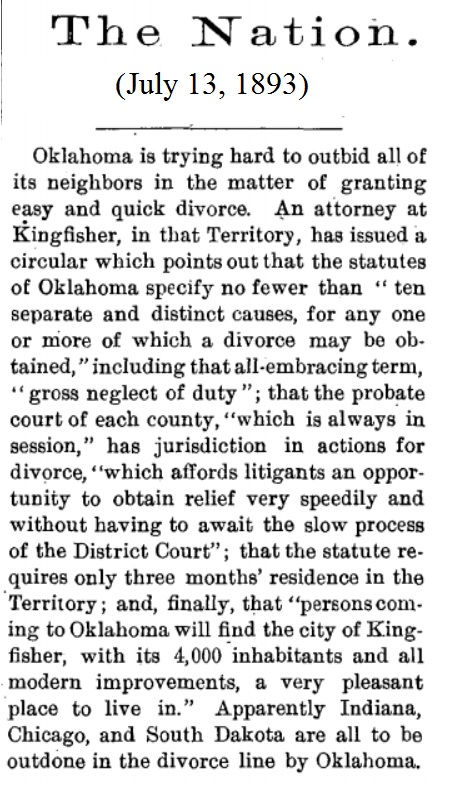
The Nation 1893Oklahoma is trying hard to outbid all of its neighbors in the matter of granting easy and quick divorce. An attorney at Kingfisher, in that Territory, has issued a circular which points out that the statutes of Oklahoma specify no fewer than “ten separate and distinct causes, for any one or more of which a divorce may be obtained,” including that all-embracing term, “gross neglect of duty”…
{T}he statute required only three months’ residence in the Territory; and finally, that “persons coming to Oklahoma will find the city of Kingfisher, with its 4,000 inhabitants and all modern improvements, a very pleasant place to live in.” Apparently Indiana, Chicago, and South Dakota are all to be outdone in the divorce line by Oklahoma. 

–The Nation, July 13, 1893

Divorces weren’t easy to come by in much of the country – especially older states like New York, which were so conservative and obsessed with family values compared to renegades like Oklahoma. In some cases it literally took an act of the state congress; in most it required proving blatant infidelity or substantial abuse. You could move to a state with less-restrictive divorce laws, but establishing residency in the eyes of the law often took a year or more, and the variety of local obstacles could prove dizzying. 

Even then, the spouse from whom one sought separation was often required to be physically present in order to secure legal disentanglement – something they might not be willing to do if they were for some reason unhappy with you… say, for instance, if you were in the middle of a divorce. 

But not in Oklahoma Territory. They wanted fresh blood and they weren’t overly particular how they secured it. Besides, Oklahoma was all about new beginnings during this period – fresh starts, and unlimited optimism. Ironic, right?

We weren’t alone in promoting the divorce business. South Dakota for a time set the standard for shameless pandering to the corrupted and unfaithful. We taught them a thing or two, however about breaking up not being at all hard to do. 

Outlook 1894

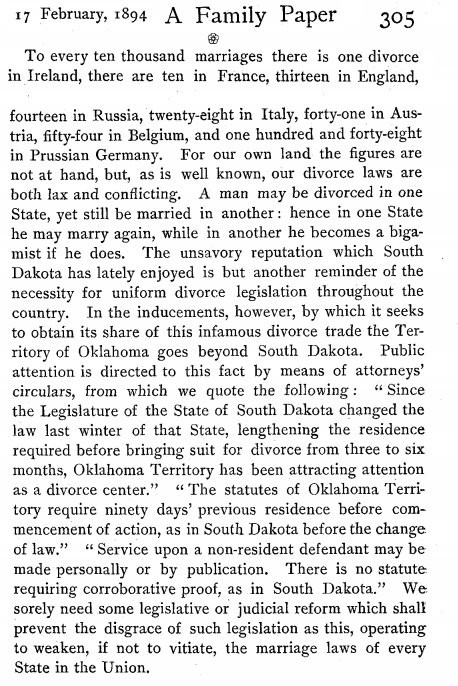
{O}ur divorce laws are both lax and conflicting. A man may be divorced in one State, yet still be married in another; hence in one State he may marry again, while in another he becomes a bigamist if he does. The unsavory reputation which South Dakota has lately enjoyed is but another reminder of the necessity for uniform divorce legislation throughout the country. 

In the inducements, however, by which it seeks to obtain its share of this infamous divorce trade the Territory of Oklahoma goes beyond South Dakota…

Our priorities have changed, but our compulsive, legislative need to be the worst in every preventable category has remained remarkably consistent over a century later. 

The statutes of Oklahoma Territory require ninety days’ previous residence before commencement of action, as in South Dakota before the change of law.

OK, we didn’t so much beat them on the residency thing so much as they retreated slightly. Wimps.  

But we completely tromped the Dakotas when it came to notifying your soon-to-be-ex of your intended proceedings:

Service upon a non-resident defendant may be made personally or by publication. There is no statute requiring corroborative proof as in South Dakota.

—The Outlook, February 17, 1894 

In other words, for an Oklahoma divorce you didn’t have to prove you’d informed your partner of your efforts to quit them, or go far in giving them a chance to respond or to appear. All you had to do was place notice in a paper they might theoretically read. If they don’t respond, the courts would assume they were fine with it. 

Periodicals of the 1880s and 1890s are full of editorials and investigations into the increasing popularity of divorce across the country. The North American Review, one of the longest-running and most literary periodicals in all of American publishing, asked five well-respected authors – all of them female – the rather loaded question, “Is the woman more to blame for unhappiness in marriage?”

Spoiler Alert: Yeah, pretty much. 

The most progressive of the bunch, author and journalist Rebecca Harding Davis, was the least comfortable pinning every sin of Adam on Eve. She was also not convinced the root problem was a new one:

Are Women To Blame

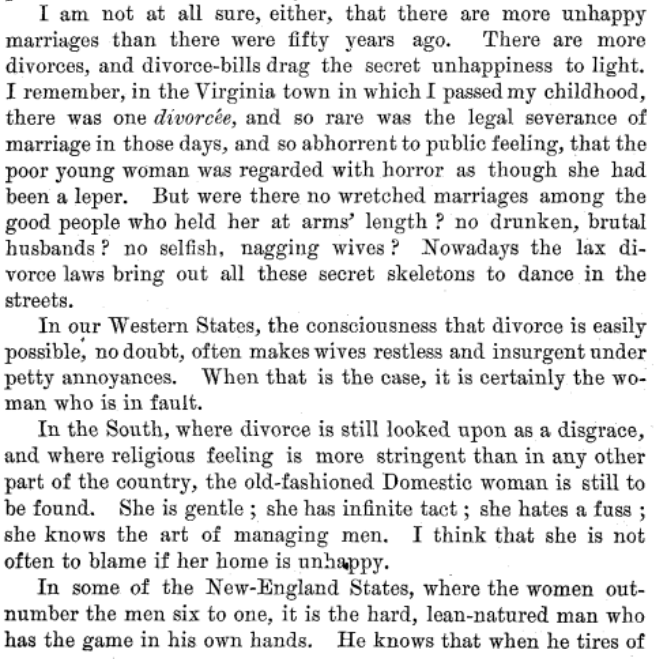
I am not at all sure, either, that there are more unhappy marriages than there were fifty years ago. There are more divorces, and divorce-bills drag the secret unhappiness to light. I remember, in the Virginia town in which I passed my childhood, there was one divorcée, and so rare was the legal severance of marriage in those days, and so abhorrent to public feeling, that the poor young woman was regarded with horror as though she had been a leper. 

But were there no wretched marriages among the good people who held her at arm’s length? no drunken, brutal husbands? no selfish, nagging wives? Nowadays the lax divorce laws bring out all these secret skeletons to dance in the streets. 

But as to the lax divorce laws of some of the newer states (and territories)?

In our Western States, the consciousness that divorce is easily possible, no doubt, often makes wives restless and insurgent under petty annoyances. When that is the case, it is certainly the woman who is in fault.

“Restless and insurgent” actually rather nicely describes some of the most interesting and capable women in my world. “She was warned. She was given an explanation. Nevertheless, she persisted.” 

Booyah, baby. 

In the South, where divorce is still looked upon as a disgrace, and where religious feeling is more stringent than in any other part of the country, the old-fashioned Domestic woman is still to be found. She is gentle; she has infinite tact; she hates a fuss; she knows the art of managing men. I think that she is not often to blame if her home is unhappy.

In some of the New-England States, where the women outnumber the men six to one, it is the hard, lean-natured man who has the game in his own hands…

—“Are Women To Blame?”, North American Literary Review, May 1889. 

You get the idea. 

Disputes over marital termination, not surprisingly, often ended up in court. One case, involving Mr. & Mrs. Frank Magowan (spelled ‘MacGowan’ below) became rather well-known to those looking to the judicial branch for moral rebalancing: 

Validity of Divorces

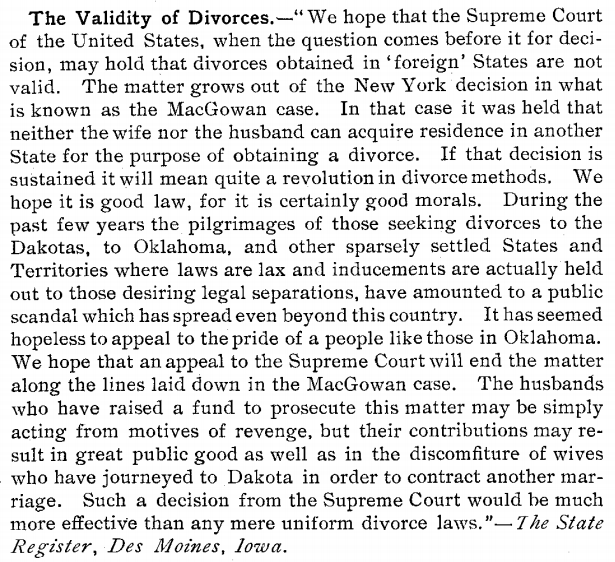
We hope that the Supreme Court of the United States, when the question comes before it for decision, may hold that divorces obtained in ‘foreign’ States are not valid. The matter grows out of the New York decision that is known as the MacGowan case. In that case it was held that neither the wife nor the husband can acquire residence in another State for the purpose of obtaining a divorce. If that decision is sustained it will mean quite a revolution in divorce methods. We hope it is good law, for it is certainly good morals… 

It’s nice to know that not so very long ago, at least some states valued the sacredness of holding captive someone you used to love but who now despises you. On such foundations are strong societies built.

During the past few years the pilgrimages of those seeking divorces to the Dakotas, to Oklahoma, and other sparsely settled States and Territories where laws are lax and inducements are actually held out to those desiring legal separation, have amounted to a public scandal which has spread even beyond this country. 

It has seemed hopeless to appeal to the pride of people like those in Oklahoma. We hope that an appeal to the Supreme Court will end the matter…

“It has seemed hopeless to appeal to the pride of people like those in Oklahoma”? That’s rather insulting, don’t you think? Rude, even. Makes me wish I were married to the author just so I could move here and divorce their ugly behind. 

The husbands who have raised a fund to prosecute this matter may simply be acting from motives of revenge, but their contributions may result in great public good as well as in the discomfiture of wives who have journeyed to Dakota in order to contract another marriage…

—“Employment of Women,” The Literary Digest, February 27, 1897

Wow.

Imagine a time and place in which men – purely out of hostility towards women they believe have overstepped their bounds, or forgotten their station – promote legislation cynically crafted to teach those wenches a lesson and keep them in their place. Now imagine that such legislation succeeds because even those without such blatantly ugly motives believe a little heel-to-neck is probably good for the unclean – that it keeps them in line. 

Oklahoma was for a brief, shining moment on the OTHER side of that dynamic. It was on the “everyone deserves an opportunity to rise above their past” side of things. 

I know, right?! History is crazy. 

Even the French were appalled – and you know how hard it is to offend the French. 

French View of Divorce

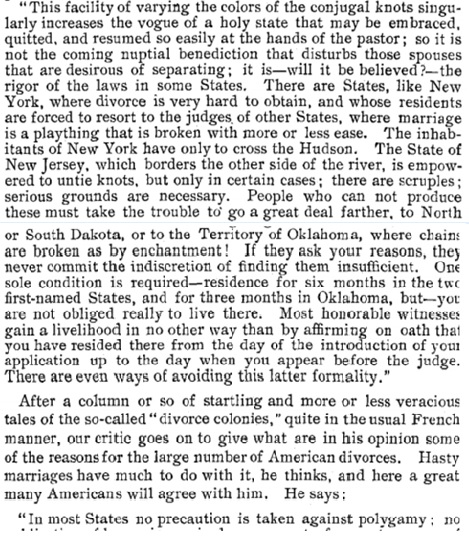
“This facility of varying the colors of the conjugal knots singularly increases the vogue of a holy state that may be embraced, quitted, and resumed so easily at the hands of the pastor; so it is not the coming nuptial benediction that disturbs those spouses that are desirous of separating; it is—will it be believed?—the rigor of the laws of some States. 

There’s such a fine line between colorful rhetoric and just being obnoxious about it. (And yes, I see the irony.)

There are States, like New York, where divorce is very hard to obtain, and whose residents are forced to resort to the judges of other States, where marriage is a plaything that is broken with more or less ease. 

Meow SLICE

The inhabitants of New York have only to cross the Hudson. The State of New Jersey, which borders the other side of the river, is empowered to untie knots, but only in certain cases; there are scruples; serious grounds are necessary. 

Yeah, New Jersey and their stern scruples. Some things never change. 

People who can not produce these must take the trouble to go a great deal farther, to North or South Dakota, or to the Territory of Oklahoma, where chains are broken as by enchantment!

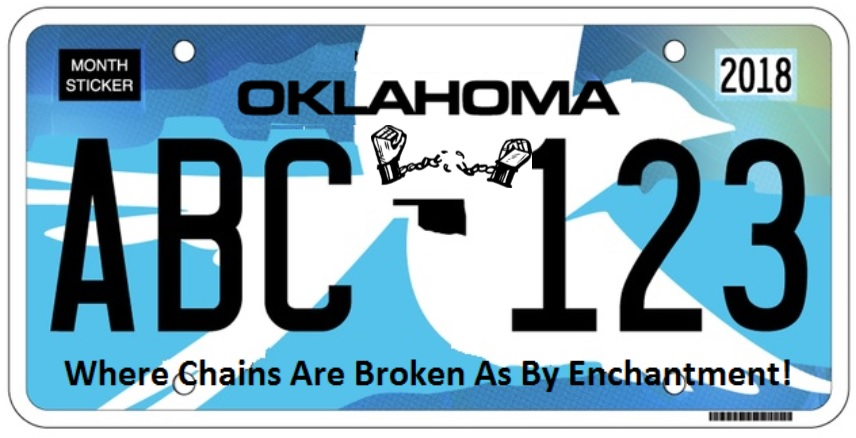
That should go on our license plates: “Oklahoma – Where Chains Are Broken As By Enchantment!”

OK Plates

If they ask your reasons, they never commit the indiscretion of finding them insufficient. One sole condition is required—residence for six months in the two first-named States, and for three months in Oklahoma, but—you are not obliged to really live there. 

What? Another wrinkle!

Most honorable witnesses gain a livelihood in no other way than by affirming on oath that you have resided there from the day of the introduction of your application up to the day when you appear before the judge. There are even ways of avoiding this latter formality.” 

—“A French View of Marriage And Divorce In The United States,” The Literary Digest, August 7, 1897

We should never have bailed them out of every war for the entire 20th century. 

My absolute favorite commentary on Oklahoma as divorce factory comes in the form of a play. “While You Wait,” by Charles Newton Hood, was published in June of 1900 in a magazine called The Smart Set. The play, which is fairly brief and absolutely worth reading in full, consists entirely of dialogue between Mr. and Mrs. Van Cleef – a well-to-do couple who’ve managed to live together quite civilly for several years despite realizing very shortly into their marriage that there’s no actual love between them. 

Mrs. Van Cleef, however, has a solution…

Mrs. Van Cleef—Well, I have been looking into the matter a little and I think that it could all be arranged very nicely and easily, and everything would be lovely. The circular says—

Mr. Van Cleef—The circular?

Mrs. Van Cleef—Oh, yes, I forgot to tell you. I wrote to some lawyers in Dakota and Oklahoma, who call themselves “Divorce Specialists,” and advertise “Divorces While You Wait;” and really, the way they put it, all you have to do to get a divorce is just to go out there and spend a few months enjoying the lovely climate and all that, and come back divorced…

Mr. Van Cleef interrupts to make sure she’s been discreet with these inquiries, then she continues:

Mrs. Van Cleef—Now, in this divorce business, there seems to be a great rivalry between South Dakota and Oklahoma, but the Oklahoma firm’s circular is a great deal the more enticing. Listen. It says (she reads from a circular which she takes from her pocket): “Our newer States, in compiling their laws, have seen fit to show more liberality in the matter of obtaining divorces than may be found among the older States, whose laws on this subject were enacted at a time when ideas were less in accord with the advanced liberal thought of the present.

”As the Mohammedan devotee confidingly turns his eyes toward the tomb of his beloved leader, so has Dakota been regarded as the Mecca of hope to weary companions in matrimony.”

Isn’t that nice? We’ll be the weary companions…

This amuses me on so many levels. 

Mrs. Van Cleef goes on to explain that Oklahoma has clearly been giving Dakota a run for its divorce earnings. 

It says we have to live there only ninety days before we can get a divorce and be as free as the glorious air of Oklahoma. All we have to swear to is that we are uncongenial and incompatible, and you swear that you are a poor, neglected husband, and I’ll swear that I am a poor, neglected wife, and we’ll go out there for a little vacation, and you can hunt and explore and neglect me and be uncongenial and incompatible, and I’ll climb mountains and fish and be incompatible and uncongenial and neglect you, and we’ll have just a lovely time, and there won’t be any scandal, and when we come back we’ll just be good friends…

They go on to ponder what a coup the railroads might manage if they were to arrange package deals for husbands and wives traveling together to Oklahoma, then returning separately—or with different companions.

While You Wait

Maybe it’s my love of dark humor, but I find the entire thing hilarious over a century later, despite the happy ending. 

As Oklahoma continues to seek new ways to make divorce more expensive, more embarrassing, or simply more difficult, it’s a shame we can’t look to our past – our roots – and remain a bit more faithful to the policies which got us where we are today. To dance with the one what brung us, as it were. 

Instead, we’re faithlessly abandoning them for new priorities, and ideologies. We’re cutting loose our old, somewhat embarrassing ways for a hotter, younger legislative philosophy. It’s like we’d rather not even talk about our collective past at all, if we can avoid it. 

Shame, shame, shame. Where’s the loyalty?

RELATED POST: Boomers & Sooners, Part One 

RELATED POST: A Chance In Oklahoma (w/ Commentary)

Why Are Some Curriculars “Extra”?

Three R'sIt’s difficult to question things we don’t realize we assume. For example, few of us ponder why we easily trust our family doctor to diagnose pretty much ANY part of our body, internal or external, except our mouth. Our mouth, it seems, is so darned complicated and unique compared to, say, our aortic valve or epidermal sheath, that only SPECIAL DIFFERENT OTHER TYPES OF DOCTORS can even LOOK at this oral outlier.

The sole exception involves gagging you with a stick while you say ‘aaahhhh’ – a breach of etiquette required to view your throat (which doesn’t even count).

We don’t really think to question it. That’s just how it is, was, and always shall be. Except it’s not. It hasn’t been THAT long since your local barber would be as likely to pull your troublesome tooth as trim your sideburns. It was all above-the-shoulders care – why limit yourself?

Factory EducationSchool is rife with these sorts of assumptions. We simply MUST shuffle students from boxed area to boxed area in slightly-under-an-hour increments. We have roughly the same number of kids in each class, one subject per teacher, and at some point papers of various kinds must be placed in baskets to “grade.” Eventually, all experiences must reduce to a number between 1 – 100 and one of five letters, none of which can be ‘E’ because that’s stupid and wouldn’t tell us anything – unlike, say, ‘C’. 

It’s really rather bizarre.

But these things are at least being discussed, and challenged. The sense that we’re missing something isn’t new, but the subject does seem to be heating up lately, thanks to a variety of issues – Common Core, Race to the Top, No Child Left Behind, anything involving Bill Gates, Jeb Bush, Arne Duncan, or Michelle Rhee. If those don’t get your panties in a wad, I could add TFA, charters, vouchers, or Virtual Embezzlement… those oughta do it.

The ease of utilizing blogs and social media probably hasn’t hurt. Teachers can rant and share and question with a comfortable combination of anonymity and familiarity – and with peeps from around the edu-niverse. I myself have a lil’ blog which is more or less education-focused. You should check it out sometime. 

Something I don’t hear questioned much, though, is the nature of our ‘core curriculum’. Sure, the specifics vary from district to district, and grade to grade, but it’s generally assumed that all students need Math, English, Science, and – time permitting – some kind of History or Social Studies. Ideally they’ll get a little Art, something Computer-ish, maybe even whatever it is we call “Home Ec” these days. But the Big Three-and-a-Half remain constant across an otherwise fractured edu-nation. 

Marching BandAnd if students behave, and keep the right letters on their weekly personal-reduction-to-a-point-value report, they may be allowed to play sports, or participate in drama, or band, or debate, or cheer, or dance, or some other ‘extra-curricular’. 

We call them that because they’re things going on OUTSIDE the curriculum – outside of the presumably important, useful, REAL purpose of school stuff. 

That’s the thing I’m surprised we don’t question more often. What makes these things ‘outside’, compared to, say… Physics? Algebra? State History? What makes some classes ‘curricular’ and others, well… ‘extra’? 

If you’re failing Algebra, you can’t play Basketball. But if you’re failing Basketball, they don’t stop you from going to Algebra until you get your game back on track. This little motivational system only works one way.

Why?

Algebra is important, but so are athletics. If our goal is “college, career, and citizenship ready,” Basketball is far more likely to help you with the latter two. Algebra wins for the first, but mostly that just means that doing math qualifies you to do harder math. 

Girls BasketballMost of these kids are never going to be professional athletes. But neither are they likely to become professional mathematicians, or chemists, or historians, or novelists. The skills and knowledge gained in each of those realms nevertheless serve a larger good. They help to form a fuller, better, hopefully somewhat happier person.

The sorts of life skills learned and practiced in a strong band, drill team, or competitive speech program are just as applicable to career and personal success as anything covered in English class. If we’re hoping to produce team players not afraid to take risks, our girls’ volleyball team is way ahead of, say, AP Physics.

There are even, apparently, entire classes devoted to – get this – LEADERSHIP. Who knew?

The value of individual effort and responsibility combined with teamwork and group accountability – the drive to be the best one can be while maintaining appropriate sportsmanship – overcoming adversity – recognizing that struggle produces progress – the power of setting both short-term and long-term goals – adapting quickly and capably when things don’t go according to plan…

Are these things really so much less important than learning to factor binomials or identify regions in which the Afton point seems to have replaced the Clovis?

I’m not dismissing the importance of content knowledge in a variety of areas – I love my subject and if granted my boon would elevate it to the number one priority for all school children everywhere in the world.  Heck, I even value learning for learning’s sake – it’s fun, and fulfilling, and just plain good for us. It also makes us less useless, and hopefully a tad less odious.

But I’m just not convinced our current caste system of subjects is nearly as obvious or necessary as we think.

STEM CarI sat in yet another #STEM breakfast recently and heard extolled the glories of project-based learning with clear assessments whose rubrics were known in advance and a process built on collaboration – what the rest of us might call ‘band rehearsal’, ‘theater’, ‘competitive debate’, or ‘football practice’.

In this case they meant mostly science-y stuff, which is all wonderful and good. But we already have classes where students do those things. They’re just not allowed to keep doing them unless they pass Science.

Are we currently turning out a generation so fluent in algebra, world history, chemistry, and grammar that it would be tragic to risk any of it in exchange for a few life skills? Are we so certain that kid who finds his calling in Theater Production would have totally aced that Old Man and the Sea quiz if he hadn’t been wasting his time doing something that might lead to employment in a field he loves?

I’m not suggesting we do away with the cores. I AM suggesting we expand our idea of what constitutes a ‘core subject’ and do a better job exploring to what extent stuff kids actually want to know and be able to do can be utilized as more than a carrot or a stick to navigate them through the things we think they simply have to know whether they want to or not.

I am suggesting we’re vain to think we know exactly what will or will not be ‘good for them’ long term, especially when their gifts and inclinations suggest otherwise. I am suggesting that we cannot equip a generation to be flexible and adaptable and useful by cramming them all into the same Enlightenment-era curricular mold, enforced through a factory-model school system.

I’m suggesting we question our assumptions. 

{NOTE: This is a reboot of a previous post. Like your mom.}

Related Post: First Class, or Coach?

Related Post (From “The Disappointed Idealist” Blog): Academic vs. Vocational – Why Does It Need To Be A Choice?