So another year is concluded, and I’m once again doing my best to focus on things I might control, might impact, might get right from time to time. Clearly my game-changing influence on state politics didn’t turn out to be very impressive.
I thought by way of purging myself, though, I might look back and see how much carrying on I actually did on the topic of the Oklahoma Legislature this past year – and, um… well, it was a lot.
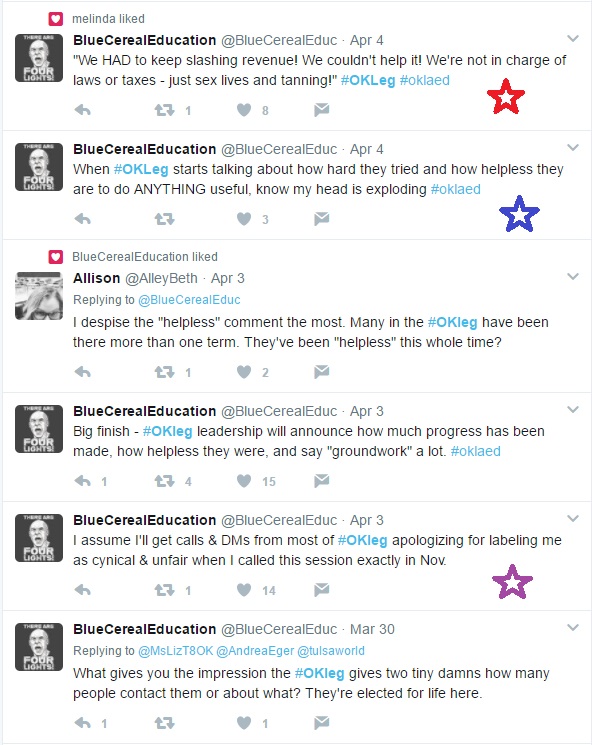
Here are some highlights by way of a couple of Twitter searches in several different formats. I’ve put stars – or, some kind of odd shapes – next to a few which I’ll be lording over the masses for some time to come.
Searching Teacher “Raises”:
I hadn’t realized I’d begun (began? beginned? begone?) using #OKLeg so far back, but apparently…
I had a little trouble retrieving just tweets from November 2016, right after the election, but found them in some Twitter Analytics feature which cuts off a few, but leaves enough to get the general idea.
Apparently, I was frustrated with the results…
I’m planning on putting more time and energy on BlueCerealEducation.net, which is coming together nicely, and hope to be distracted by getting used to my new job somewhere outside of Oklahoma soon.
But it’s impossible to know for sure how things will unfold, so these are just goals – not guarantees. Still, I’m trying in sharing this little recap to move past pointless efforts to impact this state politically, socially, or any other -ally, and to focus on things which are actually interesting or fulfilling – and which periodically prove useful to others as well.
You are loved and appreciated, my darlings. Just because you’re surrounded by bastards doesn’t mean you’re not absolutely golden. Walk in warmth, and keep your eyes open – no matter how much it hurts.
My wife and I live in a non-descript middle class suburban neighborhood. It’s more white than not, but there are a half-dozen families of color up and down the block, including a Hispanic couple and their kids two doors down and across the street. We haven’t socialized, but we wave from time to time. You know how it is with neighbors.
I hate mowing. I long for random teenagers to show up wanting to mow my lawn. YES! Oh my god yes – money is no object, son. Cut like the wind! Several years ago, I simply walked down the block to where a kid was mowing and asked if he wanted to come do mine for $20 as well. That was a great summer! Now that it’s Spring once again, I’ve been keeping my eye out for this season’s entrepreneurial youth…
I noticed a young man – a teenager, I think – mowing the lawn at the Hispanic house I mentioned. Excellent! I wonder if he’d be interest—
I stopped.
I’d started to walk over and ask if he wanted to mow my lawn. Then it hit me – he’s Mexican, or something. I was immediately gripped with the conviction that no matter how carefully I tried to phrase it, my “real” question would be clear: “Hey, I notice you’re Mexican – kay posse? You mow my lawnito?”
I had actual panic in my stomach, despite having never left my driveway. I was almost a racist! My brain took an impatient tone (I’d swear it sighed at me internally) and told me how ridiculous I was being. I just wanted someone to mow. Like he was doing right that minute, probably without even thinking about race. Logically, my course was clear.
But… I’ve been mowing my own lawn so far this season. I tell myself it’s about staying in shape. I’m not buying that, of course, but I try not to think about it too much.
There are words and phrases I’ve used for decades which are obvious leftovers from my old-school evangelical upbringing. For example, I readily refer to any male my age or younger as “brother” in casual conversation:
“Afternoon!”
“Hey.”
“You gonna make it, brother?”
“I guess we have to, don’t we?”
It’s not used in mockery of anyone or anything – it’s just how people talked to each other in the church in which I grew up. I find it warm without being too intimate, like adding just a dash of pepper to your eggs.
I used the term without thinking on lunch duty one day with a young Black man I don’t know. I was on autopilot while making the rounds, talking to kids and trying to be “a presence,” and made some joke about whatever was going on at his table as I walked by. It didn’t really work, and he wasn’t amused.
“We didn’t do anything.”
“I was just messing with you. No worries, brother!”
“Please don’t call me ‘brother.’”
Clearly I was failing at building those bonds they harp on in inspirational teacher books, but the kid wasn’t being hostile or particularly confrontational. It was, in fact, exactly the approach we encourage them to take when unhappy with something – use your words. Express what’s on your mind, clearly but politely. There’s no rule that says you have to smile and make the old white guy feel comfortable as part of the exchange.
“My apologies – just habit. But if you guys are doing OK here, I’m going to keep acting like I’m actually running things here just by walking around.”
That’s called diffusing the situation with hilarity.
It wasn’t a big deal by itself, but I was kicking myself internally. Then again, it could have been worse. I could have called him “boy.”
Before you explode in neo-liberal rage, please understand that something like half-a-century old and from Oklahoma. It takes constant effort not to slide into a very rural, clichéd drawl of the sort encountered in those Smokey and the Bandit movies, or any time we make national news for something embarrassing:
“We jes’ don’ think that these here Mooslims otter be ‘loud to jes’ train in are here flyin’ schools so as they can jes’ gunna fly some kin’a gawdammed plane into anotha’ church or nothin’! Choose this day who ya’ gonna’ serve is all I’m sayin’.”
My use of “boy,” therefore, has nothing to do with racial dynamics. In fact, it’s about as white as you can get, dialectically speaking. My kids hear it from me more than they’d like:
“Now look here, boy – ain’t you go no brains in your head at ALL, goin’ ‘round actin’ such a’ways in front of God and everyone? Holy Moses in a leaky basket, son!”
Sometimes meaning is so very context-specific.
Am I just being all politically correct and paranoid? I don’t think so. It’s more a matter of trying to communicate accurately and effectively, and being aware of audience – just like with those crazy primary sources we use in class. I’m not nearly as cautious around students with whom I have an actual relationship. They figure me out pretty quickly, and intent matters. If I say something that doesn’t register well, they usually tell me. Life is SO much easier that way.
But I horrify myself nonetheless. There are kids I get mixed up when they’re not in their “normal” seats while I’m handing back work. They tend to be of the same general description and don’t talk much in class – the same students whose names I can’t remember when they come back to visit the next year.
I have a half-dozen pale little engineering boys throughout the day who read the same dragon books and wear what must be the same glasses. Most have good grades and speak when spoken to, but they’re not boisterous or anything. It’s embarrassing when I get them mixed up and give Clyde’s Herron’s paper to Herb Clyson, but hardly fatal.
It’s when I do the same thing with Kim Nguyen, Lisa Huyen, and Ann Xuinn – all perfect young ladies of Vietnamese extraction. They politely hand it back and inform me it’s not theirs, or – far worse – quietly trade papers after I move on. (In my defense, they always sit together and their handwriting looks exactly the same and oh god I think I’m white-splaining so I’m going to stop now.) Such carelessness on my part is unforgivable after the first week or two, but on top of that I fear I’ve somehow done something racist – or, far worse, looked like I’ve done something racist. It’s traumatic.
Oh, and probably weird for them, too, I guess.
And yet, when it comes down to it, I’m not exactly being persecuted for being an old straight grumpy white guy. If anything, the entire system is set up to support my biases and druthers. We’re a pretty balanced district when it comes to discipline, but general expectations and preferred means of communication, recreation, or even celebration, are largely dictated by what could be considered white middle class mores – what we call “the right way to do things.”
Kids might make fun of their teachers from time to time, and that has to be addressed, but I’ve heard nothing that compares to the monkey noises aimed at a group of my Black girls earlier this year or the rather uninventive faux-Asian accents and pulled back slanty-eyes I had to confront just two weeks ago (completely unexpectedly, too). I can’t imagine being on the receiving end of such things at this age.
Other issues are less clear-cut. There’s an important difference between teaching kids how to speak and behave professionally in order to best promote their personal success and trying to force tired-old-white-lady behavior on them when they’re fifteen, bored, and not good at connecting actions with consequences. Important, but often blurry. And don’t get me started on “the soft bigotry of low expectations” or “grit” or…
In short, I simply can’t imagine what it’s like for anyone who doesn’t present as 100% sugar-and-gluten-free white bread.
I’ve been on a bit of an emotional rollercoaster the past few years as I’ve advocated for teachers and public education. Far too often I’ve become defensive, depressed, hostile, or completely irrational. I vividly remember sitting in a hotel room in St. Petersburg Florida last summer, 94% certain I was about to have an actual stroke over someone’s Facebook comments about #oklaed.
I’ve offended friends, gone low-road with antagonists, lost sleep, and otherwise been a mess over the rhetoric used towards my collective peers and the state’s overall treatment of my profession.
Which I chose.
And could leave at any time.
While living in a comfortable house. In a safe neighborhood.
Surrounded by friends and a system currently in distress but still very much catering to my demographic.
Annoyed but unafraid of the police if I’m stopped for a busted tail light.
Certain if I’m treated badly by the person across the counter that the issue is crappy customer service.
Knowing if I raise my voice to the folks who for some reason simply cannot find their clearly labeled seats in the arena (even though the game has started and if letters and numbers are that complicated perhaps they should arrive earlier) they might resent me or even threaten me, but that they’re unlikely to assume I represent my entire demographic – particularly since they’re usually part of it as well.
So maybe I do have white guy problems… but they don’t seem so bad compared with those who don’t.
“So… why do you think they hate Mexicans so much? Do they really think we’re all bad people, or are they just racists, or…?
It was a sincere question from one of my most brilliant girls. She doesn’t yet know all she will, but she sees more than most and asks the most sincere, probing questions. They always grab my interest, and are rarely easy to answer.
And yeah – her family is from Mexico.
I acknowledged her concerns, and did my best to suggest maybe most Republicans (the “they” in the context of our larger conversation) didn’t see themselves as hating Mexicans and might not be overtly racist. In my best developmentally-appropriate, big picture way, we talked about fear and frustration and how the U.S. has changed in the past few generations and how difficult that is for some people – especially when they think they recall a simpler, stronger past.
We recalled discussions in class about the general narratives of the political left and the political right, and while I don’t think she walked away feeling like she owed any hugs to the Trump campaign, I hope she saw complexity where before she saw naked hostility.
Then again, people don’t yell and post “complexity” at you for being Hispanic, so it’s a tough sell, even when I’m at my most fair and balanced.
You can’t teach American Government or Oklahoma History – or any Social Studies, I would think – without social and political disputes coming up. I have a disconcerting number of freshmen boys (and one girl?) this year with the strangest Nazi obsession… they’re not proper fascists, near as I can tell – it’s hardly that developed or ideological. I’m not sure they’re even truly racists – although you wouldn’t know that from their whispered comments.
Mostly they seem to just find the whole movement strange and funny and abrasive, in the same way one watches reality TV transfixed by the shouting matches or Maury Povich announcing “you ARE the father!” They love Trump, but know little of his policies or even his daily scandals – they just like the way he’s able to be such an a-hole and stir everyone up and still do whatever he wants without shame, reason, or accountability. It’s middle school boy nirvana.
I have some very self-aware Black girls, several of whom aren’t in the least bit afraid to speak out when race or gender are on the table – directly or indirectly – and a few pockets of dragon-book blue-hairs, ready to emotionally slice apart anyone who bullies their gender-fluid friends, no matter what sex, orientation, or species they find to be their true identity this week.
We’ve got rednecks and jocks and nerds a’plenty. Misfits and nitwits and slackers. This year I have an unusually high number of thoroughly modern Asians from very traditional families who have no idea how they’re going to tell their parents they don’t want to be surgeons or chemical engineers. It’s really quite a mix.
I love many of them naturally, and all of them by choice. And that means I have a personal, as well as a professional, commitment to hearing and understanding their points of view and feelings on a wide variety of topics. All teachers do.
For as vocal as I am here and on social media, you’d be surprised how many of my students insist they’re not really sure if I’m a Democrat or a Republican (I’m registered Independent, my rational mind leans Libertarian, but my heart and daily reality drive me much further left than I can ever find comfortable). I don’t make the kind of effort I once did to hide my personal opinions and beliefs; they’re 15 – they can handle it.
But that doesn’t change my willingness to hear them, try to understand them, and – most importantly – to help them question their own thinking and better understand that of others.
I know – kumbayah and goo-goo-gachoo, right?
I have a good friend and former colleague who left my district several years ago to teach at a private Christian school. She’s one of the best examples I’ve ever known of what conservatism can be. She lives her beliefs, is uncompromising in expressing them, and easily backs them up better than most people actually running the system. Somehow, none of this prevents her from perfect graciousness towards anyone of any mindset or background, as long as they demonstrate a similar willingness to step up and own their stuff.
If she’s occasionally a bit harsh, it’s a function of blunt honestly – and I assure you, she’s not playing mamby-pamby with folks on the far right, either. As you might imagine, I adore her in all the ways one can adore.
And yet, moving from public school to Evangelical High, she quickly found herself having to explain things like why the Civil Rights movement was even seen as necessary by people of color in the 1950s and 1960s, or what exactly makes dudes think there are legal reasons they should be able to marry other dudes. And she does explain, and engage, because that’s what good teachers do. It’s not about philosophical equivocation or moral relativism – it’s about intellectual honesty. “Here’s what people believe and say to explain why they do what they do.”
The fact that I can have a few laughs at her expense as she’s telling me these stories is blue sky. But they’re sympathetic laughs; we’ve all been there in various ways:
“Why does the media just want to criticize everything Trump does and won’t give him a chance?”
“What difference does it make to them who I’m in love with? How does it hurt their marriage what I do?”
“Do you think Trump is like Hitler?”
“It seems to me like everything Democrats want is just based on feeling and none of it is about reality.”
“So does Oklahoma just hate teachers, or is the whole idea of education they’re trying to destroy?”
“She’s racist against white people.”
I’m not saying I’m unshakeable, but it takes a real doozy to knock me completely off-balance. You’d be surprised what you can hear and still maintain eye contact, listening and nodding slowly.
Not so much with other adults. It will no doubt come as a shock to many readers, but I’ve been known to lob a metaphorical grenade or two just to see what’s shaken to the surface. It’s not that I’m insincere – I just don’t always worry about audience or balance or tone before expressing whatever’s on my mind.
The audience, you see, is entirely different. Voluntary, and largely of age.
Sometimes I’m supported with intellectually honest responses; other times I’m called down with opposing facts and arguments. I enjoy and appreciate this – it’s one of my best learning styles. Periodically I offend people, which isn’t usually the goal, but doesn’t keep me up at night weeping in silent shame, either. If your values are as solid as you proclaim, you won’t be thrown off your game by one grumpy old man ranting on Facebook.
But I was reminded recently of the variety of messages people take from some of these grenades. Allen Lehman, who I know only from social media, challenged something I’d written. It involved politics as well as religion, so you know good times were inevitable. I responded in a series of clarifying rants, which in MY mind were entirely calm and focused, until I looked back at all 18 paragraphs and realized he’d used maybe five sentences sprinkled throughout to completely undermine the validity and scope of my point. And he was quite possibly right in more than three of them.
Cheap and dirty, that – remaining calm and rational while I carry on. Totally underhanded, Lehman! *shakesfistatspace*
We took the discussion to private messages, where – Disney moment here – it turns out we didn’t disagree about everything at issue so much as he found my approach to be counterproductive and unfair. “Productive” and “fair” aren’t always my top two priorities, so he may have had something there, and eventually we were completely off topic and LOL-ing back and forth.
It was a very different conversation than the one I had going publicly, and that’s OK. Different audience, different purpose, different mojo.
We talked about how important it is to have acquaintances from across the political spectrum and with a little variety in their demographics, and to “hear” them as often as possible. I am truly thankful for the angry lefties I know on social media, and the calculating libertarians – even the right-wingers whose heads may soon literally explode from the cognitive dissonance they struggle to resolve, given current leadership. I value the faith of the faithful and the cynicism of the small business owners and the artistic weirdness of all the musicians I’m somehow connected with, despite my own tonal mediocrity.
Allen was my most recent reminder that I tend to get a bit hyperbolic, I sometimes overgeneralize, and from time to time I may have to eat my words. But I’ll take that risk, because it brings me into different conversations with different people with different perceptions and priorities. They’re not the same conversations I have with my students, or even always my peers; the dynamics and goals are different and – paging Marshall McLuhan – “the medium is the message.”
So when I argue with you and mock all you hold dear, it’s honestly not personal. It’s my effort to get your attention, to administer electroshock therapy to terminal reality. I want you to show me where I’m wrong, or incomplete, or misled. I’m hoping you can bring in essential different conversations.
Some of you have noticed over the past few months that there’s a new Blue Cereal site – BlueCerealEducation.net. This originally came about due to technical issues I was having with the host of this site – the .com site – issues which now appear to be resolved. *fingerscrossed*
Rather than mass-copy everything over, I’ve been lovingly revisiting old material and trying to include only stuff which is potentially classroom or teacher-friendly – no unnecessary swear words, manageable lengths, and nothing overly tied to time and place. Posts which make the cut have been revised, then posted with PDF versions attached for easy use in class or workshop and whatnot. (Hey, I use stuff like that all the time when I can find it – just the right length, just the right reading level, etc. I’ll risk sounding vain if it means I might accidentally be useful.)
I confess I’ve kept a few things just because I like them as well, but it’s a blog – how regimented can it really be?
I’ve considered what to do about the two versions – combine them, separate content into the .com stuff and the .net stuff, or say to hell with it all and delete the whole mess, and I think I’ve come to peace with something that makes sense to me but may not to anyone else. (Then again, it’s not like you’re paying for this pith and vinegar – this brilliance is free, even with unlimited wit’n’charm sauce. So I guess that makes it my call!)
New content will still go here, on BlueCerealEducation.com. While I’m trying not to focus too much on state politics or local policy, this is the place for it if I do. New posts, new research, new pedagogy, etc., will come here first and be shared in all its well-intentioned glory.
I’ll keep revisiting and reworking anything bordering on legit and posting it to the new site in the new format. Classroom resources, Supreme Court cases, primary sources, etc., along with whatever history I manage to write. If something I blog about teachers or teaching seems to resonate more than a few months after I first get it off my chest, it may eventually go there as well.
In other words, this is the clearing house, and .net is for what I hope is the good stuff. Or at least the stuff that’s as good as I’ve got.
If you were subscribed to this site’s mailing list before I added the second site, you should be on both mailing lists. Otherwise, it’s up to you to subscribe to either or both. Long-time #11FF will recognize some of the material being sent out, but hopefully it’s new enough to be enjoyable again, or at least not too much trouble to delete. Let me know.
@BlueCerealEduc is still me far too unfiltered on Twitter, and hope you’ll join the fun with Blue Cereal Education on Facebook as well. Always feel free to message or email with comments or questions, opinions or insights. You are appreciated more than you know. All of you.
By now you’ve heard or read the kerfuffle. A group calling themselves the Oklahoma Republican Platform Caucus has issued their “plan” for resolving the state’s budget woes. They claim there are 82,000 non-English speaking students in the state, and suggest we “Identify them and then turn them over to ICE to see if they truly are citizens, and do we really have to educate non-citizens?”
It’s difficult in the current social and political climate to address questions like this seriously. The modern GOP has managed to conflate “real American values,” a “prosperity doctrine” version of Christianity, and good old-fashioned “pompous a-hole” into a guiding ideology – a sort of “Fascists For A Fearful Angry Jesus” club (F-F-FAJ, for short).
Despite repeated protestations that such a mindset represents only a small minority of the Party, it’s apparently that small minority which controls most of the legislation, shapes most of the platform, and determines most of the public face of all things Republican. Until we come up with some sort of system in which legislators vote on stuff and the secretly swell majority has input, this is apparently the group with whom we must deal.
Others have addressed the most obvious black holes in their reasoning – anyone who speaks a second language is probably illegal, immigration raids in elementary schools are more practical than simply paying a living wage to educators, etc. It’s especially ironic that a state which devotes so much legislative energy to symbolically defying the federal government would suddenly inviting the most oppressive optics of the beast to roam the halls of our schools.
As outrage over this “plan” spread across social media, a number of seemingly decent people asked what, exactly, was wrong with the idea. Why should we pay to educated children who are here “illegally”? Fair question, and one which I will do my best to address without dissolving into my usual outrage or bitterness.
I make no promises about that last part.
1. The primary function of public education is not about benefitting the individual, but the society in which they live, work, and otherwise interact.
I know we talk a great deal about loving kids and serving children and helping them find their unicorn rainbow donut, and that’s great. Most teachers have a heart for young people or we couldn’t tolerate their inanity as much as we do. Maybe individual teachers take up the profession to reach individuals – and that’s fine.
But as a society, as a state, we wrote universal common education into our constitution because it’s what’s best for the economy, for social cohesion, and the general welfare of all citizens. In other words, I want you to understand basic math and science not primarily so you’ll have a fulfilling career in the aerospace industry, but so you’ll make better decisions as a voter, an employee, and as the people I have to deal with on a daily basis. It’s not so different than the reason I want the fire department to put out the fire in your house or for your kid to learn personal hygiene – my house is only two doors down, and my best interests happen to correspond with yours.
These kids are here, for whatever reason. What, exactly, is the benefit to society of making sure they’re as ignorant as possible and have nothing to do all day but look for ways to entertain themselves while you’re at work or school?
2. We don’t generally hold children accountable for the choices of their parents.
Conservatives seem to long for Old Testament times. For as much scripture as we hear mangled on the floors of the OK House and Senate as justification for bad law, they almost never reach past Malachi. In much of the Old Testament, immediate families and even descendants unto seven generations could be punished for the sins of some patriarch or other. Entire cultures were slaughtered at God’s command for not being part of the chosen specials He actually liked. They were very different times.
But we live in the 21st century, and in a republic, no less. Most States don’t let 10-year olds vote, or drive, or drink, or smoke, or decide whether or not they want to have sex with grown-ups, or pose nude, or choose their own doctor, or their own meds, or decide whether to get an abortion, or even a tattoo or a piercing. In other words, they’re not legally or ethically responsible for their situation or even most of their decisions. Barring overtly criminal behavior – most of which suggests some combination of bad upbringing and mental health issues – they’re not the problem. Punishing them suggests they are.
3. Chasing “illegal children” is not a real solution; when we get sidetracked by arguing about it, we lose sight of the actual problem.
Oklahoma has a budget problem. Our tax policies, instituted to support specific businesses and spark trickle-down prosperity, aren’t working. We have people at the Capital whose job it is to fix that. It is one of their top few functions and obligations. And they don’t want to.
We can continue the argument about exactly what the solutions should be, and exactly how many of these wonderful, rational, well-intentioned legislators are up there trying their bestest-hardest-superduperest. But we must continue that argument. Even rounding up and deporting everyone who has an accent or a hard-to-pronounce last name doesn’t put teachers in the classroom or gas in the tanks of state law enforcement. It doesn’t fix roads or bridges or keep grandma alive.
It’s what they call “red meat” for constituents. We find a dirty passage in some novel on a list as proof of perversion in a reading program, or obsess over U.N. plans for environmentally sustainable agricultural practices; both are proof only Representative Righteous can prevent global conspiracy from coming to your tomato garden while your child’s English teacher turns her gay! It’s why we repeatedly push bills demanding that single pregnant women be publicly flogged while insisting the federal government has no right to regulate guns or enforce civil rights legislation.
It keeps folks on all sides worked up about nonsense and off the primary topic – our leadership isn’t doing what they are there to do. What they promised us they’d do. What they were elected to do. What all ethical and professional decency requires them to do.
4. Refusing to educate kids based on their legal status is unconstitutional.
We can kick and scream all we like, but for better or worse John Marshall established “judicial review” in the early 19th century and the North won the Civil War in 1865 (you can blame Republican leadership for that, by the way). Whatever pride the Oklahoma State Legislature takes in keeping an army of lawyers busy year-round defending our defiantly unconstitutional laws unsuccessfully in federal court, the fact remains that jurisprudence on this issue is well-established and unlikely to change anytime soon.
Plyler v. Doe (1982) struck down a Texas law denying funding for education to illegal immigrant children as well as efforts to charge illegals $1,000 a year for their kids to go to school. The short version of the Court’s reasoning:
First and foremost, it violates the “equal protection” clause of the 14th Amendment. Students may be in the country illegally, but they are still “persons within {our} jurisdiction” and cannot be denied equal protection of the laws. That protection includes the “due process” clauses of the 4th and 5th Amendments, and these kids have not been convicted via due process of anything meriting denial of their education.
Second, it doesn’t further a “substantial goal” of the State. Depriving children of an education has not been shown to reduce illegal immigration or raise test scores, particularly since these children have little or no control over their parents’ decisions and are hardly the most challenging group we face before us each year.
Third, kicking them out of school is bad for society. Public education “has a pivotal role in maintaining the fabric of our society and in sustaining our political and cultural heritage; the deprivation of education takes an inestimable toll on the social, economic, intellectual, and psychological well-being of the individual, and poses an obstacle to individual achievement.”
Fourth, it’s not a real solution to the supposed problem. The State could offer nothing other than speculation suggesting this would have any sort of positive impact on either their economy or their educational goals.
For what it’s worth, the state is equally obligated to educate young people who’ve committed actual crimes. Ask any teacher how many “ankle bracelet kids” they have in their building this year. That’s the thing about school – we take them all. We try to reach them all. We believe that all of them could get better, and that any of them could be great. It’s what state leadership hates most about us – we try to love all of them, regardless of their color, religion, or commitment to making America “great” again.
Conclusion: As this issue is argued, don’t confuse it with whatever you feel about immigration in general, or Mexicans as a stereotype, or Trump vs. Obama vs. Fallin vs. Maddow. We’re all mad about something, and some of us are mad about everything.
Recognize it for what it is – typical right-wing fear and loathing, distraction and avoidance, dressed up as great American principles. You want a better state? A better nation? Pick better people than this and insist on better ideas.





 My wife and I live in a non-descript middle class suburban neighborhood. It’s more white than not, but there are a half-dozen families of color up and down the block, including a Hispanic couple and their kids two doors down and across the street. We haven’t socialized, but we wave from time to time. You know how it is with neighbors.
 Some of you have noticed over the past few months that there’s a new Blue Cereal site –
  I’ve considered what to do about the two versions – combine them, separate content into the .com stuff and the .net stuff, or say to hell with it all and delete the whole mess, and I think I’ve come to peace with something that makes sense to me but may not to anyone else. (Then again, it’s not like you’re paying for this pith and vinegar – this brilliance is free, even with unlimited wit’n’charm sauce. So I guess that makes it my call!)
 I’ll keep revisiting and reworking anything bordering on legit and posting it to the
  By now you’ve heard or read the kerfuffle. A group calling themselves the Oklahoma Republican Platform Caucus has