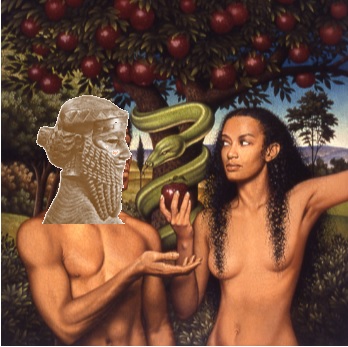
Sargon and Eve

Sargon & EveDo you ever start off intending to write about one thing and no matter how much you try to stay on target, you keep shooting off an entirely different direction like a blog grocery cart full of one item and with a bad wheel (*squeak lurch squeak squeak lurch*) and although you’re desperately trying to steer back to what you set out to write about, you just… can’t – at least not until you’re so close to your max word count that there’s no point?

No?

Just me, then?

*sigh*

Figures.

I recently decided to do a series of brief bios on BlueCerealEducation.net (my effort to go semi-legit and post solely about history and pedagogy and such, minus all the swear words and political rants). There would be four, all drawn from the same They Might Be Giants song. In fact, that’s how I decided to open the first draft:

~~~~~~~

Then they wouldn’t understand a word we say, so we’ll scratch it all down into the clay, half-believing there will sometime come a day someone gives a damn – maybe when the concrete has crumbled to sand. We’re the Mesopotamians – Sargon, Hammurabi, Ashurbanipal, and Gilgamesh!

The Mesopotamish sun is beating down and making cracks in the ground, but there’s nowhere else to stand in Mesopotamia – the kingdom where we secretly reign, the land where we invisibly rule as the Mesopotamians – Sargon, Hammurabi, Ashurbanipal, and Gilgamesh!

“The Mesopotamians” (They Might Be Giants, 2007)

Mesopotamia is generally considered to be the birthplace of civilization. It’s where our ancestors first transitioned from a hunting and gathering lifestyle to a more settled, agriculturally-based sort of living. The area roughly corresponds with modern Iraq, Syria, Jordan, and Israel, forming a sort of “Fertile Crescent.” If there was a literal Garden of Eden, it was most likely located in Mesopotamia.

A case could, in fact, be made that the story of Adam and Eve, in addition to whatever spiritual lessons it conveys, is an allegory for the Neolithic Revolution – a fancy name historians use for the transition from hunting and gathering to agriculture and the subsequent development of early civilizations, partly because it’s shorter than saying all of that other stuff but mostly because it sounds WAY smarter and elitist and ancient history gets little enough respect as it is.

Adam, literally translated, means “man,” a word with its roots in either “red,” “to be made,” or both. In Hebrew, it’s an intentional bit of divine wordplay on the words for “earth” or “red dirt,” which doesn’t really prove anything regarding whether or not Adam was an actual dude, but makes for interesting speculation. “Eve” means “life” or “life-giver,” presumably referring to woman’s ability to crank out those adorable spawn.

According to the account in the second chapter of Genesis, the “Lord God took the man and put him in the Garden of Eden to work it and take care of it.” A few verses later, we’re told that “the Lord God had formed out of the ground all the wild animals and all the birds in the sky. He brought them to the man to see what he would name them; and whatever the man called each living creature, that was its name. So the man gave names to all the livestock, the birds in the sky and all the wild animals.”

Because this was apparently not quite as fulfilling for Adam as God had hoped, he then went ahead and created Eve. Who would have guessed a working man would prefer a naked woman to figuring out what to call the platypus?

Setting aside the whole snake and fruit thing for a moment, it’s not much of a stretch to suspect this account in some way echoes a more general settling down of sorts. The whole concept of man and woman together hints of family and a less freewheeling lifestyle – that’s fairly universal throughout time. There’s no suggestion Adam hunted any of the critters he so lovingly named, although some are referred to as “livestock” – a concept tied to settled civilization. (The same folks who came up with “Neolithic Revolution” refer to the domestication of animals and the ongoing use of them for food, clothing, labor, etc., as “Pastoralism,” which not only sounds super-educated but a tad poetic.)

Once they’d disposed of the common enemy of nomadic hunter-gatherers (or made friends with them through trading), the gardening folks and the animal husbandry folks didn’t always get along. You may recall that the reported issue between Cain and Abel involved the former offering up agricultural offerings while the latter offered meat, and blood, from his livestock. God was not impressed by Cain’s efforts, leading to all sorts of subsequent efforts to explain exactly what exactly Cain did wrong, since food offerings had worked for plenty of other gods throughout human existence.

The issue continued in various forms all the way up to modern times, unresolved until the Oklahoma! concord of the early 20th century, when Aunt Eller famously reconciled both sides by firing her shotgun in the air. By the end of the square dance, the farmer and the cowman were, in fact, friends. 

But whether or not Adam with his mad naming skills, Eve with her forbidden fruit, Cain with his inadequate grains, or Abel with his sanctified veal, were literal individuals or not, they have some competition in the “earliest folks in history” department. That’s where the Mesopotamians come in – at least one of them, anyway.

Sargon of Akkad. Or, as he seemed to prefer, “Sargon the Great.”

~~~~~~~

Notice anything problematic with that draft? Yeah, it was over a thousand words before I got to my supposed topic. I’m not the most regimented guy in the blogosphere, but that’s far from ideal in the ‘structuring and focus’ department.

But at least we’re there, now – right? But that wheel (*squeak lurch squeak squeak lurch*) kept yanking me to Aisle 2…

~~~~~~~

Traditional historians – the same ones who coin terms like “Neolithic revolution” and prefer to use B.C.E. (Before Common Era) in place of B.C. (Before Christ) and C.E. (Common Era) in place of A.D. (Anno Domino, or “in the year of the Lord), even though both systems still base all of historical time-keeping on the birth of the same Baby Jesus SO WHY GET ALL WEIRD ABOUT WHAT YOU CALL IT?! – consider Sargon the first individual clearly identified in all of written history. By their reckoning, the oldest surviving written records of the Genesis account are less than 3,000 years old, while the first references to Sargon are pushing 4,000 years old. That spares them the dilemma of arguing over just how literally to take the whole Adam and Eve thing – at least in reference to this particular topic.

On the other hand, while there does seem to have been a literal Sargon kinging over a literal kingdom, much of what was recorded about him back in the day was very likely exaggerated. Perhaps downright mythical.

What the modern reader must keep in mind, though, is that the line between “literal” and “mythical” wasn’t nearly as defined a few thousand years ago. This wasn’t because everyone alive back then were stupid primitive ooga-booga types, hunched and hairy and dragging women around by their hair. It’s that stories – even histories – had very different roles than they do today. Their priorities were different.

Legends and mythology persist in stories and art because they hold value, and proclaim truths other than the merely factual. That’s why many devout Christians aren’t particularly tied to a literal interpretation of many Old Testament tales – they consider the Bible to be a guide to man’s relationship to God more than a badly organized science or history textbook of some sort. Historians, on the other hand, would very much like to be better able to unravel the legendary from the literal with figures like Sargon – and go to great lengths trying to do so.

Here’s what seems fairly certain:

Sargon was the first ruler of the Akkadian empire, which conquered the early Sumerian city-states around 2340 B.C. His kingdom included most of Mesopotamia and parts of surrounding areas as well…

~~~~~~~

As I tried unsuccessfully to force myself to cut out the all-consuming intro and just talk about Sargon, I realized something else was bugging me, besides the post not being about what the post was about. Worse… it was potentially theological.

I think I wanted to write about us missing the point of the Adam & Eve account, at least in regards to that fruit we’ve always been told was an apple (the first of many things we’ve read into scripture over time which simply aren’t there).

I wanted to talk about blame and accusation and alienation from one another, starting with our withdrawal from the Almighty. I wanted to talk about “knowledge of good and evil” being less about promoting naivete and more about condemning judgement of others. I wanted to connect Adam’s defensiveness and willingness to sacrifice Eve and her efforts to deflect that betrayal on to the Serpent to Cain’s decision to slay Abel rather than ask his God what he could be doing better in the “pleasing offerings” department.

I wanted to connect it all to modern realities and the corruption of our faith.

But it’s not that kind of blog, and when I’ve tried similar approaches in the past, I’m not convinced they resonate with anyone but me. And besides, poor Sargon! He deserved a proper post of his own.

So I cut most of the other stuff out, and I fixed that wheel. At least until now…

*squeak lurch squeak squeak lurch*
Weird Silence

Dewey Really Believe This?It’s funny the things that make us uncomfortable.
Not, like, in general. It’s not funny that snakes make me uncomfortable, or anyone messing with someone else’s eyeballs. Hair anywhere other than someone’s head. Dogs in the backs of moving pickup trucks. Those things should make anyone uncomfortable.

But it’s weird what can make us uncomfortable in our classrooms. One of them happened to me today.

It’s been a wild start. I wrote previously about trying to “hit the ground running,” which we did. Friday was all photos and orientations and policy manuals. Monday was a shortened schedule so kids could view the eclipse (yes, we used funny glasses). Tuesday was a “late start day” for meetings and then “Bonus Hour” in the afternoon and a special “close reading” activity and boy-howdy was I relieved when I realized we’d finally have THREE DAYS IN A ROW on the same schedule to finish out this week!  

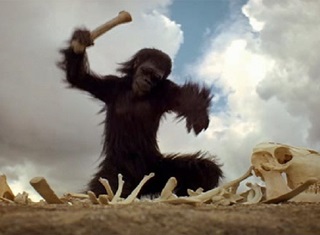
See, man learned to use tools... or, in this case, to hit bones with other bones, which seems much less impressive.In the midst of the chaos, we’ve introduced “World History” and what it means to add “AP” to the beginning. I’ve crammed in a few lectures, some jigsaw reading, a pretty big discussion about foundational themes – all while trying to get to know my kids enough to be effective in a new subject in a new place in a new reality stream.

Yesterday, I introduced an assignment I knew might take them a while. See, at some point, if you’re going to learn history, you have to start learning some history.

I’ll let that sink in.

I love creative teaching strategies and movement and interaction, and yes, I let one class talk me into showing “The Mesopotamians” music video after they’d been particularly productive. But eventually one of two things has to happen if kids are going to learn world history. Either I’m going to need to tell them stuff they need to know about world history – probably with visuals projected on a big screen in some way – or they’re going to need to read stuff about world history – probably from a book or article I’ve provided.

It’s that latter option which led to the weird, uncomfortable thing.

See, we busted out our textbooks for the first time yesterday – but late in the hour, when they barely had time to admire the large, consistent subheadings and svelte incorporation of maps and graphs. Today, I gave them most of the hour to read through the chapter and figure out what parts seem important before beginning this nifty, artsy-fartsy assignment I chose mostly because I think it’s pedagogically sound at this point with these kids, but partly because I have a huge classroom with very bare walls and I think the results will look both academically impressive and decorative. 

Judge me, baby – I will not apologize. *throws arms open and head back, waiting*

So after some introductory things and a recap of goals and expectations for the assignment, I sat down and… let them work. I had to start figuring out the online grade book and enter some assignments from earlier in the week. I’d also planned on looking over next week’s content when I realized…

It was silent in my room. Eerie creepy quiet, in the wrongest sort of way.

Thank god I’m a weathered veteran, or I might have bolted right then. Instead, I forced myself to maintain a detached, pseudo-disinterested facade as I casually surveyed the situation.

Eye SurgeryMy ears eventually picked up the subtle scribbling of little mechanical pencils, and the periodic turning of pages. After what must have been seventeen or eighteen hours, a young lady leaned over to her tablemate and pointed to something in the text, whispering an apparent inquiry. Her cohort considered whatever she’d said, then nodded and gave a brief response which seemed to satisfy her. They both then continued doing this… this… horrifying “old way” schoolness.
I considered clarifying that it was OK for them to work together, including actual speech if necessary, but I knew they already knew that. And they were collaborating, at least here and there. So instead I took a casual stroll around the room, answering a few questions of the sort apparently important enough to ask when I pass into their “inquiry zone,” but which hadn’t merited a trip all the way to my desk or the labor of raising an entire hand.

It seemed they were all on task. Some were more productive than others, of course, but they were by and large playing school. So I did something crazy.

I sat down and entered some grades, then started reading up on the Classical Period of China in Chapter Three.

And that was perfectly OK. Productive, even.

The weird part is that for several minutes, this made me feel guilty. I was afraid someone might walk by and see what was happening and judge me – a fear having nothing to do with my very supportive and sensible co-workers and everything to do with reading too many education books and blogs.

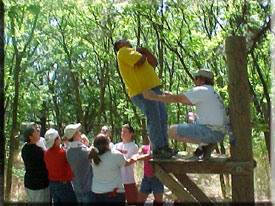
Trust Fall - the heavy guy has to have LOTS more trust than the others.If you’ve taught for any length of time, you’ve endured endless PD days, videos, handouts, faculty presentations, and perhaps even a horrible skit or two, built around three basic assumptions: (a) all teachers used to suck in every possible way, providing endless “before” examples, (b) most current teachers have no idea how to work with young people and probably don’t even like them very much, usually because of our cultural insensitivity, and (c) if we don’t embrace {insert trendy strategy here}, we’ll continue to suck and most likely destroy the future.

It’s much more pronounced on social media. The blogs, the chats, the #irritweeting platitudes. Somehow, the worst offenders seem to always have 28.6K followers and a new book you should buy.

“Classrooms don’t have to be quiet all of the time. If I come to your room and it’s loud, I won’t scold you – I’ll congratulate you!”

“We need to be the guide on the side, not the sage on the stage!”

“Whoever’s doing all the work is doing all the learning. If you exert the least bit of effort in preparing or implementing a lesson, you’re stuck in the Dark Ages of mimeograph machines and overhead projectors!”

Ironically, there are some pretty hard and fast doctrines generally accompanying these “revolutionary” ideas. Kids should be in charge of everything related to their education – content, methodology, evaluation, location, etc. – from about age four through their first Master’s Degree. Teachers who lecture or use Powerpoint in any context or for any purpose are the Devil’s Pedagogues. “Relationships” are more important than content or structure or pedagogy or pedigree, reading or writing or math – after all, they don’t care how much you know until you stop lighting stuff on fire in buckets and embrace starfish as they learn grit by celebrating failure, thus leaving two sets of footprints in the sand.

Honestly, it may be rooted in good intentions, but it gets a bit judgey. Most religions do when they stray from their central purpose.

ToolboxSo I’d like to assure all of the baby teachers out there, and remind some of the veterans, that all instructional and classroom management advice – the pedagogy, the brain research, the anecdotes, the activities – are (or should be) about giving you ideas. Options. Tools. Challenging you, or inspiring you. Maybe shaking you up or forcing you to question how you do things from time to time.
They’re not divine revelations. Flipped classrooms are a cool idea that work for many teachers in many circumstances; they’re not carved into stone tablets that Moses posted online for the Israelites to view as many times as necessary at home and ask questions about during the assembling of the people. Close reading strategies are good for many kids in many situations, and most of us could stand to be a bit more intentional about stuff like this, but they’re not silver bullets, no matter what that sample class from New Jersey did in that video. Even Socratic Circles or Inquiry-Based Anything sometimes work and sometimes don’t – that’s what keeps teaching interesting.

If you’re boring the crap out of your kids with droning lectures, then stop. If you’re ossifying their little brains with book work and worksheets, then you really do suck – you’re the guy in those horrible anecdotes they use to justify torturing the rest of us. And if you don’t actually like your kids… dude – go sell shoes or something. Less stress, more money.

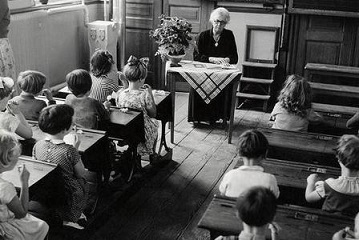
Granny ClassroomQuestion your methods, absolutely. Challenge your perceived results. Be transparent with your co-workers in considering ways to be more effective. Don’t be insecure and stuck in the mythical, dark “ancient ways.”

But if you’re doing your best to figure out what works for you and your kids, and that involves a lecture or two, then you go, girl. If you require kids to occasionally sit down and crunch some content, do so without shame or apologies. You may even sporadically find use in multiple choice quizzes or a *gasp* movie or two.

“Old school” is not a synonym for “failure.” Neither is “direct instruction,” “hard deadlines,” or “quantitative assessment.” Progress is doing what works for your kids in your classroom in your reality. If you’re doing that, you don’t owe anyone an apology and have no need to make excuses. Buy that teacher book because it motivates you; not because it shames you. You’re already awesome, and many of you are working miracles in a fallen, stupid world. For totes realsies. Thank God you’re doing what you do, every day, so damn well.

Even if your classroom is, you know… occasionally a bit too quiet.

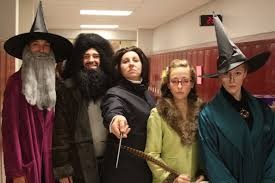
HP Teachers

RELATED POST: Teach Like You

RELATED POST: Why Kids Learn

RELATED POST: What Misfits Wish Their Teachers Knew (Guest Blogger – Courtney’s Voice)

Reflections On The Newiest of New School Years (Days One & Two)

My pacing was off today.

It’s funny that that’s what I’m taking home with me and into the weekend. Tomorrow – Friday, Day Three – is  a logistics day. It’s all orientation, pictures, and other “have to” stuff. That’s fine, and I don’t have to prepare much. Maybe I can get to know some of my kids a bit better along the way.

But right now I’m mostly just frustrated with myself – somewhat unfairly, I might add.

I’ve never done 72 minute periods before. They’re an advantage, though. 15-ish additional minutes a day will add up quickly in terms of covering extensive content and some rather demanding skills before the almighty AP Exam. And I like having fewer students – not quite 100, at least in terms of those I’m directly teaching. I’ll learn names more quickly, and hopefully start to understand their academic strengths and weaknesses more completely… maybe even teach gooder as a result.

But as of right now, at the end of Day Two, all I can think about is that my pacing was off. You’d think I was a complete rookie – and not a particularly promising one.

I wrote last time about my plans for Day One. I decided to share my reflections partly to follow up, and partly to help me organize my own thoughts and perceptions. Besides, who knows? Someone may find these ramblings helpful or encouraging. We could all stand to be a bit more real with one another.

I scribbled a note to myself after school yesterday, “Reflections D1: 72 minutes is long, long period – glad I over-planned.”

Let’s count that as a win, shall we?

And the first day went fine. There were some scheduling snafus before school, and confused kids… It happens, no matter how well powers-that-be plan or what software they’re using. It’s the nature of a large organization with lots of moving parts. It was unwelcome reminder, however, of how many logistics and patterns and people I still don’t know in my new home – stuff kids needed me to know, and which I didn’t realize I didn’t know until that moment.

But those were hiccups, not real problems. You smile, you acknowledge that things seem to be a bit confused, and you figure out who to call. It’s not about blame; it’s making sure the kid knows they’re not just stupid or doing it all wrong. There’ll be plenty of time for crushing their self-esteem later, when it really counts.

The lesson worked. I don’t know that it was brilliant, but it was active and they all played along with varying degrees of success. I jotted down a few observations for future reference:

I forget how comfortable kids are on Day One. They all know one another, even if I don’t.

I made a conscious choice to dive right in to loud and active – before we’ve talked expectations, or behavior, or even looked at a syllabus. It’s inevitable that most groups, then, will be loud and active, and some of them will operate outside the desired boundaries, either to test them or just because they just don’t know.

My classroom A/C is out. Well, not OUT, but not working well. It’s muggy and hot and that makes everything more difficult. It colors my perceptions of events and it puts a warm moist drag on everything I’m asking students to think about or do. The right people are working to handle it – I don’t share this to complain and I realize this is another common reality of even the best public schools. But I should be honest and acknowledge that it’s a factor.

Some of my predictions about the activity were correct. I suspected there’d be a wealth of events associated with North America, and there were, although western Europe was almost as heavily filled. Many groups, though, had quite a range around the globe.

In fact, many students added events not listed in the initial discussion. I’m not sure if other ideas simply occurred to them as they worked and talked, or if they wanted more balanced maps. Some asked before they made this change to the assignment to fit their druthers; others just… did it. Interesting.

Most of the timelines had some “clumping,” as predicted – but not the past 200 years as I’d suspected. Far more common was the period between Columbus and the Civil War. That makes total sense, given that it’s the history class most of them took last year. Duh, Blue.

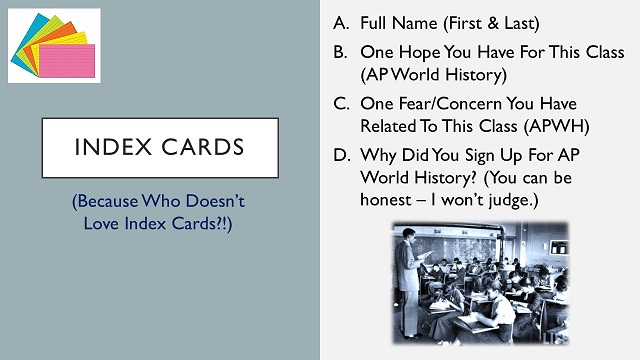
The activity did NOT take 72 minutes. Stretching it with extra discussions and some modifications on the fly, it was 45-50 meaningful minutes. I’m glad I anticipated that possibility and did the index cards.

The primary reason students listed for taking this class is weighted GPA or a transcript that looks good on college applications. A few were told by a trusted teacher or counselor that they WOULD take AP World whether they thought they wanted to or not. This seems to have been generally received as a sign of love and confidence in them rather than something oppressive or demanding. Relationships are very big here. 

Their primary fears were almost all about bad grades, being overwhelmed, or failing. No surprise there.

Today was Day Two. I had an introductory content lecture/discussion (and yes, I still use Powerpoint – go ahead and judge, I’m not apologizing) and then a variation of jigsaw reading I call “Did You Read What I Read?” The lecture/discussion was too long and not as well-organized as I’d hoped. I also had a few technological quirks that I’m 90% sure were a result of me doing something wrong. It wasn’t a disaster or anything – it went fine, other than when I couldn’t get the slides to advance or the video clips to show. I’d just had higher hopes for my first lecture. I’m generally engaging and energetic, and build in plenty of interaction and moments of small group discussion. This was my chance to…

Oh, wow. I just realize something.

I think I’d hoped to prove something today about my capabilities and whether or not I’m as good as the folks who hired me seem to think. I… (come on, Blue, you can edit this out before posting it live)… I wanted it to be engaging and meaningful and a good use of time for the kids, but I think I’d hoped it would help me feel better as well.

Go figure.

Then, because I talked too much and forced some of the conversations a bit, we didn’t have time to do the reading thing. Unsure how to manage the time late in the hour, I tried starting it with my 1st Period anyway, even though I knew we’d have to come back to it. Again, it went fine. I doubt they had any idea anything wasn’t going as I’d hoped. But it should have been better. 

I’ll regroup, now that I’ve met my kids and have a feel for the daily schedule, I’ll have a better plan for next week. Guess I should read up on some World History before then as well.

But there’s something else that’s impacted me already at this new school. Two small interactions – both similar, and both carrying more weight than I’d have ever guessed possible.

I mentioned above some paperwork confusion on Day One. The initial young man who’d come to me thinking he was in the right place but who wasn’t anywhere on my roster had been a bit rattled. It was his first day of High School, after all, and although he’d done the right things and followed the right instructions, he’d ended up in what seemed to be the wrong place. He played it off well, but it was not a great way to start the day. I eventually had to send him to the front office to get it straightened out.

He came by my class during passing period later that morning and told me they’d gotten his schedule fixed. He expressed disappointment he wouldn’t actually be in my class, but thanked me and wished me a great first day. He reached out unprompted and shook my hand, and I wished him the best as well.

A small thing, but not at all a small thing.

I’m across the hall from a teacher who’s clearly very popular with her former students. Both mornings kids are running up to her, hugging her and asking her questions and telling her about their summers or their schedules or their lives. One young man came by with two girls this morning and waited patiently, smiling a few steps back, as they embraced their former teacher and spoke to her excitedly. I made eye contact and joked, “Man, she’s this popular and I haven’t been hugged yet even though I’m in the same hallway!”

He laughed politely and said maybe my time would come, then reached out to shake my hand. He then told me he’d hug me if it would make me feel better. It was funny, but I decided not to push it and thanked him and wished him a successful day.

The kid yesterday was 14. The young man today, maybe 16 or 17. Neither know me at all, but look at them shine.

I hope I can live up to their examples.

A Whole New (AP) World…

A Whole New (AP) World...

It’s been a long time since I’ve been new at something related to school.

I’ve taught different subjects, moved to different rooms, met and collaborated with different co-workers, and of course each fall I’ve met and gotten to know whole new groups of students – but that’s not the same as being new.

The last time I was new, Bill Clinton was being impeached and the Euro was being introduced as a collective, unity-building form of currency.

Now I’m in a new town in a new state in a whole new district teaching a whole new class – at least to me. I like the area so far, and absolutely love the people and the district, so thankfully that’s not an issue. I’m confident I can handle AP World History once things get rolling. If for some reason things don’t start well, I’m blessed that I can turn to several of the best folks in the country at that sort of thing thanks to the relatively small universe of College Board consulting and training. Heck, I already feel supported by my new colleagues – even the weird ones.

Fighting Irish LeprechaunOn the other hand I’m not sure where the copy machine is or whether or not it’s OK to use categories in my grading. I haven’t met a single student or led a single class here. So while I’m not worried, exactly, I just…
It’s all new. And I’m new to them as well. That’s weird.

So I thought perhaps I’d try something new in Blue Cereal bloggery as well. I’m a big fan of Mr. Anderson Reads & Writes by Englishy-type Peter Anderson, and of Three Teachers Talk by Amy Rasmussen and Co. (there are way more than three of them, but hey – it’s not a math blog). Anderson reflects with such transparency on a variety of things related to his role in the classroom while still keeping his overall focus on pedagogy and teacher effectiveness; I’m humbled to consider him a long-distance friend. And 3TT – the insights, the strategies, the cyber-collaboration? If I could just become them when I grow up, I’d feel totes legit forever. 

Given that most of my time and energy is focused on this new subject and these new students anyway, I thought I’d try something similar and share some things I plan on using in the classroom as we begin this week. I may even follow up and let you know how they actually go. 

My classes will be AP World History – some all Freshmen, others mixed grades. The district is in an area that has a small-town feel but faces challenges of the sort you’d associate with inner-city districts, although not nearly so pronounced. The student population is majority-minority, but we’re not talking Freedom Writers or Lean On Me here. This is a nice community that’s weathered some hard times in recent decades. But they’ve weathered them.

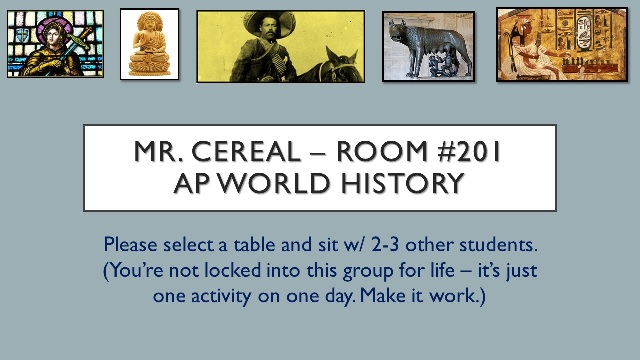
Day One Slide1

I know some teachers like to work on classroom procedures or go over the syllabus on the first day. I’m not criticizing that approach, but I prefer to set a tone and hit the ground running. I want to give students a good idea of what sort of content they’ll be dealing with and get an idea of what they already know and can do. We’ll get to the syllabus and all that soon, but not today.

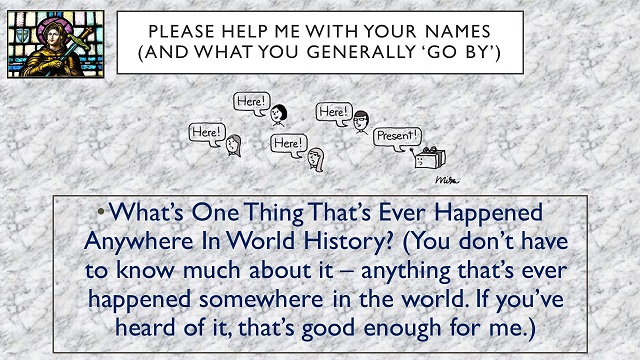
Day One Slide2

The thing is, as a practical matter I have to take attendance and start learning their names. Partly that’s just good foundation if we’re going to have a useful relationship, but it’s also required in my new district that I enter that attendance at some point early in the hour, and I can’t do that yet without going down the list because these kids are all new to me.

So we’re going to try to do both – the introductory lesson and the names. I’ll call them one at a time, make corrections to my pronunciation or try to figure out if they seriously go by ‘Booger’ or if they’re screwing with me, and so forth. But then I’d like each to tell me something they know about, or have at least heard of, that’s ever happened anywhere at any time in world history. I’ll record these on the white board as we go. No wrong answers – just finding out what they know or think they know.

I expect this to take a good 15-20 minutes, at which point I’ll already be late putting in attendance on my very first day. But at least we’ll be rolling in terms of learnage, yes? Here’s hoping that offsets my tardiness on some rather critical bookkeeping.

Day One Slide3

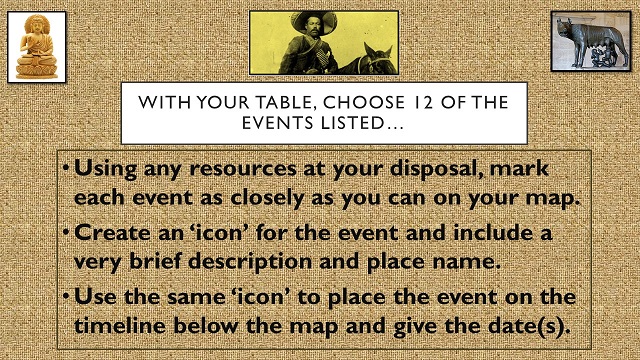
Day One Slide4

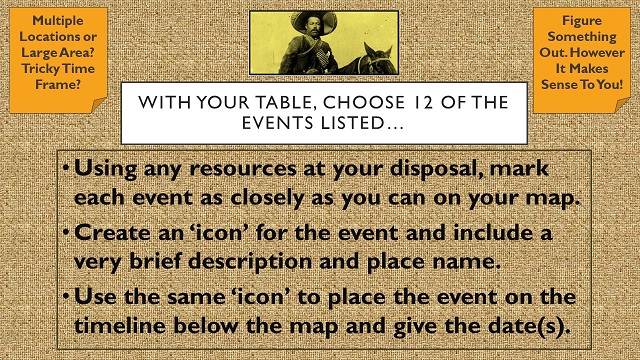
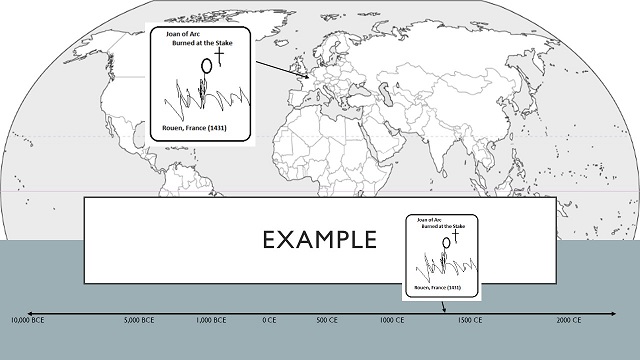
There will be colored pencils and blank world maps at each table. I went a little crazy and actually made the maps 4-pages each – standard 8.5″x11″ printer paper, with a quarter of the map on each page, taped together lovingly. I’m not sure this was entirely necessary, but it kept feeling like the way to do it, so that’s how I did it. 

See, I’m a big fan of listening to reason, and being practical, and even stretching yourself past your comfort zone. I’m an even bigger fan, however, of teachers learning to trust their instincts – especially when your gut keeps nagging you about something but won’t quite explain to your head why you should do it that way.

My gut said make the maps big, so they’re big. 

Day One Slide5

My example doesn’t actually look like what I envisioned theirs would look like. I wanted the sample to be readable on the screen up front, and my picture just kept getting bigger, and… there it is.

But upon consideration, mine looking so weird might be a plus. It’s an introductory activity, not an assessment, and I hope to convey early on that what I’m usually looking for is thought and effort and ingenuity rather than strict adherence to directions. If they’re placing the events they’ve chosen on the map and on the timeline with reasonable accuracy, how they make that happen is not overly important to me. There are times to be a stickler for format, absolutely. But I don’t think this is one of those times. 

What am I hoping happens? Why am I doing this lesson on Day One?

I’m hoping students find ways to work together and help one another at their tables; if that doesn’t happen, I’ll know we need to work on that soon. I’m hoping they’ll utilize the resources in the room and whatever personal devices they have to procure useful information – in this case, dates and locations for events chosen by themselves and their classmates. I’m curious to see how they handle tasks without much guidance from me as to “how.” 

I’m especially curious how much they already know – what events they list, and how much they know about them going in. I’m curious how they do with some very basic research skills, and with working together. I’m wondering how they’ll respond to me and my style throughout the process. And, if I’m being honest, I hope they’ll find it engaging and slightly fun and curious about a few world history things. I hope it gives us all good momentum on Day One. 

Day One Slide6

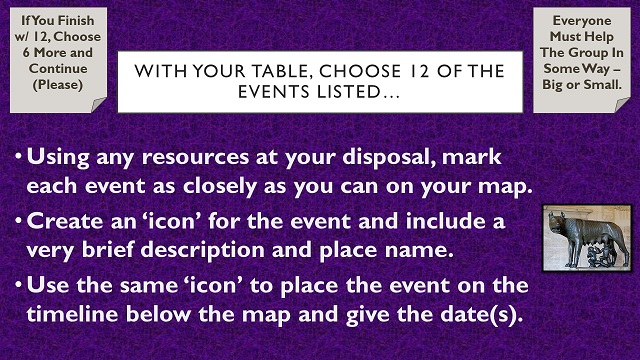
I was totally guess-timating when I asked them to choose 12 to begin with. They may easily do twice that in the time allowed, or may struggle to place half that number. I definitely don’t want dead time if some groups are substantially faster than others. That, too, will be interesting to see. As any teacher will tell you, you never really know what to expect, no matter how many times you’ve done something or how good your planning. And in this case, it’s all new.

Or did I mention that already?

Day One Slide7

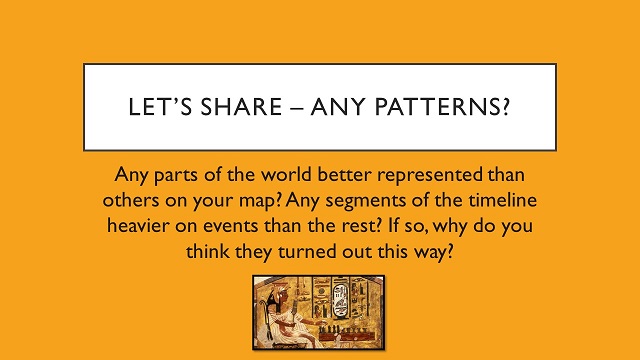
I’m predicting there will be a definite bias towards events in North America and from the past 200 or so years. I’ll go further out on that limb and speculate that many events elsewhere will be stuff that involved the U.S. in some way – WWII, the War on Terror, etc. But I don’t know this for a fact, and I’m genuinely curious what we find. 

Whatever the results, it’s worth asking why. They’ll be asking that a lot this year; might as well get in the habit now. Occasionally I might even help them find the answers, if they’re the sorts which can be found. Not every time, though. That might make them crazy – we’ll see. 

Day One Slide8

Honestly, I’m hoping we don’t get to this slide on Day One. That means the primary activity and discussion went well enough to fill 70 minutes meaningfully. But new classes and new schedules mean it will be a few weeks before I have a good feel for timing, and I hate “finishing” class with time left. There should always be a plan – ideally a productive or meaningful one. This is that.

Friday will apparently be a logistics/clubs/orientation day and we’ve been told we’ll need to be “flexible.” This sort of activity would fit well that day, if I haven’t used it already. I might even add something about my being new to the area and ask them what I should know about it. It’s not about my getting to know the area, of course, so much as the kids. That supports better teaching, and better learning. Even better scores, if that’s your thing.

So I feel ready, mostly. It’s not like I haven’t done this before. 

OK, not this, exactly – but things like this. In other places, with other kids, in other surroundings. 

Here, though, it’s all new

I can’t wait to find out how it goes.

Blue Serials & News (July 9th, 2017)

I have seen their information on the lighter side of dumbness; I have heard the new statistics, and the stomping on the ground.

Picking slowly up the rockslide, one thing always seems apparent – if the climb becomes too much, I can always turn around…

(Meat Puppets – “Comin’ Down”)

Old Blurry B&W Photo Might Be Of Someone

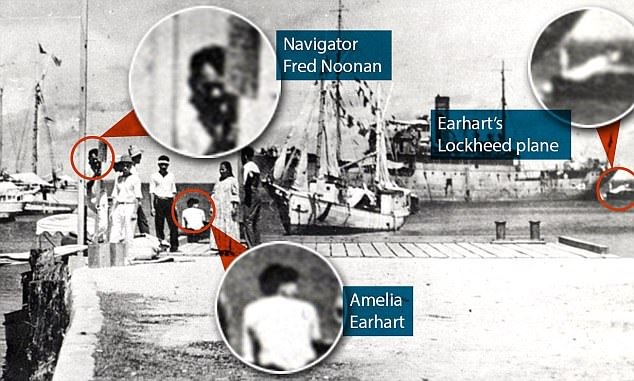
A. Earhart #11FF PlaneThe Big News in History this week was, of course, the discovery of a photo possibly suggesting that Amelia Earhart and her navigator Fred Noonan survived their (presumed) 1937 crash and may have been alive for months or even years, likely as prisoners of the Japanese. Earhart and Noonan are thought to have run out of gas over the Pacific ocean, but no meaningful remains or wreckage have ever been found – well, until now… sort of. Maybe. Depending on what you make of it.

A. Earhart PhotoSo this is potentially exciting, or at least fodder for a few more breathless documentaries – deep-voiced narrator, camera zooming in and across old b&w photos while strings crescendo before every commercial. That’s fine. I’m just glad the guy with the History Channel Documentary Voice can find work outside of Monster Truck season.

While I have no argument with THC or anyone else grabbing on to these “discoveries” to stir up genuine interest, can we at least talk about phrasing, please?

{N}o trace of the aviator, navigator Fred Noonan or her twin-engine Lockheed Electra airplane were ever found, confounding historians and fueling conspiracy theories ever since.

“Fueling” conspiracy theories? Really? Too soon, friends – too soon.

Also Exciting: New Non-Evidence That Someone May Have Once Died Somewhere

The latest Earhart discovery must be true because “forensic dogs” have established that someone at some point in the history died on an island – therefore Amelia Earhart is almost certainly the person in the photo because why else would a dog ever bark or sit down near a tree?

Within moments of beginning to work the site, Berkeley, a curly red male, lay down at the base of a ren tree, eyes locked on his handler, Lynne Angeloro. The dog was “alerting,” indicating to Angeloro that he had detected the scent of human remains.

Next up was Kayle, a fluffy, eager-to-please female. She also alerted on the same spot. The next day Marcy and Piper, two black-and-white collies, were brought to the site. Both dogs alerted.

The signals were clear: Someone—perhaps Earhart or her navigator, Fred Noonan—had died beneath the ren tree.

I’m not wishing to belittle the efforts of these, um… “forensic dogs,” but this is silly – even for National Geographic. I prefer to stick to professionals with established credentials, like, say… Lassie. Or Balto. Or McGruff.

McGruff & Trump

If you want to know more about the reliability of dogs as sniffer-outers of various things, I highly recommend “The Mind of a Police Dog” from Reason Magazine a few short years ago. Spoiler Alert: it’s not the dog’s fault when what they do is misread or misapplied; like most things, it’s people projecting what they want to be happening onto animals for whom happy masters are more important than accuracy ratings.

Napoleon Had An Ice Machine on St. Helena

Shannon Selin is a novelist who’s particularly fond of featuring Napoleon in her historical fiction (the French military genius, not the guy who drew “Ligers” and tried to get Pedro elected Class President). Her ongoing research into the not-so-tiny general (the idea that he was unusually short is a myth) has spilled over into history bloggery, and it’s far more fascinating than you might think. She is, after all, a writer – keen words in interesting combinations conveying engaging ideas… it’s what she does for a living, kids.

After Napoleon Bonaparte was defeated at the Battle of Waterloo in 1815, he was exiled to St. Helena, a remote British island in the South Atlantic. Napoleon had a number of admirers in Britain, including Lord and Lady Holland, who regularly sent books and other gifts to him. In the summer of 1816, they sent Napoleon an ice machine.

Come on, you know you want to hear the rest of that story, right?

It’s just as well such contraptions weren’t more popular, though. Apparently, drinking cold water could kill you in the 19th century.

If these briefer pieces suck you in – and they will – you should totally dive into Selin’s examination of what sorts of things Napoleon liked to read, and the demands he put on his underlings to create a giant portable Amazon Kindle for him to bring along during his various military exploits. It’s golden.

Please Put Stickers On My Face

Not all Frenchies were so academic in their pursuit of sophistication. Hunter Oatman-Stanford of Collector’s Weekly explains “That Time the French Aristocracy Was Obsessed With Sexy Face Stickers.”

The French called them mouches or “flies,” because of the dark spots’ resemblance to small insects alighted on fashionably pale skin… During the late Renaissance, these conspicuous spots spread among the stylish set and tantalized onlookers, to whom they seemed like a secret language: Were hers placed in symbolic locations? Did his cover signs of illness or injury? Were messages encoded in the spots’ distinctive shapes?

Mostly, people just wanted to look good.

Go read it. Seriously. There are pictures and everything. Avoid Oatman-Stanford’s own page, though, unless you’re ready to write off the rest of the day to random bits of odd history and curious insights. I may be in love. Is it possible for me to have another website’s babies?

Serious Grown-Up Education Talk

On “Easy” Books and Better Readers – Pernille Ripp, PernilleRipp.com

Easy books, whether they be graphic novels, books below their actual comprehension skills, free verse, audio books, or even picture books, can get such a bad reputation in our schools.  As if those books are only allowed in the brief moment of time when they fit your exact level, whatever level means.  As if those books are only meant to be discovered when you have nothing else to read, when you actually are allowed to read for fun, rather than for skill.

Yet these are the books that keep us loving reading.  That keeps us coming back.  Those books that we devour in one sitting because we must find out what happens next, aren’t those “easy” books for all of us?

I do so love me some Pernille.

SC Fails Students Still: More on Grade Retention and Misreading Literacy – P.L. Thomas, Radical Eyes For Equity

To paraphrase Peter Greene (Curmudgucation), when you mix politics and education, you get politics. So we’ll keep saying it until it no longer needs to be said – education policy set by politicians isn’t about education, it’s about politics.

Retention based on reading scores is bad policy. It’s bad pedagogy. It’s stupid and it doesn’t work. We only do it because it helps to maintain the current paradigm in which poverty or less-than-ideal upbringings are character flaws of the child and another excuse to enforce systemic racism. Thomas puts it better than that, of course:

Once again, literacy policy often fails to address valid literacy practices or to acknowledge that literacy proficiency is strongly correlated with systemic conditions beyond the walls of the school or the control of teachers.

Worksheets on literacy skills, test-prep for state assessments of reading and writing, linking teacher evaluations to students’ test scores, and retaining children are simply not only flawed literacy policies, but also negative influences on children’s literacy and academic achievement.

Why do we think poor people are poor because of their own bad choices? – Maia Szalavitz, The Guardian

While we’re on the topic, you should really read and share this one as often as possible without alienating all of your friends.

Actually, read it, share it, talk about it, and share it again even if it does alienate some of your friends. You probably just need better friends.

The Last Day of Third Grade – Sherri Spelic, Edified Listener

I thought we should wrap up with something a bit more encouraging, although still edu-legit and kid-focused. I love Spelic’s heart, despite not being much of a caring, thoughtful type myself, probably because of how well it works in conjunction with that beautiful mind of hers.

Report cards are what they are: institutional records of school attendance and academic…achievement? maybe…

The weight and significance we assign to this tradition and the actual document will vary – among families, between kids, within a school, across school levels and types. My hope is that I can convey to my son that we have choices in deciding how big a deal it is in the grand scheme of things.

If I really want to know about his learning then I have to ask him. And listen to his responses. I need to pay attention to what happens when we read a story together, to the questions that come up for him pretty much any time we are together… If I really want to know how the school year is and was, the most I can do and perhaps also the best, is to be available, open, present.

BlueCerealEducation.net

BCE dot net is still growing – “Have To” History is starting to gain some momentum, and the “Classroom” section is far more complete than it was a few weeks ago. I’m especially excited about the updated “Reading in Social Studies” section and encourage you to peruse it and offer suggestions for additional subjects and titles. Please visit the new site and poke around.

Until then, be strong, my #11FF. You are making more of a difference than you know – if not politically, then personally. And doesn’t that matter far more anyway?