Marco Polo History

I have not told half of what I saw. (Marco Polo on his death bed, when encouraged to retract some of his crazy stories before facing judgement)

It’s unlikely that Polo actually observed firsthand everything he claimed… (Every Polo biographer since then)

Marco Polo NetflixI’ve been watching Marco Polo on Netflix. The series didn’t last long – it started strong, then tanked after two short seasons. Apparently Netflix took quite a loss.

It’s interested me enough so far, though, that I started a book about Polo and his travels. I picked it up used a few months ago for my classroom library, then forgot about it until packing up for the summer. Since I’m watching the series, I figured I’d bring it home.

Marco Polo is an interesting tale on several levels, not least because it’s not always easy to tell when he’s reporting hard facts (however unbelievable they must have seemed to readers), when he’s employing hyperbole or artistic license to make a larger point, or when he’s repeating legends and hearsay as firsthand experience. Further complicating matters, his account was written many years after the events it describes, and with the help of a successful romance novelist. So… take his story for what it is.

Except… I’m not actually reading Marco Polo’s account of his travels – I’m reading ABOUT Marco Polo and his account. While I don’t doubt the expertise of the author, I’m learning the parts SHE finds most significant or interesting, through HER voice and interpretation of HIS voice and interpretation. Modern commentary, facts, and expert insight into a seven hundred-year-old travelogue shamelessly mixing commentary, facts, and hearsay.

And wild lesbian orgies.

Or are those just in the Netflix version? I’m still learning as I go on this one.

Which brings me back to history according to Netflix. The series is an artistic spin on Polo’s account, itself an artistic spin, both based-on-but-not-bound-by factual history. I’m hardly an expert on the subjects involved, so I’ve developed a system for determining historical validity.

If a passage in the book connects with something in the show, and they more or less agree, I consider that information irrefutable. If I watch the series struggle through something counterintuitive in terms of accessible storylines, I internally file that information as plausible. And anything including extended lesbian orgies, I accept as artistic discretion – essential to a larger truth, whether they fit the story or not.

And oh, what artistic discretion! Here, I’ll rewind and show you again as proof…

I fear perhaps I’m modeling some rather shoddy history. It seems like I should be far more concerned with accuracy and documented facts as best they can be discerned. I used to cringe at Disney’s Pocahontas, and I still resent The Patriot and Cold Mountain. Why go soft now?

Still, the show DID get me reading the book. And much of the information I’d have otherwise had difficulty synthesizing or retaining has proven “stickier” because I enjoy the show. Events or characters which wouldn’t necessarily rouse my intellectual ya-yas on the printed page give me a bit of a rush when I recognize them from the screen. When I recently predicted the behavior of a character based on my reading, you’d have thought I’d just translated the lost languages of Mohenjo-Daro or unearthed a pristine copy of the Trump pee-tape. The circle was now complete! I was but the learner. Now, I am the Master! Step aside, David McCullough – I GOT THIS.

Netflix Polo Cast

I had a professor at Tulsa Junior College back in the day who taught several of the required history classes most four-year universities expected as part of a well-rounded transfer student. I remember two big things about those classes.

The first was Hannibal – the only Black kid in the room. Hannibal knew a great deal more than I did about American (or any other) history. He and I had several interesting conversations about being Black in a socially “white” world, especially in the context of public schooling. Whatever clue-age I managed in my early years of teaching students who weren’t entirely like me was largely due to his patience and clarity. I wish I could thank him.

The other part I remember was the impact of Professor Burke’s stories about American history. I was particularly entranced by my first exposure to the tawdry tales of Andrew Jackson and Rachel Donelson.

AJ & RD Love StoryDonelson was a divorced woman at a time when aspiring public figures did not associate with – let alone marry – such soiled creatures. Jackson fell in love with her and they wed, only to discover a few years later that her original divorce had never been finalized and they’d been living in bigamy. Jackson fought for her honor – sometimes literally – but his political opponents fed on the fallout and it was simply too scandalous to fully overcome.

After losing the controversial Election of 1824, Jackson finally won the Presidency in 1828, a watershed moment in the expansion of American democracy and for all practical purposes the birth of the modern Democratic Party. Rachel died before Inauguration Day of heart failure; Jackson forever blamed his political opponents.

Professor Burke’s tales of Jackson and Rachel and her ex-husband – an abusive scoundrel named Lewis Robards – were the sort of baroque melodrama cable TV and YA fiction later learned to weave into dirty gold. The stories were full of anachronisms and hyperbole and plot condensations – reduced like soup to their tastiest elements. I wasn’t the sharpest kid in the room, but even back then I was pretty sure Rachel hadn’t telephoned Jackson in distress (“Andy! Andy! He’s fulminating at me again!), nor had “Andy” hopped onto his duel-sport to Lancelot her away to the Hermitage.

But I didn’t care – I loved his stories and felt like I was learning. Years later, Professor Burke’s stories repeatedly anchored the “real” learning I did about Jackson and his world – kinda like this silly Marco Polo show.

Canada Bombing White HouseOther times, though, the ways in which history is presented, distorted, or simply fabricated, aren’t intended to enlighten, educate, or even entertain. Sometimes people just LIE – to manipulate, to justify, to obfuscate. In recent years, I’m not even sure many of the worst perpetrators actually KNOW what’s supportable and what’s not in their bizarre renderings; they don’t even seem to care. Simply repeat the lie ad infinitum, and make its refutation personal – as if history is just another religious doctrine or political ideology to be hurled at one’s enemies or slathered like cheap gilding over your own corrupted ideologies.

Not to be too dramatic or anything. I mean, I’m not Marco Polo.    

Reality matters. Oddly, this is a controversial and politically loaded statement at the moment. Facts are important, even when they’re inconvenient – sometimes BECAUSE they’re inconvenient. They don’t change based on the sheer repetition of bombastic nonsense or the lusts and machinations of the powerful.

But compiled facts aren’t usually SUFFICIENT if we’re trying to learn cohesive lessons. They can’t teach us what matters, or explain causes, effects, motivations, failures, or human nature. All history is interpretive – no matter who’s telling it or who pretends it could or should be otherwise. Events happen for reasons, they have effects, they fit into various contexts and complicate multiple lives. There’s also simply too damn many of them to present the entire record of mankind as an unbroken, sterilized anthology. And we keep learning about and creating more of all of it – daily.

How to best pick and choose, present and shape that history is a valid question and an appropriate debate. It assumes, however, that those so engaged are operating within an agreed upon range of morally defensible goals. Choosing a Black guy to play James Madison who breaks into song while engaging an Asian Aaron Burr is artistic discretion; insisting that the Civil War was about states’ rights or that most slaves were slaves by choice are damnable lies which do real damage to living people and our collective memory, no to mention our collective ideals.

Netflix, presumably, wants to make a few bucks pushing popular history. Polo likely wanted to thrill his audiences while still introducing them to an exotic world he found genuinely amazing. Professor Burke just wanted to help a bunch of clueless kids learn and remember some American History. I’ve shaped a few tales myself over the years, attempting to emphasize a lesson or better understand an era. Sometimes it works, other times I’m just… wrong.

None of which deserve the sort of condemnation earned by intentional twisting or recklessly disregarding our collective past in the service of narcissism, power, marginalization, “other-izing,” or the deification of evil.

History teaches us. It challenges us. It entertains us. Sometimes it confuses or discourages us; other times it exhorts and enlightens us. It’s bigger than our understanding and better than our application.

History may be complicated and subject to some interpretation. It may provide inspiration for some questionable artistic spins in the name of entertainment or experimentation. What it should NEVER be, however – what it MUST NOT become – is the subjective plaything of whoever’s in charge, to manipulate and discard as they whim.

Compared to that, how much harm can a few more lesbian orgies really do?

Now where’s that remote…?

Aliens Building Pyramids

RELATED POST: Useful Fictions, Part I – Historical Myths

RELATED POST: Useful Fictions, Part III – Historical Fiction… Sort Of

RELATED POST: Useful Fictions, Part V – “Historical Fiction,” Proper

“Tank Man”

Some of you remember this guy. This moment.

Tank Man (During)

It was June 1989. The Chinese Communist Party (CCP) had been in power for forty years, following decades of civil war against the Kuomintang (KMT), or Nationalist Party. The People’s Republic of China (PRC) was declared in 1949 with Mao Zedong as its unquestioned first-among-equals; he ran the nation in ways both brutal and strange.

The KMT, led by Mao’s nemesis Chiang Kai-Shek, retreated to Taiwan, where they established Alt-China, or China Classic, and remained (in the eyes of the west) the officially recognized government until 1971. Despite being virulently anti-Communist, the KMT weren’t exactly “good guys” in this tale. Taiwan was under martial law for nearly forty years, led by a government in perpetual paranoia over potential spies or Commie sympathizers. In 1971, the United Nations finally said “screw it” and gave their seat to the PRC.

Little Red BookWithin a few short years, China Major – the big, red part we all know and love today – went from a “Cultural Revolution” in which anyone insufficiently excited about Chairman Mao’s “Little Red Book” was assaulted, humiliated, or simply made to vanish, to welcoming President Nixon and celebrating the “thawing” of relations with the west. For the next few decades the U.S. and China took turns pretending to care about basic human rights, while China purchased a bunch of America’s debt – eventually rendering the whole “shared values” thing moot because neither could afford for the other to fall no matter what else they did.

China craved economic growth and global legitimacy, seeking the ideal mix of market forces and “Chinese Socialism.” They loosened their grip on the little people, hoping they’d behave on their own if they knew what was good for them. China even wrote itself a new constitution, adopted in 1982. It’s super-socialist, to be sure, but also rather ambitious in terms of protecting personal liberties.

In 1989 a popular politician by the name of Hu Yaobang died (he was 73 and had a heart attack – nothing nefarious). Hu was rebellious and relatively progressive, popular with idealists and college students – the Bernie Sanders of his day. Students and others took to the streets to mourn his passing and to speak out against those still alive and in power – and then against corruption, and against the party’s mistreatment of Hu while he was alive, and whatever else came to mind along the way.

That was late April.

The protests ebbed and flowed, and government response was inconsistent. Sometimes they cracked down and other times seemed open to discussions. Protestors were unpredictable as well. It’s complicated enough to be clear what you’re against; far trickier to consistently project what you’re for. There were hunger strikes, rallies, some violence, and lots of yelling.

Always with the yelling, those protestors.

By June 4th, the government had had enough. After several strong editorials warning the masses to wrap it up and get on with their carefully managed lives, troops were sent in to disperse the crowds. They rounded up some, but other times simply fired into the crowds. This wasn’t a situation where tensions built and someone’s moment of panic sparked a massacre; this was methodical military action carried out according to the wishes of their superiors.

Tanks then rolled into Tiananmen Square. Protestors who refused to move or who simply couldn’t get out of the way were rolled over – several reports say multiple times, so their remains could be literally hosed into the sewers rather than taken away and buried. Clearly China was sending a message about just how seriously all of this new “freedom” was to be taken – and they were willing to sacrifice their own citizens and a certain amount of reputation in the eyes of the world in order to do it.

The official death toll was 200 – 300. The Red Cross estimated 2,700. Recent memos between British and U.S. officials suggest an alarmingly specific 10,454 – dead at the hands of their own government.

China did its best to implement damage control with the international press. Reporters tell stories of their equipment being seized, their hotel rooms trashed, and their well-being threatened over the words and images they were determined to send back to their respective outlets. But It turns out that pesky liberal media can be quite heroic sometimes, no matter what flavor of corrupt, arrogant power is trying to shut them down this time.

That is why – against all odds – we have this footage from June 5th:

Who is he?

We don’t really know, although there are theories and conflicting reports. He may have been a 19-year old student named Wang Weilin, or he may not have been. He was definitely pulled away – but were they government agents, or sympathetic protestors trying to protect him? He may have been imprisoned, tortured, or killed, or he may have simply faded into obscurity and gone on with his life. We’ll probably never know.

Here’s what we do know. He had absolutely no reason to think those tanks were going to stop.

They hadn’t, the day before. As he stood there defiantly he could hear the gunshots and screams of other protestors paying for their defiance. It’s not clear where he came from or how he ended up alone in Tiananmen Square, facing off with destruction, but 20 years after “Tank Man” became an international symbol of… something, this photograph, taken from a different location several minutes before its more famous counterpart, was unearthed:

Tank Man (Before)

He’d decided.

He’d seen them coming, and he’d decided.

It looks like he was on his way back from the grocery store or something, doesn’t it? One of the 20th century’s most iconic rebels seems to be wielding… fresh citrus and minty dental floss!

I’m particularly impressed that he had the gumption to climb up on the tank and – it seems – yell down to the men inside it.

I’m probably projecting a bit – idealizing the event – but the more I watch it, the more convinced I am that he was refusing to limit the interaction to human vs. machine. I think he’s up there insisting that inside the machine are other men. Other Chinese. Other citizens. Other humans. I think he’s demanding they own up to their role, that they confront him, or answer to him, on behalf of the people.

Like I said, projecting.

He didn’t stop the tanks. We can’t reasonably connect his actions to the saving of any lives. At best, he slowed down one segment of a long, complex series of horrors for about five minutes.

Tank Man LegosNothing changed in China’s policies, tactics, or narrative. The Tiananmen Square Massacre is scrubbed from all internet searches and prohibited in all texts. If “Tank Man” lived past his asymmetrical showdown, it’s supremely unlikely he had any idea that his actions had been viewed or discussed by anyone not there that day. Even if he’s alive and well today somewhere in China, odds are he has no idea that he’s an iconic photograph or world history talking point.

Whatever his fate, he leaves us with a rather disquieting question…

Did it matter?

Did his efforts accomplish anything? Was his defiance worth the risk? Did he have the slightest impact, that day or the years to come? Did he alter or improve his society, his government, or his world?

Sure, he’s in the history books, but so is Chester Arthur (in the appendix, at least). So are entire paragraphs explaining the distinctions between feudalism and manorialism. So are Anastasia’s sisters. I love history, but I doubt my world changed one way or the other because Olga Romanova showed up for picture day.

So… did “Tank Man” matter?

I’ve never stood in front of a tank, or willingly put myself in any danger more substantial than voicing my opinion of an outfit my wife was trying on. I’d never be “Tank Man.” Simply put, I lack the courage.

He makes my challenges seem so silly and small. He makes my struggles seem so… safe.

We teach. We listen. We blog. We share. We love and we sacrifice, we rework and retry. We stand here with our little bags and our inflated gumption and we demand that the bad things stop. We insist that humanity come out, own up, and take over, knowing that it usually doesn’t. We often lose. We often fail. And when we do stumble into a win, there’s no one snapping contraband photos.

Like “Tank Man,” I’m not sure we’re changing anything. It’s very unlikely anyone’s even watching – or that if they are, that they understand what we’re trying to do, or why it matters.

Unlike “Tank Man,” the odds that I’ll be crushed by a military vehicle for my efforts are very, very slim. I may wonder if my state retirement is being properly invested, but while Indiana doesn’t love public education any more than Oklahoma does, they’re not out to end my life and torture my family to drive the point home.

So that’s a plus.

Still, I keep wondering –  the soldiers in those tanks, the politicians making those decisions, the protestors lingering near the square, or the millions who’ve stared at that picture since… were they in some way changed by his wild, desperate efforts? Is there any way he could have imagined, or that any of us can know, whether any of what we’re doing so much as nudges the world in the direction we so desperately need it to go?

The whole thought process can be rather crippling.

And yet, it seems I’m still talking about “Tank Man” thirty years later. He makes me want to risk more and care harder.

So… I suppose I have my answer.

Tank Man Nobody

RELATED POST: I’d Rather Be Aquaman

RELATED POST: Joan of Awkward (Addressing the Supernatural In History Class)

RELATED POST: All Or Nothing

Teacher Tired

Tired I’m tired. 

Not depressed tired. Not complaining tired. Not even angry tired – not this time. Just… tired.

Teacher tired.

Meghan Loyd used this term a while back, and – like Meghan – it’s captivated me ever since. It’s just so true.

This isn’t one of those “our job is harder than anyone else’s” posts. I don’t know if it is. I used to be wiped coming home after a day in retail, managing a small music store, but it was different – more of a “I-hate-my-life-and-resent-everyone-who-walks-in-and-that’s-probably-not-a-good-career-sign” tired. I used to reach near-zombie states when I was in an ambitious local band back in the day, but that was a sweatier “thank-god-Whataburger-is-open-at-3-a.m.-but-I’ll-suffer-for-this-in-the-morning” type of exhaustion.

I’m not interested in trying to one-up anyone else’s tired. I lack the interest or the energy. But I would like to look for a moment at this particular flavor of semi-somnambulation – “teacher tired.”

Some of it’s physical. Despite what popular blogs and edu-books tell you, we still spend an enormous amount of time each day on our feet, moving, speaking, listening, observing, gauging, considering, adjudicating, and otherwise trying to juggle-inspire-drag-trick-cajole a barrel of disparate children into learning – often against their deepest wills and wants. There are very few lesson plans so clever that once wound up and let go, they pretty much run the room themselves the rest of the day. So yeah – we’re tired at the end of the day.

Some of it’s mental. No matter how well you know your pedagogy or content, your mind pulls a half-dozen directions throughout the day as you try to keep track of what you’re saying or what’s being said, what you’re doing or what’s being done, who looks engaged and who doesn’t, what seems to be working and what doesn’t, and whether or not you’ve already made that joke or if that was the other three times today.

Tired 2There are constant interruptions, perpetual paperwork, and endless bureaucratic requirements you’re expected to manage before, after, and during each class without losing whatever flow you’ve managed to establish with your kids. And the questions – you just never know what kids are going to ask, or why. You don’t want to shoot down some odd-but-sincere inquiry due to your own impatience or paranoia, but neither do you want to cater to inattentiveness or intentional distraction. Are they suddenly curious about this tangential issue, or are they just being squirrels? Should you nurture their individualized learning urges, or are they screwing with you and snickering in their dark, twisted souls?

So yeah – it’s a taxing gig even on the best days.

Not that you let it show. Whatever else you are during the school day, you are – for better or worse – one of their primary models for what an educated adult with some sense of personal and professional responsibility looks and sounds like. It’s not about being “fake”; it’s about maintaining the dynamics, expectations, and positive energy required to keep school moving along and more-or-less on track.

I dunno, maybe some of you need only unleash a single dose of “the learning” on your eager wards, then hiply sit on your desk offering pithy insights and witty redirection as they sprout and thrive intellectually and interpersonally. Most of us, however, are running some version of a hybrid engine – drawing on our personal reserves to supplement the student energy which we’re pretty sure should be doing most of the work but… their batteries must be in backwards, or something.

I myself find it particularly difficult to stare every day at so much ability, so much – pardon the cliché – potential, knowing many of them can’t or won’t see it. Some will, eventually, but others will never use it or value what they could be.

Tired 3It’s draining to watch kids in whom you are deeply invested kick and drag and protest and resist even when you KNOW they could spend half-as-much energy just playing along. Yes, the system is flawed. Yes, the structure is limiting. Of course, the inane and the mandated infect it all. But there’s still beauty and truth and meaning and function in so much of it – OH THE POSSIBILITIES!!! They just can’t (or won’t) see it, and you can’t make them. It’s exhausting. Ask any of us.

I don’t think teachers are martyrs by any stretch, but it’s an emotional sacrifice to remain politically and socially vigilant, rebuking principalities and powers and determined ignorance in high places. Yes, we chose this – a profession built on willful delusion and deep convictions, standing awkwardly against whatever rough beast slouches towards Bethlehem this time around. We insist on believing that all kids have value, and can learn, and that they’re not all the same. We refuse to reduce them to “meat widgets” whose only function in this life is to serve their corporate overlords. (And before someone asks, of course we want them to be employed and make themselves useful; we just don’t believe that’s our sole source of meaning and purpose in this fallen world.)

Turns out being a bunch of godless, un-American heretics is tiring. And I’ve avoided the hardest part.

I have no interest in compiling tales of woe and suffering on behalf of my students. Besides, they’re not my stories to tell. They belong to those who live them, and press through them, and who are one way or the other shaped by the sheer volume of darkness some of them deal with before puberty. IT’S JUST SO WRONG.

We can talk about “snowflakes” and say “back in my day” and post memes about 18-year-olds fighting in Vietnam, and that’s all fine – like I said before, I’m not interested in “winning” this one. But I’m not all that convinced our generation turned out nearly as polished and durable as we like to suggest, given the state of things at the moment. Maybe being thrown in that pool, hit with that belt, and shot at in that swamp didn’t make us tough and self-reliant so much as, say… callous a-holes and opioid addicts addicted to porn and reality TV. But damn those weaklings for not wanting to follow in our footsteps, right?

I have too many students who are expected to excel at everything they do, and who do everything. It’s unsustainable because they hate all of it and resent the people who make them keep doing it. I refuse to doubt parental good intentions, but if I had the power to do so, I’d beg them to CHILL THE %#*& OUT. Tell your kids you love them and they’re doing a good job and you’re proud of them, and you know they’re not going to end up like they did – or like their older brother – or like their dad who left way back when, or whatever. You can nudge them towards excellence later, Mom – you’re losing them and they’re losing it and more pushing won’t fix it.

Tired 4I have too many kids in the middle of custody disputes, or living with friends of their Aunt because they couldn’t all sleep in the car any more, or whose parents are alcoholics, or who are in counseling for things they don’t want to deal with, or who refuse to go to counseling to begin with. Girls who’ve been booted from their social circle or left by the boy they trusted enough to do things for and who lack the support system to cope with the emotional fallout. Half of my boys are baby giraffes trying to emulate their favorite YouTube channel all day and the other half think they’re Danny Zuko in Grease. Somewhere inside of that, though, they’re freaking out a little because neither is working.

I have kids wrestling with depression – something I’d long ago accepted was a very real thing, but which I simply could not appreciate until watching it so closely this year. I’ve had to call child services to report abuse while trying to maintain the trust of students who fear I’ve just made their lives worse instead of better (and who may not be wrong). I have kids who handle their own poverty rather casually, leaving me unsure whether it’s a front or whether they’ve simply had to step up and “be the adult” in their situation. Many who work, many more responsible for siblings, far too many who have no reasonable options for at least the next two or three years, and I have to focus on “yeah but once you graduate…!”

Sometimes it’s self-imposed pressure to get into the right college and find the right career, whatever that means at 15. Sometimes it’s fear of parents finding out about a single quiz grade, even if their class average remains stellar. Some are just whiney and entitled, but that’s harder than you’d think to untangle from fear, or desperation, or something else I can’t quite put my finger on. Some of my kids I don’t understand at all, even this late in the year – so that’s unforgiveable.

We love them all – sometimes naturally, sometimes by force of will. You try to leave it at the door when you leave – boundaries and self-care and all that. The gig does have its upsides – those moments they “get it” are nice, as are those few times you feel like something you’ve said or done has helped a young person find some sort of direction or hope. Also, I get to learn and talk about history for a living. I love my job – most of us do.

But I’m tired. I suspect you are, too. We might as well own it.

I’m going for coffee. Want one?


The Problem With Linear Reality (You Can’t Go Back)

Time keeps on slippin’, slippin’, slippin’… into the future.

One of the sobering things about edu-bloggery – or social media in general – is how hard it can be to keep up when your tangible, so-called “real” world gets crazy. Far more humbling, though, is that when you DO fall away for a time (slowly, and then all at once), the entire apparatus and most of those involved keep right on going just fine.

Which is rude.

It would be ridiculous, of course, to expect any less. And despite my substantial ego, that’s not actually the difficult part. You see, I miss it. The writing and the editing, the labor and the self-loathing. I miss the reworking, the doubting, the publishing, and the connecting.

There were times I’d knock out several posts a week and discover that thousands of you were reading and sharing them. Other times I’d labor for days over such pith and profundity that I doubted there were words or emotions left in the universe for others to use… and manage a good three or four dozen views. Sometimes the most amazing conversations would start in the comments; other times it was that same bit of misspelled spam from some college essay writing service in Russia.

The numbers weren’t really the point, though. It was the process. The struggle. The recurring leap.

It helped me reflect, and to clarify thoughts and emotions. It brought me into contact with some of the most AMAZING people. It forced growth, and – if I’m being honest – it far too often left me snickering endlessly over some clever phrase or another which I’d somehow managed to wring out.

And then real life asserted itself.

I took a new position this school year, in a state far, far away, teaching something I’ve not actually taught before. I love our new home, and the area, and my co-workers, and my kids. I’m glad we made the move – especially given the new lows to which the Oklahoma Legislature is attempting to sink.

That being said, this year has completely kicked my ass. It’s mocked me and broken me and shamed me and frustrated me, leaving me without cab fare and not calling for weeks at a time. I scribbled about this previously, but in retrospect, I think I dialed back the intensity a bit in an effort to maintain my own little ‘growth mindset.’ And while I don’t mind ranting, I prefer to provide you, my Eleven Faithful Followers, with the sort of witty, contrary-but-inspirational Blue magic you and I have both come to adore.

Now that the annual reboot looms, however, I confess that the learning curve of a new subject was much more intense than I anticipated. My pedagogy and strategies and years of experience seemed suddenly seemed rather… shallow – perhaps even fraudulent – like I’d been skating by on audacity and circumstance and confusing it for talent.  Above all, my inability to more quickly figure out my kids and adjust to what they REALLY needed and where they were was simply…

Well, it was unforgiveable.

“Don’t beat yourself up, Blue – you did the best you could. You probably made more of a positive difference than you realized some days.”

Yeah, I probably did. But that doesn’t make it OK. They needed more. They needed better. I absolutely must go back and redo this year – to fix some of it, and try better things.

But that’s the problem with linear reality – we can only learn forward. We can only change in one direction, and even those efforts are based on limited, often flawed perceptions and information.

There are those who insist that if they COULD go back and change anything about their lives, they wouldn’t do it – because those experiences are what made them who they are today.

Pshaw.

Nonsense.

Hockey of the horse.

I’d go back in a heartbeat, several times if necessary, and I’d change so very many things, over and over until I figured out what might work – how much more I could accomplish; how much less damage I could do.

But no.

Time is marching on. And time… is still marching on.
You’re older than you’ve ever been, and now you’re even older. And now you’re even older. And now you’re even older. And now you’re older still.

It’s the time of year that kids start coming to me for “make-up work,” wanting to know what they can still turn in. Whatever my past failings, I do sometimes learn, and two decades have taught me that it’s generally pointless to give students a pile of old assignments to complete NOW – out of context, and in bulk. That’s not really how learning works.

“Here’s that Quarter Pounder with no pickle you asked for three weeks ago” isn’t exactly a life skill, but then again neither is “sorry you fail there’s no hope for you now guess you shoulda done it when you had the chance cackle cackle.”  One alternative I’ve come to like, depending on the student and the surrounding circumstances, is to suggest that rather than get bogged down in what they should have been doing two weeks ago, they focus this sudden burst of concern into THIS week’s work, THIS week’s discussions, THIS week’s activities. Give me one good week (sometimes two), at least 80% of your energy each day, mostly keeping up with whatever we’re doing now, and if that happens, well…

Maybe one or two of those old zeroes can go away. Maybe the next quiz can count double – as itself, and in place of that last quiz you bombed. That sort of thing.

It shouldn’t be easy, of course. Straying from the course comes at a cost, especially when it’s a result of willfully poor choices. But it should be possible – at least in most situations. I mean, I don’t know how your gig works, but I don’t get paid any extra for assuring kids in March that they’re mathematically doomed and they should appreciate what a valuable long-term life lesson this is as they come to class for no possible reason the rest of the year.

In case you’re worried, I don’t think we do them any favors when we go to the other extreme and shield them completely from their own irresponsibility, either. It’s an imperfect balance, and there’s no “rule” to it that fits all situations or all types of kids.

Nothing we do is that simple. Ever. Which is exhausting.

You failed – you sunk like Jonah to the whale. Big mouths follow behind you; still small voice swallowed up by you
You failed – you picked the right time to fail – got your past behind you; got your future in front of you
You can’t go back. You can’t go back. You can’t go back.
You can go on…

I have several students who are starting to nail down college plans – where to go, whether or not to swim for this school or keep doing drama at that university. Even those with several good options struggle, partly because they’re starting to realize a rather painful lesson of semi-adulthood:

For ever choice you make, every path to which you commit, there are multiple other options you aren’t taking. You can sometimes change, but for the most part, you’ll never really know for sure what those other paths would look like – you can’t save the game and replay this level later using a different strategy. It’s forward… always.

Nor are there always “right” and “wrong” choices. Sometimes all of your options are bad, but you must nevertheless commit one way or the other. Sometimes a half-dozen different roads look fine, but you can only take one at a time and at best see through the grass darkly what lies along each.

We just have to learn to be OK with this, and to make the best call we can, then WALK BOLDLY AND WITHOUT LOOKING BACK (unless it’s to learn a bit from what’s back there without getting mired down, of course).

Sometimes you screw up. Sometimes you just don’t know better. And sometimes you do the wrong thing even when you knew it was a bad idea. Whatever the reason, the options are all forward. In that sense, they’re all in one basic direction.

So it’s almost summer. Some things will change dramatically soon, others will just keep plodding along. Maybe it was a good year for you; maybe you can’t wait for this one to end. Maybe you did amazing things, or maybe you just can’t believe how few things actually worked out the way you’d hoped. Could be it’s time for a change – but is it a change of paths, or of attitudes and mindsets along your path? Do you need to take a deeper look at your own stuff, or cut yourself a little more slack and realize you’re working miracles with what you’ve been given?

Hell, maybe it’s all of the above, and more, all tangled up at once. It happens.

But forward we go, my beloveds. Forward.

Timmy’s Cell Phone Plan (Adventures In Standardized Testing)

Big PhoneWe did some practice test questions in our faculty meeting this morning.
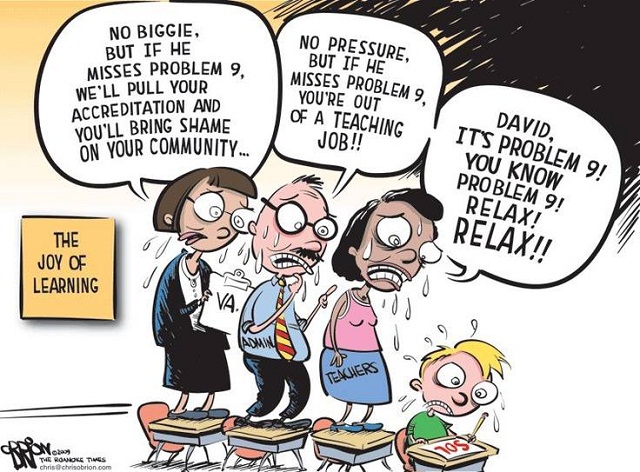
I get it. State testing season is upon us, and while I see the many amazing things happening in my new district, our recent scores have us on the state’s “naughty” list. The pressure is seriously building for the folks with slightly nicer desks than mine to turn things around.

State tests in Indiana take over the known world beginning in February – making Oklahoma’s “end of instruction” exams (which came two months or more before the end of instruction) seem somehow reasonable in comparison. If we’re going to be devoting our energies to persuading students of the value and importance of the damn things in the weeks to come, the reasoning goes, we should have some idea of what they actually look like.

I’ve already had a taste. This year is the first year the entire process is computerized. You’ve all seen the headlines in recent years about the number of times the whole system crashes halfway through this most modern and sophisticated of Teacher Effectiveness Measuring Systems; it seemed thus prudent to test the bandwidth a bit ahead of the official charade. Perhaps more importantly, the powers-that-be wanted students to be familiar with the procedures and formatting – the endless codes to be entered and ticket numbers to be verified, the bewildering joy conveyed by the mandated script over things like the availability of on-screen highlighting tools, and the way there’s ALWAYS that one kid who simply can NOT get logged in no matter what you try, leaving the entire room in frustrated limbo.

In short, my students all hate the damn tests months ahead of time.

Now, we can talk a good game about how important these are to graduation (they have to pass a certain number to get out of here with a decent flavor of diploma), but if my kids were long-term planners, they wouldn’t wait until the weekend after major projects are due to begin ignoring half of the instructions and doing them completely wrong. Insisting they be patient and maintain diligent enthusiasm over the opportunity to theoretically “demonstrate what they know” while I walk around trying to figure out why Enrique’s Passcode Verification Edu-Cipher keeps opening up the AP Latin Online Exam instead of High School Algebra is simply not persuasive.

After the first 15 minutes, I don’t really believe it myself.

In any case, teachers were given a sample math problem to solve this morning. Math teachers circulated to offer assistance after watch for shenanigans. My table was confronted with a serious dilemma on behalf of a fictional Timmy. Should he go with the cell phone plan that charges a monthly fee and then a small amount per text, or the plan with no monthly fee and a slightly higher amount per text? How many texts a month would make the first plan more advantageous?

Let’s set aside that cell phone plans don’t really work that way anymore; it’s a clear effort to take math and use it in a real world setting, even if that real world was in 2003.

For non-math people, we did rather well. We took the monthly fee of the first plan and divided it by the difference between per-text charges in the two. The answer was a nice round number – 300, I believe – and thus the number of texts at which the plans would cost the same. More texts than that and he should go with the monthly fee plan; fewer and he should stick with the higher per-text cost.

Look at us go! Real world math with a few scribbles on scratch paper! It took a few minutes to sort through the logistics, but we win at state testing.

Only we didn’t.

Our answer was correct, but we’d skipped the required step of writing out the equation necessary to work the problem. That’s what would be graded by the Electronic Masters. Did we know how to assign variables, and isolate ‘x’, and which rules applied, and all that?

Um… no, but we solved the problem. Not only that, we UNDERSTOOD our solution. Still, I suppose I could see some benefit to the expectation that students be able to translate that into the appropriate “language”…

Even that wasn’t enough, however. The real secret to success, once the problem was actually solved, was knowing how to use the on-screen tools and required answering box to enter the right symbols in the right order and leave the proper number of spaces in order to meet some pre-determined but loosely defined concept of what “showing your work” might actually look like to a minimum wage worker in Idaho looking at a key on a laminated sheet of some sort.

In other words, we failed high school math because we only knew how to use it to solve real-world problems, not how to make the test happy.

In my naivete, I thought the biggest challenge in math was still getting kids PAST the equations and into understanding how that math can actually be used. I thought the goal was to figure out how many tiles Savannah needs for her outdoor swimming pool, or the price point at which Carlos can afford fancy coffee once a week and still pay his rent. But it seems that’s not the goal at all.

The goal is to serve the machines. To nurture even deeper cynicism on the part of my kids about the actual point or value of even being her to begin with. To further bind their sense of identity and worth to their ability to game a rubric.

And I thought my internal tension over the time I spend focused on AP Exams was stressful; these poor math teachers! They love their subject – they’re really good at it – and they see the value, the fun, the joy, the depth! But if they’re going to qualify for those merit bonuses – or in some cases, keep their jobs at all – it has to all boil down to making the machines happy by pummeling their students into compliance.

Oh, and don’t forget to help the students remain relaxed and model some enthusiasm about taking the tests to begin with, of course.

It doesn’t help that behind my “still new here don’t make trouble still new here don’t make trouble” smile, I’m pretty sure the whole process is just another excuse to condemn public schools and undercut whatever progress we’ve made towards equity and more useful definitions of growth and excellence. While they don’t openly despise education with quite the fervor to which I grew accustomed in Oklahoma, this is still the Land of Pence and a VERY red state whose legislature simply goes to slightly more trouble to dress up their Trumpish loathing of all things social-contracty.

Even trying to ignore local politics, the undercurrent of seething resentment at ANY public money at all going towards the enlightenment of kids with blue collar parents and hard-to-pronounce last names is palpable. The hysteric bonds of ideology still chafe when again crushed (how surly they must be!) by the bitter angels of their nature.

Even assuming the best – that the state is acting out of willful ignorance rather than overt malice – I confess I am not looking forward to testing season. This has been a weird enough year and there are many things about my kids’ mindsets I wish I could magically transform – and no end to my personal failings as I’ve tried to lead them along a difficult path they have limited interest in treading.

And yet, I hate knowing they’ll be subjected to the monster in the weeks to come, and that there’s little I can do about it. For that matter, I don’t actually fault the district for their efforts to reshape some of their statistics, either. I suppose I could hold my breath that some new wave of rational political reform, untied to corporate overlords or bizarre ideology will sweep into power nine months from now, but that seems unlikely as well.

So I’ll keep trying to drag my little darlings to the water of life and hold their heads under until they discover the joys of learning, and hope that the clusterfoolery of standardized testing don’t exterminate what little progress we’ve made. If all else fails, I am confident that I am now fully qualified to get back into retail and help people like Timmy choose the best cell phone plan for him – as long as I don’t have to explain to a computer program how we figured it out.

Test Anxiety

RELATED POST: Am I Teaching To The Test?

RELATED POST: Actual Reflections (and too many questions)

RELATED POST: My Karma Ran Over My Dogma