Wick-Ed

Candle ManThink of something you love.

Not a person – a topic. A hobby. A personal passion.

Now pretend that it’s very important to you to share this passion with others. In fact, you’re getting PAID to spread this interest and your expertise. This is exhilarating and terrifying, because on the one hand you’re being given the opportunity to make a career out of something you deeply care about, but on the other… this passion is part of what defines you.

It’s personal. It matters to you. You care whether or not it’s done WELL.

Still – GIDDY!

Plot Twist: Most of those with whom you’ll be sharing are here against their will and care nothing about your topic, nor do they wish to. Also, they’re supposed to be learning about six other things they don’t care about all at the same time. 

But nothing’s perfect, amiright? And besides, surely once they’re exposed to what you’re really talking about, they’ll start to love it a LITTLE – how could they not? Your interest wasn’t planned or forced – you can’t HELP but dive in. It’s naturally engaging! It’s just a matter of lighting the first few candles in the bucket, surely.

How will you begin?

Well, you should put together some sort of high-interest discussion-starter to get them talking about your passion. You labor for hours trying to find the right entrance point – something accessible, but relevant.

Something rich in possibilities, but which still clearly lays the groundwork for where you’ll go next. You research, you revisit, you consider various mediums – a presentation of some sort, or a reading – maybe some audio or visual stimuli. Oh! Oh! Where is that one thing you used to have, with the stuff that was so—THAT?! You need THAT! Boy howdy, we are rolling now. A few dozen hours, and Day One is going to ROCK. THEIR. WORLDS.

OK, what next? Some content – some background – some substance to build on yesterday…

Plot Twist: Tomorrow’s schedule will be entirely different to accommodate some sort of school assembly, and there’s a fire drill, despite all the construction. Oh – and don’t forget the anti-bullying video you’re required to show. That’s fine… it’s just that nothing you have planned will actually work now and you’ll have to rethink it all. It’s now nearly 1 a.m. and you’ll deal with it in the morning.

Like A Candle In The Lounge...You press on bravely and creatively, full of vigor and highly qualified by any measure. You differentiate, you target different learning styles, and you make sure to effectively incorporate some of that technology the district is so excited about. Mostly, though, you woo, cajole, and inspire the $%&#@ out of that content and those skills! You leave it all on the podium all day, every hour.

Most of your kids politely go through the motions. A few overdo it, but as overachievers rather than converts. Several fall asleep or zone out watching trashy videos and eventually you give up redirecting them. Their total efforts combined don’t come anywhere close to what you poured into preparing.

Plot Twist: Your principal happened to drop by to observe for nine minutes and wonders why you’re not doing more differentiation or incorporating more technology. For the rest of the day you fight petty resentment of your students for that part.

You resent his comments from the observation as well, but you don’t fight those feelings so much.

It’s not that teaching is always complicated or demands superhuman self-sacrifice – we’re not Gandhi or Peter Parker. But if you’re not careful, it can drain you like a vampire with an eating disorder. (Not the kind where they’d drink less blood, though. One where they drink more. Lots more. So that you’re— look, it can be draining, OK?)

Candle Consumption

I hate this meme. I’m pretty sure most educators do. It comes up from time to time on social media, and consensus is that it’s dysfunctional and far too martyr-ry.

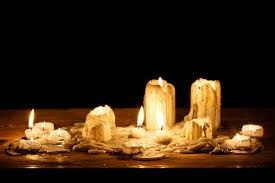
Like most irritating things, though, there’s enough truth mixed in to make it sticky – like Dr. Phil, or napalm. There’s nothing particularly noble about destroying yourself in the delusion that it “lights the way” for others (unless, I suppose, your goal is to model self-destruction). But the teacher-student relationship is in many ways one-directional, and without some self-awareness and waxy buildup outside of the school day, it will wear you away.

See, by and large, teenagers don’t give back. Many of them simply can’t – they don’t have it in their skill set, or they lack the emotional surplus. Some probably could, but they just don’t – life is complicated enough when you’re 16, and it’s not an especially self-aware time of life in terms of our impact on others.
I'm Melting I'm MeltingAnd honestly, it’s not really their job at this point. For educators, just inculcating the awareness in some of them that there ARE other people in the world who have actual thoughts and feelings, and that part of being human is learning to accommodate such inconveniences, can be a herculean (and oddly controversial) task.

The opposite can be just as challenging, as many of our best young spawn can’t imagine that their broken universe isn’t somehow their fault, and they’re terrified the rest of us will figure it out soon and come for them.

They are consumed with inadequacies, guilts, and fears that are not their own, but inflicted on them from every direction.

That doesn’t mean they’re not fully enjoyable. Many are amusing, thoughtful, engaging, or otherwise pleasant – it’s like they’re almost people sometimes. They’ll surprise you with what they can do when you least expect it – then crush your hopes with the most bizarre cluelessness just to keep you on your toes. They’re like walking-meat versions of Alexa or Android Auto.

“OK, Google – please play more music by this artist.”

“Sure. Asking to play more music by *pause* ‘Mike Doughty’. This artist was also in *pause* ‘Soul Coughing’. Would you like to include *pause* ‘Soul Coughing’ in your playlist as well? I can shuffle the tracks for maximum emotional variety and turn up the volume when I register that you are singing along.”

“Thanks, Google! That’s very—”

“I’m afraid I don’t understand that command. Try speaking more clearly or using different words.”

“Never mind, I just—”

“You must have a subscription to Google Play to access music from *pause* ‘Nevermind’ by *pause* Nirvana.

“No, I – just play this artist.”

“I am unable to find music in your library by *pause* ‘This’.

“No. Cancel. Play music by ‘Mike Doughty’.”

“Searching for ‘No Cancel’. I will now lock into an eternal ‘thinking’ loop until you hate everything about technology…”

We can love our students and expect a great deal of them academically, but whatever we walk away with from the experience has to be built on internal foundations – constructed fulfillment based on our perceptions of their growth, their understanding, their happiness.
How To Deal With...The hours you put in on content, on activities, on logistics, aren’t theirs to reward. Whatever time you give to their joys or terrors has to be entirely out of your professional surplus. The moment you begin needing anything back from them is the moment the relationship is out of balance.

And you don’t always see it coming.

The last time I ‘lost it’ with a class was over them… talking. Cutting up. Not knowing where the lines were for informality. I snapped and left the room rather than saying something truly ugly which I hoped I didn’t really mean, but might have.

But it wasn’t about the talking – that’s a classroom management issue. It was about how desperately I was busting my @$$ trying to figure out what would be effective with this group – how to accommodate who they were and where they were at academically and emotionally while still clinging to the expectations of the district and the course. I loved them, but I was burnt down trying to make it work – and they didn’t appreciate it AT ALL, the little $(@#&$!

I’d lost too much wax. When a 15-year old is getting under your skin, something is out-of-kilter – something not 15 years old.
Animated CoupleYou can’t fix all of it. Hell, sometimes you can’t fix ANY of it. All you can do is try one more time to bring your topic to life, and connect it to what you know of them. You try to listen, and to remain aware. From time to time you offer encouragement or resources. You’ll probably never be quite sure if you’re actually helping, or just filling space. And they’re teenagers – their reality is their reality. Doesn’t mean it’s not true – it just means it’s not always the same type of true.

Then YOU WALK AWAY AND DO THINGS UNRELATED TO SCHOOL. You talk shop with a few colleagues, but you refuse to ONLY talk shop – especially with family and other friends. You try to have a life of some sort.

Honestly, you’re better in class when you’re not always in class. That doesn’t mean be lazy, or that there aren’t weeks (or years) that are a helluva lot more work than others, but you gotta have OTHER stuff – or those kids are all you have.

And that’s not good for you. Or them. Ever.

Go add some wax.
Candle Stubs

RELATED POST: Teacher Tired

RELATED POST: Why Kids Learn (a.k.a. ‘The Seven Reasons Every Teacher MUST Know Why Kids Learn!’)

RELATED POST: Tips For Parents (To Defeat Your Child’s Teacher)
The Screen

The Screen

I don’t usually mind dealing with technical quirks. If something basically works, even if it requires fiddling here and there, I’m good.

Mostly.

Other times, though, technology turns on you. Maliciously. I’ve had home printers over the years grow increasingly hostile and sarcastic towards me as they refuse to print, inexplicably change orientation, or outright insist they’re not connected, have never been connected, and wouldn’t know what to do with a connection if they found one but-whatever-because-they-can’t-so-why-are-you-bothering-me, human?

I’ll unplug and restart, FAQ and Troubleshoot, update drivers and Google myself into emotional exhaustion, all to save $2.40 and a 20-minute trip to Staples – where I often end up going anyway.

Days later, having moved on with my life and hopefully grown a bit in the process, I sit down to work on something new. As my computer comes to life, so does the printer – stirring and spinning and warming up, mocking me as it builds suspense towards the inevitable…

And here come 18 copies of the thing I gave up on a few days before. Multiple pages each. Which is why I’m always out of ink, despite rarely actually printing something on command at home. 

Sure, you can fight it – hit STOP and DELETE and unplug things and throw them out the apartment window to the parking lot below like people do. A few days later, it’s off to Best Buy to purchase any-brand-but-THAT-one, hook it up to your wife’s computer (just in case it was something with your laptop, which you refuse to openly blame because why anger it along with the others?) and in mere minutes it’s asking to print a test page…  

Here come 19 copies of that thing from last week – this time in whichever color you’re lowest on. The stuff you ended up destroying the previous machine over. Page after page spitting onto the floor for the rest of the evening. Clearly they’re all in this together. 

My kids were testing today, and I had a rare opportunity to get ahead on planning next week. I was moving around some tables in Word, trying to decide whether they’d help my darlings better organize important themes or merely crush all hope out of their souls, when my cursor momentarily stuck. 

It happens. I’m blessed with technology in my room, but I’ve learned that it’s the mixed variety. I inherited the largest classroom in the building through no merit of my own – it’s what the teacher before me had when she moved up. There’s a Smart Board of some sort, a laptop that actually runs things, and a wireless monitor, mouse, and keyboard. There are other important-looking items connected as well, but I’m not sure what all of them do. I’ve learned not to experiment. 

My first month here – about this time last year – I tried rotating my desk to a better position. But there are cords. Cables. Wires and zip ties. Velcro, and tightly bound… things entering the wall in some places while different things emerge from others. Many of them go into the important-looking enigmas on and around my desk; others are wrapped and hang sadly alone behind the trash can. It all appears intentional, but not in a ‘Building Tomorrow’s Classroom Today’ sorta way; it’s more of a “I think we can get the Enterprise to leave orbit but we’ll only get once chance and might blow up” vibe. 

But it all works. Well, you know… mostly. 

Between you and me, I’d prefer to lose the wireless stuff. I’d rather just work off the laptop, smaller screen and all. Wireless stuff gets quirky, and it takes up desk space. But still – I’m genuinely thankful. Many educators would love to have it so good.  

There are three screens – the laptop, the monitor, and the big screen up front. If I’m using PowerPoint, I need to Extend Screen One to Screen Three. After class, when I want to work on a presentation without turning on the big screen again, I have to Extend Screen One to Screen Two – except that’s not always an option in the dropdown menu. (I haven’t yet figured out why it’s there sometimes and other times not.) So we… Duplicate Display on One and Two? Ah, that does it, although there are actually two completely different things showing now. But who cares, right? It works. 

The next day, the district wants us to show a video about bullying, which means I need to Duplicate Screen One to Screen Three. We’re tight on time, so that option has inexplicably vanished today. I can either, let’s see… Extend Display to Screen One? No, never – or what’s this? Duplicate  on All Screens? That’s new. Sounds like something that should work – except that my screen is suddenly large and fuzzy, which is weird. The sound is playing, but the image up front is frozen, until I open Settings again at which point the laptop is tired of my incompetence and goes completely black. Also, an ad has just popped up for incontinence. Or maybe against it. I’m too distracted to catch the details. 

You get the idea. And that’s without anyone touching or brushing too close to the screen at the front of the room. Touch it – even accidentally – and all bets are off what the computer and its various displays will do. The big screen itself flashes and sputters like a wounded animal in the ugly convulsions of digital death, and I have no choice but to restart before all is lost. 

But as I said, it all works well enough once you get used to it. I’m grateful. And flexible. I’ve learned to be flexible. 

Until I broke everything today, forever. 

My cursor was stuck. Word has a mind of its own when it comes to moving tables around, so I wasn’t overly concerned – just confused. Then it happened – I did a kind of 5-finger tappity-tap-them-all on the keyboard. Not angry, not hard, just a quick finger-drumming, two runs in quick succession. Human code for “HELLO?! ARE YOU FEELING ME IN THERE?”

My display promptly flipped upside down. 

Huh. 

That wasn’t the plan. 

No idea how I caused that, but obviously it was something in my type-itty-type fest. OK. This was fixable. There’s a setting, right? There’s always a setting. 

The laptop display wasn’t affected. It’s anchored a bit far back on my desk, so I had to lean in to see what I was doing, but there, under Settings, was something about screen rotation. Here we go – rotate 180 degrees! That was ea—

Now my laptop display was upside down. Oh, but my monitor was back to normal.

Huh, again.  

Like a bad sitcom, I repeated the process several times. Stuff kept changing, but never back to where I wanted it. In fact, I think it gradually got worse. 

My kids are still testing and I’m trying to play this cool so no one notices. Besides, prepping for next week is overrated, amiright?

Let’s try extending Display One to Display Three. There we—WHAT THE HELL?!

The monitor display is upright, but it’s blobby-blurry. That won’t work. Duplicated Display Two on Display—

Where’d it go? The laptop is blank now. I can tell Settings is open, but I can’t get an image on the laptop and the monitor is blobby-blurry. Where did—

Ah. The big screen. I’ll just have to subtly turn it on and hope they’re so engaged in testing that they don’t notice. Here we go, it’s warming up…

Settings were open on the big screen – sort of. They were open at a 90 degree angle, filling half the screen, which distorts things more than you’d think. And I couldn’t get the cursor to move into that section. 

I kept at it, though. I may not be smart, but I have grit enough to send Carol Dweck into trembling pedagogical ecstasies. It was like chasing wet soap in a straightjacket – each effort rotated images, altered resolutions, or sometimes just made things go away, but over time it was all clearly getting worse, and I began to fear I’d have to ask for help. For THIS.  

I had to use my cell phone to email tech support. All this tech, and I had to Swype with my fat old fingers on that tiny little phone screen to try to explain, without sounding either enraged (I really wasn’t – just defeated) or irredeemably idiotic. I then did the smartest thing one can do in such a situation – I shut it all down, and calmly walked to another workspace in the room where I began refreshing myself on next week’s content while my kids finished their writing. 

A half hour later, I quietly booted it all up again. I right-clicked and looked more closely, and there it all was – the option, in the menu, one screen at a time, back to 0 degrees and crisp resolutions, and all is again right in the universe. Maybe I panicked too quickly, or maybe I too easily perceive malice when none exists. Heck, there’s probably a kind of metaphor in it all – a lesson about education or life which would make a nice blog post…

I rushed home and began to type. Most posts take multiple drafts, but this one—

I coulda swore I’d unplugged that printer, but for some reason it’s whirring and making the most ominous clanking sounds. I wonder what dark effort from my past it will be ejecting the rest of the evening… With what new oddities will it taunt me?

I don’t care, machine – Bring. It. On. I’m ready.

RELATED POST: The Colored Chalk Learning Revolution

RELATED POST: 10 Lessons Learned from Common Core Testing

RELATED POST: Play That Funky Music (7 Steps of Professional Growth)

Mini-Presentations: Don’t Come to Connecticut!

Colonies Slide OneI wrote a few weeks ago about a strange decision I made in an AP U.S. History class to do ‘tear art’ one day as a review, but also as a sort of change-of-dynamic activity. Today I decided yet again to try something that might prove brilliant, might be a disaster, or – as with the ‘tear art’ – might land in some nebulous zone in between. 

About the same time my AP U.S. kids were doing the ‘tear art’ experiment, I had done something with my solitary AP World History section which I hadn’t done before. I called it ‘Mini-Presentations’, mostly for lack of a better term. Students were given one of four brief articles about the Mesopotamians (like in that song). They grouped themselves based on their randomly assigned figure – Sargon, Hammurabi, Ashurbanipal, or Gilgamesh. It’s a small class, so this meant groups of 2 or 3 per Mesopotamian ruler. 

They then had 35-40 minutes to read the article, discuss with their partner or small group, and create a five-slide presentation hitting certain key points about their assigned person. The presentations were given during the second half of that same class period, and required to be 3-5 minutes in length. (There were a few other guiding details, but they’re not important here.) We’re a one-to-one school for the first time this year, so they all have Chromebooks. They’ve also apparently used Google Slides so much over the years that the format isn’t an issue at all – there’s no “learning curve” regarding the technology in this case. 

Colony Slide Three

Four groups, mostly high-ability, relatively motivated students, and a 70-minute period – what’s the worst that could happen? And honestly, it went insanely well. Only one of the presentations was a little text-heavy, but even that one nailed the essential content and moved along quickly. I was pleased, although I’m not sure how soon I’ll do it again. Probably not until after Christmas. 

So my APUSH class has their first real exam tomorrow, and I wanted something which could potentially review some of the content they weren’t strong on, but which wasn’t additional homework or out-of-class stress leading up to the test. (Don’t worry – there’s already plenty they’re supposed to be reading, watching, and doing throughout the week. I’m not that compassionate or progressive in my teaching mindset.) I thought of the mini-presentation idea, which had gone fairly well with the APWH group recently. 

As you might imagine, it’s not a lesson which lends itself to great detail or analysis of the subject matter, but in this case I didn’t want depth and analysis – I wanted main ideas and overall familiarity with the various regions, sprinkled with quirks of particular colonies. Whereas the Mesopotamians version was more or less an introduction to new information, this one was intended to be a creative recap of stuff they already knew (at least theoretically). It’s also a very active way to spend 70 minutes – a plus, given how many days we’re analyzing docs or grinding through content.  

So… why not? LET’S DO IT!

Colony Slide Two

As students entered the room they were handed a card, either pink or green. On each card was the name of one of the original thirteen colonies. I briefly explained that their job was to either promote their colony or warn off potential settlers, with 1750 being their general reference point – not yet rushing into revolution, but well-past that first generation of colonists. 

Students with green cards were given general expectations for their five slides wooing potential settlers – here’s who we are, here’s a bit about our history, here’s what’s happening with our industry or agriculture or semi-representative local government, etc. Students with pink cards were told to do the opposite and warn off those considering their colony – here’s who we are, a bit about our troubled history, and why you want to steer clear of our current conflicts with the Natives, the Spanish, or disease, or oppressive religious figures, etc. Students with the same colony could work together even if they were on opposite sides of the argument since much of the information would be the same. 

It went fairly well, but unlike with the ‘tear art’ experiment (which left me uncertain even afterwards whether it had even been the right call), I think the Colonies Recap Mini-Presentations COULD be excellent. I’m definitely going to try some variation of it again, perhaps with different content later this year, but definitely at this point next year. There will, however, be a few substantial changes based on how today unfolded…

Colony Slide Four

First, most students handled the pressure rather well. One purpose of the activity I was NOT upfront about was that it forced them to review and compile a lot of information quickly, culling out what’s most relevant for their argument, and presenting it in a semi-organized fashion all in a very limited span of time and under a certain amount of pressure. I don’t like to design many lessons specifically around AP Exams unless I’m sold on the content and skills involved anyway (which I largely am, despite the College Board itself making us all crazy more often than not), but in some sense this was test preppy. My darlings need to get comfortable crunching info quickly and presenting it coherently under pressure – that’s the nature of an AP Exam. But surely that’s also a life skill, yes? Working under a deadline, balancing quality and efficiency, evaluating and synthesizing what they know in order to make a persuasive case for something – seems like a reasonable upper-level expectation to me. 

And, to be fair, we were reviewing why you should or shouldn’t move to Connecticut in 1750, so it wasn’t exactly defusing a nuke as the timer hits single digits or anything. 

In any case, I honestly expected more complaining or arguing, but the majority stepped up and just handled it, even if the results looked as rushed as they were. I think that even if I don’t want this to become one more thing on their plate as they prepare for our first test, some minimal front-loading would make it a more effective day next time. I’m not sure what that would look like just yet, but perhaps something as simple as assigning the colonies the day before and asking them to come prepared with a short list of pros and cons of moving there circa 1750. I still don’t think I should tell them what we’d be doing with that information until they arrive the next day, so I’ll have to think about this part. 

Colony Slide SevenSecond, I should never have included all thirteen colonies. It’s not that kind of a class. We care about the various regions (Southern, Chesapeake, Middle, New England), but not the specifics of every single one. Virginia is worth time and attention, and there’s enough unique and interesting stuff about Rhode Island, Georgia, or Maryland, that the mini-presentations work, but it was a much harder and less productive assignment for kids who drew New Jersey or Delaware. That was foolish, and completely on me. 

Third, I wasn’t realistic about the time it would take to give all of the presentations. I had done some rough math in my head, but clearly should have considered putting the numbers on paper, because we ran out of time even in my smaller class, and got through less than half of the presentations in my larger section. The exam is tomorrow, on a Friday, and I’m definitely not postponing it for this, so I had to quickly come up with a back-up plan (if you didn’t present, I’m grading just your slides, but since you weren’t planning on that you have until this time tomorrow to flesh them out, but seriously-don’t-spend-hours-on-it-just-make-sure-I-can-tell-you-know-what-you’re-talking-about-because-this-was-never-supposed-to-be-homework). 

Colony Slide FiveOne way to address all three of these issues, at least partially, would be to arrange it as a small group activity by design. Fewer variations on the cards, meaning you find the person whose card matches yours and that’s your partner or group. That worked well in the Mesopotamian version, and two or three students tackling the same thing means more information and fewer presentations. That also allows some wiggle room for students strong on content crunching but not in love with standing up and talking. I want all to speak in front of peers eventually, but it’s not essential for every activity. 

So it wasn’t brilliant, but it was a start, and I felt like I could afford the risk because most of the legit stuff has been going well. Students who are playing school with us are already warming my cold, disgruntled heart with their insights and growth and legit-but-seriously-weird styles. I confess that, out of pure vanity, I sincerely hope that the next time I’m reflecting all over you, my Eleven Faithful Followers, it will be to report an act of brilliance and/or inspiration on my part – something about which I can be truly giddy and perhaps even feel a bit smug. 

Until then, remember – we can’t control whether or not what we’re doing is actually changing the world. We sure as hell can’t control how others respond. But we’re going to try again TODAY to do our damnedest to build vision and strength and knowledge and skill – because if there IS any hope, our kids are where it begins. 

Colony Slide Six

RELATED POST: Holy Pedagogical Days

RELATED POST: Am I Teaching To The Test?

RELATED POST: Weird Silence

Tearing It Up

Tear Art

We’re exactly two weeks into the new school year, and things in AP World and AP U.S. History have started off about as well as one might expect, given the many interruptions and the wide variety of skill levels and content-knowledge gathered together in each section.

They may be talented teenagers, but they’re still, you know… teenagers.

Last year was a bit rocky at times, and it was important to me that this year start strong. I’m not claiming anything particularly magical has occurred, but so far it’s been a decent balance of high expectations and just enough compassion for those finding the learning curve a bit steeper than they’re used to. Overall, though, I’ve been damn near legit. (I’ll even go out on a limb and say that, as a general rule, feeling like you more or less know what you’re doing is quite a bit more enjoyable than feeling like you’re in over your head and are probably ruining the future in a dramatic, easily-traceable-to-you fashion.)

And then it happened.

I was being all pedagogical, sitting in my classroom at the end of the day and pondering options for the morrow, when the most ridiculous, artsy-fartsy revelation popped into my head.

We should do tear art!

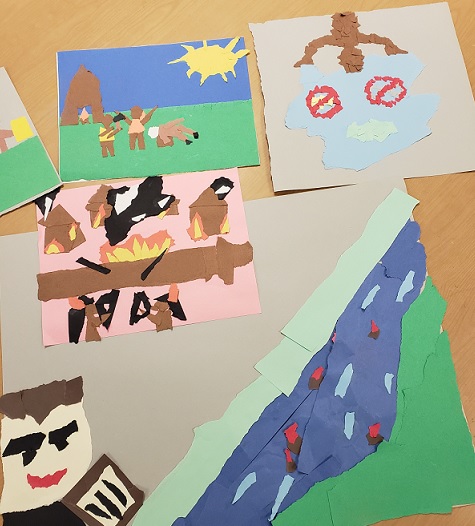
For those of you unfamiliar with the idea, tear art involves stacks of variously-colored construction paper and plenty of cheap glue sticks. Students are given a time period or range of topics, and – without revealing their choices to anyone around them – use their little hearts, minds, and hands to tear out shapes and glue them onto a base page, or to one another.

No scissors allowed. No rulers. No compasses, staples, astrolabes – not even a hole punch. And no numerals or letters – you cannot write on your tear art with any form of pen, pencil, or marker, nor can you tear the paper into alphanumeric figures. It’s shapes and colors and glue, baby – working together to convey knowledge, insight, and understanding.

It’s great for certain age groups or types of students. It lends itself well to topics involving social movements, artistic expressions, strong emotions, or other intangibles best represented impressionistically. (One of my girls asked me suspiciously today where I’d come up with the idea, eventually sharing that her mom used it with her in-patients at a local “psych ward” – which I’m pretty sure is teenager code for some sort of mental health care facility for young people in the area.)

But for reviewing initial European contact with Amerindians or the various approaches of the Spanish, French, and English towards colonization?

Not so much, surely.

I toyed with the idea a bit, and repeatedly discarded it. We weren’t at a logical point for breaking our serious, focused, AP-momentum just yet. The strengths of the activity didn’t really fit this type of content. And, while I prefer not to admit it, I’m to some extent still trying to prove myself in some way I can’t quite put my finger on – a sensation no doubt rooted in my own needs and dysfunctions rather than anything external.

So, no – not tear art. Not now. Not here.

But it just kept coming back to mind.

I eventually made the mistake of checking my supply closet and had plenty of construction paper – although I have no recollection as to why. (I haven’t done the activity in years.) I’d need a few more glue sticks, but those are cheap and Wal-Mart still has all their school supplies on—

NO! LOOK, SELF… you’ve already put together the close reading thing with those colonial documents and that “City on a Hill” excerpts, and they’re just starting to get the hang of primary sources. Save the artsy-fartsy for, I don’t know… some other time. Some time it makes more sense.

Not that playing with colored paper and glue really fits anywhere in the AP curriculum, but still…

*sigh*

As an over-thinker, the dilemma quickly evolved. Soon it was no longer about sticking to the orthodox stuff vs. trying the artsy-fartsy – it became, in my mind, about whether or not I was going to follow my gut and do something that might look stupid (hell, it might be stupid), or go with the perfectly good alternative lesson plan that was entirely justifiable and appropriate for the theoretical confines of the course and wouldn’t look severely weird if someone were to drop in for a visit in the middle of things.

It became about whether or not I was going to take a risk based on twenty years of trying weird crap that sometimes turns out to be brilliant, sometimes turns out to be *SHRUG*, and sometimes completely wastes 72 minutes of our collective lives that can never be recovered or redeemed. It became about whether or not I was willing to fail this early in the year, practically on purpose, when it was so very important to me not to – at least not now. Not this soon. Not after last year.

It sounds far more noble writing about it after the fact – like my face at some point transformed into a beacon of resolve and understanding, my hair blowing majestically as I gaze up and to the right of the camera, smirking heroically until we cut to commercial. There was still a very real chance that the whole idea was still going to be stupid and would not only waste an entire class period but undercut some of the momentum and credibility I’d started to build with this group. That’s not even taking into account how common it is for peers or evaluating administrators to drop in this time of year to observe. (What’s the code on the rubric for “looks like it’s all going to pedagogical hell in a badly torn-and-glued basket”?)

We did the tear art. It wasn’t a disaster. I mean, it was a bit messy, but that was to be expected. And I hadn’t covered ‘glue etiquette’ in my syllabus.

But most students enjoyed it. The traditionally excellent were pushed a bit out of their comfort zone, but they managed (no surprise there). The majority seemed to find it cathartic. The ones who committed themselves to it actually learned a few things, as did those who remained attentive as each class member in turn held up their final product and the rest of the class guessed what it represented.

So it wasn’t an utter embarrassment. That’s good.

But was it a great use of time? I’m not sure. I think so, but I couldn’t back it up with data or anything. Based on informal feedback, a number of them reworked and rethought the material, making it stickier and more meaningful. Others, not so much.

But even if the only accomplishment was that it was kinda fun while still reinforcing content, I’m comfortable with that in moderation. So many things impact how well students will work for you, learn for you, most of them completely out of our control. Maybe it was a release, or a rapport-builder, or some other intangible that will make tomorrow (when we get to those primary sources I’m so genuinely excited about) more effective, more meaningful. Maybe it helped pull back the rubber band of learning before snapping the arm of ignorance.

Or maybe we just played with glue for an hour in the name of college-level history. I’m still not 100% certain.

So this is not a heroic story, let alone a promo for tear art. What it is, I think, is my small effort to confirm whatever it is your gut is telling you. It’s very unlikely I’ll do anything truly crazy – I’m not against shattering paradigms, but that’s just not me. I believe very much in balancing what I think sounds “interesting” with what’s fundamentally sound – useful, professional, appropriate. I started my career twenty years ago relying almost exclusively on energetic good intentions and a modicum of wit; I like to think that over time I’ve learned some of the science of the gig, and that I go to that proverbial “tool box” before leaping once again off the cliff after that demented muse who for some reason still taunts me from time to time.

But I hope my need to play it safe, or my desire to maintain credibility with peers or others, never completely overrides the recklessness of that first decade or so, or those random moments of “what if?” More than that, I hope you, my Eleven Faithful Followers, will take a moment to ponder whatever it was that convinced you to educate the spawn of others for a living (already a crazy concept). Whatever it was that you envisioned or tried or did before “reality” set in, or test results were posted, or your peers got that look on their faces, I hope you’ll consider trying it again, or chasing that weird new idea you had over the summer, or nailing down that stupid “we should really” you and that one colleague keep kicking around.

It might be stupid, but it might be brilliant. It might fall somewhere in between. But you’ll pick up such colorful scraps, and may even find yourself smirking a bit as you scrub the glue off your podium. 

RELATED POST: Teach Like You

RELATED POST: Post-Reading Assignments (The Artsy-Fartsy Stuff)

RELATED POST: The Sticker Revolution 

The Mesopotamians & Jumping the Classroom Shark

Some of you are familiar with this 2007 release from They Might Be Giants:

Pop culture connections are a blessing and a curse in the high school history classroom. On the one hand, YAY ANYTHING THAT REINFORCES CONTENT IN UNEXPECTED WAYS! – even if it’s strange, inaccurate, and fictional {I’m looking at you, Hollywood}. On the other, it’s difficult to anticipate when such things have jumped the shark in relation to teen culture. Just to keep things really frustrating, some of the most promising and engaging sources are so far from school-appropriate that no amount of editing will make them OK, no matter how much I want to use them anyway.

But I don’t. Because… employment.

{In case you’re not strong on making inferences based on close reading and context, neither of these are particularly appropriate videos, language-wise.}

So we’re left looking for clean-but-engaging – a fragile field, to be sure.

Think of those school assemblies where administrators wear their caps backwards and rap about school policy. There are elementary students who will forever find this the coolest thing in all of academia, but not enough mental bleach to redeem participating “authority figures” in the eyes of those same kids five years later. You see it happen with stuff that’s pretty impressive in its own right – like Flocabulary or those cool History Teachers songs. I know others who’ve experienced this in relation to Crash Course or Hip Hughes History, although I still find both of them valuable resources. It’s just hard to anticipate with a given group.

There was a painful video several years ago of a public school teacher doing parody math songs karaoke in class. I won’t link to it here because I appreciate the risk involved – the leap of shameless faith she decided to take in hopes she could break through the expected drudgery and have a real impact out of the proverbial gate. But it was, well… it was awful. The worst sort of painful. Better she read the syllabus to them until the room lost collective consciousness.

That’s what I worry about with stuff like The Mesopotamians. I love the band, and the track, and I don’t want it to be party to anything cringe-worthy – or even something tired. Most of my students, strangely, have heard it before. Last year when we started covering Hammurabi, a number of them asked if we could watch it. {Standard answer: of course you can. I’m sure it’s on YouTube and any number of other websites. I hope you enjoy it – just don’t do so during class.} But when I changed my mind the next hour and started with it as an introduction, there were sighs and eye-rolling.

So go figure.

The MesopotamiansAdd pop songs and zany videos to the list of things that can be brilliant with one group and suddenly mean nothing to another. It’s another reason the whole teaching thing is as much art and guesswork and gut-level improv as it is a craft or a science. It’s another reason that online education or computerized learning may have a role to play in public education, but like symphonies composed by algorithms or those confession booths in THX-1138, there are limits to what they can do.

Seriously, where are they hoping to find all of these kids who will stay focused and self-motivated if only the software can adjust to their reading levels and multiple choice responses quickly enough?

But I digress.

I don’t know if I’m going to show the video again this year, but I am going to reference it as an anchor for the unit. The four individuals referenced in the song lived in different times and different civilizations united only by their geography and pre-classical status. One of them (Gilgamesh) is most likely entirely fictional. But they matter both for who they were (or were supposed to be) and what they represent in the larger story. My hope is that by using the song and video as a starting point, I’ll give my students a non-threatening frame-of-reference to help them slog through the substance.

We’ll see.

Several years ago I began a rather ambitious project I called “Have To” History, the goal being to produce 2-3 page summaries of essential people or events in history for students who don’t actually care but are expected to know stuff about them. There are, of course, already numerous reference sites online, but there are countless blogs as well and that certainly hasn’t stopped anyone from adding one more. I’m hoping the focus and format make them useful for certain sorts of students (or teachers). At my current rate, I should have at least two dozen posted and available for download by 2089 or so.

In any case, I’ve recently revised and (hopefully) improved the four H2H installments drawn from The Mesopotamians. My current plan for class is to do some sort of jigsaw activity with them, although we’ll see once I’ve actually met this year’s kids. We’ll do something with them, most likely. They’re attached to this post on the off chance anyone else teaching Ancient World History or AP World (which includes ancient civilizations for one more school year before the curriculum shifts) might find them useful. Let me know.

RELATED POST: Chasing Justinian & Theodora

RELATED POST: Sargon & Eve

RELATED POST: The Sticker Revolution