
This Land Is Whose Land? (From “Well, OK Then…”)

NOTE: I’m revising and reorganizing much of the content from “Well, OK Then” as part of an overall effort to ‘clean up’ this site. This post is one of those newer, better versions of something previously shared.
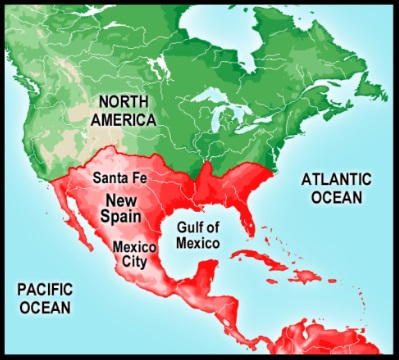
New SpainThe first European nation to lay claim to what is now Oklahoma was Spain, via wanderings sent forth from New Spain – what today is Mexico. 

Other than periodic expeditions hoping perhaps there was more to the Great Plains than met the eye, the Spanish weren’t particularly enamored with the northeastern-most reaches of their claims in the New World. They weren’t looking to colonize or expand on the same scale as their Anglo cousins, and the whole area was just… flat. And hot. And completely bereft of gold, more gold, or all the gold. 

The neglect became permanent after the defeat of the Spanish Armada in 1588 by the English, with substantial assistance from a suddenly very-Protestant God. Spain was already struggling to maintain its role as a major player back home in Europe, and no longer had the energy for shenanigans in the Western Hemisphere – not without a greater payoff. 

Little surprise, then, that the French met with little resistance when they claimed a big ol’ chunk of the New World as “Louisiana Territory” in 1682. The original boundaries looked a little different than they would 121 years later when Jefferson made his famous “Purchase” of the same name, but Oklahoma was included in both versions. 

The French did exactly nothing, near as we can tell, in this part of the Territory while under their purview. Not that we needed them here, getting their… Frenchness all over us. But still – it would have been nice to be wanted, you know?

The area changed hands again at the end of the French and Indian War – the same one most of you remember from American History class. You may recall that it wasn’t the French vs. the Indians; they were allies against the British colonies along the eastern coast of North America. Like most things, it was complicated – part of a larger “Seven Years War” going on in Europe, and mixing itself into pre-existing issues between the colonies and the locals, etc. 

It was at the conclusion of this war in 1763 that the British first got serious about raising taxes on the American colonists to help offset some of the costs of their “protection.” This sparked a whole other series of events more familiar to the average student and leading to seriously overpriced fireworks every summer. 
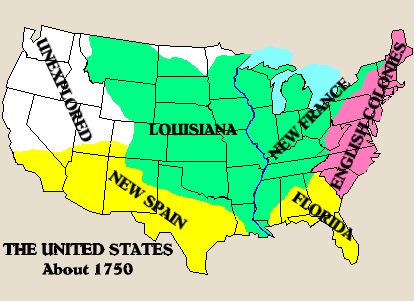
U.S. Map 1750In any case, the Treaty of Paris (1763) transferred proud ownership of all this flat, red dirt to the British, despite a secret agreement handing it over to Spain only a year before. It says something about the status of pre-settlement Oklahoma that Spain didn’t even fuss over this double-dealing; their primary concern involved other territories included in that exchange. 

That explains, however, how land arguably belonging to the British could be returned to France by Spain in the year 1800. These were the days of Napoleonic hegemony – the proverbial “little general” who wanted to take over all of the known world.

EXCEPT OKLAHOMA BECAUSE WHY BOTHER AND HEY T.J., WANNA BARGAIN ON SOME BIG, FLAT, USELESS LAND?

Um… hello?! Potential state here! Home of natural resources and flora and fauna and stuff? Wind, sweeping down the plains? Hawks with questionable work ethics circling above? I get that we’re not the prettiest state in the room, but we’re at least… OK, right?

*sigh*

And people wonder why to this day we’re one giant inferiority complex, with a side of paranoid delusion. Texas proudly waves its ‘six flags’ representing various stages of its history. We had three prior to statehood, playing ‘hot potato’ with us like the homely friend of the popular girls they were really looking to – um… “homestead.”

But finally, a nation that needed us! That could appreciate us! Say what you like about the early U.S., they were some exploring and expanding fools! President Jefferson sent out Lewis and Clark and Co., who began mapping the entire area of – 

Hey! Where are you going? Meriwether! Bill! Down here, big fellas! It’s me, Okla –

*sigh*

Sunnuvabitch. The Dakotas. They’re all hot’n’bothered for Nebraska and the Dakotas. Seriously? 
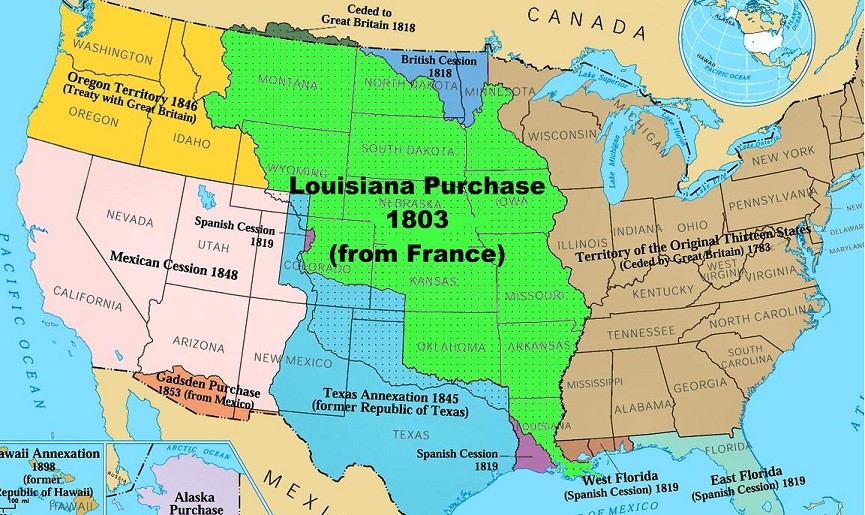
U.S. Map - TerritoriesFine. We’ll waive our *mumble* wheat for someone *murmur* can appreciate *grouse* land we belong to is grandma’s crusty *obsenitiesandbitterness*.

There was thus very little to discuss between our inconspicuous transition into United States Territorial-ness in 1803 and the involuntary arrival of the Five Civilized Tribes via “Indian Removal” in the 1830s.

Meanwhile, white America was expanding much more quickly than expected. Immigrants were packing the shores, and those already here were spawning like blind prawn. While encounters with Amerindian natives had produced mixed results since the time Columbus first mislabeled them, five tribes in the southeastern part of the country had adapted far better than most, and conflicts had been relatively minimal.

The Cherokee, Creek, Chickasaw, Choctaw, and Seminole, while distinct peoples in and of themselves, became collectively known as the “Five Civilized Tribes” (5CT). Keep in mind, of course, that this was not a self-selected title – it was bestowed by white Southerners in the area. This use of “civilized” wasn’t drawn from someone’s textbook definition or discerned anthropologically; it meant that these Indians were a lot more like the white folks around them than them other Indians, who were generally considered savage, wild, and dangerous. Decadent, actually. 

Boo, savage Indians!

The 5CT, in contrast, were largely agricultural. They were far less nomadic, more highly educated, and far less likely to practice hit’n’run raids on white neighbors. Many converted to or at least adapted elements of Christianity, even wearing uncomfortable shoes and learning English in order to facilitate good relations.

If the primary cause of conflict with Natives was cultural, as is often asserted, then the 5CT should have had little trouble with the wave of white settlement surrounding them. If it were purely an issue of gold or other mineral wealth, as our textbooks like to emphasize, the problem would have been substantially more localized. 
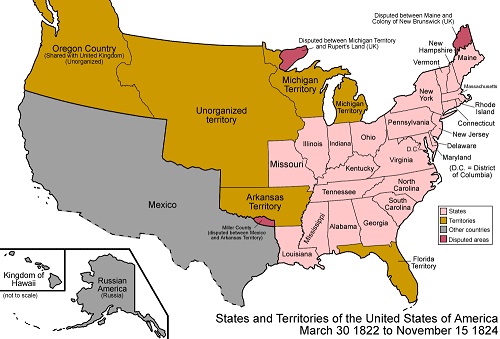
U.S. Map 1824But the U.S. found it necessary to violate a number of its own fundamental values and laws in order to kick FIVE distinct nations out of an area roughly the size of THREE entire states. They did so at enormous cost to themselves and unforgivable loss of life to those removed. This was driven by something bigger than gold, something fundamental to an expanding nation.  

White homesteaders wanted land. They needed land. They deserved land. 

Not that they were likely to come right out and put it that way. From President Andrew Jackson’s First Annual Message to Congress, December 8th, 1829:

The consequences of a speedy removal will be important to the United States, to individual States, and to the Indians themselves. The pecuniary advantages which it promises to the Government are the least of its recommendations… 

“Pecuniary”? He’s been reading Jefferson’s letters again. Not bad for an uneducated orphan kid, actually.

“Pecuniary” means financial, or profitable. Perhaps fiscal growth was the “least” of many reasons to move the Indians, but he sure didn’t waste any time mentioning it.

Like, first. 

It will place a dense and civilized population in large tracts of country now occupied by a few savage hunters. By opening the whole territory between Tennessee on the north and Louisiana on the south to the settlement of the whites it will incalculably strengthen the southwestern frontier and render the adjacent States strong enough to repel future invasions without remote aid… 

See? Not all of our motivation is selfish and monetary. They’ll also make a nice buffer between us and the Apache. Why should we be carved open and burned alive if we can throw a few Chickasaw in the way instead?

It will separate the Indians from immediate contact with settlements of whites; free them from the power of the States; enable them to pursue happiness in their own way and under their own rude institutions; will retard the progress of decay, which is lessening their numbers, and perhaps cause them gradually, under the protection of the Government and through the influence of good counsels, to cast off their savage habits and become an interesting, civilized, and Christian community.

What good man would prefer a country covered with forests and ranged by a few thousand savages to our extensive Republic, studded with cities, towns, and prosperous farms embellished with all the improvements which art can devise or industry execute, occupied by more than 12,000,000 happy people, and filled with all the blessings of liberty, civilization and religion? …
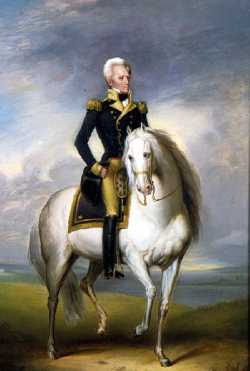
Andrew JacksonThere we go – the “besides, it’s good for them” defense. We used a variation of this to justify slavery, you may recall – saving all those crazy Africans from their ooga-booga religions and cannibalism and such, freeing them up to play banjos around the fire and partake of the finest Christian civilization. 

It’s quite a mix of values, though, isn’t it? Removal will leave them alone to do their own thing, but it will also force them to become more like us – which is the opposite of being left alone and doing their own thing. Besides, Jackson explains, what good is a bunch of trees and land when we could pack in cities and industry and corporate-style farming?

Maybe he hadn’t been reading Jefferson after all. 

The tribes which occupied the countries now constituting the Eastern States were annihilated or have melted away to make room for the whites. The waves of population and civilization are rolling to the westward, and we now propose to acquire the countries occupied by the red men of the South and West by a fair exchange, and, at the expense of the United States, to send them to land where their existence may be prolonged and perhaps made perpetual. 

The term ‘Manifest Destiny’ hadn’t been coined yet, but the ideology permeates Jackson’s language. There are no individuals making choices, or cultures colliding – merely inevitable progress “rolling to the westward.” 

Doubtless it will be painful to leave the graves of their fathers; but what do they more than our ancestors did or than our children are now doing? … {White settlers} remove hundreds and almost thousands of miles at their own expense, purchase the lands they occupy, and support themselves at their new homes from the moment of their arrival. 

Can it be cruel in this Government when, by events which it cannot control, the Indian is made discontented in his ancient home to purchase his lands, to give him a new and extensive territory, to pay the expense of his removal, and support him a year in his new abode? How many thousands of our own people would gladly embrace the opportunity of removing to the West on such conditions! If the offers made to the Indians were extended to them, they would be hailed with gratitude and joy.
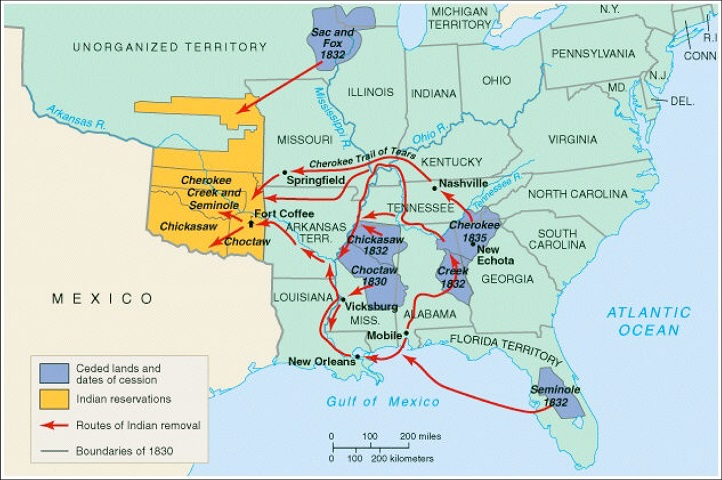
IR MapJackson may be overdoing it a bit, even by the standards of the day. His primary purpose was most likely not to convert anyone adamantly opposed, but to assuage any guilt on the part of those already looking for an excuse. That’s why we talk about “audience” and “reason” when we do document analysis, kids – dead white guys can be sneaky.  

Whatever else Jackson was, he was a genuine champion of the “common man.” As a creature of his times, that rarely included the 5CT or anyone else with meaningful pigmentation – it meant white homesteaders. 

Like the generation of Founders on whose shoulders he consciously stood, he recognized the connection between land and opportunity, land and character, land and democracy. 

He was generally plainspoken, but that didn’t mean he had no understanding of human nature. He knew that sometimes lofty goals and hard decisions required… framing. He was no diplomat, but he was certainly willing to play the demagogue here and there if he believed his cause was deserving. 

And there was no higher cause than this American nation. These people. This potential. He may have hated Indians, or he may have not. It didn’t matter. America had a destiny, and that destiny needed more land. 

That chunk of Louisiana Territory that kept getting tossed around and ignored is about to become useful.
Land Ownership and the Foundations of Democracy, Part Two (Westward, Ho!)

When my kids were little, we used to go to Bishop’s Cafeteria to eat with my dad. He was old, and old people like cafeterias – so we went. 

My son would fill his tray with everything he could fit in, including that cafeteria classic – brightly colored, cubed Jello. My daughter was much pickier, but inevitably she chose the wiggly cubes as well. The boy would snarf down his selections in minutes; the girl would take hours if we let her. 

It is worth noting that she didn’t usually eat the Jello. 

She liked to look at it. The table would inevitably get jostled a bit, or otherwise nudged, and the Jello would wiggle. It’s what Jello does. She loved that. And, to be fair, that’s just as valid a use for Jello as any other. (Just because something is edible doesn’t mean it serves no other function – otherwise, neither houseplants nor family pets would be around long.) 

But that’s not how my son saw it.

“Sis, you gonna eat that Jello?” 

“No.” 

“Can I have it, then?” 

“No.”

“Why not?” 

“It’s my Jello.” 

“Are you serious?” 

Of course she was serious. I had to question his bewilderment, given that this scene was played out repeatedly over the years. Still, his outrage seemed to build quite genuinely, every time… 

“Come on, Sis – you’re not going to eat it!” 

“No.” 

“But WHY?!?” 

“It’s MY Jello.”  And at this point, she’d usually give it an extra lil’ nudge – *wigglewigglewigglewigglewiggle*  

“DAD!” 

“Yes, Son?” 

He’d explain, as if perhaps I’d been abroad on business the whole time, rather than sitting there at the same table while things unfolded according to sacred family tradition. I’d express my condolences, but had to concur with Sis that the Jello at issue was, in fact, HER Jello. It didn’t help his case that he’d snarfed an entire platter of foodstuffs only moments before – including a very similar chalice of… cubed Jello. 

It never went well. 

As the United States began to expand west, its people encountered numerous native tribes who were – to be blunt – in the damn way. Our national sin in regard to Amerindians is not that we overcame them, it’s that we did so bathed in such hypocrisy. Rather than declare war, we declared eternal friendship. We killed them in the name of peace and in pursuit of a faith built on martyrs. We took everything from them while demanding their gratitude – for our civilization, our religion, and our pitiless modernity.

To be fair, we needed the land. They had it, but… well, they weren’t really using it properly. The Plains tribes especially were the worst sort of land-wasters – hunting when hungry, gathering when gathering was useful, hanging out, carousing and eating and socializing and such… 

We lacked the words to declare them hippies, but ‘utopians’ didn’t seem harsh enough. Not one single factory. Very little organized agriculture. No hospitals. No schools. Just relationships alternating with quiet reflection.

I’m overgeneralizing, of course – there were hundreds of tribes and cultures and such – but by and large, they weren’t doing proper America things with the lands they claimed as theirs. And, as with the Jello, subjected to repeated wiggling but remaining unconsumed, our frontiersmen forebears weren’t impressed by the arguments of those claiming that land ownership requires neither cultivation nor mall-building.  

(And don’t even try to pretend there was no such thing as ‘owning land’. That doesn’t even make sense. That’s like saying you can’t own people – ridiculous.)

It was genuinely maddening. Let’s not overlook that. Mixed in with the greed and selfishness and prejudice and maybe even some dark damnable thoughts was palpable frustration – an almost holy outrage – that this land was being denied them by a people unwilling to do more than jiggle their Jello.

We needed that land – we deserved that land (because if having it allows us to establish worthiness, then we should have it BECAUSE we’re worthy – it makes perfect sense, if you don’t think about it too closely).  

This is not just about me and mine – although it IS very much also about me and mine. We’re here as part of something bigger – something important – something holy – something democratic – something special. 

Killing Indians for personal reasons wasn’t considered particularly onerous by the standards of the day. Most of the civilized world was still pretty comfortable with what would today be condemned as racial and cultural elitism. This was beyond that, though – this was brushing aside a backwards culture and a darkened people (figuratively?) to make room for progress. Light. Democracy. The New Way. 

Because we NEEDED this land for settlers. For homesteaders. For citizens. Without it, there’s no progress. Without sufficient land, the whole of-the-by-the-for-the concept clogs up – it could even fail. And if American democracy fails, the new nation fails. If it fails here, it fails everywhere. Tyranny returns, darkness wins, and monsters rule the earth.

Conflict with Mexico was not much different. Their culture was nothing like most Amerindian peoples, but neither did we particularly fathom or appreciate their social structure, economic mores, or anything else – nor they ours. Perhaps outright disdain for one another played a different role than with the Natives, and certainly by that point the sheer momentum of Westward Expansion eclipsed whatever underlying values or beliefs had fueled it a generation prior, but whatever the immediate motivations, the same conviction of absolute rightness oozed from the words and letters of those pinche gabachos manifesting their destiny.  

It’s not logical, but it is very human to devalue how others process their world and the goals they choose to pursue. The Natives had every opportunity to make themselves productive – to get a little schooling (hell, we offered it to them FOR FREE), learn proper civilization, even to take care of themselves through the miracles of modern agriculture. The Mexicans had plenty of chances to be, um… less Mexican.

But let’s set aside for a moment that we were inflicting antithetical values and lifestyles on a diversity of proud peoples. We’ll ignore the generations of broken treaties and outright deception. I’d like to focus on the third element of the equation – the rigged game, even should the Locals choose to play our way. 

Poor tools. Bad soil. Spoiled supplies. If there’s such a thing as a “level playing field,” this wasn’t it.

They were assigned a value system and lifestyle they didn’t want, with the full weight of state and federal governments forcing compliance. They were assigned the worst land on which to practice this new system, and given inadequate tools and other supplies. The stakes were incredibly high – at best, they were expected to emulate those with the right equipment, in which case they could perhaps almost survive as second-class citizens. More likely, they would fail, starve, or simply give up – this not being a game they’d wished to play anyway. The dominant citizenry would then point to this “failure” and label them as lazy, incompetent, or otherwise flawed.

(If you didn’t know better, you’d think I was talking about how conservatives manage public education, wouldn’t you? There may be many reasons to study and enjoy history, but the last thing we want to do is to begin recognizing the variety of ways in which humanity manifests the same tendencies and plays the same games across time and place. We might have to learn from it and confront it in real life, and let’s face it – that’s awkward for everyone.)

After the Civil War, many Freedmen believed they deserved – that they had in fact been promised – “40 Acres and a Mule.” Some had actually been granted such at the unauthorized discretion of Union generals who, reasonably enough, took land from defeated plantation-owners and redistributed it to former slaves.

These few instances were reversed to smooth the transition into Reconstruction and maintain the almost cultish commitment Americans had to property rights – and, apparently, to irony. The freedmen received nothing.

Well, that’s not entirely true. They received freedom. That was a pretty big deal. But freedom to do… what? With no education, no land, no resources, no momentum – what, exactly, were their options?

Many stayed where they were, working the same land they’d been working, in exchange for food and shelter. Others left their former “masters” and wandered, either seeking loved ones from whom they’d been separated or simply wanting to go… somewhere else.

Many ended up working for white landowners under various arrangements. The South had just lost a rather brutal war – they didn’t have money to pay anyone. But food, shelter, a place to be… that they had. Eventually sharecropping and tenant farming were ubiquitous. 

Freedmen didn’t have any land, or a realistic way to obtain land. Carpetbaggers from the North began establishing schools, the government had a few agencies, but overall opportunity was… limited. Just over a decade after the South surrendered the war, the North surrendered Reconstruction and brought their troops home in exchange for the Presidency of Rutherford B. Hayes.

You all remember Hayes, right? A President for whom it was worth giving up the closest the nation had ever come to realizing its founding ideals?

Yeah, me neither.

The freedman had gained everything – in theory. On paper, they were free! The men could vote! Land ownership! Education! Equality before the law! Unalienable rights, in your FACE!

But without land, or a practical way to obtain land, they couldn’t provide for themselves. The system didn’t facilitate advancement via laboring for others – just ask the Lowell Girls, the Newsies, or any ox. Freedmen (or others without land) couldn’t do the things people had been conditioned to expect as a prerequisite for suffrage – for being a ‘full American’.

Despite written law, it was ridiculously difficult for freedmen to vote. It was impossible to gain economic ground, individually or as a community. Expression is severely limited when any unpopular thought can result in loss of livelihood. How does one maintain a sense of self against so much negation? At what point do we become our labels?

That’s the suffrage part. If Jefferson was correct about the spiritual and moral benefits of “laboring in the earth,” working land belonging to another may or may not have been worth partial divine credit. In terms of vested interest in our collective national success, whatever support black Americans lent to their country came without terrestrial reciprocation.

White men who succeeded under the system believed they deserved to succeed. Most had genuinely worked hard and made good choices by the standards of the time. It was not entirely logical to see those who did not flourish as clearly undeserving – but it was entirely human. We are not, after all, overly rational beings.

We all want to be part of a meaningful system, an ordered universe, and to be justified in whatever satisfaction we draw from our efforts. Generally, ‘facts’ adjust themselves to fit our paradigms rather than the reverse. That’s not specifically a white thing – that’s a people thing.

What began as a checklist for civic participation became the default measure of a man. What was intended to protect representative government from the incompetent or slothful became an anchor on those who didn’t fit certain checklists as of 225 years ago. They were unworthy. Not quite full Americans – and thus not quite real people. Not in the ways that counted.

The issue became your state of being rather than your efforts, choices, or abilities. It was self-perpetuating and self-reinforcing. It became circular.

Eventually land would lose its status as the ultimate measure and cure-all, and we’d find something new which absolutely must be made theoretically available to all for ‘democracy’ – such as it is – to survive. This new ‘golden ticket’ would replace land in terms of both the opportunity it purports to provide and the gage by which we rank value and ability. As with land, many will feel compelled to force the façade of equity into the equation while denying the risk of large-scale success by undesirables. {Hint: it starts with an ‘E’ and rhymes with ‘zeducation’.}

But that’s a few generations away. For now, men were looking west and feeling the pull of its potential – and of theirs. 

None of our Founders or Framers could have anticipated just how quickly this baby nation would begin filling up – the locals spawning and immigrants flowing in as fast as boats could carry them. Nor is it fair to judge their worldviews and prejudices entirely by the standards of our own times. We can recognize their shortcomings and even their sins without completely demonizing them. 

It did mean, however, that the ideals on which the nation had been founded quickly proved problematic in their implementation. Even in the limited, white male paradigm of the day, fulfilling those ideals seemed to require more territory than we’d realized. And yet… they still seemed like such promising ideals.

We were going to need even more land, or this wasn’t going to work.

Land Ownership and the Foundations of Democracy, Part One (What Made This Particular Destiny So Manifest?)

Land was a big deal when our little experiment in democracy began. Why?

Let’s ask the Founding Fathers. They seemed bright. 

We hold these truths to be self-evident, that all men are created equal, that they are endowed by their Creator with certain unalienable Rights, that among these are Life, Liberty and the pursuit of Happiness.–That to secure these rights, Governments are instituted among Men, deriving their just powers from the consent of the governed… 

(Declaration of Independence, 1776)

Consent of the governed? As in, the people being ruled make the rules, and all that? Huh – big responsibility. Harder than it sounds.

Given the number of reality shows based on the challenges of a dozen or so people living together in a free house with unlimited alcohol and no jobs, running an entire country based on the collective will of the masses seems… problematic. “Come at me, IDAHO!”

And the rallying cry had been “No taxation without representation!” The phrase has survived, but over the years we’ve lost sight of something rather obvious in these words, and inherent to our founding ideology: If paying taxes means you deserve to have a voice in your government, then it’s not unreasonable to suggest that having a voice in your government is contingent on your willingness and ability to pay taxes. 

In other words, you have to own something valuable enough to be taxed. Like, say… land.

So we have two issues in play as the Founders wrestle with outlining this new government – the connection between paying into the system and thus earning a voice in the running of that system, and the practical challenges of who exactly “consents” to that government on behalf of the whole. Little wonder our progenitors might try to reconcile them in concert – hopefully without overtly dialing back those fancy new ideals they’d been proclaiming to justify the entire project. 

They weren’t starting from scratch. There were some longstanding assumptions about land ownership – or the lack thereof – with which they could begin. 

If it were probable that every man would give his vote freely, and without influence of any kind, then, upon the true theory and genuine principles of liberty, every member of the community, however poor, should have a vote…

You gotta pay close attention when any argument begins with “in theory…”

But since that can hardly be expected, in persons of indigent fortunes, or such as are under the immediate dominion of others, all popular states have been obliged to establish certain qualifications, whereby, some who are suspected to have no will of their own, are excluded from voting; in order to set other individuals, whose wills may be supposed independent, more thoroughly upon a level with each other.” 

(Alexander Hamilton, Quoting Blackstone’s Commentaries on The Laws of England, 1775)

So, in order to assure that everyone’s political voice is more or less equal, we’re going to have to deny a political voice to some – to those without the ability to provide for themselves. Otherwise, the entire representative system may be undermined through the ability of the wealthy to manipulate the indigent.

Ironic, huh?

Then again, Hamilton was kinda Machiavellian about such things. Maybe someone less… cynical?

Viewing the subject in its merits alone…

That sounds a whole lot like “in theory” again…

…the freeholders of the country would be the safest depositories of republican liberty. In future times the great majority of the people will not only be without landed, but any other sort of property. These will either combine under the influence of their common situation, in which case the rights of property and the public liberty will not be secure in their hands; or, which is more probable, they will become the tools of opulence and ambition, in which case there will be equal danger on another side. 

(James Madison, Speech in the Constitutional Convention, August 1787)

No help here from the ‘Father of the Constitution’. Apparently handing power over to men without land leads to either a tyranny of the masses (mob rule) or a system in which the ignorant and easily agitated are led about by the manipulations of the wealthy and power-hungry.

My god, we wouldn’t want that. Can you imagine?

It appears that while our new nation was taking the concept of self-rule well beyond anything previously attempted, there were still substantial concerns over appropriate limits. This isn’t a dilemma unique to starting new nations. It’s one thing to talk about student-directed learning, for example, but quite another to hand them the chalk and the wifi password and tell them you’ll check back in May.

Get too idealistic, and the system devolves into chaos. Maintain too much structure – aka, limitations – and you quickly become just like whatever system you were trying to get away from. It’s like trying to balance Jello on your nose while you learn to unicycle. 

Hey – you know who we didn’t ask? Jefferson! I mean, you can find quotes from Jefferson to prove just about anything, right?

You have lived longer than I have and perhaps may have formed a different judgment on better grounds; but my observations do not enable me to say I think integrity the characteristic of wealth. In general I believe the decisions of the people, in a body, will be more honest & more disinterested than those of wealthy men: & I can never doubt an attachment to his country in any man who has his family & peculium in it…

(Thomas Jefferson, Letter to Edmund Pendleton Philadelphia, Aug. 26, 1776) 

I had to look up ‘peculium’. It means ‘stuff’ – including family, income, etc. Not quite the same as land, but still property – still evidence of competence via one’s successful estate. In other words, no help from T.J.

Jefferson here confesses to a sort of paradox – he doesn’t believe for a moment that wealth indicates personal integrity or even political wisdom. At the same time, he finds it easier to trust the input of someone who’s invested in the success of the nation of which they’re a part. 

It’s the difference between shopping at Bobo’s Grocery Extravaganza and working there, or between working at Bobo’s and investing your life savings in Bobo stock. If I’m a shopper and Bobo’s fails, it’s merely inconvenient. If I work there and it fails, it’s a problem.

But if my kids’ college savings and my retirement are all tied up in Bobo’s, I’m going to go above and beyond to do a great job every time I’m there. I may clean up even when that’s not part of my job, or study up on products I’m not actually required to know about. I’ll certainly be ultra-friendly to every customer who walks in the door. Heck, I may come in on my day off just to kinda help out. 

Because I’m invested. 

Land ownership suggests one is not only capable, but invested in the nation’s success. If I’m a landowner, I care very much about the next election, the local statutes, the state questions. Crazy Harold who lives under the bridge talking to his urine may be a nice guy, but he’s not overly concerned with researching the finer points of foreign policy. 

Well, unless his pee tells him to. 

So it seems that whatever else they argued about, our Founding Fathers were largely in agreement about one thing. Landowners were reliable, and self-sufficient. Their voice was their own. Those without? Not so much.

Keep in mind this was a new country – a baby nation. The Declaration was as much a birth certificate as a break-up letter, and our forebears were trying something entirely new. They were idealists, sure – but they were also educated, and realists, and had some idea of the ways in which people tend to behave.

If this ‘self-government’ thing didn’t work, America would fail. If America failed, then democracy had failed. And if democracy failed here, it effectively failed everywhere – in many cases it would never even begin.

The Dark Ages would return – tyranny and ignorance. Monsters once again rule the earth. It would be what we in the social sciences call “bad.”

It was John Adams (of all people) who best explained how the young nation could be both a land of opportunity and pragmatically defend itself against fools and freeloaders.

It is certain in Theory, that the only moral Foundation of Government is the Consent of the People.

There’s that “in theory” again…

But to what an Extent Shall We carry this Principle? Shall We Say, that every Individual of the Community, old and young, male and female, as well as rich and poor, must consent, expressly to every Act of Legislation? No, you will Say. This is impossible…

Adams probably talked too much, but I do love how he steps his audience through his reasoning. It’s very Socrates, very Holmes, very Bill Nye the Government Guy. Franklin may have been the poster child of the Enlightenment in the New World, but Adams was its lesson-planner and incessant blogger.

But why exclude Women? You will Say, because their Delicacy renders them unfit for Practice and Experience, in the great Business of Life, and the hardy Enterprizes of War, as well as the arduous Cares of State. Besides, their attention is So much engaged with the necessary Nurture of their Children, that Nature has made them fittest for domestic Cares. And Children have not Judgment or Will of their own…

How did Abigail not kill him regularly?

I know a number of impressive women both professionally and personally. They are varied and wonderful creatures, but very few qualify for the epithet ‘delicate’. Clearly John was not in the room during childbirth.

But will not these Reasons apply to others? Is it not equally true, that Men in general in every Society, who are wholly destitute of Property, are also too little acquainted with public Affairs to form a Right Judgment, and too dependent upon other Men to have a Will of their own? … Such is the Frailty of the human Heart, that very few Men, who have no Property, have any Judgment of their own…

There it is – the same basic argument which was made time and again by our Framers. You gotta pass the 8th grade reading test to take Driver’s Ed, you gotta keep a ‘C’ average or better to play football, and you gotta have your own land to vote. It’s nothing personal. It’s simply an imperfect indicator of minimal competence.

Doctors gotta have degrees to doctor on you. Accountants have to be certified to do spreadsheets on your behalf. Barbers have to have special certificates confirming their competence to snip your hair off with scissors. None of these hold the power over the vast numbers of people a voter does. None could do the damage possible at the hands of the unqualified citizen.

Or so they reasoned. Personally, I think they were overreacting. I mean, pretty much everyone can vote today, right? And things are going –

OK, maybe they weren’t overreacting. 

But Adams doesn’t leave it at that. He elaborates on a solution, a counterbalance. He looks at the long game.

Power always follows Property. This I believe to be as infallible a Maxim, in Politicks, as, that Action and Re-action are equal, is in Mechanicks. Nay I believe We may advance one Step farther and affirm that the Ballance of Power in a Society, accompanies the Ballance of Property in Land.

The only possible Way then of preserving the Ballance of Power on the side of equal Liberty and public Virtue, is to make the Acquisition of Land easy to every Member of Society: to make a Division of the Land into Small Quantities, So that the Multitude may be possessed of landed Estates.

If the Multitude is possessed of the Ballance of real Estate, the Multitude will have the Ballance of Power, and in that Case the Multitude will take Care of the Liberty, Virtue, and Interest of the Multitude in all Acts of Government. 

(Letter to James Sullivan, May 1776) 

It’s all kinda understatement to say that the first century of American history was largely shaped by this need for land. 

Some of it was primal and selfish, of course. At times, shiny rocks were in the ground or particularly nice lumber stuck up out of it. But those were the temporal motivators. The ethical Under Armour of expansion as a whole was this political – almost spiritual – paradigm. 

To be a City on a Hill, one must have a hill. To be a republic – a government of-the-by-the-for-the – one must have qualified voters. The most universal way to demonstrate basic responsibility, competence, and character, was land ownership. Thus the almost sacred role of land in both the founding and expanding of this new democracy. It was, to many Framers, the most obvious and tangible measure of a man’s legitimacy, his investment, and his potential value as another voice in the national discussion. 

Without widespread, relatively easy access to land, democracy wasn’t possible, and this grand experiment would fail. If democracy failed here, it effectively failed everywhere – it would, in fact, never even begin elsewhere.

Dark Ages. Tyranny and ignorance. Monsters rule the earth.

Every homestead was a 160-acre, individually-sized portion of national ideals. Its role was not asserted so much as perceived – much like many other “self-evident” truths bandied about in those days. And as if that weren’t enough, the issue wasn’t solely terrestrial.

Those who labor in the earth are the chosen people of God, if ever He had a chosen people, whose breasts He has made his peculiar deposit for substantial and genuine virtue. It is the focus in which he keeps alive that sacred fire which otherwise might escape from the face of the earth. Corruption of morals in the mass of cultivators is a phenomenon of which no age nor nation has furnished an example. 

(Thomas Jefferson, Notes on Virginia, 1782)

I’m no authority on Jefferson, but you don’t know that – so let’s just play along and not make trouble, alright?

“Those who labor in the earth…” 

I suppose he could have just said “farmers,” but this paints a more vivid picture to set up where he’s going. It’s not about a role in the economy or the food chain – it’s about the agency of individuals, applied not merely to ground or soil but to the “earth”. It’s a wide-angle lens on an idealized way of life – Jefferson’s strength.

“…the chosen people of God, if ever He had a chosen people…” 

Wow. Jefferson getting all allusion-y up in here. The most obvious antecedent would be the Israelites of the Old Testament. Jefferson wasn’t a huge fan of biblical literalism, but that wouldn’t negate its value as a frame of reference. 

The addition of “if ever he had a chosen people” may be read as emphasis (“that’s a miracle if ever I saw one!”) or a touch of skepticism (“if there are such things as miracles, this would be one”) – an ambivalence consistent with his few recorded thoughts on scripture. But the power of the image – the holy role of the Hebrew children –he utilizes quite intentionally.

It wasn’t much of a leap from Old Testament progenitors to fresh young Americans – the City on a Hill, the people whose destiny was quickly becoming manifest, and a culture who a century later would carry their “white man’s burden” well past the boundaries of the continent.

But for now the issue was land – or at least the way of life it promoted.

Farmers worked 365 days a year. Soil still needing tilling on your birthday, cows needed milked on Christmas, and no matter how sick you might be, those crops weren’t going to reap themselves. It was labor-intensive and the hours were long, and yet after doing all you could do, all day every day – you waited.

You waited for the rain. You waited for the growth. You waited for the births. You waited for the universe to do its part.

Sometimes it didn’t. Often, even when it did, it took too long and was too slow and there was no way to rush it, but many ways to ruin it. This combination of intense human application and eternal patience is inconceivable generations later. Almost nothing works that way anymore – at least not the sorts of things to which you set your hand on purpose, to carry proudly from cradle to grave.

Sometimes enough years and sufficient survival teach similar lessons in the 21st century – but they come too late to shape much more than our troubled reflections. The laboring Jefferson extols, however, produced “substantial genuine virtue” – a type of perspective and wisdom unavailable minus the requisite experiences.

You won’t find accounts of farmers going rogue in meaningful numbers, he claims. Presumably this is related to all that “virtue” and “sacred fire,” but it also seems unlikely that any successful farmer could have found the time or energy to be particularly corrupt. The natural consequences of immorality or irresponsibility would be an immediate, self-inflicted deterrent. Like playing in the traffic or juggling chainsaws, any screw-ups would be painfully self-correcting.

Agriculture… is our wisest pursuit, because it will in the end contribute most to real wealth, good morals and happiness.  The wealth acquired by speculation and plunder, is fugacious in its nature, and fills society with the spirit of gambling.  The moderate and sure income of husbandry, begets permanent improvement, quiet life, and orderly conduct both public and private.”  

(Thomas Jefferson, Letter to George Washington, 1787)

Jefferson had a distrust of bankers, stock markets, or anything financial industry-ish – so much so that he took great personal pride in never having the foggiest idea how to make his estate solvent. (He died in substantial debt.) Farmers raised essentials. They produced raw materials which could be woven into clothing, smoked for pleasure, eaten to survive. “Real wealth.”

Bankers scribbled numbers in little books, in stuffy rooms, producing nothing, but somehow always taking from you. Farmers dealt in uncertainty, but financiers gambled. While farmers produced, money men “plundered.” The soil, properly tended, would always be there – would always prove reliable. Paper numbers and percentage points never were.

Jefferson is claiming an essential role of land beyond voter qualifications. He’s claiming it as a lifestyle – a moral anchor, social stabilizer, and the only true source of economic security. Husbandry grows in men the essential traits of a fledgling democracy – applied labor, determination, patience, and pragmatism. It’s the wisdom of the earth in the hands of the earth’s masters.

Those Enlightenment-types thought science-y thoughts, but they were still quite comfortable with a little melodramatic sheen to their carefully chosen words. I can’t imagine what it must have been like to spend twice as much time on how you say something as you did on what you were actually saying. Sounds tiring. 

*ironic yawn* 

I think our governments will remain virtuous for many centuries as long as they are chiefly agricultural; and this will be as long as there shall be vacant lands in any part of America. When they get piled upon one another in large cities as in Europe, they will become corrupt as in Europe.” 

(Thomas Jefferson, Letter to James Madison, 1787)

Uh-oh.

As yet our manufacturers are as much at their ease, as independent and moral as our agricultural inhabitants, and they will continue so as long as there are vacant lands for them to resort to; because whenever it shall be attempted by the other classes to reduce them to the minimum of subsistence, they will quit their trades and go to laboring the earth.” 

(Thomas Jefferson, Letter to Mr. J. Lithgow, 1805)

So let’s recap…

Land ownership allows the property owner to demonstrate his capability, his competence, his potential to be a useful voice – a valid voter. It suggested he was invested in the success of the nation. 

Land ownership promotes solidity, character, ethereal virtues reflected in wise words and actions – valuable in and of themselves, sure, but especially necessary in a nation relying on the people themselves to provide effective leadership – directly or through their choices regarding representation.

Land must be available to meet the demands of an expanding nation. Without sufficient, arable land, the ideals on which the nation was founded lack the requisite elements to survive. It’s not an optional ingredient – it’s the eggs in the democracy omelet, the flour in the ‘Mericake. 

Finally, in a nod to inconveniently unfolding realities, Jefferson argues that even the POTENTIAL of land ownership – its availability – provides an essential safety valve, a check on the industrializing leaven of Europe as it attempts to leaven the entire American loaf. That he so easily adjusts his faith to accommodate current events I leave to you to interpret as you see fit.

None of our Founders could have anticipated just how quickly this baby nation would begin filling up – the locals spawning and immigrants flowing in as fast as boats could carry them. If these fancy new ideals were going to expand with them, we needed to act quickly.

Opportunity. Responsibility. Chosen people. If it fails here, it fails everywhere. Darkness. Tyranny. Monsters rule the earth.

They were going to need more land. And looking west, it was largely taken…

The American Civil War, Part One (1861-1865) – From “Have To” History

Stuff You Don’t Really Want To Know (But For Some Reason Have To) About the American Civil War…

Three Big Things:

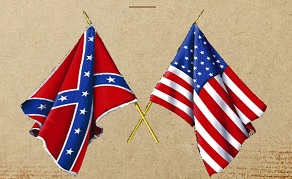
Civil War Flags1. The North had more of everything except capable military leadership. They also weren’t fighting to defend their home states, their farms or families, or their overly-romanticized “way of life.” Despite Lincoln’s best efforts, the North kept finding ways to lose for most of the first half of the war.

2. Both sides assumed the war would be brief and glorious. Except for a few experienced military men who remembered the Mexican-American War, troops on both sides went in “green” – inexperienced and ignorant of what they were getting into. Many were excited by the chance to fight. Once they’d “seen the elephant,” however, that enthusiasm was quickly tempered.

3. July 1863 was the turning point of the Civil War. From that month forward, the outcome was inevitable – the South was going to lose. The fact that they prolonged it as long as they did was either noble or especially tragic, given the extensive damage it was necessary to inflict before they surrendered.

Part One (1861-1863)

The Civil War is one of those topics so extensively studied and discussed that it’s easy to get lost in any one of a hundred directions. This list is nowhere near comprehensive and every event or issue addressed easily deserves its own “Have To” entry. For that matter, most have been the subject of too many legit publications to tally.

But if your goal is to fake your way through a class discussion or pretend you’re pulling your weight as part of a group project of some sort, here are some basics you simply must know, in roughly chronological order.

The “Anaconda Plan” (Early 1861) – As it became clear that war was looming, General Winfield Scott, hero of the Mexican-American War and the highest-ranking officer in the Union Army, proposed a simple strategy. The North had more people, more boats, and more resources in general. Its army was full of untrained soldiers (as was the South’s) and armed conflict would mean great loss of life on both sides. So, he argued, the U.S. should use its navy to essentially ‘blockade’ the South – control the Atlantic and Gulf of Mexico, then seize control of the Mississippi River. Starve them out. The plan was mocked, as was Scott, for such an unmanly approach to warfare. A political cartoon satirizing the idea showed a giant snake wrapped around the South, about to squeeze – hence, “anaconda.”

As it turned out, the war was won largely by taking control of the Mississippi, cutting off the South, and starving them out of action. Scott didn’t get to gloat long, however – he died less than a year after the war ended.

The Border States (Delaware, Maryland, Missouri, and Kentucky) – Between Lincoln’s election (November 1860) and his inauguration (March 1861), Seven southern states (all slave states) seceded to form the Confederacy. Four more joined them after hostilities erupted, leaving eighteen northern (and far western) free states loyal to the Union. Four ‘Border States’ with slavery remained in the Union as well. Lincoln took unusual measures to assure their loyalty, including martial law, suspending habeas corpus, stationing troops in problem areas, and other possibly unconstitutional steps. Historians still debate this part today; you should utilize furrowed brows and feign deep concern over whether this was the right call on Lincoln’s part if given the opportunity.

Copperheads – Name given to Northerners who were against the war, led by Northern Democrats (“The Peace Party”). They criticized the draft, abolitionists, and Lincoln’s “despotic” rule for destroying values of America.     Copperhead newspapers even called on Union troops to desert.

Republicans first used the term “Copperheads” as criticism, claiming the Dems were full of venom and struck without warning. The “Peace” Democrats embraced the label and reframed it as a reference to the copper “head” of Liberty, which they cut out of the large one-cent coins in use at the time and wore as badges of honor. President Lincoln had many of the leaders and newspaper owners arrested and held without trial, claiming it was necessary to violate a small part of the Constitution to save the nation. (See above.)

Cotton Diplomacy / “King Cotton” – The South believed Europe needed their cotton and would trade for weapons, food, medicine, etc. They also wanted England and France to recognize the C.S.A. as an independent nation. They pushed the issue by refusing to ship cotton overseas when the war began, not realizing Europe had plenty already stored and other countries producing it closer to home. Europe didn’t appreciate the attempted manipulation, and the South was stuck with lots and lots of cotton and not enough food or ammunition.

Battle of Fort Sumter (April 1861) – First shots of the war. Union fort off the coast of South Carolina. Whereas most military property in the South was essentially abandoned between Lincoln’s election and his inauguration, Anderson held his ground. On April 12th, before dawn, Confederate forces on the beach opened fire, which Anderson returned. By early afternoon, the fighting was over, with exactly zero deaths on either side.

The first fatalities came about as a result of malfunctioning weaponry during a ceremonial flag salute as part of Anderson’s surrender. Some say this battle foreshadowed just how weird the rest of the war was going to be – but not how bloodless.

First Bull Run (July 1861) – The first ground battle of the war. Both sides were wildly optimistic about the war, each expecting to easily whip the other and be home by Christmas. Union troops “marched” from Washington, D.C., to Richmond, Virginia, with little discipline or organization along the way. Once the actual fighting started, though, both sides did much better than expected despite being “green.”

The North seemed to be gaining the advantage and was pushing back the South until three things happened:

(1) “Stonewall” Jackson earned his nickname by holding critical defensive lines via force of personality and borderline sociopathic conviction in the divine will. 

(2) The first recorded instance of the “Rebel Yell” was used in conjunction with Southern charges, scaring the bejeebies out of Union troops and inspiring reenactors and inebriated rednecks for generations to come.

(3) Southern reinforcements arrived by train (while the Union received none). Clearly, they hadn’t read the section in your textbook explaining what a massive advantage the North had because of their technology and railroads. Confederate forces turn back the Union and essentially chase them all the way back to D.C.

Traditional interpretation says after First Bull Run, the North realized the war would be difficult and began preparing in earnest while the South swelled with overconfidence. In reality, it was more complicated than that – the South’s confidence carried them through the next two years while the North’s fear of repeating their opening humiliation crippled them almost to the point of losing the war. But we’re not really doing subtlety here, so…

George B. McClellan – Commander of Union Army for most of the first two years. Vain and insecure at the same time, he despised Lincoln. The average soldier loved him, and he was gifted at organizing, training, supplying, preparing, even fighting when forced. Perpetually convinced that he was outgunned, outmanned, outnumbered – but never out-planned. I can’t work in these conditions! It’s not paranoia if they’re really out to undercut and blame you! (Except that they weren’t – it was him.)

Lincoln finally canned him after Antietam, which was technically a Union victory despite McClellan’s bizarre… everything. He later ran against Lincoln as the Democratic candidate for President in 1864. Ulysses S. Grant called McClellan “one of the great mysteries of the war.”

Old Tactics / Old Medicine / New Technology – Napoleonic tactics (like “line up and charge!”) were still considered both honorable and effective, despite improved weaponry making such tactics essentially suicidal. Weapons were improving – things like bullet-shaped bullets, rifled barrels, and exploding shells made for more accurate and more extensive life-removal. Medicine was still primitive and largely ineffective; more soldiers died from infection and disease than from being shot, stabbed, or blown up. 

If you want to sound particularly thoughtful, question in the hearing of your instructor why both sides would continue utilizing outdated tactics for so long despite the lessons of the Revolution. Suggest that sociology, psychology, or perhaps our unwillingness to actually learn from history when it matters most, all came into play. If you get stuck, stroke your chin and look troubled. You’re on your own from there.

Battle of Shiloh / Ulysses S. Grant (April 1862) – While McClellan was frustrating Lincoln in the East, Grant began working towards control of the Mississippi River in the West. At Ft. Henry / Ft. Donelson, he earned the nickname “Unconditional Surrender” Grant for his unwillingness to compromise with the enemy and becomes a “hero” back home. Briefly.

At Shiloh, Grant is caught unprepared and driven back to near-defeat by the end of the first day of fighting. Despite massive casualties, he counter-attacks the next day and regains the ground lost. The number of dead and wounded far surpasses anything else seen in the war so far. The public is horrified and began calling on Lincoln to replace Grant. The President responds that “I can’t spare this man; he fights.”

The Draft / Draft Riots – In April of 1862, the C.S.A. enacted the first military draft in American history. Many found being forced to fight for states’ rights and individual liberty to be someone paradoxical and resisted. Vocally.

The U.S.A. instituted a draft of their own in March of 1863, and it was nearly as unpopular as in the South. The Union, however, was already fighting for the right to make you do what they thought was right, so at least it seemed less hypocritical. Still, there’s a whole “freedom vs. security” discussion to be had if the opportunity presents itself, limited only by your ability to produce comparable examples of this same tension throughout American history. It might even get you out of whatever work you’re supposed to do that day as your instructor seizes on this “teachable moment.”

Both sides had provisions by which the wealthy could buy their way out of serving or hire a substitute to fight in their place, fueling further resentment and class antagonisms. Riots broke out across the North, most notably in New York in July of 1863, leaving many dead and feeding the narrative that perhaps it would be best to just let the South leave after all and get back to whatever “normal” would look like now.

Robert E. Lee – Leader of Confederate forces and the most-loved man in the South (and more loved than anyone in the North). Lee wasn’t a big fan of slavery and didn’t support secession. Lincoln offered him command of the Union army, but he wouldn’t take up arms against Virginia. A devout Christian who took responsibility for the loss at Gettysburg and tried to fight with integrity and honor, Lee represented everything the South wanted to believe about itself in terms of honor and ideals.

That’s part of what makes debates over his statues in the 21st century so emotionally loaded – he was the real deal in terms of an old-school gentleman who did what he thought was right, and in the most noble ways. It’s just that in this case that meant killing hundreds of thousands of Americans in order to destroy the Union and maintain the enslavement of an entire race of people. So, you know… complicated. (History teachers almost always love it when you acknowledge or pretend to discover complexities in history, so feel free to milk this one.)

Battle of Antietam (September 1862) – Robert E. Lee invaded the North (1 of 2). He was trying to move the destruction of war out of South and put more pressure on the North to leave them alone. (To win, the North had to WIN; the South merely needed to NOT LOSE.) Union soldiers found a copy of Lee’s covert plans wrapped around some cigars in an abandoned rebel camp, and McClellan declared he NOW had what he needed to defeat Lee and end the war! Except that he was still McClellan and dithered while Lee – realizing his plans had been compromised – prepared for battle.

The result was the single bloodiest day of the entire Civil War, but technically a Union victory. McClellan failed to pursue Lee’s defeated forces, prompting his dismissal by Lincoln. Antietam nevertheless gave Lincoln the victory he needed to issue the Emancipation Proclamation. He also issued a call for African American troops, leading to the formation of the 54th Massachusetts Infantry.

The Emancipation Proclamation (January 1st, 1863) – Formulated in 1862 and released after the Union “victory” at Antietam, this document freed slaves in areas remaining in rebellion against the Union while maintaining slavery in states loyal to the Union – effectively applying only to areas where it could not be enforced.

The Proclamation nevertheless finalized the transition of the Civil War from one largely focused on preserving the Union to a war to end slavery and promote more of an “all men are created” vibe despite racial disparities. It received mixed reactions at home (even in the North) but eliminated any danger of direct European support for the south, lest European nations be perceived as fighting to support slavery.

Gettysburg & Vicksburg (July 1863) – Lee invaded the North (2 of 2) and clashed with Union forces at Gettysburg. This 3-day battle culminated with “Pickett’s Charge” uphill against entrenched Union troops. Losses were massive, especially for the South. After Gettysburg, the war was effectively lost for the secesh (despite dragging out 2 more years). The best-known film about this battle, appropriately titled Gettysburg (1993), is unique for being the only war movie which feels roughly the same length as the multi-day battle it recreates.

Meanwhile, in the West, Grant had laid siege to Vicksburg – both the city and Confederate forces stationed there. After more than a month, they surrendered in early July. The civilian population had faced starvation, disease, etc. (‘total war’). This completed Union control of the Mississippi River (as per the much-maligned ‘Anaconda Plan’).

Finally, it’s in July of 1863 that the Massachusetts 54th made their dramatic (but suicidal) assault on Ft. Wagner (the climactic scene in Glory). It was a massive military loss, but a hugely important symbolic moment for Black Americans and how they were perceived by the population at large. Their valor led to the use of an additional 180,000 black troops in the remainder of the war.

You Want To Sound REALLY Smart? {Extra Stuff}

General Grant had Ft. Donelson, commanded by a General Buckner who happened to be a former friend of Grant’s and who’d helped him out considerably in years past, surrounded and without hope of escape. Gen. Buckner sent down a note asking for his terms of surrender, expecting something fairly chivalrous and gracious – especially considering their past relationship. Grant’s response quickly became legendary:

SIR: Yours of this date, proposing armistice and appointment of commissioners to settle terms of capitulation, is just received. No terms except unconditional and immediate surrender can be accepted. I propose to move immediately upon your works.

I am, sir, very respectfully, your obedient servant,
U.S. GRANT, Brigadier-General, Commanding.

In addition to making Grant a hero back home, and earning him his nickname, the phrase “I propose to move immediately upon your works” became something of a catchphrase for a wide variety of scenarios – including, apparently, young men attempting to strike just the right amount of “naughty, but clever” in their time alone with young ladies. There’s no clear tally of how often this approach was successful.

It’s Bobblehead Night

Bobblehead GirlIt’s funny how you can get caught up in the game. 

It feels like you’re winning, or losing, or getting lucky, or getting screwed by bad calls. You’re not, though – not usually. Usually you’re just caught up in the moment, the fiction that you’re involved. 

Sometimes people are surprised at the team you support. There’s usually a story, and it rarely involves an objective look at the players, the strategies, the values, the records. Maybe you grew up somewhere they were popular, or you inherited the devotion from family or your circle of friends. Maybe there were individuals who caught your attention back in the day, who you could really look up to and enjoy – maybe even admire. 

They’re long gone, of course. So are the rest of the team you used to know. There’ve been several coaching changes, two new general managers, an updated mascot, and some really unfortunate choices in some of the aesthetics, but you still think of them as “your team.” They don’t play the game anywhere close to the way they used to that you loved so well, but you figure times have changed and they have to change, too. 

So you buy the merchandise, you watch them on cable, you cheer and boo and talk about what they are or aren’t doing with anyone who’ll listen. Sometimes you even go see them play live on special occasions. Their name might be the only thing they still have in common with the team you first fell in love with, but for some reason you stick with them. Maybe it’s just that the changes came so gradually you could never quite pin down when it all became so… different. 

We’re such a tribal people, aren’t we? Put any group of five or six in a room and within a few hours there will be “teams” of some sort. There will be “us” and “them,” however structured or un, hostile or subconscious. Teachers vs. administration, my department and those “other” departments, the capable and those perceived as, well… iffy. Girls vs. boys, black vs. white, religious vs. rational, pro vs. con. It’s neither good nor bad, I suppose – it’s just human nature. 

In the wrong circumstances, of course, things do get out of hand. The visiting fan is harassed in the stands; the couple from out-of-town is assaulted at the sports bar. Why, exactly? What harm are they doing in wearing their colors? Cheering for the wrong goals? Stepping out of their place and into our consciousness? 

Honestly, half the time my support has as much to do with how much I despise their opponents as it does anything else. It’s certainly usually easier to explain why I want the other team to lose than what I expect from mine if they win. 

We tell ourselves it’s team loyalty, but that’s one-sided at best. No one on “the team” even knows who we are, let alone cares about our actual lives, even if we do have such vivid recollections of that night we ran into someone at Target or we stood in line for hours to get that autograph and they said that thing

And we don’t actually win or lose based on their successes or failures – other than vicariously, that is. When they win, they gain – more glory, more influence, probably more money and choice over time. Even when they lose, they usually personally win – they still make tons of money, have tons of influence, and seem to live as they please. 

We’re excited just to get a cap or a bobblehead. Just to rent a seat for a few hours to cheer. They may wave or otherwise acknowledge us, but it’s generic courtesy at best – and show business at its worst. 

Sometimes our guys get hurt, and we wince. Other times they hurt someone, and while we may not express it openly, we’re relieved it’s not one of ours. Occasionally one of our team does something really bad, and we have to find ways to be OK with that and still love the team. If the entire team descends into dirty play, we’ll probably end up cheering and finding ways to rationalize it away. The alternative is to abandon our team, and start fresh – and honestly, we don’t really have the energy to go back to the beginning like that. Besides, the illusion would be lost – that we were inevitably part of the club, that we had that… connection

And besides, although we hate to admit it, sometimes we like the dirty plays – especially when they get away with it. Sometimes we thirst for a little cathartic release, a little vengeance, and little validation by proxy. The emotional dynamics probably make for some fascinating study by folks who are into that sort of thing, but we don’t like to overthink it – the emotional release is just too good. In the same way we’ve always kinda loved an outlaw, a mobster, a dirty old man who can’t or won’t censor himself in a crowd, we like it when our guys get away with stuff. Especially when they win. That makes it all worth it, doesn’t it?

If challenged, we can always come up with things to genuinely praise about our team. It’s a big group, and these are some talented, ambitious folks. There are always some positives on which we can focus. If the nastiness becomes too glaring to justify, just dismiss it as part of the game, then shift focus to something more defensible. Something less, you know… discouraging. Less complicated. Less horrifying. 

Because this is our team. It doesn’t matter what others say about them. What do they know? They’re losers anyway, right? Probably just bitter over last year’s semi-finals. Heh… those were good times. Felt like all that hard work (that we didn’t do) finally paid off (although not, you know… for us). Felt like the ‘good guys’ had finally won, and we couldn’t wait for the new season to start. 

Can anyone blame us for wanting to hang on to that feeling for a little bit longer? Not that we don’t have doubts about the direction things are going – sure, there are some concerns. But this was such a great team, weren’t they? Back in the day? And there are some good things…

What’s that? What sport am I specifically talking about?

Oh… no, I’m not… 

I mean, I’m not really into sports. I can see why you thought so, though – I guess the same things would be true about those as well. I’m sorry, I should have been more clear. 

In any case, we’d love to have you in our section for a bit. We have better hot dogs, and I’m pretty sure it’s Bobblehead Night. Let me know. You can always go back to your side once they’re playing the right way again. And wouldn’t it be nice if they at least noticed you were gone? If enough of you were to move to this side, even temporarily, I’ll bet they would. I’ll bet they’d rethink a few things. 

They might even want your thoughts on how to make it a better team. You certainly seem to have a few. It’s just a thought. 

Either way, sit down. The next period is starting.