
The Olmecs (from “Have To” History)

Stuff You Don’t Really Want To Know (But For Some Reason Have To) About the Olmecs

Three Big Things:

Olmec Head1.The Olmec are generally considered the foundational civilization of Mesoamerica – the region now hosting southern Mexico and Central America. They were the cultural forefathers of later, more familiar peoples like the Mayans and Aztecs.

2. The Olmec seem to have built the first pyramids in the Americas, played the first organized ballgames, and been the first to process and enjoy… chocolate. 

3. The Olmec left behind some heads. Big stone heads. Really, really big stone heads.

The Basics

The Olmec dominated Mesoamerica from around 1200 BCE to 400 BCE, an era that experts on such things call the “Formative Period” of Central America. Subsequent civilizations would manifest Olmec elements for many centuries – their crafts, their games, their gods – making it particularly maddening how little is actually known about them with any certainty. It was long thought they’d somehow managed such longevity and influence without a written language, although more recent discoveries of decorative inscriptions suggest that – in keeping with traditional definitions of “civilization” – they did, in fact, write stuff down.

Now if only someone could figure out how to read it.

Further complicating matters is the absence of human remains. The rainforest decomposes and absorbs the dead rather efficiently, so while archeologists have uncovered some interesting accessories and other goodies, it’s difficult to speculate with any accuracy as to what the Olmec ate, how they died, what diseases they most often endured, etc.

What CAN be said with some certainty is that the Olmec were an important trading partner with surrounding peoples as far north as Mexico City and as far south as Nicaragua. Traditional scholarship says they were the leading civilization of their millennium, the “mother culture” of Central America. More recently, however, a number of rebellious young academic-types (probably brought up on too many History Channel docu-dramas) insist this to be a distortion based on too many inferences from too little evidence.

While the Olmec were certainly important, they argue, they were more of a “sister culture” – interacting with equally significant, if less-researched, contemporaries. This “mother-sister” debate is heady stuff among ancient historians and their ilk – right up there with “Who did Cain marry?” and “Did Han really shoot first?” It can get rowdy in those academic journals and conferences of theirs.

The Olmec, like other ancient civilizations, flourished thanks to geographical good fortune – fertile soil and ample water. Crops like corn, beans, and various nuts were nutritious and plentiful, and fishing in the Gulf of Mexico would have supplemented them nicely. Agriculture allows surplus, and surplus allows specialization, urbanization, and centralization of power into a government able to compel labor and coordinate large-scale projects – infrastructure, public services, even monumental architecture of various sorts.

Or, say… giant stone heads. You don’t get big ol’ heads like that without strong central government. You just don’t.

Pyramids, Sports, and Chocolate

The name “Olmec” isn’t what this elusive society probably called themselves; it was bestowed by the Aztecs centuries later, and literally means “rubber people.” As potentially entertaining as such a moniker could be, it’s most likely a reference to the Olmec’s legendary skill at extracting latex from native trees and brewing it into various sorts of rubber. One product was the hard, heavy ball they used to play a game whose name we also don’t know, but which seems to have been a combination of soccer and quidditch, minus the fake injuries or flying brooms. It’s also the oldest known example of organized sports in all of world history–so there’s that.

Olmec MapAnother first was the Olmec love of chocolate. They drank this delicacy as far back as 1900 BCE, before they were even a presence on the world stage. Cacao beans require extensive processing before consumption, and taste very little like what the average westerner thinks of as “chocolate” today. After being ground into powder, they were mixed with a variety of things, from flowers or honey to maize or chili peppers. Ideally, the result was then stirred into hot water and whipped into a froth before joyfully imbibing.

These magic beans became valuable trade items, and those prosperous enough to afford such luxuries had special cups from which to partake and presumably their own little procedures as to how to best enjoy the experience. Then as now, there’s nothing so tasty or fun that the privileged can’t turn it into an elitist ritual. (See “golf,” “caviar,” and “table manners.”) There’s even evidence of “counterfeit” cacao beans, which seem to have been hollowed out and filled with sand. Imagine having THAT kind of time on your hands.

Speaking of conspicuous consumption, the Olmec also developed (independently of their counterparts across the ocean) a more traditional expression of personal or political power – pyramids. Archeological evidence suggests that the Olmec were the first civilization in the western hemisphere to bury their dead in or under such structures. The practice seems to have evolved out of the humbler and more universal practice of enshrining the deceased under their own homes, with survivors moving somewhere less… cadaverous. Over time, those so able built bigger and bigger tributes to themselves, and eventually something akin to the Egyptian pyramids – although smaller and most likely stepped rather than smooth – became a thing among the Kochs and Kanyes of the day.

Those Big Stone Heads

The first of the famous Olmec heads was discovered in 1862 by a farmworker in Veracruz while plowing. Since then, sixteen others have been uncovered. They run from three to nine feet high and weigh tens of thousands of pounds. Each is carved from a single boulder of basalt, a volcanic rock which must have been brought from many miles away over difficult terrain – again a function of hegemonic leadership.

Each head is uniquely detailed, and they were probably brightly painted; such intense labor and attention strongly suggesting that specific rulers were being memorialized. Most wear leather headgear of the sort used in the ballgames described above, although whether this reflects a Putin-ish obsession with token manliness or the hats doubled as military gear is uncertain. Their facial features are similar to those of locals living in the region today.

These aren’t the only artistic works left behind by the Olmec; they did smaller carvings in jade and other materials, and even left us a few cave-paintings. Their art displays a serious reverence for jaguars and an appreciation of snakes and birds-of-prey. “Were-jaguars” combined human and feline features, while a recurring baby-human-jungle-cat combo looks particularly ominous.

The Olmec worshipped at least a dozen different gods, each with their own distinctive features and functions. As with many early civilizations, crops and fertility were a recurring theme. Research on the Olmec continues, and while there are plenty of theories, there is as of yet no persuasive narrative tying together the abundance of known miscellany. One can only wonder if the Olmecs had any idea they were leaving behind such an intriguing mess of mysteries. Or, if they did, whether the idea that we’d care about them so much, thousands of years later, would this have given them, um… big heads.

The Great Depression (from “Have To” History)

Stuff You Don’t Really Want To Know (But For Some Reason Have To) About the Great Depression

Three Big Things:

Dust Bowl Mother1. The Stock Market “Crash” (October 29th, 1929) marked the beginning of the biggest, longest, worstest, economic and emotional depression in all of U.S. History. It impacted most of the rest of the world as well.

2. President Franklin D. Roosevelt (FDR) pushed an unprecedented series of government programs and other laws collectively called the “New Deal” by way of trying to fix things. Historians and economists argue about how much good they did. Many elements of “big government” today began as part of this “New Deal.”

3. The Dust Bowl – Depression was felt even more deeply across the Midwest due to a decade of drought which made it almost impossible to grow anything. The apocalyptic dust storms of the 1930s led to the term “Dust Bowl,” now used to more generally refer to the overall misery and suffering of farmers and their ilk.

Causes of the Great Depression and the Dust Bowl

1. Unrestrained faith and investment in the stock market / “buying on margin.” The 1920s are remembered as the “Roaring Twenties” for a reason. Life was good and getting better, it seemed like everyone had a job, technology was providing untold convenience and possibilities, and the economy was going only one direction – UP. This led to inflated (and unsustainable) stock prices, and people “playing the market” who had no business doing so. Banks loaned money too easily, and it was not unusual for average families to go into debt in order to buy stock with the assumption they’d pay off the loan with their profits.

2. Overproduction. Manufacturing was still a major industry in the U.S., and productivity was up. Credit was easy to obtain, and people bought consumer goods at unprecedented rates. Eventually this had to slow; each household needed only so many washing machines or radios, and businesses found themselves grossly overstocked. That meant prices dropped, but also that workers had to be cut, wages fell, and people could no longer buy as much, which meant even less demand, and there you go.

3. Unequal distribution of wealth. The gap between rich and “regular” had grown dramatically. While there’s nothing wrong with being wealthy, the man with ten times as much as his neighbor doesn’t necessary spend ten times as much. The man who makes a thousand times what you do may take more vacations and buy nicer things, but probably not a thousand-fold so. Since there are only so many mansions, paintings, and yachts one can use, much of that wealth grows stagnant. Like water, money does best when it keeps circulating – flowing, rising, raining, repeat. When things get too out of balance between the top and bottom, it barely even trickles down.

1920s Farmers4. Crop prices plummeted. Before it quit raining, farmers were producing a wider variety of crops more efficiently than ever before. That worked out well during WWI because soldiers gotta eat, and the U.S was on a team with lots of nations, all of whom had soldiers to feed as well. When the war ended, however, prices dropped dramatically. Being hard-working, rugged individual-types, most farmers doubled down and worked harder, planted more land, or borrowed money to acquire even more machinery, fertilizer, etc. It worked – they grew even more food – and thanks to basic supply and demand, made even less money as a result.

5. Over-Farming / Drought. The “Dust Bowl” was brought about by a combination of man’s short-sightedness and nature’s cruelty. Farming practices of the 1910s and 20s stripped away anything which might otherwise hold the soil together – grass, bushes, trees, weeds, etc. Every arable inch was planted with cash crops. Then it quit raining, almost entirely, for close to ten years. Soil without moisture is dirt and the Midwest is where “the wind comes sweeping down the plains.” Miles of unprotected soil plus fierce blowy-blowy meant raging, destructive, dark-sky dirt storms like nothing people had ever seen. It was terrifying. And it hurt.

Black Tuesday NewspaperThe Trigger – “Black Tuesday”

On October 29, 1929, the bottom fell out of the stock market. There’d been signs – the previous Thursday had almost been the day, but a handful of big money types shored up confidence by buying shares in major industries at well-above market value. It didn’t hold. “Black Tuesday” set off a domino effect of selling, panic, business failures, bank runs, and even a few suicides.

President Herbert Hoover

Hoover is generally portrayed as a hardliner, unsympathetic to the plight of those impacted by the Depression. This isn’t entirely fair, but he was hesitant to push the Legislature to do too much for fear of unintentionally making things worse – both short and long-term. The makeshift homeless camps which sprang up in big cities became known as “Hoovervilles,” which didn’t help his reputation.

The New Deal

Franklin D. Roosevelt was elected President in 1932 promising a new approach – he’d try stuff. Lots of stuff. If something worked, he’d keep doing it. If it didn’t, he’d try something different. The “New Deal” was a series of legislative efforts pushed by the President to stabilize the economy, get people back to work, and to offer help for those in the most immediate danger – often denoted as “The 3 R’s: Relief, Recovery, and Reform.”

Historians argue about the extent to which the “New Deal” actually fixed anything, but many of its programs are still around – Social Security and “Minimum Wage” laws, for example. Also going full speed almost a century later are the FDIC (if your bank folds, your deposits are insured), the Federal Housing Administration (regulates construction standards and financial stuff associated with home-buying), the TVA (dams, electricity, flood-control, and such), and the SEC (which theoretically protects investors from fraudulent stock market practices and monitors corporate takeovers and such so that inherited wealth and people with jobs like “fiscal management security options specialists” can’t just do whatever they want – because wouldn’t that be a shame?)

FDR Wheelchair, Dog, GirlFDR’s regular “Fireside Chats” – Radio time spent speaking directly to the American people – offered a sense of unity and hope which forever changed expectations of a President in times of need. First Lady Eleanor Roosevelt also published a regular column in which she responded to letters from those seeking assurance or aid.
On December 7, 1941, the Japanese bombed Pearl Harbor. The next day, American entered World War II. That meant soldiers, and uniforms, and guns, and food, and airplanes, and fuel, and drivers, and medics, and equipment, and transportation, and training, and… the Depression was over. The U.S. was at war. FDR would go on to be the only American President to win FOUR terms, although he died before serving out the last.

You Wanna Sound REALLY Smart? {Extra Stuff}

If you’re wanting to throw in some extra detail, consider looking into the following: the “Bonus March,” The Grapes of Wrath, the WPA (Works Progress Administration), FDR’s “Court-Packing Scheme,” or major criticisms of the New Deal. Any of these topics can fill volumes – and have, in fact.

That’s not even getting into FDR having polio, Eleanor Roosevelt as a transformational First Lady, or the gross racial disparities in how New Deal relief was applied. Pick a direction and have fun with it – it’s the Depression.

The Seneca Falls Convention (from “Have To” History)

Stuff You Don’t Really Want To Know (But For Some Reason Have To) About the Seneca Falls Convention (1848)…

Three Big Things:

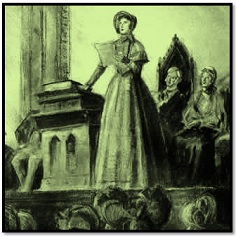
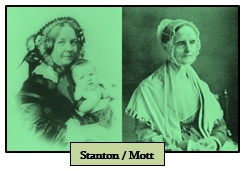
Seneca Falls Speech1. Lucretia Mott and Elizabeth Cady Stanton – Denied the right to participate in the first “World’s Anti-Slavery Convention” in London in 1840, Mott and Stanton decided that if women were to be effective reformers, they’d need more rights themselves. They spearheaded the first “women’s rights convention” on record in Seneca Falls, NY, eight years later.
2. “The Declaration of Sentiments” – Modeled after the Declaration of Independence, this document (read at the convention) declared that “all men and women are created equal” and the “history of mankind is a history of repeated injuries and usurpations on the part of man toward woman.” It’s probably excerpted in the back of your textbook somewhere.

3. Controversy over Suffrage – Stanton was part of a contingent who wanted to push for women to be given the right to vote; Mott and other more cautious activists resisted, fearing it would be so unpopular as to harm their efforts overall. The resolution passed, however, despite having little impact on election laws at the time.

Background

The first half of the 19th century became a time of great social reform across the United States, although most movements were far more active and had much greater impact in the northern half of the young nation than the “tradition”-driven south. Temperance, prison reform, abolition, the beginnings of public education, better care for the mentally ill, and women’s rights were largely intertwined issues – sometimes conflicting but mostly supporting one another. Underlying all of these reform efforts was the idea that society (and the people within it) could be made better.

While men tended to lead most of these reform efforts, women were active in unprecedented ways. It was not unusual for reform-based organizations to vigorously debate whether or not to allow women to speak at their meetings or on their behalf publicly, weighing principle against the practical impact. Any group risked losing potential allies and essential support should they so brazenly defy social and political norms.

Elizabeth Cady Stanton, who was a Quaker, and Lucretia Mott, who was not, were part of a group who travelled to London to take part in the first World’s Anti-Slavery Convention. While allowed to attend, they were forced to sit in the balcony and could not speak or participate. The decided that if women were to have meaningful impact in various other areas of reform, they would first need a little social and political efficacy of their own.

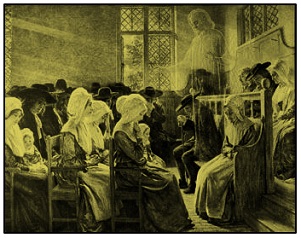
Quakers Being QuakersThe Quakers believed in the “priesthood of all believers,” a particularly Protestant sort of Protestantism which meant the church as an institution went easy on the doctrinal details or authority of the clergy and heavy on the relationship with Jesus and personal Bible study. Their belief in the value of all individuals meant they were some of the earliest abolitionists and tended to be strong proponents of women’s rights. There was thus considerable support for the idea of a “women’s rights convention” from Quakers – both women and men – in the Seneca Falls area.
The Convention

The first day was intended to be exclusively for women, with men admitted on the second. Some women arrived with their children – of both sexes – and a few dozen men who hadn’t gotten the memo showed up as well. They were allowed to attend with the understanding they’d not interrupt or cause shenanigans.

Day One was largely devoted to the reading and discussion of the Declaration of Sentiments. A few changes were adopted, and it was voted on and approved by the Convention. The women then discussed a series of “resolutions” composed by multiple organizers by largely edited and finalized by Stanton. They said things like –

Resolved, That woman is man’s equal–was intended to be so by the Creator, and the highest good of the race demands that she should be recognized as such.

Resolved, That the women of this country ought to be enlightened in regard to the laws under which they live, that they may no longer publish their degradation, by declaring themselves satisfied with their presentposition, nor their ignorance, by asserting that they have all the rights they want…

Resolved, That the same amount of virtue, delicacy, and refinement of behavior, that is required of woman in the social state, should also be required of man, and the same transgressions should be visited with equal severity on both man and woman…

Resolved, That woman has too long rested satisfied in the circumscribed limits which corrupt customs and a perverted application of the Scriptures have marked out for her, and that it is time she should move in the enlarged sphere which her great Creator has assigned her.

Resolved, That it is the duty of the women of this country to secure to themselves their sacred right to the elective franchise…

That last one is the “right to vote” part that caused such a kerfuffle; it eventually passed along with the rest.

Stanton and MottDay Two largely followed up on these same two documents, but with men allowed to participate this time, and there were discussions of other legalities and practicalities. Those present signed the final forms of the Declaration and the Resolutions, and there were more speeches rousing the crowd to action and on towards victory and so on and it was apparently all quite inspirational.

There were numerous other conventions across the north in subsequent months and years, some bigger and bolder, others not nearly as impressive. But the birth of them all was in Seneca Falls, New York, July 19th and 20th, 1848.

You Wanna Sound REALLY Smart? {Extra Stuff}

Mary Ann M’Clintock – Quaker woman whose name should probably join Stanton’s and Mott’s when discussing the organization and successful running of this major undertaking. M’Clintock hadn’t gone to London, but she was an active abolitionist and part of the earliest conversations in which the convention moved from “idea” to “goal.” Several of her daughters were involved as well, and her home was the site of several extensive planning sessions leading up to the convention. The original Declaration of Sentiments was drafted in her parlor and presumably with her input along with a small handful of other women present. She was voted Secretary of the Seneca Falls Convention and her husband, Thomas, served as “chair” for several sessions in which both men and women were in attendance.

Frederick Douglass – Former slave turned author, orator, and abolitionist, and who was the only African American of either sex to attend the Seneca Falls Convention. When the controversial issue of women’s suffrage was being debated, Douglass spoke in its favor and argued that he should not receive the vote unless women did as well. He recognized even then the intertwined natures of women’s rights and rights for Black Americans. It took others a bit longer.

Blame

Blame

You all know this one:

{The Lord} said, “Who told you that you were naked? Have you eaten from the tree of which I commanded you that you should not eat?”

Then the man said, “The woman whom You gave to be with me, she gave me of the tree, and I ate.”

And the Lord God said to the woman, “What is this you have done?”

The woman said, “The serpent deceived me, and I ate.”

Genesis 3:11-13 (NKJV)

It’s the first story from the first book generally agreed upon as sacred by the world’s most populous religions. In it, people screw up and quickly sacrifice their most important relationships out of selfishness, shame, and resentment. I don’t know whether the story of Adam and Eve and their Slytherin friend actually happened; I am certain, however, that it’s true.

Don’t worry – I’m not going to go all theological on you. But whatever else the Bible is, it’s a penetrant guide to our mortal hopes, fears, and foibles. It’s the ultimate anthology of sin and salvation, leaving us to debate only the details and the extent to which it should be taken literally.

Let’s fast forward a few chapters. Turns out the “blame” theme doesn’t end with humanity’s banishment from Eden:

Sarai said to Abram, “See now, the Lord has restrained me from bearing children. Please, go in to my maid; perhaps I shall obtain children by her.” And Abram heeded the voice of Sarai. Then Sarai, Abram’s wife, took Hagar her maid, the Egyptian, and gave her to her husband Abram to be his wife… So he went in to Hagar, and she conceived. And when she saw that she had conceived, her mistress became despised in her eyes.

Genesis 16:2-4 (NKJV)

When authors repeat a theme with minor variations, they’re trying to tell you something. Great literature does it, Broadway musicals do it, even sitcoms do it. Two stories, melodies, or wacky conflicts weave around one another, each echoing and expanding the other. The parallels between this passage and the account of mankind’s initial fall are striking – as are the differences. 

The right clergyman could preach a Venn Diagram of these for a straight month.

Then Sarai said to Abram, “My wrong be upon you! I gave my maid into your embrace; and when she saw that she had conceived, I became despised in her eyes. The Lord judge between you and me.” So Abram said to Sarai, “Indeed your maid is in your hand; do to her as you please.” And when Sarai dealt harshly with {Hagar}, she fled from her presence.

Genesis 16:5-6 (NKJV)

As in the Garden, no one wanted to own their role in the problem. As in the Garden, none of those involved (among the humans, anyway) was entirely blameless or maniacally evil. Let’s be honest – hanging such pretty fruit nearby and naming it something like “Eternal Life” was just begging for the newbies to fail. And leaving Abram hanging for so many years after promising him so much? Men have certainly boinked around with less cause throughout history. Heck, IT WAS HIS WIFE’S IDEA.

In her defense, her entire value as a woman was on the line, and she’d been faithfully following his magical voices for a decade or so without payoff. Maybe it was time to give things a nudge? (You may remember an old joke about a man who waved off two boats and a helicopter because he believed God would save him from the flood. The twist is that those rather mundane earthly solutions WERE his promised salvation.)

Abram, Sarai, and Hagar all had good reason to be confused – perhaps even frustrated. But like many of us, each had difficulty owning their choices – their efficacy. Any genuine search for truth or improvement has to begin by accepting one’s own fallibility and ignorance. It takes humility to learn from mistakes – our own or those of others.

Sarai: “This is on you, Buddy!”

Abram: (*steps back*) “She’s your servant – I’m going to let you sort this out.”

Hagar: “None of this was my idea – I’m outta here.”

One last story. It’s told three separate times in the book of Genesis (chapters 12, 20, and 26) with minor variations.

Abraham (or Isaac) enters a new region and worries how he’ll be treated, especially since his wife is something of a hottie (remember, she still hasn’t had kids at this point). He tells whoever’s in charge that she’s his sister, which is apparently technically true – they’re related in some way. (Translations are tricky for stuff like this, and the original authors had other priorities than making life easy on future historians).

The king takes Sarai (or Rebekah) into his harem, which includes a waiting period during which God intervenes and punishes the entire household for – get this – not realizing they’d been lied to by the people God actually likes much better. This not only preserves the sanctity of the married couple but prevents God from raining down even more severe destruction on the victims of the deception, who are not God’s chosen favorites because they’re the wrong ethnicity and from the wrong region.

It was the Old Testament, people – they were harsher times; you get harsher gods.

But here’s where Abimelech (the deceived party in two of the three versions) approaches things somewhat differently than the protagonists and presumed heroes of the narratives. Having been confronted by God with the truth of the situation, he pleads his case to the Almighty, then takes concrete action:

So Abimelech rose early in the morning, called all his servants, and told all these things in their hearing…

Presumably this was so they could adjust their behavior based on this new information.

…and the men were very much afraid.

You think?

And Abimelech called Abraham and said to him, “What have you done to us? How have I offended you, that you have brought on me and on my kingdom a great sin? You have done deeds to me that ought not to be done.” Then Abimelech said to Abraham, “What did you have in view, that you have done this thing?”

Genesis 20:8-10 (NKJV)

It’s possible Abimelech is simply expressing his outrage. He has every reason to be chafed. But the narrator records his specific phrasing, and if we learn nothing else in English class, we’re inundated with examples of how authors love packing meaning into the subtleties of dialogue and background details.

Abimelech: “How have I offended you? Why would you do this, exactly? Seriously, that was messed up.”

It just seems like a much healthier, more direct way to confront a problem.

Abimelech: “So… best case scenario – what did you think would happen?”

I ask my kids variations of this question all the time.

Abraham’s response is typical of what we’ve already seen from the future Father of Nations:

And Abraham said, “Because I thought, surely the fear of God is not in this place; and they will kill me on account of my wife. But indeed she is truly my sister. She is the daughter of my father, but not the daughter of my mother; and she became my wife. And it came to pass, when God caused me to wander from my father’s house, that I said to her, ‘This is your kindness that you should do for me: in every place, wherever we go, say of me, “He is my brother.” ’ ”

In other words…

Abraham: “It was because of you people…”

Combined with…

“And besides, technically…”

Topped off with…

Abraham: “This was all God’s idea. I’d still be back in Ur chillin’.”

Abimelech’s response is interesting.

Then Abimelech took sheep, oxen, and male and female servants, and gave them to Abraham; and he restored Sarah his wife to him. And Abimelech said, “See, my land is before you; dwell where it pleases you” …

So Abraham prayed to God; and God healed Abimelech, his wife, and his female servants. Then they bore children; for the Lord had closed up all the wombs of the house of Abimelech because of Sarah, Abraham’s wife.

Genesis 20:14-18 (NKJV)

There was no extended rationalizing about what happened – no recorded complaints about the completely bogus way accountability was doled out – no lingering bitterness over the cost or headache. Abimelech had a kingdom to think of – a people to lead. He couldn’t afford to be defensive or small because he had responsibilities. Relationships. A role to fulfill.

I may infer too much, but Abimelech sounds like someone comfortable enough with who and what he is that he has little use for blame. Honesty, sure. Accountability, absolutely. But finger-pointing and petty denials? Nope. Sorry. More important things to do.

Even when he’s the one getting screwed over – unlike, say, Adam. Or Sarai. Or Abraham.

I think there’s a lesson here for classroom leadership and our relationships with difficult students, peers, or parents. I fear there’s a much larger lesson regarding my approach to society and politics.

If I’m comfortable with who I am and what I’m doing, what does that change about how I confront criticism? Opposition? Betrayal? Confusion? Is the priority fulfilling my role or defending my record? When should we pursue more complete accountability and when is it best to simply say, “here’s what I’ve got; dwell where it pleases you”?

I’m not sure I know enough to be more specific or better gage the extent to which we should take such things literally, but I know it’s on my mind and that it’s probably important. 

Then again, it’s not like I can help it – you’re the ones reading and egging me on. If anything, this is all your fault. Let God be the judge!

RELATED POST: Jonah’s Education

RELATED POST: It’s Not About Them (It’s About Us)

RELATED POST: Obedience School

John Ross vs. the 1835 Treaty of New Echota (from “Well, OK Then…”)

NOTE: I’m revising and reorganizing much of the content from “Well, OK Then” as part of an overall effort to ‘clean up’ this site. This post is one of those newer, better versions of something previously shared.

Chief John Ross was a “mixed-blood” Cherokee who nevertheless became the best-known and arguably the most effective tribal leader of his generation. His supporters tended to lean traditional – they were conservative, and old-school – wanting little or no contact with whites and uninterested in their version of “progress.” 

Because he would not agree to voluntary removal, the U.S. found others in the tribe who would. They plied them with land and money and the argument that this was going to happen one way or the other – so they might as well make it as painless as possible. The signers of the Treaty of New Echota (1835) violated the most sacred of Cherokee laws while lacking the status to even speak for the tribe to begin with. 

Ross was not impressed, and wrote this to Congress on September 28th, 1836:

It is well known that for a number of years past we have been harassed by a series of vexations, which it is deemed unnecessary to recite in detail, but the evidence of which our delegation will be prepared to furnish…

{A} contract was made by the Rev. John F. Schermerhorn, and certain individual Cherokees, purporting to be a “treaty, concluded at New Echota, in the State of Georgia, on the 29th day of December, 1835, by {U.S. Commissioners} and the chiefs, headmen, and people of the Cherokee tribes of Indians.” A spurious Delegation, in violation of a special injunction of the general council of the nation, proceeded to Washington City with this pretended treaty, and by false and fraudulent representations supplanted in the favor of the Government the legal and accredited Delegation of the Cherokee people, and obtained for this instrument, after making important alterations in its provisions, the recognition of the United States Government. 

And now it is presented to us as a treaty, ratified by the Senate, and approved by the President, and our acquiescence in its requirements demanded, under the sanction of the displeasure of the United States, and the threat of summary compulsion, in case of refusal… 

Chief Ross knew his facts and his audience. He wastes little energy on extraneous issues or the details of past problems. He goes straight to what is essentially contract law – and accuses the U.S. of making a fraudulent deal. Abusing Indians might not have been all that un-American, but bogus contracts were certainly close. 

By the stipulations of this instrument, we are despoiled of our private possessions, the indefeasible property of individuals. We are stripped of every attribute of freedom and eligibility for legal self-defence. Our property may be plundered before our eyes; violence may be committed on our persons; even our lives may be taken away, and there is none to regard our complaints. We are denationalized; we are disfranchised. 

Ross doesn’t talk about the land, or his people’s culture, etc. He doesn’t badmouth the individuals who signed the Treaty of New Echota, beyond indicating they had no right to do so. 

He instead highlights elements of the situation which were more likely to resonate with his audience. After establishing the invalidity of the treaty, he argues that it violates their property rights. Few things were more sacred to real Americans. John Locke argued that protection of property – which he defined as “life, liberty, and estate” – was the sole function of government. Jefferson replaced “estate” with “pursuit of happiness,” but lest there be any confusion, the Fifth Amendment specifically defends “life, liberty, and property” from government intrusion without “due process.”

Which this, clearly, was not. 

Ross then throws in freedom (liberty), the right to defend yourself before the law, and personal safety. Those are the big three – life, liberty, and your stuff. They’re held together by the underlying assumption that such “natural rights” are every man’s refuge in a nation built on such ideals. 

It’s a brilliant approach. He has facts and reasoning on his side. Unfortunately, facts and reasoning weren’t going to decide this issue – the results were determined before he’d even bought his ticket. The U.S. was concerned only with rhetorical cover at this point. The Treaty gave them that – they knew damn well it wasn’t legitimate… they just didn’t care. 

Ross does speak to the ethical abhorrence of the situation, albeit briefly:

We are deprived of membership in the human family! We have neither land nor home, nor resting place that can be called our own. And this is effected by the provisions of a compact which assumes the venerated, the sacred appellation of treaty.

We are overwhelmed! Our hearts are sickened, our utterance is paralized, when we reflect on the condition in which we are placed, by the audacious practices of unprincipled men, who have managed their stratagems with so much dexterity as to impose on the Government of the United States, in the face of our earnest, solemn, and reiterated protestations.

Then, like a good five-paragraph essay, he repeats his main point by way of conclusion. 

The instrument in question is not the act of our Nation; we are not parties to its covenants; it has not received the sanction of our people. The makers of it sustain no office nor appointment in our Nation, under the designation of Chiefs, Head men, or any other title, by which they hold, or could acquire, authority to assume the reins of Government, and to make bargain and sale of our rights, our possessions, and our common country. 

And we are constrained solemnly to declare, that we cannot but contemplate the enforcement of the stipulations of this instrument on us, against our consent, as an act of injustice and oppression, which, we are well persuaded, can never knowingly be countenanced by the Government and people of the United States… 

{We} appeal with confidence to the justice, the magnanimity, the compassion, of your honorable bodies, against the enforcement, on us, of the provisions of a compact, in the formation of which we have had no agency.

It’s almost like he thinks governmental power is derived through the consent of the governed. “No removal without representation!”

Not really very catchy, I guess. 

Ross’s complaints would fall on deaf ears. The powers-that-be had already undermined Cherokee sovereignty via two Supreme Court cases. In the first one, Cherokee Nation v. Georgia (1831), the Court refused to hear the actual case – a complaint by the Cherokee that the State of Georgia kept passing laws which infringed on their guaranteed sovereignty within their own boundaries. The Court determined that the Cherokee certainly weren’t American citizens, but neither were they exactly a sovereign nation – at least not any more. Their relationship with the U.S. was like that of a “ward to its guardian.”

In other words, they were Dick Grayson to America’s Bruce Wayne. And they would never turn 18 in the eyes of the law. 

The second case was brought by a white guy – a missionary to the Cherokee by the name of Samuel Worcester.  Georgia had passed a law requiring non-Cherokee to get permission from the state before going onto Cherokee land – without bothering to include the Cherokee in the process. Worcester ignored the prohibition and kept doing his thing, and was arrested and jailed. In Worcester v. Georgia (1832), the Supreme Court declared that only the federal government could deal with the tribes – Georgia couldn’t do that.

The decision was considered a victory for the Cherokee, but it didn’t really change anything. President Jackson is often quoted as having said “Marshall has made his decision, now let him enforce it!” There’s no record of such as statement, but it was certainly consistent with Jackson’s general attitude towards the Court, the Natives, and anyone else who disagreed with him about anything ever. 

The Court’s decision did not, in any case, shape or limit anything Jackson or Congress chose to do in relation to the Tribes thereafter. That the other two branches could ignore such a decision with impunity was a pretty clear indication of the status of a bunch of “savages” vs. the segment of “all men” actually represented.

So it’s 1836 and the Treaty of New Echota has been signed, by influential Cherokee if not by those actually authorized to do so. Stand Watie, Major Ridge (it’s a first name, not a title or rank), Elias Boudinot, and others, led nearly 10,000 of their countrymen to Indian Territory. 

This was NOT the “Trail of Tears.” This was the “voluntary” part, more or less. It was several years before the remaining Cherokee were rounded up by force and driven to join their people far to the west. The suffering on this journey is well-documented and not one of the prouder moments in U.S. History. 

The later arrivals, after so many months of death and suffering, were not particularly happy to see their earlier counterparts, already established in what would later be known as “Oklahoma.” The signing away of their lands wasn’t received much differently than if they’d offered up a few hundred of their virgin daughters for debauchery and eventual beheading. It was not only wrong, it was specifically against Cherokee law and carried the strongest possible consequences. 

Several of the leaders of the “Treaty Party,” whose names had validated the removal treaty, were assassinated on the same night, not long after the remaining Cherokee arrived. It’s assumed that John Ross was behind this, or at the very least was aware of it before it happened, but no one knows for sure. 

Whatever the justice or injustice of this decision, it isn’t the sort of thing that smooths transitions or promotes unity. The tensions weren’t new – full-bloods already tended to be pretty conservative while mixed-bloods were far more receptive to change and some elements of white culture – but this didn’t help. These same divisions will reappear in less than a generation when the white guys start dragging the Five Civilized Tribes into their “Civil War.”

It’s worth noting that the time period between Indian Removal in the 1830s and the start of the Civil War in 1861 is considered something of a “Golden Age” for the Five Civilized Tribes. This might be partly a sort of historical “spin” to offset white guilt over removal, but it’s not without merit.

The Tribes had brought their Black slaves with them to Indian Territory. The story of slavery among the Five Civilized Tribes is a whole other tale, but the short version is that by and large, slavery among the Tribes was far less onerous than that practiced by white southerners. Slavery is still slavery, of course, but it generally lacked the malice and violence brought to mind when discussing early American history. 

For a quarter of a century, then, the ‘Red Man’ and the ‘Black Man’ lived in relative peace and quiet in Indian Territory. They rebuilt their governments, their schools, their presses, their churches, and their lives. They learned to adapt to the realities of this new territory and enjoyed a rare generation free of white interference. 

Until that war thing, at least. Once that started, it was all pretty much downhill for the Cherokee and every other “civilized” tribe. For good.