
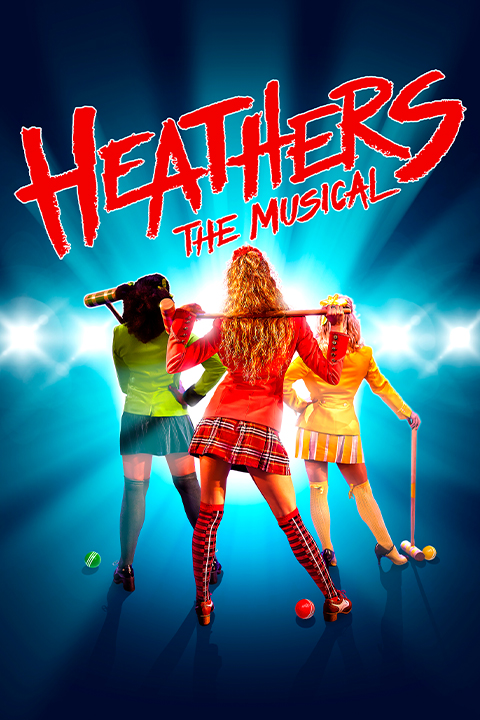
Heathers: The Musical

Heathers West End Promo

But I know, I know, life can be beautiful.
I pray, I pray, I pray for a better way
If we changed back then, we could change again
We can be beautiful…
Just not today.
(“Beautiful,” from Heathers: The Musical)

I’ve been fixated on Heathers recently, probably because the musical version has been revived and is currently running in London’s West End. Many of you no doubt remember the 1989 movie starring Winona Ryder and Christian Slater, a film which sparked an undying love for Doris Day (“Que Sera Sera… whatever will be, will be…”), even though she didn’t sing the version used in the film, and which elevated Shannon Doherty to a level of pop culture credibility even Beverly Hills 90210 couldn’t destroy.

Not long before we left Oklahoma, I came across a promo for Heathers: The Musical being staged by a local troupe at the Tulsa PAC (in, um… one of the ‘smaller’ theaters hidden within). My wife and I went, and while she was underwhelmed, I was immediately hooked. This was one of the darkest, most joyful, shameless, full-of-hope productions of anything I’d ever experienced.

Also, there was a rather clever song about testicles which shouldn’t have worked, but totally did. Kudos to the lads who managed to sell THAT one musically and comedically.

It turns out the show had run Off-Broadway for several years to mixed reviews, starting way back in 2014. Much like the movie, it’s a dark comedy which exploits murder, suicide, homophobia, and teen sexcapades (including attempted date rape) for laughs alongside an almost preachy sort of moralizing. Apparently not everyone loves that.

Come back girl, now don’t play hurt – if  you don’t want me starin’, why you wearin’ that skirt?
We can’t be tamed and we can’t be blamed; it’s all your fault that we’re inflamed!
‘Cause once, you were grody and grotty – now you’ve got a body like a Maserati!
Stroke my fur, make me purr! Hey! You wanted to be popular!
You’re welcome – look where you are…
You’re welcome, come get your football star!
You’re welcome – you’ve joined the pros.
Once we squeeze you, you’ll stay squoze.
You’re welcome!
(“You’re Welcome,” from Heathers: The Musical)

For the record, our protagonist escapes that particular situation then murders them both. But, you know… in a fun way.

Dark or not, the messaging of the various musical incarnations is far more overtly positive than the film. Veronica (the protagonist, played by Winona Ryder in the original) is less bad-ass and more earnest, and several supporting characters come across more sympathetically than they did without all the singing. Some of the songs have to grow on you, but are generally at their best when overly ambitious. That ‘shamelessness’ I referenced earlier applies to the sunshiny bits as much as it does the dark humor – and in my opinion, somewhat sanctifies itself in the process.

I don’t seem to be entirely alone in this assessment. Not only is the show doing quite well in London at the moment, but it’s managed to remain oddly popular with high school drama classes and other local-type thespians. Demand was such that the creators eventually produced a separate, PG-ish version for use in settings where repeated uses of f-bombs and slang for various sexual organs might prove distracting. Clearly there’s something about this show that speaks to the high school experience powerfully enough that drama teachers around the country keep going to their principals to explain why they’re inviting parents to a production with such a high mortality rate and a liberal use of language which under normal circumstances could get you suspended for bullying (or arrested for hate crimes).

There are also several English-as-a-second-language versions out there that will really rock your afternoon, if you’re so inclined.

That said, it’s certainly not everyone’s cup of pathos, and I won’t take it personally if you end up not loving it in the same way. (My wife and I don’t agree about this movie or this musical at all, but we seem to still be getting along OK. Love means learning to accept that sometimes she’s just plain wrong about big, important things.) What’s more interesting to me at the moment is why this particular musical resonates with me as strongly as it does.

I’m reasonable enough to recognize that despite the passion of its fans, this show is no Waitress, Hamilton, or Something Rotten. So what is it that keeps me searching YouTube for poor quality videos of high school productions or sketchy rehearsal footage from abroad? Why have I twice spent actual money for bootlegs not nearly as good as what I can find online for free?

I think it’s all that scarred, broken, but ubiquitous hope shining out through the sleaze.

Now, I say my boy’s in heaven, and he’s tanning by the pool.
The cherubim walk with him and him, and Jesus says it’s cool!
They don’t have crime or hatred, there’s no bigotry or cursin’ –
Just friendly fellows dressed up like their favorite Village Person!
Well, I used to see a homo and go reachin’ for my gun –
But now I’ve learned to love – I love my dead gay son!
(“I Love My Dead Gay Son,” from Heathers: The Musical)

More specifically, my affection for this twisted musical stems from three basic sources…

First, there’s the whole “high school is brutal and terrifying” element which runs throughout. Even the popular and powerful kids are full of fears, insecurities, and foibles. We all know this – it’s not exactly news. But it’s portrayed so vividly here that it plucks my little educator heartstrings. While handled differently, it reminds me in many ways of the first three seasons of Buffy, the Vampire Slayer. In that world, typical high school struggles manifested as literal monsters for Buffy to, um… “slay.” In Heathers, those same struggles are simply hyperbolized, making the execution of various antagonists a bit harsher than watching Sarah Geller stake demons, vampires, or those rubbery fish-boys who ate the school nurse.

Either way, however, it’s worth remembering that when you’re seventeen, the stuff that’s happening to you in the cafeteria or at the dance may genuinely be the WORST thing that’s ever happened in your life to that point. Minimizing high school trauma – like belittling high school relationships – is ignorant and elitist. I’d also argue that when it comes to artistic expressions of that trauma – be it Sixteen Candles or Carrie – it’s important to recognize the difference between hyperbolized fiction and actually promoting homicide or romanticizing death. It’s art offering commentary on life… not a documentary or public service announcement. (You can tell by all the singing and the way the actors dress differently to play multiple roles.)

Deep inside of everyone there’s a hot ball of shame
Guilt, regret, anxiety – fears we dare not name
But, if we show the ugly parts that we hide away
They turn out to be beautiful by the light of day!
Why not shine, shine, shine a light on your deepest fears?
Let in sunlight now and your pain will disappear!
Shine, shine, shine – and your scars and your flaws
Will look lovely because you shine!
(“Shine A Light,” from Heathers: The Musical)

Second, I love the idea that hope and acceptance and making life suck less often means the most when done by messed up people in small, inadequate ways. I don’t think it’s much of a spoiler (it’s been over thirty years, after all) to reference the famous ending of the 1989 movie in which Veronica invites Martha (an outcast who botched her own suicide attempt) to rent some movies and make microwave popcorn. The musical closes on a similarly humble note. The massive celebratory group number is effectively post-curtain; the actual denouement (and the antidote to interpersonal horror) is an act of individual kindness and personal refusal to play those reindeer games.

We live in dark times. There are voices still insisting we can change the big problems, and maybe they’re right. It’s worth being reminded, however, that many of the most important things we can do start with much smaller acts. If I were going to start a religion, I’d probably focus on this sort of thing – the feeding, healing, helping, and encouraging of those most marginalized. (It’s a terrible way to take over the world, however, so I doubt it would ever catch on.)

The point is, Heathers – for all its hyperbole and theatrics – is anchored in small, one-on-one human relationships. It’s about the importance of how you speak to people at lunch or how you treat them when they do something embarrassing. These things are huge… because they’re small.

Everyone’s pushing. Everyone’s fighting.
Storms are approaching – there’s nowhere to hide.
If I say the wrong thing, or I wear the wrong outfit
They’ll throw me right over the side.
I’m hugging my knees and the captain is pointing –
Well, who made her captain?
Still, the weakest must go…
The tiniest lifeboat, full of people I know.
(“Lifeboat,” from Heathers: The Musical)

Finally – and I’m not necessarily proud of this one – I like how untethered it is by concerns of propriety or its own potential to offend pretty much anyone. While I’m weary and horrified at the ugliness of our political leaders, religious organizations, and societal spokespeople, I’ve never been able to get too worked up by “offensive” comedians or other artists. I’m not saying I find them all funny or enjoyable, or that I want my tax dollars to pay for crucifixes to get dunked in urine or whatever. There are plenty of people whose comments don’t interest me and whose words or music I find trite and desperate.

Nevertheless, I’m not a huge fan of censoring or shutting down voices I find problematic. Boycott those sponsors and label those lies when appropriate, but I can’t very well throw fits on social media about this or that joke, song, film, or tweet I found loathsome while lamenting the neo-book-burning recently begun by the Republican Party in schools across America. I realize not all speech is constitutionally protected and not all expressions should remain commercially profitable. I’m not ready to tattoo Protocols of the Elders of Zion on my bare butt and run through the mall naked “on principle” – but neither will I discourage true artists from questioning and challenging us via their art.

Plus, I suppose I love a good bit of juvenile snark when well-applied in service of the greater good. And, in the end, that’s what Heathers is all about. Hope in the midst of hell – even when that hell includes high school.

{Minor Update – The London version of Heathers: The Musical is streaming for free on Roku. You don’t have to buy anything or subscribe to anything to watch it. There are some updates to the show which aren’t important for first-timers to recognize, but it’s a high-quality live recording if you’re curious what I’m carrying on about. And just in case your’e wondering, I’m not getting anything out of this. Shockingly, I’m not that central to the British Musical scene.}

8 Lessons For White Teachers In “Urban” Schools

Yo Yo PaI wrote recently about some of the challenges of being an old white guy from a non-descript middle-class background teaching in a high-poverty, majority-minority school. My goal was to be honest about some of the difficulties without veering into whining or – worse – appearing to criticize my kids. Whatever my struggles, they pale (if you’ll pardon the expression) compared to many of theirs.

It’s in that same spirit that I’d like to share some end-of-the-year thoughts for anyone who might find themselves in a similar situation at some point, either as a newbie teacher or as an experienced educator moving into an unfamiliar district. I offer no data, no documentation, and no guarantees – merely hard-won insights based on my subjective experiences.

Still, let’s be honest – I’m much, MUCH wiser than most of those “real” experts, so let’s just assume this list is canon until proven otherwise.

(1) You Don’t Actually “Get It”

My first year here, a veteran teacher (also white) took me aside and told me to read the books and go to the workshops and do everything I could to understand my kids, but to recognize that we’ll NEVER be as “woke” as they are. “You and I will never quite understand what it’s like to be in their worlds, and if you pretend you do, they’ll see right through you.”

This was (and is) good advice, whatever your demographic details. Do the reading. Pay attention to the conversations. Understand the research. But don’t presume you “get it” unless their world was your world first.

(2) Own Your Biases & Assumptions

Repeat this to yourself out loud at least once each day before you head to work: “I may not think so, but I have biases. I make assumptions and form generalities which are sometimes incorrect. This is a natural, human thing to do and doesn’t make me a bad person – but it can hinder my efforts to be a good teacher unless I’m careful. What should I be questioning about my own thoughts or feelings today?”

Here’s an easy example: many of my students like rap and hip-hop (are those even different things these days?) A significant minority, however, prefer K-Pop, 90’s-era grunge, or some other genre not normally associated with “those kids.” If I simply assume they all like rap and hip-hop, it builds unnecessary barriers from something I’d hoped would build connections. Something with a bit more bite: for years, I’ve called students by their last names – “Mr. ___” or “Miss ___” as a sign of respect and an attempt to elevate expectations. Here, this produces outraged reactions and verbal hostility beyond what I ever could have imagined. This is not hyperbole – it’s a very consistent reaction among 90% of my students when I slip up and forget. Whatever my intentions, it simply doesn’t mean to them what I think it should mean – so I adjust. 

It’s actually not that difficult to avoid egregiously offensive stereotyping (assuming you’re not clueless or a complete tool). It’s the little things that catch you off guard and trip you up. Even if you don’t offend or horrify anyone, you’ll feel silly and it won’t do much for that whole “rapport” thing you’re going for.

(3) You Need Thick Skin.

This is true of teaching in general, but (as I wrote about a few weeks ago) broken kids tend to radiate anger and hurt and fear and other emotional concoctions I can’t even properly identify.

It’s fairly rare in my building for a kid to lash out at a teacher directly. I’ll get “attitude” or the occasional snub when attempting to speak to someone (usually from kids I don’t actually have in class, and thus with whom I have little or no relationship). From time to time a student will unexpectedly dig in on something small and escalate the situation past what seems reasonable, but these are separate events to be managed – not an ubiquitous feature of the environment.

In my experience, it’s the sheer volume and intensity of the unspoken emotions which can be crippling. I don’t want to sound overly mystic or touchy-feely, but the real challenge isn’t usually specific kids with specific attitudes, expressions, or behaviors I can identify – it’s the intangible waves of doubt and anger and injustice and posturing and uneasiness.

(4) Be Consistent (Within Reason)

This is a biggie in almost any classroom situation, but I’d argue it’s exponentially more important with kids from broken backgrounds and disenfranchised demographics. If you’re strict about the rules, be the same level of strict every day, with every student, as best you can without obvious harm. If you’re lax about late work, be the same amount lax throughout the year whenever feasible. Perhaps most importantly, leave your personal emotions in the car and be the person they need you to be no matter how you really feel that day.

Teenagers in general have an exaggerated sense of injustice – and my kids take this to whole new levels. They also tend to take things far more personally than other groups. Let a teacher be absent for a few days without providing a good reason (in the eyes of their kids) and even the students who don’t like them begin wrestling with abandonment issues. Speak more harshly than you intend or overlook a question in the middle of a chaotic moment and you might as well have slapped them right in the id.

This doesn’t mean you can’t hold kids accountable or that you should never adjust based on circumstances. Just remain aware of anything which might be perceived as “unfair” and be prepared to justify it to yourself, your kids, and anyone up the chain.

(5) Don’t Expect Consistency In Return.

This, too, can be a “teenager” thing no matter what their demographics. It seems far more volatile with my current kids, however, than with groups I’ve had in the past, not just in terms of attendance, behavior, or academics, but emotionally as well. It’s like they’re controlled by dozens of internal game show wheels constantly being re-spun to see what comes out next.

I have a young lady who rarely (if ever) makes the slightest attempt to participate in anything educational. She’s not always disruptive, but neither will she go through the motions with us just to be cooperative. When I make an effort to speak to her during more relaxed moments (just as I do with most kids from time to time) she’s often resentful, bordering on rude. On the other hand, when I leave her alone for more than a day, she asks me why I’m “ignoring” her and sounds genuinely offended.

Today after school, a young man I don’t remember ever seeing or speaking to saw me in the hall, called my name, then gave me a quick combination fist-bump-bro-hug-finger-snap-something that caught me completely off guard. I think I hid my surprise pretty well, but I still don’t know what I did to earn the exchange.

(6) Be Kind (Not Soft)

Some groups respond well to sarcasm and abuse as a love language. I was brutal to my suburban freshmen (of all colors), but no matter how cruel I managed to be, they ate it up and decided it made us “tight.” My current kids can be quite ugly with one another without seeming to take it badly, but I know instinctively (and without any doubt) that it would be a terrible idea for me to join the dozens. I can be a good teacher and develop productive relationships with my kids without sharing the dynamics they have with our security team (all of whom are Black) or some of the other staff. It’s not about me proving anything or earning “wokeness” bonus points; it’s about what’s best for the kids in front of me. 

I’ve raised my voice to a full class a few times throughout the year when necessary to get their attention, but it’s my conviction that there are few – if any – situations in which an old white man yelling at individual students of color will lead to better outcomes. Maybe it’s the mamby-pamby liberal in me, but I just can’t stomach it. Plus, I’m not sure anger or hostility (no matter how strategic) is particularly effective with any demographics, at least these days. Maybe they never were.

Be firm. Follow through on consequences. Expect the best. But recognize that the sort of posturing or emotional responses which might be excusable (if not ideal) in other circumstances may do irredeemable damage to your relationship with those already marginalized – and possibly to the kids themselves.

(7) Don’t Patronize

Under no circumstances should you try to be cooler or hipper or more “down with the kids” than you truly are. If you actually play that video game, love that album, or eat that food, then bond away when situationally appropriate. But dear god, PLEASE don’t try to use slang you don’t fully understand or emulate speech patterns which are not your own. I’m not suggesting you have to maintain a commitment to the Queen’s English or refuse to learn their language in order to improve communication; I’m merely pointing out what a bad idea it is to be disingenuous – however noble your intentions.

They’ll eventually explain to you anything you’re not understanding about their slang or their approach. Enjoy those moments, but don’t think they free you up to make a fool of yourself.

(8) It’s Not Personal.

As with much on this list, this is a good thing to keep in mind with any students in any situation, but it’s particularly apt with underserved kids. Some days, you’ll feel like you’re making progress and developing some good communication; the next day, they want nothing to do with you or your (seemingly) pointless lessons. If you rely on positive interactions to sustain you, you’ll find yourself deflated by negative feedback or disengaged days. There’s a messy balance between “reading the room” enough to adjust what you’re doing for maximum effectiveness and the need to simply push ahead with what you know to be right even when they’re giving you nothing to draw on.

Keep talking to your peers (the good ones, anyway). It’s OK to vent as long as you soon come back around to the things in your control and your professional and ethical commitments to figuring out what’s best for the young folks in your care – whether they love it or not. Don’t be afraid of asking for help with uncomfortable issues, but neither should you assume that every awkward moment or frustrating interaction is about race, or poverty, or culture, or whatever. Sometimes teaching is just weird and people are just complicated.

Especially teenagers.

RELATED POST: A Leap of Well-Intentioned Delusion

RELATED POST: Of Assumptions and Performative Wokeness

RELATED POST: Why Don’t You Just MAKE Them?

Zod Wallop

Zod Wallop Cover & Link

The wedding was held outdoors. An April sky darkened and gusts of wind, like large, unruly hounds, knocked over folding chairs and made off with hats and handkerchiefs. A bright yellow hat went sailing over the lake, cheered on by two small children.

Ada Story said to her husband, “I told Raymond this was not the season for an outdoor wedding.”

Her husband, who was watching a black cloud race toward him as though it had singled him out and intended some mischief to his new summer suit, replied: “I don’t know how you’ve lived this long and missed it, Ada. Our Raymond isn’t interested in traveling the highway of our advice.” Their son did march to his own drum, particularly when he was refusing to take his medication.

Mrs. Story sniffed and lifted her face to the darkening heavens. I hope they hold off, she thought. In case her own mind might misinterpret her thoughts, she added, The rain clouds, I mean. I hope the rain holds off.

All the chairs were filled with the wedding guests now, and there was, really, something exciting in the prospect of so much finery exposed to the elements. The riskiness of life, of all human ventures, was underlined by the first large raindrops and the growl of approaching thunder. The minister’s robes billowed in the winds, and the coming storm seemed intent on editing him, first snatching one piece of paper, then another, and launching them into the air. Reverend Gates displayed considerable dexterity as he darted after his text, and the crowd burst into a flurry of applause when he executed a twisting leap and fetched a loose page that seemed already lost to the lake. No outfielder snagging a bleacher-bound fly ball could have displayed greater style, and since the crowd had no way of knowing that the retrieved paper contained a rather tedious rehash of St. Paul’s thoughts on duty, their enthusiasm was unrestrained.

The Reverend Gates, having regained command of his notes, was giving them the once-over through gold-rimmed spectacles, when a stirring of voices caused him to look up.

A fat man in a tuxedo, perilously perched on a bicycle and pedaling with frantic enterprise, had crested a green hill and was now racing toward the gathering. His speed was disconcerting, but what truly troubled the Reverend Gates was the man’s appearance. He had two heads.

The minister’s rational mind harumphed loudly, but as the cyclist drew rapidly nearer, his two-headedness seemed more undeniable.

In the next instant, Reverend Gates realized that he was looking at a man – now so close that his blue eyes and explosion of brown mustache identified him as the groom, Raymond Story – and a monkey. The monkey, a small, soot-black, frightened mammal, was clutching Raymond’s neck and chattering wildly in the time-honored tradition of a passenger attempting to exert some control over his destiny.

(Excerpt from Zod Wallop by William Browning Spencer)

Zod Wallop is one of my favorite books of all time. It’s the single most engaging piece of fiction I’ve ever read, and remains so each and every time I’ve devoured it. It’s a book about loss and acceptance, innocence and broken people, and a crazy man with a monkey who believes he’s on a holy mission. It’s also about an author afraid of too much truth and withdrawn from human connection because he simply can’t take the harsh reality of personal loss.

In short, it’s one of those books I like talking about at any opportunity. The problem is, few people around me have read it. Most have never even heard of it, other than my carrying on about it. In other words, there’s no one to talk about it with.

If much of my own rhetoric is to be believed, this shouldn’t be a problem. Make your own way! March to your own drumbeat! Don’t go along with the crowd – you do you! Learn to live with who you are! Yay, individuality!

If I’m being honest, I’ve sometimes looked down a bit on folks who watch specific shows or listen to particular music or read certain books just because they’re popular. That’s what’s wrong with modern culture! You’re why the Kardashians happened! Have some dignity, people!

On the other hand, folks who do that get to talk to one another about those shows, that music, and those books. They have a shared Squid Game experience, however tragic I might find that to be. Meanwhile, I’m over here marinating in my own lofty elitism with my far superior music collection and personal library.

Alone.

So there!

Raymond Story cycled down the aisle between the folding chairs and stopped. He dismounted, frowned, and approached Reverend Gates.

“I’ve brought a monkey,” Raymond said, in a matter-of-fact tone that the minister found comforting – for no good reason, really. Raymond looked around, turning in a slow circle, and said, “They can’t influence a monkey.”

The Reverend Gates had known Raymond since the day of Raymond’s birth. The reverend was not, therefore, as unsettled as a stranger might have been under similar circumstances.

“Your mother’s arranged a lovely ceremony,” Reverend Gates said. “All we seem to lack, indeed, is the… ah… bride.” …

A large white van rose up over the hill and bore down on the crowd. Reverend Gates felt his arm clutched tightly and Raymond’s voice boomed in his ear. “Allan has not failed me. We’ll want a short ceremony, Reverend.”

The van spun sideways and lurched to a stop, revealing a blue insignia and the words HARWOOD PSYCHIATRIC emblazoned on its side. The vehicle rested placidly on the grass, and then it began to rock, the sliding door slid open, a ramp lowered to the ground, and someone in a wheelchair, flanked by a half dozen milling shapes, emerged.

“My Queen!” Raymond bellowed, causing the reverend to jump. The sky exploded; the world dimmed under sheets of gray, implacable rain. Umbrellas bloomed.

“Oh dear,” Ada said, as she huddled under her husband’s umbrella. “Wouldn’t you know it.”

She felt her husband’s arm encircle her waist and draw her closer. “It’s only weather,” he said.

Of course, part of the appeal of literature is that it IS company. The right story can be travel, or counsel, or knowledge, or inspiration. When you READ, you’re already talking about the content with at least one other person – the author (or at least the text). You often talk about it with yourself as well. A good book has a way of poking around inside you and making you think about things differently, and maybe feel things differently as well.

One of the primary justifications for including diverse literature in any school curriculum is that fiction promotes empathy. How many people alive in the United States today think and feel as they do about the Holocaust largely because of Anne Frank’s diary or that little boy in the striped pajamas? How many of our perceptions concerning right and wrong in society and government have been shaped by our connections with Boxer in Animal Farm, Piggy in Lord of the Flies, or Katniss Everdeen in The Hunger Games?

I’d never claim to truly know what it’s like to die from cancer just because I loved The Fault in Our Stars, but it’s given me a far better appreciation for the range of ways in which people respond to severe illnesses. I’ve never been Black or female or gay, but I’m a tiny bit closer to being able to connect with and value those who are because I’ve been allowed to become those things in a small, temporary way when I read.

But it’s not just a better understanding of others we often find between exposition and denouement. Many novels, short stories, and other texts mess with our understanding of ourselves as well.

Generations of young American boys grew up believing they could succeed even during hard times because of Horatio Alger books. Generations of high school girls grew up believing that sex with someone hundreds of years older than themselves AND a vampire couldn’t be THAT bad thanks to Twilight. Books force us to recognize ourselves not only in the heroic, but in the shameful. The broken. The desperate. The angry. They let us root for the protagonist even when relating far more closely to the supportive friend, the bewildered parent, or even the antagonist. Good stories shake up what we think, believe, and feel, leaving the solid bits reaffirmed and the shaky bits, well… shaken.

Good friends know when to encourage you, when to distract you, and when to call you out. Literature often does all three at once.

Which brings me back to Zod Wallop. I won’t try to summarize the plot here (you can look it up easily enough), but suffice it to say that it challenges with reckless abandon the distinctions we make between fantasy and reality, conviction and delusion, individuality and connection. The main characters turn out to be inextricably interwoven into one another’s stories for better or worse – and not all of them are thrilled at the realization. It’s not easy to befriend a madman with a monkey who claims to be on a holy crusade, especially when his mission is driven by your own words, feelings, and values (none of which were intended to mean what he insists they must).

And yet… maybe that’s what it takes to return to reality. Maybe we have to accept the unbearable and embrace the unbelievable to get back to living.

Reverend Gates had ceased congratulating himself on his calm. His own umbrella had been wrenched from his hand by the brutish gale. One of the wedding guests offered him an umbrella.

I’m as wet as I am going to get, Reverend Gates thought, and he dismissed the offer with a wave of his hand. His notes were a sodden lump. His white hair, generally a fine, regal mist, was plastered to his skull. He wondered if he looked as bad as the monkey, which had been transformed into a sort of gigantic sodden spider.

The reverend leaned forward, clutching his Bible, squinting through the deluge. Dim figures were coming down the aisle between the twin fields of umbrellas. A giant in a billowing raincoat emerged from the shadowy curtain of rain. He was pushing a wheelchair that contained a gray, hooded figure. A lovely girl, barefoot and wearing a white, one-piece bathing suit, walked beside the wheelchair, one hand casually resting on the occupant’s cloaked shoulder. She wore a white terry cloth headband into which bright yellow daisies had been tucked. The effect was oddly elegant. She smiled, pushed a strand of black hair from her cheek, and looked up at the minister who, disconcerted by the candor of her gaze, retreated into austerity, motioning them to move forward quickly.

“My beloved approaches,” Raymond said. “Like the sun.”

Reverend Gates glanced at Raymond, whose round face was slick with rain. Raindrops danced on the young man’s rain-glued hair, creating a silver halo. His eyes seemed unusually blue and bright. God, Reverend Gates thought (and not for the first time), had hugged this boy too tightly. …

The past several years have not been great ones for me. We all know the externals – the pandemic and the Trump years and the disappointment of watching friends and family embrace fascism and white supremacy in the name of an unrecognizable Jesus and a mythologized American past. I haven’t had it any worse than anyone else, and I’m sure my life was and still is far easier than many. I am either blessed or lucky, depending on your point of view, and I recognize this daily.

But I haven’t handled things very well. I bailed on most social media not because of my lofty principles, but because I didn’t like who I was when handed that microphone. I’ve drifted away from most of the folks skilled at tolerating me in real life. A spot of unpleasantness a few years ago completely derailed how I thought of myself as a teacher and a colleague, which in turn forced me to realize how heavily I’d been leaning on those elements of my identity to prop up pretty much everything else.

I still believe much of the rhetoric we throw around about the impact teachers can have on students, but those kites need string and someone with a good grip and their feet firmly planted on the ground. That was no longer me.

Things have gradually gotten better, but I don’t think I’ll ever feel about teaching, or being part of a community, or the supposed “calling” behind the profession, the way I used to. At the same time, I’ve probably spent too much energy soaking in the resentment and self-loathing of it all. I don’t believe in avoiding or denying unpleasant emotions or uncomfortable realizations, but that doesn’t mean we have to marinate in darkness forever.

Just ask Wanda Maximoff, amiright?

I think it’s time for me to read Zod Wallop again. It’s not a perfect novel, and it’s certainly not a holy book or a magical cure for anything, but it is a wonderfully manic fantasy which wrestles with the road back from isolation and anger and other very dark places through faith and passion and existential leaps into uncertain possibilities. By taking readers into a world of impossible events and unlikely characters, it circumvents our usual defenses and surprises us with just how much of ourselves we find there. Spencer shakes things up enough that by the time we land at the end, there’s a good chance we’re a bit better off than we were when we started.

Maybe we’re a bit better, period.

If Zod Wallop isn’t the book that does that for you, there are other titles out there. Lots of them. Whatever madness remains to be faced, collectively or personally, none of us have to do so alone. Grab a good book and hold on tight.

Harry listened. And remembered how Amy had giggled. “Daddy, a tree doesn’t grow in a flash,” she had said.

He had read the beginning of this book to her. He remembered now. He had been writing it before Dr. Moore had urged him to write. Yes. He had been telling the story and he had stopped when Amy died.

Harry ran out of the room. The grim hallway was littered with bodies. Some dark, furred thing the size of a large dog snuffled amid the corpses. It heard Harry’s approach and turned, regarding Harry with three small, red eyes. Harry snatched one of the glowing orbs that lighted the hall and threw it at the wall above the creature. The ball exploded with a cascade of arcing light and the creature grunted and lumbered away.

“Harry, wait!”

He turned and saw Jeanne coming toward him, golden, wending her way through the gore of shattered bodies.

“Go back!” Harry shouted.

“No.”

He waited then. She took his arm. “You’re going down to the ocean, aren’t you?”

“I have to,” Harry said.

Jeanne turned him and looked in his eyes. He saw them as he had never seen them before, not fearless – fear was certainly there – but filled with conviction, clear, dark, as luminous and mysterious as the universe itself.

“We have to,” Jeanne said. “We.”

Rabbit Trails: Cecil Rhodes and the Moral Complications of… Everything

NOTE: I’ve been playing with ideas for a future “Have To” History book, tentatively titled “Who In The World?” The premise would be to tackle major events and issues in world history through a series of brief narratives or biographies of world figures whose names may sound vaguely familiar but who aren’t the “A-listers.” Cecil Rhodes certainly fits that bill, but I’ve been having trouble narrowing down what to include and what to cut from his story. The draft I’m sharing today demonstrates both the potential of using biography as an anchor for larger themes and issues and the dangers of the rabbit trails which naturally result from this approach. I doubt most of this will make it into the final version, if such a thing should one day come about.

Cecil RhodesCecil Rhodes potentially represents many things in world history. In doing so, he reminds us of the futility of attempting to categorize our forebears into “good guys” and “bad guys.” Rhodes was… complicated. It in no way excuses the wrongs for which he was responsible for us to recognize and appreciate the laudable elements of his story. If anything, it reminds us that in the right circumstances, most of us are quite capable of being both swell and abhorrent – sometimes within a very short time frame.

As Marvel comics (or the Bible) figured out long ago, our heroes often have an unpleasant feature or two, while the nastiest villains may retain smatterings of graciousness, talent, or good intentions of the sort we’d much rather be reserved for someone more likable – hence the endless debates over whether or not the Declaration of Independence is forever tainted by Thomas Jefferson’s record as a slave owner or when it’s appropriate to spill tea on Nelson Mandela or Martin Luther King, Jr. Personally, I’ve always found flawed heroes to be far more inspirational and complicated villains far more illuminating. Few of us can aspire to be as flawless as Superman of Gandhi as commonly presented. Perhaps, however, we can strive to emphasize the better angels of our nature even as flawed, fallen mortals.

Then again, Rhodes was no Jefferson or Gandhi by any measure, no matter how much grace we choose to employ. Whatever his mitigating intentions or ideologies tied to his times and circumstances, Cecil was in many ways a very naughty man who used and abused those he deemed lesser than himself – which was most people.

Rhodes wasn’t American, but his life echoed a Horatio Alger tale: misfit kid defies all the odds and becomes monumentally successful. He craved wealth and power and exploited both once attained. He believed his race was naturally superior to all others – particularly those native to the continent of Africa, where he made much of his fortune and at one time had two countries named after him. He used his wealth and political power to fight for the protection of the “little people” (of various races). He started a war which wasn’t at all necessary and cost tens of thousands of lives. He believed deeply in British values and culture and the good it could do for the world at large once embraced.

Rhodes was idealistic when it came to British values or the power of education. He left behind an endowment committed to providing opportunities for others like himself to attend Oxford University and carve their own pathway to success, explicitly specifying that “no student shall be qualified or disqualified for election … on account of his race or religious opinions.” At the same time, he pretty much laid the groundwork for what would later be known as “apartheid” across South Africa.

Oh, and he helped make diamonds sacred in western culture, sparking a bizarre conviction (which still lingers today) that unless you cement your relationship with small rocks worth several years’ salary, you’re not REALLY in love.

So, like I said… complicated, despite leaning quite naughty by modern standards.

The Son’ll Come Out, Tomorrow…

And his disciples asked him, saying, Master, who did sin, this man, or his parents, that he was born blind?

Jesus answered, Neither hath this man sinned, nor his parents: but that the works of God should be made manifest in him.

But his disciples muttered to themselves and insisted, that can’t be right. He’s mistranslating the original Greek or something. Can we go back and choose a passage from the Old Testament instead?

(John 9:2-4, Modern American Version)

Cecil Rhodes was born in 1853 in Hertfordshire, just north of London. He was by all accounts a rather “sickly” child – a generic term covering anything from asthma to allergies to lactose intolerance (but stopping short of something major enough to secure accurate diagnosis, like scarlet fever. His father was a clergyman in the Church of England, making the family what we’d today think of as “middle class.”  His older brothers attended what were known as “public schools,” the nineteenth century British equivalent of ritzy private schooling. Cecil, however, was sent to the local “grammar school,” an early version of what Americans today would think of as a decent, local public high school – humble, but still set above any “charity schools” in the area.

When he was sixteen years old, Cecil fell victim to “consumption” – most likely tuberculosis or something similar. This was a fairly severe condition in the nineteenth century and not everyone recovered. As we’ve recently been reminded, serious ailments which prove difficult to control tend to spark socio-political reactions on top of the personal suffering they cause. When people feel frightened or out of control, they tend to embrace explanations which offer them some sort of control or detachment from danger or suffering, reality be damned. Folks in nineteenth century England were no exception.

Like so many nasty things, tuberculosis was (and is) caused by bacteria attacking various organs inside the human body, most particularly the lungs. All that coughing and gagging and spitting up blood helps spread the ailment to fellow humans, making it highly contagious – particularly in crowded households, cities, or anywhere else people live and work together. Biologically, the disease itself was an equal opportunity infector. Rich folks were just as susceptible as the poor, other factors being equal.

But of course, other factors weren’t equal – end therein crept that socio-political dynamic history teaches us to expect. One of the primary benefits of wealth was having a little elbow room, thus reducing the chances of infection to begin with. Your surroundings tended to becleaner and you were more likely to spend time outdoors, further restricting the spread of yucky things.

Correlation, Causation, and the Moral High Ground

Nineteenth century medicine wasn’t quite caught up on the whole bacteria/infection thing, but physicians certainly noted the correlations between nasty conditions and disease. One of the most common treatments, in fact, was to send the afflicted who could afford it to warmer, and thus presumably healthier, locales, where they’d be directed to spend more time outside breathing fresh air and reading epic poetry or whatever. (In Cecil’s case, that meant sending him to South Africa to farm cotton with one of his brothers – but we’ll get back to that in a moment.)

Illness, in other words, correlated with poverty in the sense that poor folks were more likely to live in crowded, unsanitary conditions. Poverty, in turn, often correlated with the sorts of lifestyles upper classes derided as immoral and in constant violation of proper social norms. It’s not always easy to distinguish between difficult circumstances and poor personal choices, then or now.

By way of example, for centuries those paying attention had noted a strong correlation between bad smells and severe illnesses. It was thus reasonable enough to assume that strong odors were actually the source of many ailments. Avoid the nasty scents, and you’d reduce your chances of getting sick.

This “miasma theory” had such staying power because it largely worked. Staying away from gross things will, in fact, reduce your chances of serious illness. More time outside and “socially distancing” from others makes you less likely to take in new germs. Keeping your surroundings clean, eating healthier foods, and getting enough sleep also lower your odds of “consumption.” We can all break out our “correlation does not imply causation” memes, but it wasn’t such a crazy supposition – incorrect or not.

It was thus natural – if unfortunate – that many perceived a strong correlation between poverty and the careless, often “immoral” life choices which accompanied it, and tuberculosis. In other words, the disease took on an ethical component. As is so often the case throughout history, sufferers were thought to be at least partially responsible for their own conditions. If those living better lives, with better educations, and better morals, and better resources, were less likely to contract tuberculosis, then maybe those who did fall ill (or die) were kinda asking for it. Add in a predisposition for divine retribution and eternal justice and whatnot and you get the very human “just-world fallacy.”

Science Progresses; Bias Conserves

And therein lies the problem. (Well, one of them – and a BIG one.) The confusion about the source of illness is problematic from a purely medical standpoint, of course, but that element tends to clear up over time because that’s how science works – explanations are proposed, tested, messed with, and tried out, until refined into better explanations. Lather, rinse, repeat. It’s the oversimplification of the moral and personal factors which proves far more dangerous over time. Nearly two centuries later, and we’re still not fully convinced that poverty and illness aren’t primarily caused by the afflicted simply not being as wonderful as we are.

I mean, it should be obvious – we’ve worked hard to do all the right things, and while it hasn’t been easy, we’re doing OK. Therefore, that’s how things work. Therefore squared, anyone for whom things aren’t working out must not have worked as hard as we have or done as many right things – otherwise, the system is chaotic and random and meaningless and there’s no point to any of it and madness rules eternity.

It’s a tempting bit of reasoning, especially if we work very hard to avoid thinking about it too clearly. (It’s far “truer” when we just kinda “feel” it in the background and don’t over-analyze it.) Such a monumental fallacy goes nicely with some false dichotomy icing and blood-red sprinkles spelling out “EITHER OUR CHOICES MATTER OR THEY DON’T” in an awkward sugary scrawl (and the “DON’T” kinda crammed in at the far edge).   

In any case, “consumption” meant Rhodes was unable to attend the same sorts of schools as his brothers. He was instead sent to South Africa where it was warmer and he could spend more time outside, in this case working on a small cotton plantation with one of those same brothers. It just so happened that something else was going on in Africa at this time – something shinier and more appealing than picking or refining cotton.

Africa had diamonds. Lots of them. Now it simply needed someone with a little vision to make the most of the sparkly beasts.