Helen Churchill Candee & Oklahoma Boosterism (Part Two)

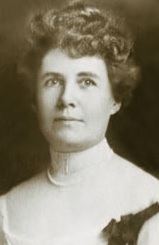
HCC SmallIf for some strange reason you’ve not already read Part One several times already and copied favorite bits onto sticky notes to post around your bedroom and kitchen, I there waxed adoring over Helen Churchill Candee and her first extensive article about life in Oklahoma Territory, published in The Forum, June 1898. She wrote at least three other articles about O.T. in the time she lived there, all very positive towards her temporary homeland but varied in style and focus. 

The shortest of these was published only a month after the Forum piece in Lippencott’s Monthly Magazine (July 1898). Lippencott’s had been around since just after the Civil War and was well-known for its literary criticisms, science articles, and other general-interest-type essays and stories. It’s the magazine which first published The Picture of Dorian Gray (Oscar Wilde) and which convinced Arthur Conan Doyle to write a second adventure (The Sign of the Four) featuring this “Sherlock Holmes” character he’d introduced a few years before.

You get the idea.

Oklahoma Claims” takes a far more narrative format than her other O.T. essays, consisting largely of Candee’s (fictionalized?) account of riding out to a claim with a good ol’ boy named “Ollin” and his “buxom niece,” Leora. It’s dialect-heavy, somewhat humorous, and the closest of the four pieces to almost actually criticizing homesteaders or others in the Territory who took advantage of the system.

As we rode along over the red rutted roads that cross the prairies, Ollin remarked,—

“My woman won’t go to the claim, for she says if I ever get her there she’ll have to stay an’ hol’ it down. But that ain’t so, for we’ve lived there long enough every year to satisfy the law, an’ I’m just about ready to prove up and sell it.”

“That isn’t what ‘Uncle Sam’ gave it to you for, is it? Weren’t the claims given away so that each man could have a chance to provide a settled home for his family, and land enough to support them if well cultivated?”

Ollin’s leathery face wrinkled into a smile; his small blue eyes lost their habitual look of searching, which had been gained through years of prairie work with Indians, outlaws, and herds. 

“Uncle Sam is an awful nice man,” he drawled, “but he’s got to sit up all night to be up early enough for Oklahoma folks. There’s slick ways of holdin’ down claims you’d never dream of…” 

The “hundred an’ sixty” refers to acres, the standard size of a plot under the Homestead Act (1862) and generally followed for homesteads in O.T.  Town lots, of course, were substantially smaller.

”There’s our girl, now,” and he glanced at the bovine maiden, who had, however, a shrewd look in her eyes and a general air of self-possession. “She’s got a claim up in the Strip, but she lives with my woman an’ me. Every two weeks she takes some one with her an’ goes to spend a Sunday. That’s an awful nice way to earn a hundred an’ sixty, ain’t it?”

I’d like to be the kind of reader who goes high road on stuff like “the bovine maiden,” but it’s funny and effective beyond its role as essentially a ‘fat joke.’ It implies much about the niece’s true personality and intellect – not all of it bad, certainly, but largely unflattering. Combine that with “a shrewd look in her eyes and a general air of self-possession” and we’ve got the sort of condensed characterization far more typical of a strong short story than an informational piece. 

Still, we somehow keep getting informed:

“But I thought that the government demanded that a homesteader should improve the land,” I suggested. 

“That’s right. Our girl’s nobody’s fool. She’s let her claim to a family who farms it an’ goes half on the profits,” he responded, with an admiring glance at the clumsy monument of shrewdness, whose ample form and voluminous drapery hid all of her wiry pony save hoofs, head, and tail.

Much like a political cartoon, painting the niece as comically obese implies she’s something of a ‘weight’ or burden on the system, or society. Perhaps lazy, perhaps dull, she’s the antithesis of everything an Oklahoma homesteader was expected to be – from her gender to her work ethic to her ability. Candee would never stoop to overtly suggesting such a thing, of course, but she makes sure that Ollin’s admiration for her is suspect throughout – not because he’s insincere, but because we recognize the general absurdity in his evaluations of both people and circumstances. 

“You should have seen the day the Cherokee Strip was opened. She rode right in with the best of them, lickity-split through bush an’ timber an’ draws till she left most of ‘em behind, an’ then out she whipped her gun an’ a hatchet an’ began to chop the sprouts off a black-jack. ‘Whatcher doin’, Leora?’ I hollers as I was a scootin’ past. ‘Improvin’ my lan’!’ she yells back; an’ I’m blessed if that very thing didn’t save her when some feller tried to driver her off—that an’ her gun.”

That Leora – she’s a feisty one alright. 

“Did you run for a claim in the Strip when you had one here in the original territory of Oklahoma?” I asked the question as a reproach, for I did not like to discovery chicanery in a son of the prairies. 

“Yes, I run for one,” returned Ollin, with a sheepish laugh. “First, off I started in to help our girl, but when I saw her get so quick suited I looked out for number one. I got a mighty nice place, too, an’ set there four hours happy as a horned toad. Then four fellers come along an’ pointed their guns at me an’ tol’ me that was their claim and I’d better get off. So I got off. But it was a blamed shame. I had no more right to it ‘n you have, but they might ‘a’ let me alone till some feller come along I could sell it to. That was all I wanted.”

Now, Olin was an honest man, but who could resist the temptation to grab when a free grab-bag is opened by the government? Besides, the man who has once led a life of adventure can rarely settle down permanently to conventional regularity. 

And there it is. Candee won’t deny the “chicanery” she observes, but neither will she generally condemn the individuals partaking in it. Ollin didn’t mean to violate the system – it just kinda happened. Who could resist the temptation when the government set things up in such a way? Besides, he’s an adventurer by nature – a knight errant, of sorts. Only not. 

Clearly a Joss Whedon fan, Candee uses plot and humor to frame pith and poignancy, often at the most unexpected moments:

…{B}ut life on a claim is narrower than life in a city tenement. Fancy two rivals living on the same quarter-section, hating each other as bitterly as ever did contestants for a throne. For these the whole world is narrowed down to one hundred and sixty acres, and all evil is concentrated in the person of the other claimant. 

Remember that both men have regarded his venture in a new country as the last throw of the dice, and to lose now means a living death. Brooding over the threatened loss, feeling that earthly happiness can be secured only by the removal of the obnoxious one, it is small wonder if some day one of the men is found murdered… 

Well that turned dark rather quickly. Note, though, that yet again, circumstances drive vice – not the moral failings of the individual. 

He has found the processes of the law too slow, and has exhausted his funds in lawyers’ fees. If neither the law nor the Lord would give relief, he must seek it with his own hands; he has a wife and children dependent on him; he is sure of the priority of his arrival on the claim; and so, persuaded by reason and crazed by apprehension, he kills his adversary. 

And then we’re quickly back to Ollin and his corpulent niece, discussing their homesteading shenanigans. We’re left well-informed – a reader wishes to feel educated for having read, after all – but nonetheless sympathetic towards those not created by this universe to rest easily at the top of every food chain. 

We’re left somehow caring about these desperate, backwards souls. 

We’ll get a much-expanded and far more serious look at the Territory a few years later when she writes for the folks back east again. She’s also going to make a weird dis on bicycles. 

Next time.
Helen Churchill Candee & Oklahoma Boosterism (Part One)

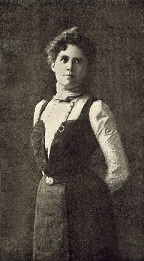
Helen C. CandeeHelen Churchill Candee came to Guthrie, Oklahoma Territory (O.T.) in the mid-1890s, primarily drawn by its lax divorce laws. She brought her two children, Edith and Harold, and ended up staying for several years. I carried on at some length ]]last time about how fascinating I’ve come to find this enigmatic chronicler – particularly in terms of her empathetic pith and generous promotion of early Oklahoma.  
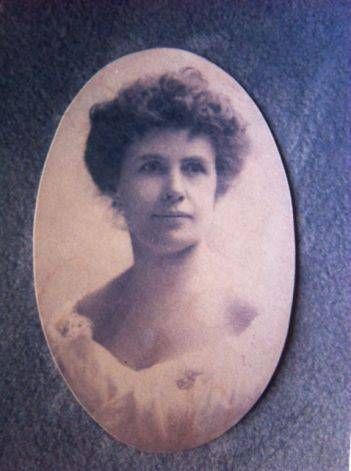
It’s really quite unhealthy on my part, I’m sure. 

Candee was already a freelance writer when she arrived in O.T.  Before arriving in Guthrie, she’d mostly done pieces on lifestyle tips, social etiquette, or other types of “women’s writing.” 

(In digging around for these earliest bits, I’ve ended up spending way too much time absorbed in old issues of Ladies’ Home Journal and whatnot. It starts innocently enough, hunting down H.C.C. columns and capturing them before noticing surrounding articles and ads. A fortnight later, I stumble into the living room unshaven and half-starved, wondering what day it is and whether or not I’m fired. I’m either a very deep researcher or a tragic example of what happens when you don’t get out more.)

Eventually Candee would be recognized as an authority on a number of historical and cultural topics, but it was during her time in Oklahoma that three important things happened to make the rest possible. First, she got her divorce and escaped an abusive relationship with an angry, insecure man. Second, in January 1900, she published her first book, How Women May Earn a Living, which was commercially successful as well as critically well-received.

Finally, and most importantly for our purposes, she became one of the most influential voices in promoting Oklahoma Territory as a valuable – if misunderstood – part of the nation. Her boosterism, though at times a bit ambitious, seems sincere. She stood out from fellow Okla-dvocates with her colorful ‘voice’ and her penetrating perspective – seeming to ‘zoom’ in and out smoothly, briefly capturing individuals while summarizing decades. 

She brought a moral clarity and insight expected of a woman with the confident authority and knowledgeable tone presumed from a man.

The earliest Pro-klahoma piece of Candee’s (of which I’m aware) was for The Forum, an ambitious periodical known for its “symposium” features, in which prominent thinkers or authors would debate various sides of contemporaneous social and political issues. The magazine had already featured several essays by future President Theodore Roosevelt, and over the years managed consistent respectability with bursts of greatness, publishing notables-to-be and tackling complex issues via diverse voices. 

In short, it was fairly legit. 

Candee opens “Social Conditions In Our Newest Territory” (June 1898) with what I suspect is a nod to The Forum’s reputation for dialectic: 

“No matter what people tell you to the contrary, there is not a man in this town who would stay if he could get out.” This was the pessimistic remark of a prominent Oklahoman to a stranger, made in a weary time of waiting for a Government appointment; but, fortunately for the growth of the Territory, there are those within its bounds who do not feel that way. They see in the new country a chance to make a fresh start, unhampered by the competition of crowded districts, and relieved of the over-stimulation of haste.

The piece goes on to backstory the territory’s openings, its developmental hiccups, and its reputation for lawlessness. While her tone suggests a certain resignation towards the bureaucratic foibles of Washington, D.C., she somehow covers the corruption inherent to Oklahoma’s birth without actually condemning the Territory or anyone in it. Even her recap of trouble with “sooners” – arguably the most foul creatures to ever soil our past – has an almost “boys will be boys” spirit:

For several weeks before the opening, the country, then being ready for the reception of homesteaders, was cleared of all individuals except the soldiers stationed there to prevent the arrival of “sooners.” The latter, however, ingeniously effaced themselves for the time only; for, when the signal gun was fired, they seemed to rise from the ground, as though Cadmus had been on earth again sowing the fabled dragon’s teeth. 

They “ingeniously effaced themselves”? She means they hid – those same soldiers being paid by taxpayer dollars to keep out cheaters – and subsequently robbed those foolish enough to follow the rules and trust the system. Candee doesn’t condone the behavior exactly, but she tells it like a preacher recounting the time they snuck beer into the dorms rather than condemning the individuals involved. 

Cadmus ended sparking a new community by following a cow, conquering some water issues, then farming – albeit with teeth. The allusion may simply be a nice turn of phrase, but it certainly lends some mythical mojo to what were otherwise dirty land swindlers – also known as the first generation of successful Oklahomans. 

I’m just saying. 

Men who had herded cattle, and those who had traded with the Indians for years, were not to be outdone by the vigilance of soldiers ignorant of sheltering “draws,” hidden “dug-outs,” and obscuring fastnesses of scrub-oak and blue-stem. “A feller had to keep mighty quiet until the marshal’s gun fired,” said a successful “sooner”; “every draw kept fillin’ with men all night long; an’ it was hard to keep from seein’ and bein’ seen.”

It’s a great story, even today. Of course, it’s been 125 years or so and every last hiding cheating sooner is long dead (may their souls burn forever). As of Candee’s writing, many of those cases were still in court, or resolved at gunpoint, or had simply led to the law-abiding sucker leaving empty-handed, having sacrificed everything for that one last chance. 

She does not so much condone as capture these men and their motivations – not via explanation or argument, but with poignant snapshots of words and moments. It is, after all, difficult to truly revile or condemn anyone we begin to understand. That is arguably Candee’s greatest strength, at least when writing about Oklahoma; she refuse to give up on the individual, even when decrying the system or the crowd.

It was a crowd of determined, almost desperate, men and women, many of whom, having failed in the fight for prosperity, had gathered here for a fresh trial. 

You can’t frame a government-sponsored ‘Hunger Games’ much more nobly than that. And she’s not wrong – at their most ideal, that’s exactly what the Oklahoma land openings were. 

Every man’s hand was against his fellow. His neighbor on the right, placed there by accident, might be the one who would beat him in the race… and, when finally the signal was given, a mad race began, the results of which make interesting history. All men started as enemies. The reward was to the selfish and to the bully; and greed and strength were the winners. 

She discusses the many disputes over lots, leading to prolonged legal action in the best cases, and bloodshed in the worst. Note, however, the tone – a sort of heartfelt hurting on behalf of those involved. The villain seems to be cruel universe or a distant bureaucracy; never the hard-working individuals. 

So much litigation is an expense which all cannot bear; and many a rightful contestant loses his claim for want of money to defend it. This condition of injustice and criminality is passing away as the time allotted by the Government for “proving up” approaches expiration; but the hatred engendered in each man’s breast was an unhappy handicap in the settlement of a new country. 

Besides this, the uncertainty, whether a man is or is not the permanent possessor of the land, robs him of ambition to improve it; for he may be working for the good of one whom he would rather kill than benefit. 

A little plug for clear property rights and an efficient legal system there. 

As I have said, the men who rushed into the Territory, and located themselves on claims, were actuated by an impelling necessity, the instinct of self-preservation, excepting always a few adventurers, who ultimately passed to more attractive fields. 

“Actuated by an impelling necessity.” If I could *phew!*-whistle in print while raising my eyebrows, here’s where I’d do it. 

Candee’s affection for her adopted state arguably rose-colors her rhetoric, but she stops short of denying all of Oklahoma’s flaws or justifying its sins. She instead chronicles the essentials while persistently searching past them for humanity and meaning. I’ve opted not to rehash her accounting of crop development, the placement of townships, or the other logistics she conveys so efficiently. Those things are of interest historically, but not germane to her voice, her writing’s “soul,” if you’ll indulge me. 

Candee is reporting, and documenting, and – let’s be honest – entertaining, but in the end, more than anything, she’s advocating. She’s making a case for a slighted Territory to be better understood and appreciated by its very distant cousins back home.

A thorn in the side of the Oklahoman is the indifference with which the Territory is treated in the East. He and his fellow feel themselves to be more loyal Americans than are New-Yorkers, and to be doing more than they to increase the spirit of patriotism… 

It is here that pure patriotism and Americanism are found. Idlers here have time to loaf; thinkers have time to deduce; and the man of ability and ambition outstrips his fellows. In this far district is again illustrated the truism, that when all men start life equal, in a few years each will find his natural level.

I don’t think that’s always true, but I love that she did – and that maybe, for a moment, it was a little.

Save

Save

Addicted To Candee

Helen Churchill CandeeHistory is full of people. 

I know, kinda self-evident – right? Like, obviously.

But stop and think for a moment about everyone you currently know or know of – people you love, people you envy, people you admire, even people you kinda wish would get eaten by aliens who digest their victims alive while mating with other scarier aliens with lots of sharp parts and stinky excretions. Everyone.  

Now multiply that number by, oh… let’s say infinity. That’s essentially how many people have lived at some point, but who you’ll never meet. People you’ve never even heard of. Human lives for which you couldn’t unearth an iota of real understanding if you devoted the rest of your life to it. 

Everything they said. Everything they did. What they felt, how they reacted, what they thought about – it can be a bit overwhelming. I mean, I can’t even remember the Presidents in order. (I’m always so distracted by Fillmore that I lose Franklin Pierce. Damn you, Millard!)

And then there are those unpredictable moments when someone catches your attention. You start to actively seek whatever little information is out there about them. It’s particularly tantalizing if there’s enough out there that you’re able to keep digging, but they’re far from being a household name. It’s like discovering that awesome indy band before they sold out and went commercial. You find yourself wanting great things for them, historically speaking, but no – the label wants the cute lead singer out front although everyone should have understood that what made it all work in the first place was the synergy and tension between all three of the songwriters, so what the hell, Balderdash Biscuit?! Warner $#%^ing Brothers?! Yeah, Color Me Viscous sold thirty-thousand copies, but you know who didn’t buy it on both vinyl AND CD? Integrity, that’s who!

Er… what I mean is, it’s hard to describe the sensation when you discover those obscure historical figures, noteworthy enough to have left a mark, but essentially unknown today. Especially when you fall in love. It’s magical, and yet unfortunate, because they’re dead. Seriously dead. Way, way dead.

Helen Churchill Candee was born in 1858 as Helen Churchill (her mother’s maiden name) Hungerford of New York. Her father was a successful merchant, and Helen grew up in relative comfort. More importantly, she was exposed to ideas and stories, music and art, history and culture, in ways unlikely to have been possible had she lived a generation before, or in her generation in almost any other part of the country. She started her formal education young in one of America’s first kindergartens, then attended the sort of girls’ boarding school only available to a certain quality of family, and even then primarily in New England.

Before she was a teenager she knew multiple languages, was schooled in grace and etiquette, and probably knew more history and literature than a majority of adult men in the nation at the time. She was particularly inspired, according to one diary entry, by an event at which Charles Dickens read aloud from one of his works. 

I’m telling you all of this because I’m going to be singing Helen’s praises soon, and I’m probably going to try to make a point about opportunity and upbringing in relation to education and long-term success and personal fulfillment. I don’t run the most focused or coherent blog you’ll ever adore, but I do tend to circle back to the ‘education’ theme. It’s in the title, you know. 

I’m firmly convinced Candee had a gift for observing people and a writing about them in amusing, poignant, and illuminating ways. I’ll carry on about her knack for capturing architectural nuances, crop production reports, and historical minutia accurately and informatively, but still continually circles back to the human experience and make all the rest of it matter. Some of that, no doubt, was from good genes and good choices. But those gifts were nurtured, and honed, drawn out, and refined, by her social and economic status. As a mid-19th century female, her abilities were given full shine due thanks to her specific geography. She took advantage of her opportunities, no doubt – and made some of her own along the way. It’s just that they were opportunities unavailable to most, whatever their gender or birthplace.  

That’s one of the things about history which just slaps you in the brain sometimes – the unimaginable variety of factors that play into who someone is or becomes, does or doesn’t do. Honestly, it boggles. I like to think choice still plays a pretty important role as well, but you can only choose from, um… your options

My word count is skyrocketing and I haven’t really gotten to the nature of my Candee addiction, have I?

Maybe I should skip to what brought her to Oklahoma and started her writing professionally. That’s how I came to know of her, after all – her pieces on Oklahoma Territory and the people therein. It wasn’t until I started researching her that I found out about her helping to remodel the White House or surviving the Titanic or riding that white horse at the head of the women’s rights march in Washington, D.C., the day before Woodrow Wilson took office. All that came later – for me, at least. It started in pre-statehood Oklahoma. 

Helen fell in love with successful businessman Edward Candee of Connecticut, and they married in 1880. She was 22. For 15 years, Edward was able to continue and expand the lifestyle to which Helen had grown accustomed. They traveled and they entertained – and not in that desperate, Gatsby-sort-of-way we read about a generation later. The Candees didn’t use their money to buy imitation culture; they used their resources to become cultured and to support culture. They were how success is supposed to work.

But there was one little problem. Henry turned out to be short-tempered and abusive. The details are thin, and even what we have from court records is suspect (being testimony given in order to secure a divorce and all), but apparently he drank excessively and often exploded at Helen and the kids, Edith and Harold. Helen decided to leave him. 

The thing was, in addition to the substantial social stigma of divorce in the 19th century, it was a damned difficult thing to secure legally. Helen hired a private detective to follow Henry on his various business trips, and while specific accusations are a bit fuzzy, she went to court in New York convinced she had sufficient proof of his unfaithfulness and/or abusiveness to secure her freedom.

The court did not agree. And now it was in the papers – public records being public and all. 

Here’s where specifics of time and place insert themselves into the equation yet again. Divorce was problematic across most of the civilized northeast, but there were places further west quite proud of their liberal unmarrying laws. The Dakotas had become the traditional vacation spot for those wishing to reboot their personal narratives with minimal time and effort – residency there could be established in a mere six months, and the courts were generous when it came to breaking sacred bonds. Lawyers and boosters in other western states advertised the comfort and convenience of their hotels, their climate, their recreation… and for a time capitalism’s wonders were fully unleashed in the direction of mommy not loving daddy anymore.

Oklahoma Territory had them all beat, however. 90 days – that’s how long you needed to establish residency. 90 days and you’re eligible to file. If your soon-to-be ex doesn’t show, the court appoints someone to speak on his or her behalf, whether they knew their “client” or not. Generally things were wrapped up in time to grab some lunch before getting back to shenanigans. 

Boasting of being a divorce mill in order to build population wasn’t necessarily anything to be proud of, but then neither was getting a divorce. Helen secured transportation for herself, Edith, and Harold, and off they went to the most hoppingest happeningest big-little metropolis of the entire Territory…

Guthrie. 

And that’s where her story really began for me. Because Helen wasn’t going to play the wounded woman or become someone’s mercy case. She had a family to support, and looking around, she had a pretty good idea where to begin. 

She was going to tell the world about Oklahoma. For money. Turns out she was damned good at it. 

Next: Candee’s Oklahoma – “Run In, My Children, and Help Yourselves…”

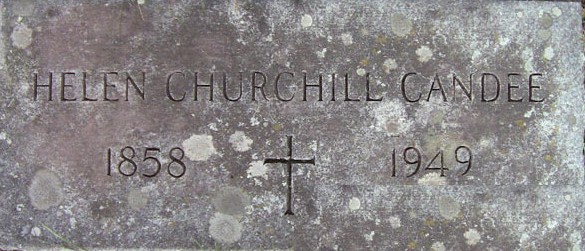
HCC Grave Stone