Ten Truths For The Overwhelmed Student

Miyagi I hear you’re feeling a bit overwhelmed with school – and maybe with life, too. Fortunately, I’m old and wise, and maybe I can help. 

Normally I’d start by asking you what’s on your mind, or what you think is causing your difficulties. Being as how this is a blog, however, and a bit… one-directional, I’ll just skip to the wisdom and insight. It applies most of the time anyway. 

Breathe RightOne. You have GOT to BREATHE.

Long and deep, in through the nose… out through the mouth – good. A few more times…

No, don’t just read on – this stuff doesn’t work if you don’t do it. DO THE BREATHING, then listen to me.

Feeling StupidTwo. You’re not stupid.

I don’t know if you’re a genius or not, but genius isn’t necessary here. I assure you, if you were stupid, your teacher would be nicer to you. He or she would have called you aside long ago and had a conversation something like this:

“Hey, um… Marcia. Look, I have some bad news. You’re too stupid for this class. It’s OK – it’s not your fault, Probably some combination of genetics and upbringing. BUT, we’re gonna need to get you into a slow kids class, OK?”

If that didn’t happen, you’re good.

Besides, here’s the crazy thing – feeling stupid usually indicates that you’re not.

There are studies and science for this, but if you were great at researching stuff we wouldn’t be having this conversation, so I’ll skip them. The short version is that smart people are far more aware of how much they don’t know and can’t do; ignorant people feel pretty good about their insights and expertise in every possible area. Sometimes they even win high political office on moxy alone.

Another part of the issue is that you’re one of the “good kids.” You mostly hang out with other “good kids,” so brilliant seems normal and above average seems dumb. In any NBA locker room, there’s one guy who’s shorter than the rest of the team. They’re all 6’8″ or 7’2″ or whatever, and he’s 6’4″ – still freakishly tall, but perpetually feeling like a midget. You’re not a midget – you just have good tastes in friends. 

So do they, by the way. 
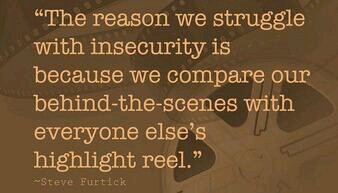
Insecurity

Three. You’re not alone.

Sure, there are a number of your peers for whom school is much easier than it is for you. That’s OK – everyone’s different. Most of the folks around you, though, are just putting up a good front – many just as panicked as you.

I know because I’ve had this same conversation often enough to make a blog post out of it. No offense, but I wouldn’t do this for just you. Too much work.

DevilAngelShoulderFour. Shut yourself up.

I suppose you could take this literally, as in “find a quiet place” – which is also good advice. But here I mean inner-dialogue-wise.

Remember the old cartoons with the AngelYou and the DevilYou on opposite shoulders? Contrary to what you might think, DevilYou isn’t primarily focused on trying to get you to rob banks or do crack. Those aren’t legitimate temptations for you – you’re a “good kid,” remember?

It IS, however, willing to maintain a constant stream of deprecation and frustration, running in the background of everything you think, feel, say, or do. Details vary with personal insecurities, but whether it’s despair, rage, detached cynicism, or simple self-doubt, it usually begins with tearing off little strips of you and pretending that’s the cost of being “honest” with yourself.

It’s lying to you. 

You can’t kill it or completely mute it – it’s you, after all – but you can recognize it and turn it down. Assign AngelYou to keep it in check. Quietly if possible, but out loud if necessary. Seriously – talk to yourself, realistically but positively. It’s good for you. 

You can be honest about your strengths and weaknesses without so much self-loathing. I promise. 

PlannersFive. Get a planner or agenda of some sort.

Mundane, right?

They work, but you have to use them. Starting TODAY, every hour, jot down what you did in class and what’s assigned and when it’s due. I know you think you’ll remember, but we’re having this conversation, so obviously…

Set your phone alarm to remind you at least twice each day – once around the time you get home from school and once several hours before you go to bed – to look at your planner. Read through it even if you don’t stop and do everything right then.

Anything that doesn’t get done gets copied onto the next day, and so on, until you do it. Continue this system even when you don’t think you need to – new habits take time.

Cross it OffSix. Choose a few things that won’t take long, do them, and cross them off.

If you do something that needs doing but wasn’t on the list, write it down, then cross it off. I realize it might sound silly, but – just trust me on this. It’s a “track record of success” thing. And it helps.

This next one is huge. Are you still with me?

The IsolatorSeven. When you’re doing a thing, do that thing.

If you decide to read an assigned book for twenty minutes, set aside that voice panicking about chemistry homework. While you’re doing your math, stop getting on your phone to “collaborate” on that English project. Pick something, and do it. No second-guessing.

One task at a time. That’s the most you can do, ever.

It’s easy to run from worry to worry until you end up exhausted and frustrated without actually getting much done. One of the greatest hindrances to completing anything is worrying about all the other stuff you suddenly fear you should be doing instead.

That’s a trap and a lie. Shut it off and choose something – right or wrong. Do it exclusively, and as well as possible. 

JugglingEight. When you’re working, work.

When you’re reading, read.

When you’re thinking, think.

Put the phone far, far away. Whatever amazing things unfold in the 20 minutes it takes to finish your calculus will still be there waiting for you when you take a break.

When you’re taking a break, take a break. Set a time limit and don’t keep finding reasons to go past it, but don’t keep worrying about what you’re not getting done.

And move around a little – it’s good for you emotionally and mentally as much as physically.

Side Note: Social power never comes from being perpetually or instantly available. Even if it’s not your intention to dangle your approval over others, delayed response time raises your standing in direct correlation to how long you let them wait.

Think of the times you’ve waited for someone to respond to you. Who holds the power in those situations? 

All Nighter

Nine. Start the big hard stuff early.

Even if you do something else first, do the bad thing next. Leave time to be confused, ask questions, or start wrong.

Human nature is to put off the stuff we don’t fully understand and to avoid thinking about that which we most dread. Suddenly it’s midnight and everything is due and you’re so totally screwed and it all breaks down.

Again.

What’s wrong with you? WHY ARE YOU SO STUPID?

That’s DevilYou, by the way. Didn’t you assign AngelYou to reign her in?

Adult BabyTen. Do the parts you can do.

Do everything you can do, even if you’re not sure of all of it. Then ask for help with what you can’t.

Read the directions – for real, this time. Call a friend. Actually read the material, take the notes, watch the videos, or try the activities. You’d be surprised how often a student thinks they’re confused when really they just haven’t done the work.

I mean, ideally there’s a reason we assign it. If you knew how to do it already, we’d just be wasting your time. It’s supposed to be hard.

When you’ve done the parts you can, THEN email or visit with your teacher. Otherwise we get this:

“I don’t get this.”

(What part don’t you get?)

“Any of it.”

(*sigh*)

Not effective. This, on the other hand…

“Mrs. _____, I have a question. I read this thing here and did this part here, and I notice in your example you indicate such and such. When I tried that, I had trouble figuring out ______________”

That I can work with. Makes it sound like you’re not just wandering around in a daze, waiting for a miracle.

Conclusion: It’s OK that it’s hard sometimes. Other times, it’s not nearly as hard as you make it. Try to separate your emotions from your thoughts from your abilities, and don’t get so derailed by what you WISH your teachers said or did differently. They didn’t, and they probably won’t, so work with what you’ve got. 

I promise you, you can do this. If I can understand it, ANYBODY can.
Kicking and Screaming

{This Post is Recycled – Reworked from a Previous Version and Reposted In It’s Updated Glory}

RELATED POST: Happy New Mirrors!

RELATED POST: Absoution (Bring Me My Crosier)


The Other

{This Post is Recycled – Reworked from a Previous Version and Reposted In It’s Updated Glory}

Rest Rooms White Colored

What’s wrong with segregation?

I ask my students this when we talk about the underlying causes of the Tulsa Race Riots – the ongoing circumstances in place just waiting for something to trigger them. Dick Rowland stumbling into Sarah Page might have been an incident all by itself, but it wouldn’t have burned Greenwood to the ground without combustibles already in place.  There were causes – one of which, most historians agree, was segregation.

If they’ve paid attention when we discuss Indian Removal, or Reconstruction, or Immigration, they should have an idea where I’m going with the question. Otherwise, they stumble through the clichés on which they were raised. Segregation is bad because everyone’s the same… we’re all equal… it’s wrong because it’s bad…

Black Girl What GirlTo their credit, some variation of ‘separate is inherently unequal’ eventually surfaces, whether they know Brown v. Board or not. They understand intuitively that when two groups are persistently kept apart, one will likely get a better deal than the other.

But what if it COULD be equal? We have Men’s bathrooms and Women’s bathrooms – separate, but similar. What if we could guarantee consistent quality, and equal value? Would segregation still be bad?

They’re sure it would, but aren’t often able to express why. Maybe they’re going on gut conviction; perhaps they’re simply THAT indoctrinated. Either way, we must discuss ‘The Other’.

When we lack relationships with people different from us, or when those relationships are so strictly defined as to preclude true interaction, we can’t help but see them as fundamentally unlike ourselves. We can’t know who we don’t know.

I don’t claim my district has eliminated all conceivable racial issues, but we’re a fairly diverse bunch – racially, economically, and to some extent culturally. We have lots of interesting colors, religions, a few very vocal non-traditional sexualities, and enough different home languages to keep things challenging.

GraduationI, on the other hand, graduated from a nearby suburban school 30 years ago with a senior class of around 700. Exactly two of my peers were Black – both guys, and both of whom played football and thus nowhere near my social circle. There was one Vietnamese kid – Truyen Nguyen – and he was really good at math. That was it in terms of diversity.

Well, there was one gay kid. We all kinda knew he was gay, but he didn’t seem to be aware of it, so we just let it slide. He knows now, and we’re all Facebook friends, so that seems to have worked out.

I had a strong, albeit largely subconscious, sense of ‘The Other’. My students don’t – at least not to such an extent.

I wasn’t particularly racist or sexist by the standards of my peers, but I walked in the sort of conviction and clarity only possible with limited knowledge, and in the peace of truncated understanding. Separate is inherently unequal, but also inherently obscuring. You can’t love, accept, or even properly argue with what you don’t know and can’t see. You don’t even know what questions to ask.

When anything involving other cultures or races comes up in class, my kids are well-armed with polite clichés and politically correct worldviews. They may even think they mean them.

But they lack depth because, for so many of my students, the idea of a world in which culture or race are a deep divide, capable not only of circumscribing what you do, but how you think, feel, or function – shaping reality itself… it’s just not real to most of them. At best it’s abstract and distant.

SelfieIn their defense, that’s true of 90% of anything we talk about – they’re Freshmen. They live in a perpetual ‘now’ with themselves, themselves, and those who amuse or arouse them this exact instant.

And themselves. 

They’ve been hearing the same handful of safe racial, religious, and sexual platitudes their whole lives, along with Stranger Danger and anti-bullying campaigns, but most have neither overtly experienced nor consciously perpetrated any of things being warned against. It can’t be real to them, any more than feudalism, factory labor, or war.

Most are simply unable to consciously fathom ‘THE OTHER’. If only we could add an odor to it, like with natural gas, we’d at least be warned when it begins to affect us…

History is full of ‘Them’. It’s fundamental throughout time and place. Babies gradually learn to distinguish ‘Me’ from ‘Not Me’. ‘Family’ is different than ‘Not Family’. In some bucolic regions, ‘Neighbor’ is still different than ‘Not Neighbor’.

As an evolutionary or historical approach, it’s not such an evil thing. As the earliest hegemonies or social contracts developed, they would inevitably involve ‘Us’ and ‘Them’ moments – over food, over land, over women. 

Much like ‘all snakes are poisonous’ or ‘reality TV is fake’, universals are a practical necessity when life is otherwise nasty, brutish, and short. The benefit of attentive discernment is outweighed by the risk. You may find a few exceptions to your rules, but the payoff is too small to justify the energy invested. “Look! A non-poisonous snake! I’ve devoted precious time and mental capacity to identifying it so I can… have absolutely no use for it. And if I’m wrong I’ll die painfully!” 

SnakesUnless you happened to be in a Disney Movie or After-School Special, the chances of making a new bestie when you reached out your Capulet arms to embrace a Montague stranger were slim compared to likelihood you’d become someone’s slave or lose your teeth so they could make a nice necklace. ‘The Other’ was scary. Dangerous. 

And to be fair, evolving from ‘All against All’ into ‘Us’ vs. ‘Them’ was actually a huge improvement socially and politically. At least you had an ‘Us’ instead of simply an ‘I’. At least societies could be built. 

Separately. 

But the world has changed. We are safer, healthier, better educated, and more entertained and entertaining than at any other point in human history. In the U.S. in particular, we celebrate ‘diversity’ in its ever-multiplying forms, and speak of being a great ‘melting pot’. Our foundational ideals, in fact, proclaim unequivocally that “all men are created equal, and are endowed by their Creator with certain unalienable Rights.”

Apparently this was unclear to some, so we added a 14th Amendment which explicitly states that a people is a people is a people. There are no gradients or levels of personhood or value in the eyes of the law or in the ideals of the United States.

Period.

That’s led to a number of kerfuffles as various individuals and groups seek to be part of ‘Us’ rather than being content in their roles as ‘Them’. They wished to be less ‘Other’. 

Some wanted to attend the same schools, ride the same busses, eat the same places, and live in the same neighborhoods as ‘Us’. Others wanted to form different sorts of families, promote different types of faith, or live some very different lifestyles, but with the same rights and respect as ‘Us’. 

Mutant Rights

It can get rather complicated. To our Founders’ credit, though, we’re mostly still trying to make it work. Contrary to how it sometimes seems, we’re getting closer and closer.

Or… we were, until a few short weeks ago. Whether or not we’ve changed our minds entirely remains to be seen. In any case, the tensions between our ideals (which most of us believe we believe) and our deepest convictions (which often run contrary to those same ideals) are just… well, it’s weird. Sometimes in a scary dark way. 

A towering sense of ‘The Other’ persists. At times it seems there are more ‘Them’ than there are ‘Us’, even 225 years after those ideals were so effectively used to birth a country whose primary task was to prove them workable. We can fight it, we can embrace it, or we can merely stumble along in ignorance of it – none of which changes that it’s there. 

If we could at least confess it, and confront it, though, we might be able to pull it into the light while we decide what to do with it. It’s shaping and changing us either way. It’s driving us to rattle our little tails and flatten our hoodie necks and spew our scary venom. There’s nothing inherently wrong with defending yourself, your “US,” or even your way of life. 

But let’s take a moment to make sure we’re not becoming the “THEM” we so fear. Let’s at least try not to become the snakes of which we’re all so afraid.

BCE #11FF Lunchbox Giveaway

Two Littles Demonstrate Wisdom

We’ll keep fighting over politics, and arguing about policies, and – if things go particularly well – debating the relative merits of fake news over the merely slanted. Whatever else this coming year will bring, it is unlikely to be predictable. Or boring. Or even remotely in keeping with the ideals envisioned by the Framers. 

BUT (and I have a big BUT), in the meantime, we have kids to teach, jobs to do, and blogging to promote. With that in mind, I bring you…

The Blue Cereal #11FF Lunchbox Giveaway Extravaganza!!!

Meghan Loyd Lunchbox

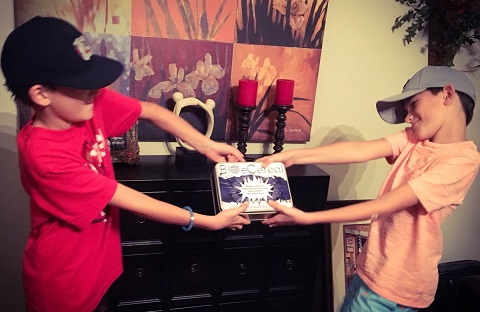
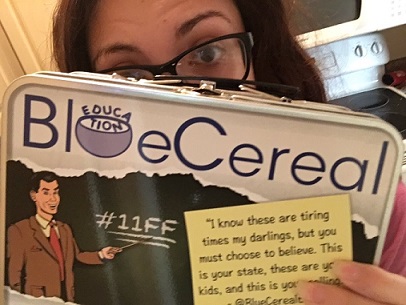
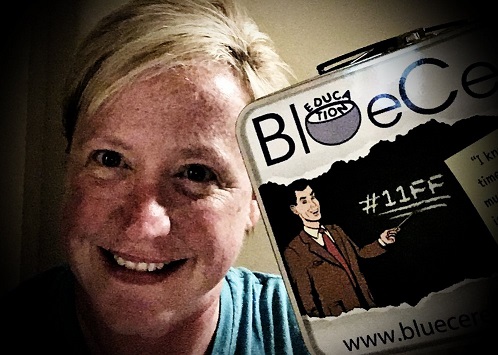
Between now and January 1st, 2017, I’ll be giving away two of these coveted rarities each week to qualifying #11FF.

What’s #11FF? It’s a hashtag referencing my ‘Eleven Faithful Followers’ – a term coined in the early days of this blog when I hoped to someday reach up to a dozen or so readers. It’s now used to more generally refer to anyone joining the cause, in part or in whole.

Swisher Goes To Lunch

What do you have to do?

Share a link to something you find interesting or useful on Blue Cereal Education. Blog posts, new or old. Classroom strategies. Document Activities. Reading Lists. The initial chapters to that book I’ll never write, Well, OK Then… Anything you think might demonstrate your wisdom and insight for having shared it. Tweet the link with an appropriate comment from you, or post it to your Facebook wall with similar framing. Tag me or contact me to let me know, and you go into the potential winners’ cyberpot. 

Preference will be given to those who personalize the tweet or FB post rather than simply retweeting or sharing – although retweets and shares are appreciated as well. Self-promotion requires sacrifice, kids – on your part, I mean. I don’t personally like to be troubled with such things. 

BCE Lunchbox Angie Taylor

Each weekend I’ll randomly select two winners. You’ll be announced, contacted, and your #11FF Special Edition Lunch Receptacle will soon be on the way! Once you’ve received it and taken the appropriate pics (at least some of which should be clothes ON), you’ll be added to the #11FF page and have official #11FF Elitist status to flaunt in front of your friends or to justify that condescending tone you take with people who just don’t get it. 

It will be GREAT!

KB Looking Good For Lunch

There will be no giveaways in January. Very likely none in February. You want lunch bling, the time is NOW. 

What are you waiting for?

Looking Simply Too Good

Freedom of Choice

{This Post is Recycled – Reworked from a Previous Version and Reposted In It’s Updated Glory}

As if the cutting-edge special effects and thespian excellence weren’t enough, Devo ushered in the 1980’s with rather high expectations of their listening audience. It wasn’t enough for us to merely whip it – we were expected to whip it good. On the title track of the same album, they scolded us for demanding “freedom of choice,” while in the same breath accusing us of not even wanting it – not really.

We were still getting over disco and they hit us with this philosophical barrage? No wonder they couldn’t get no satisfaction.

Too Many ChoicesBut they had a point. Freedom is a terrifying thing. There’s great comfort in structure – even confinement. I’ve seen this dramatically demonstrated in recent years as I’ve watched students navigate my decision to give them greater leeway in what they research, how they demonstrate it, and how they wish to be assessed. Some have flourished with the sudden reduction in boundaries, but many find themselves… hindered by too much freedom – especially if it comes with too little scaffolding, given too suddenly.

And that’s the academic version – the relatively easy one to fathom, and to fix.  Trickier are historical, social-political happenings. You know – the “real world” stuff.

One of the things about growing up around Tulsa is that you become rather familiar with people of faith and the variety of ways in which they interpret and express that faith. There are some complexities to being People of a Book, not least of which are sorting out which values and practices captured in one’s holy text are eternal, or literal, and which are temporal, or illustrative – important, but shaped by the time and place in which they were written.

Some are fairly easy. The “don’t kill each other over stupid stuff” tends to transcend time and place, and specific cultures or faiths, as does “don’t steal,” “don’t lie (at least not for selfish reasons)” and “don’t boink your neighbor’s wife on any sort of regular basis.” At the opposite end of the scale we find the other kind of “easy” – things few contemporary believers feel compelled to apply in a literal, ongoing way: “don’t eat shrimp,” “don’t wear mixed fabrics,” “keep the women quiet” (seriously – did that EVER work?), or “have fun with snakes and poison – you’ll be fine.”

Opinions SignIt’s not always so clear, however. Some stuff is tricky. Obeying your parents certainly has practical, cultural, and maybe spiritual value even today, but to what extent and in what circumstances? It’s easy to become dogmatic about something like hair length or tattoos (it wasn’t that long ago these were deal-breakers) while warnings against too much planning, or saving, are set aside quickly – often without even bothering to come up with good reasons. The modern Christian simply is NOT going to forsake ALL ELSE to follow Him – we’ll come up with the theology afterwards, if we must, but dude – seriously?

We deal with this all the time in history as well. Yes, slavery was evil, but to what extent was each and every slave owner twisted and maniacal? (Frederick Douglass and Solomon Northup both seem to suggest that the institution of slavery created evil men as much as evil men created the institution.) Religious persecution was brutal by today’s standards – the same Puritans who so famously came to the New World to escape the yokes of others quickly imposed their own harsh punishments on those in their communities who failed to fall in line. (Poker through the tongue, anyone?) But surely community standards as a general concept are not inherently… awful?

How do we balance a modern appraisal of not only the accomplishments and failures of our progenitors, but of their motivations and culpability as well? Whatever we come up with will be imperfect at best, and probably nowhere near THAT good.

Added to the complications of time and place is the fact that most cultural norms and the laws enforcing them have trade-offs we don’t like to acknowledge. The roles of women, for example, even a century ago, were rather constrained by today’s standards. There were assumptions and attitudes in play which we find offensive today, perhaps rightly so. I’d never suggest we should roll back the progress made (note the yellow rose on my lapel), but neither should we run from the realities of other cultures (including our own in decades past) which gave context to some of the practices and mindsets we today condemn.

And reality can be a hell of a mitigating circumstance.

Two Girls Two CulturesBy way of example, it may not be inherently evil and oppressive in all times and places for women and men to have had more rigidly defined roles than we’d like to see in modern America. There’s a certain security and stability that comes from carefully defined social structures, and – depending on one’s surroundings – practical benefits as well.

Were those Victorian dances you see in the movies, with fancy moves and complex expectations, limiting? Absolutely. But consider in contrast the awkward terror of stepping out on the dance floor of any modern club and being expected to shake your sober booty with, um… “freedom.” Suddenly some good ol’ western line dancing – where everyone does the same basic thing in the same basic way – makes more sense than you’d have ever accepted watching from your seat.

Pride & Prejudice society certainly comes with its own difficulties, but those cultural and legal structures evolved to protect participants as much as to crush their individual hopes and dreams. It may seem burdensome to seek an introduction by an appropriate mutual acquaintance or follow some basic formalities before openly wooing the opposite sex, but the process is far easier to understand than figuring out whether or not complimenting a co-worker’s shoes is more likely to lead to a first date or a sexual harassment complaint.

It’s a balance – freedom vs. security. Just like the war on terror, but with notes saying “Do you like me? Circle Y/N” instead of drone strikes. The structure that limits also supports. To support, it must limit. That’s the tricky thing.

Also, I think I just compared all of social and legal history to a good bra.

Two Views of the ConstitutionAs times change, or as understanding expands, freedom tends to become more and more of a priority. More choice – more freedom – means less structure. More often than not, at least in recent history, moving that direction means reaching a bit closer to our own ideals. I’m not saying it’s a bad thing.

I AM suggesting that not all historical or contemporary social or moral issues are entirely obvious, unalienable, or easily solved by a little indignation. I’m suggesting not every clash reduces to a morality tale of liberty triumphing over entrenched ethical fascism, or god-fearing decency once again restraining vice. Perhaps we should ride more moderately-sized moral horses as we exclaim over social issues – some of which center around clear violations of all we hold sacred, but others which speak to evolutionary changes more complex than ‘good’ people conquering ‘bad.’

I’m suggesting that it’s valuable to look back in history – whether decades or centuries – and evaluate the motivations and choices of those who came before. A little wrestling with their realities and assumptions can clarify rather than obscure. At the very least it can produce some much-needed uncertainty on our part. Some appreciation for the tension between security/stability and freedom/choice may prove… illuminating.

An appreciation for the gray can make us better historians and better teachers. It might even make us less annoying on Facebook.

RELATED POST: Cognitive Dissonance

RELATED POST: Condemnation Bias

RELATED POST: Liberty, Part One – The Causes Which Impel Them… 

RELATED POST: Liberty, Part Two – On Your Mark, Get Set…

Liar, Liar, Twitterpants on Fire (A Little Knowledge Is A Dangerous Thing, Part Three)

“My client wasn’t even IN the bar the evening of the murder, and if he WAS there, he doesn’t even OWN a gun! If he DOES own a gun, he didn’t have it with him that evening, and if he DID have it with him, it wasn’t loaded! Even if it WERE loaded, he didn’t use it – he didn’t even KNOW the victim. If he DID know the victim, he liked him, and if he didn’t like him, he at least didn’t kill him. But if he DID kill him, it was self-defense. And if it wasn’t self-defense, he still had a very good reason. Otherwise, he’s crazy and can’t be held accountable. Come on, he was carrying around a loaded gun – what sane person DOES that?!

I’ve told you that one way or the other he’s innocent – and all you can do is call me names? That’s so hurtful!”

Laws & SausagesIt is difficult for those of you with the slightest shred of decency to appreciate how the law and politics work. They do not operate according to anything most of us consider reasonable, moral, or even explicable. In the past they didn’t have to. Those affected had little expectation of being fully informed and no real control of the outcome.

Modern American politics has even less decency, but for different reasons. Most of us are too busy to keep up or sort it all out, and too quick to share or retweet anything with a headline confirming what we want confirmed or feigning outrage over whatever we find outrageous. Or maybe we’re just too stupid and easily distracted.

Not criticizing here – just keeping an open mind about possible explanations.

It’s amazing to me how easily we roll our eyes or exclamate our declamations over things done in the past – successfully, for centuries – and yet find it inconceivable the same things may be happening today, because… well, that’s CRAZY!

What, exactly, is it you think has changed about either mankind or the nature of power? Please – I’ll wait.

Hello?

The South attempted to secede and lost. The war destroyed lives and property on both sides, but the South had the worst of it by far. Reconstruction began, things got weird again.

Dead CW SoldierAnd then the South began writing the history of the war and the events which led to it. The war they’d lost. The one fought over a variety of issues, but in which slavery and its continuation were central and essential as defined by the South in the very documents they issued to justify their cause.

Only suddenly the war hadn’t been about slavery at all. In fact, the South was collectively rather wounded at the suggestion! Slavery?! You think – you think this was about SLAVERY?

Imagine what’d they’d have rewritten if they’d WON?

No less an authority than Jefferson Davis began cranking out volumes on the REAL story of the Lost Cause of the Confederacy. Others picked up the theme, and before long their United Daughters (still active today) were tea and cookie-ing this theme across the land.

Historians still argue about the war (they’re allowed to do that still, outside of Oklahoma and Texas) – that’s fine, it’s what they’re supposed to do.

Confederate FlagWhat’s less tolerable is the fervent hurt and chagrin evidenced by the South’s defenders at the very suggestion that secession had ANYTHING to do with slavery. It’s not that they wish to lay out a reasoned argument, you understand – it’s that they’ve reshaped history and historiography solely through repetition and strong emotion.

“To suggest secession was about SUH-LAVERY, well it it it’s it’s just… *sniff* DISHONEST!”

The rest of the nation has cooperated, by the way – we don’t like acknowledging our role in making chattel out of humans with souls any more than they do. Better to focus on tariffs and elections and economies and cultures – all persuasive alternatives, since all were involved.

The best deceptions are mostly true, after all – or true but for omissions. That’s how laws are made and history written – so be it.

Why does it matter if the South wishes to save a little face? What’s so wrong with simply focusing on the good parts in our collective history? I mean, the naysayers won their little war and got their way, didn’t they?

Can we at least keep the damn flag without everyone having a hurt-feelings-fit every time?

J Benn InterviewMy favorite hockey team captain after a tough loss and horrible officiating: “There were some tough calls, but the real problem is that we didn’t take care of business in our own end. We let too many pucks get past us and didn’t take advantage of our opportunities.”

I hated the poor play, and the poor officiating even more – but my decisive and lingering memory is how much I love the class of my team.

Also, he’s pretty.

More importantly, the team is able to go into practice the next day aware of the things they CAN control, and which led to problems. By acknowledging what they did wrong, instead of merely casting blame, they can improve – or at least that’s the goal.

You may remember the contrast between how Kanye and Beyonce handled this situation:

Swift seems to have recovered and keeps recording albums that sell zillions and zillions of copies. Beyoncé called Swift up to the stage later in the evening to give her back her moment in the spotlight. And West… well, he’s still Kanye (or not – he sometimes likes to go by “Tigerlily” or something else I can’t remember).

The lingering perception is that Kanye is a nut, Beyoncé is a class act, and that apparently Taylor Swift is a country artist (as she mentioned in the full version of her pre-interrupted speech). Reality may differ, but what we remember is what shapes events going forward.

It matters what happened and how it’s remembered because we can’t learn from mistakes we don’t think we made. Left uncriticized, Kanye is just a fighter for justice and Swift a bewildered blonde. Without her subsequent efforts to make things right, Beyoncé could just as easily been remembered as a sore loser, despite winning bigger better things that same night.

If the war was about slavery, and slavery is evil, and the South lost, then the reasonable thing to do is to start trying to repair some of the damage done by slavery. If the war was about a race-based chattel system, then we have some serious introspection to do about ourselves as a people and the extent to which we’ve failed to live up to our own ideals.

Reconstruction Cartoon - SmallOf course, if the real issues were states’ rights-ish, that’s not as bad. Federalism is about balance, after all, and if perhaps the South got out of balance, that’s clearly rectified now. If anything, the central government is much stronger than originally intended as a result!
We can spend some time trying to Reconstruct the South and push for some reforms, but at some point we’re going to need to get back to being a country again. We’ve made our point – let’s let them rebuild and trust whatever gradual progress can be made in terms of race and society.

If the war was about slavery, then both Lincoln and John Brown were right – we’ve paid for our national sin with national bloodshed. Time for a new birth of freedom.

If the war was about different understandings of the Constitution, then might makes right and we won by decimating our enemies by any means necessary. Next time the meaning of our founding documents may swing back a bit the other direction.

If the war was about slavery, then Black America may well need time and support to recover from a sort of collective PTSD. There would be imbalances to correct and scars which may never be quite healed. If we’re willing to go to war with ourselves to keep an entire race of people in degradation and servitude, what must we confess and how might we repent to set a better future course?

If 620,000 men died over tariffs or electoral procedures, then our nation is charted by whichever political and popular mechanizations produce the desired result. If the war was about anything other than slavery, maybe Black people need to just get over it and be less, you know… ‘Black’ about everything.

Keep GoingIf our ideals are as flawless and our procedures as sound as we clearly wish to promote, then inequity and suffering must stem from personal or cultural failures. If America is ‘exceptional’ in the way those now in power demand we acknowledge, whatever failures have occurred within it are individual and not national. Potential solutions or cures must, logically, come from the same. Anything else is charity. Or enabling. Or corruption.

We can’t repent of sins we can’t confess, or repair that we are unable to see as broken. This applies across any number of historical and national issues. If we build our actions and beliefs on a foundation of national amazing-ness, the ramifications are much, much larger than which textbooks we adapt or which tests we take to graduate. Conversely, if we believe the human heart – even the American heart – is desperately wicked, and deceitful above all things… who can know it? Well, that leads to humility and grace as we push forward, aware of what we are capable, for good or ill.

Two Men PrayingI’ll close with a little Bible talkin’, since that seems to be such a motivator for those pushing a better whitewashing for our lil’uns. Whatever we may disagree on, I wholeheartedly concur that we’ve lost much in our upbringing if we feel the need to run from the wisdom found in small red print:

“And he spake this parable unto certain which trusted in themselves that they were righteous, and despised others:

Two men went up into the temple to pray; the one a Pharisee, and the other a publican. The Pharisee stood and prayed thus with himself, God, I thank thee, that I am not as other men are, extortioners, unjust, adulterers, or even as this publican. I fast twice in the week, I give tithes of all that I possess.

And the publican, standing afar off, would not lift up so much as his eyes unto heaven, but smote upon his breast, saying, God be merciful to me a sinner.

I tell you, this man went down to his house justified rather than the other: for every one that exalteth himself shall be abased; and he that humbleth himself shall be exalted.”

(Luke 18:9-14, KJV)

If there’s an argument to be had, let’s have it. But let’s base it on our best understanding of the truth and the wisest possible course consistent with our proclaimed ideals – not on what best covers our collective behinds and casts the remaining blame on those least able to carry the burden.

Tulsa Race Riots

{This Post is Recycled – Reworked from a Previous Version and Reposted In It’s Updated Glory}

RELATED POST: Secession & Superiority (A Little Knowledge Is A Dangerous Thing, Part One)

RELATED POST: Forever Unfit To Be A Slave (A Little Knowledge Is A Dangerous Thing, Part Two)

RELATED POST: History Songs