A Wall of Separation – Stone v. Graham (1980)

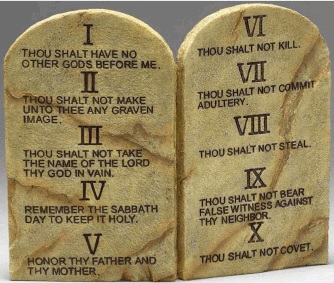
10 CommandmentsOn November 17, 1980, the Supreme Court announced its decision in Stone v. Graham – a case involving the required posting of the Ten Commandments on the wall of every classroom in Kentucky. 

This was about a month after the release of “Another One Bites the Dust” (Queen), although “Lady” (Kenny Rogers) was at that moment sitting comfortably at the top of the charts. It was less than a month before John Lennon would be murdered and “Just Like Starting Over” would be released and soar to #1. 

Reagan had just been elected, although he wouldn’t take office until January, 1981. The nation was approaching Day 400 of the Iranian Hostage Crisis. The “Miracle on Ice” had occurred earlier that year, back when only “amateurs” were allowed to compete in the Olympics. The Rubik’s Cube had just become a thing, Richard Pryor had recently lit himself on fire, and the nation seemed genuinely concerned with figuring out “Who Shot J.R.?”

None of which has anything to do with the case. Just trying to provide a little context, since for some of us 1980 seems like last month, while for others it might as well have been the year they began construction on the Great Wall of China. 

So, this case…

The State of Kentucky required that a copy of the Ten Commandments be posted on the wall of every public school classroom. The Commandments were purchased via private contributions, so no state money was used, and teachers were not required to discuss, promote, or even draw attention to the Commandments so posted. 

At the bottom of each copy was this explanation: “The secular application of the Ten Commandments is clearly seen in its adoption as the fundamental legal code of Western Civilization and the Common Law of the United States.”

If you’ve been reading this series on the “Wall of Separation,” you know how this one is going to go – right?

The Court referenced the “Lemon Test” which emerged from Lemon v. Kurtzman (1971) less than a decade before. This “test” has three parts, but the Court never got to the second base on this one, let alone third.

First, the statute must have a secular legislative purpose… 

That did it. Shut it down. 

They didn’t buy at all the assertion that the Ten Commandments were being used in a primarily secular way or to secular purpose. Had the curriculum included additional examples of historical laws, or a study of the Old Testament as literature, history, or even as a world religion, it would have been fine. As it stood, however, the Commandments were without educational context. Instead, they demanded fealty to a certain God in a certain way following specific interpretations of what that God said and wanted.

Also known as “an establishment of religion.”

It didn’t matter who’d paid for them – the state was requiring and posting them. That’s not how “separation of church at state” works.

Stone vs. Graham (1980) is interesting for several reasons. Well, to me, at least…

It was decided per curium, meaning the majority opinion was issued as written by the Court as a whole rather than a specific Justice. A per curium decision is traditionally used in far more banal situations – explaining why the Court will or won’t hear a case, or when the result is considered obvious or non-controversial. 

Given that this was a 5-4 split decision, that clearly wasn’t the case. So the anonymous majority opinion is weird. It’s also not entirely anonymous, since Justice Rehnquist wrote a dissent and three other Justices agreed with it. Let’s see, nine Justices, minus those four… 

The Supremes also decided this one without hearing arguments from either side. I didn’t know this was a thing, but presumably they figured the lower courts had covered everything they needed to know in order to decide. 

Finally, Stone was one of the first cases to rule against such a “passive display” of religion as nevertheless violating the Establishment Clause. It was from this reasoning the Court went on to take issue with some government-sponsored Christmas displays and other state-sanctioned religious ceremonies. 

Let’s see if there’s anything fun in this per curium opinion, shall we?

Hmm… they referenced Abington v. Schempp (1963). We’ve covered that one, yes? 

They then went straight to the “Lemon Test” – another familiar item to the #11FF. 

They eventually referenced Engel v. Vitale (1962) as well. I swear, it’s like they read my blog even back then! 

The Court notes that while some of the Commandments are “arguably secular matters, such as honoring one’s parents, killing or murder, adultery, stealing…” others are very specific to “the religious duties of believers: worshipping the Lord God alone, avoiding idolatry, not using the Lord’s name in vain, and observing the Sabbath Day.” 

As in Abington, the Court wants to make sure their decision is not perceived as forbidding all discussion of religious topics:

This is not a case in which the Ten Commandments are integrated into the school curriculum, where the Bible may constitutionally be used in an appropriate study of history, civilization, ethics, comparative religion, or the like…

Posting of religious texts on the wall serves no such educational function. If the posted copies of the Ten Commandments are to have any effect at all, it will be to induce the schoolchildren to read, meditate upon, perhaps to venerate and obey, the Commandments. However desirable this might be as a matter of private devotion, it is not a permissible state objective under the Establishment Clause.

There’s a great moment in Justice Rehnquist’s dissent worth sharing here:

The Establishment Clause does not require that the public sector be insulated from all things which may have a religious significance or origin. This Court has recognized that “religion has been closely identified with our history and government”… and that “{t}he history of man is inseparable from the history of religion”…

Kentucky has decided to make students aware of this fact by demonstrating the secular impact of the Ten Commandments. The words of Justice Jackson, concurring in McCollum v. Board of Education (1948), merit quotation at length:

And yes, I’m about to move from quoting an opinion to quoting an opinion quoted within an opinion. Is it getting Inception up in here?

I think it remains to be demonstrated whether it is possible, even if desirable, to comply with such demands as plaintiff’s completely to isolate and cast out of secular education all that some people may reasonably regard as religious instruction. 

Perhaps subjects such as mathematics, physics or chemistry are, or can be, completely secularized. But it would not seem practical to teach either practice or appreciation of the arts if we are to forbid exposure of youth to any religious influences. Music without sacred music, architecture minus the cathedral, or painting without the scriptural themes would be eccentric and incomplete, even from a secular point of view… 

I should suppose it is a proper, if not an indispensable, part of preparation for a worldly life to know the roles that religion and religions have played in the tragic story of mankind. The fact is that, for good or for ill, nearly everything in our culture worth transmitting, everything which gives meaning to life, is saturated with religious influences, derived from paganism, Judaism, Christianity – both Catholic and Protestant – and other faiths accepted by a large part of the world’s peoples. 

One can hardly respect the system of education that would leave the student wholly ignorant of the currents of religious thought that move the world society for a part in which he is being prepared. 

That last part is significant – “the currents or religious thought that move the world society for a part in which he is being prepared.”

In other words, no student is truly prepared to go out into the world without a basic familiarity with the VARIOUS faiths and cultural norms of the world – not merely their own. 

At some point we’ll have to look at how this decision impacted the ability of a state to post the Ten Commandments in other places – say, at that State Capitol or some such thing. Just, you know… hypothetically.

But not this time.

RELATED POST: A Wall of Separation – Everson v. Board of Education (1947)

RELATED POST: Building a Wall of Separation (Faith & School) 

RELATED POST: The Blaine Game

The Blaine Game

Treehouse

Way back in 1875, President Ulysses S. Grant called for a Constitutional amendment that would mandate free public schools and prohibit the use of public money for “sectarian” purposes. 

The idea of free public schools wasn’t new, but neither was it universal. And it wasn’t unheard of for various state governments to support education provided through religious institutions. It was working, and seemed practical at one time, so why not?

Republican Congressman James G. Blaine was happy to comply and proposed such an amendment. It came close to passage, but fell just short and never became law. 

Over time, however, various Supreme Court rulings essentially codified the same principle. It’s a tricky balance sometimes (should states help Catholic schools buy Algebra textbooks?), but generally the separation between church and state is assumed in most circumstances – including school funding. 

Most states – including Oklahoma – were less ambivalent, and have language similar to Blaine’s original proposal in their state constitutions, often informally referenced as ‘the Blaine Amendment’. For example, Article 2, Section 5 of Oklahoma’s constitution says this:

No public money or property shall ever be appropriated, applied, donated, or used, directly or indirectly, for the use, benefit, or support of any sect, church, denomination, or system of religion, or for the use, benefit, or support of any priest, preacher, minister, or other religious teacher or dignitary, or sectarian institution as such.

That language, along with Supreme Court’s interpretation of the First Amendment over the years, is why we can’t have a 10 Commandments monument on capitol grounds. It’s also why ESAs/vouchers are unconstitutional– even those currently hidden behind the shield of ‘special needs’. 

The courts haven’t agreed with me on that one yet, but that doesn’t mean I’m wrong. 

Diverse FaithsReligious diversity in the United States has expanded considerably since 1875, making the distinction between faith and politics even more appropriate. Disputes which used to involve whether or not copper buttons on your coat would cost you your eternal soul now seem quaint compared to disagreements over which god is the “real” one, or what caliber Jesus would use to eliminate children of other faiths.  

It can get personal.

For people of relatively orthodox faith in Oklahoma, this increasing diversity looks and feels very much like their fundamental beliefs and lifestyles are under some sort of attack. What used to be assumed is now suddenly controversial, and traditions which used to bind communities together are now accused of being dangerous and wrong-headed. 

Take a moment and appreciate how disturbing this is to someone not quite so detached and smugly intellectual as those on the opposite extreme. These aren’t bad people, for the most part – they’re just a little freaked out and worried about the world in which their kids are growing up.

Unfortunately, politics and pragmatism rarely allow for such reflection. Decisions must be made and funds allocated. “Blaine Amendment” or not, there are currently two pathways by which Oklahoma parents can procure state support to send their child to a private school – even a “sectarian” one.  

Philanthropy ManThe first is the “Oklahoma Equal Opportunity Education Scholarship.” This was authored by Senator Dan Newberry (R) and signed into law by Governor Fallin in 2011. 

The OEOES gives individuals and businesses a 50% tax credit for contributions made to nonprofit organizations that provide scholarships to students whose parents want them in private schools. Students must live in a district labeled ‘Yucky Doo-Doo Heads’ or worse by the state’s A-F School Shaming System (even if they’ve never actually attended public school in that district) OR live in a household “in which the total annual income during the preceding tax year does not exceed an amount equal to three hundred percent (300%) of the income standard used to qualify for a free or reduced school lunch… “

Threefold the reduced lunch threshold isn’t hardcore poverty by any stretch. This means the parents of little Theodore, who’s always gone to Word of Faith of Hope of Grace anyway, can receive financial aid from wealthy donors who will then be significantly reimbursed by taxpayer dollars. 

It’s just indirect enough to pass constitutional muster, and we could quibble over whether or not tax breaks are the same as public support. Right now, however, this is the law. 

Voucher BoyThe second is the Lindsey Nicole Henry Scholarship for Students with Disabilities, which seems to be better-known and more widely-utilized. This bill, passed in 2010, allows students who can secure the label “special needs” to take their portion of state funding and attend a private school of their parents’ choice. 

Any student with an Individualized Education Plan (IEP) who’s gone to public school in Oklahoma for at least a year OR whose parent is an active-duty member of the armed forces (often moving regularly) is eligible. Once approved, the voucher option continues through high school.

Despite pro-voucher visuals featuring a touching variety of multi-cultural children in wheelchairs and competing in the Special Olympics, it takes much less to qualify for an IEP. Any teacher can tell you the vast majority of mandated modifications are things like “allowed to use a calculator” or “sits near teacher and requires periodic redirection.” 

I’m not trivializing the role of educational modification, but we should be honest about the range of students covered by this language. 

If little Brittany’s parents can convince that 3rd Grade team that she simply MUST be given extra time on her spelling practice, or if Chauncy’s parents secure the tiniest diagnosis from their family doctor regarding his adorable 2nd Grade lisp (the kind assertively featured any time a child under the age of 20 appears in a TV commercial), they then qualify for these ‘special needs’ vouchers all the way up until their admittance letters from Stanford (Daddy’s alma mater!) 

The use of this particular ‘scholarship’ in religious schools has been validated by the courts. Several districts challenged this legislation when it first passed, and were demonized for “suing parents of handicapped kids.” The courts determined the schools lacked standing, so other approaches were tried. So far, they’ve failed. 

I’m happy enough for the parents making good use of this to get a better education for their kids. I really am. 

Private School Kids

Of greater significance, however, is the logistical reality of special needs children in MOST private schools. One of the many freedoms granted non-public institutions of learning is that they don’t have to follow IEPs or accommodations or anything else required of public schools. Ironically, an IEP may be required to GET that funding, but as soon as you’re admitted, it ceases to exist. 

While there are a handful of schools committed to better educating certain types of high-needs children – some of whom do amazing work – the vast majority are rather selective about who they do and don’t accept. Whatever their good intentions, most private schools simply lack the resources to make sure little Gertrude gets specialized attention. If she can’t step up and fit in without disrupting the flow, she’s out

Chances are she’ll never be in to begin with.

High Needs KidsFew parents of a child with substantial needs are likely to have the resources to independently fund that full-time aide to follow them from class to class, or the tutoring they’ll need to master basic math. Public schools can’t afford to do it either, but we do – because it’s the law

Public school educators arguing against vouchers (or ESAs) aren’t doing so out of some twisted venom towards religious instruction (well, some of them might be – but not the rational majority). We’re kicking and screaming because the powers-that-be are manipulating your collective sympathy and desire to do right by kids in order to redirect public funds into the pockets of their chosen favorites – many of whom are perfectly capable of funding their children’s education on their own.

We’re fussing because those who inherited the nicest treehouse keep trying to pull up the ladder so no one else can play, despite the welcome mat hanging from the highest branches and their wailing laments over the ‘choices’ of those still on the ground.

I’m not done with this issue.

RELATED POST: The Social Contract (aka “Haman’s Gallows”)

RELATED POST: Jonah’s Education 

Blue Serials (9/18/16)

[[{“type”:”media”,”view_mode”:”media_small”,”fid”:”2357″,”attributes”:{“alt”:””,”class”:”media-image”,”typeof”:”foaf:Image”}}]]

Here Are A Few Things You Absolutely SHOULD NOT MISS From The Past Week in Edu-Bloggery…

OKEducationTruthsNot Pictured – Rick Cobb, OKEducationTruths. I’m not a guy who always looks for the most dramatic story or the saddest example. I assure you, Cobb is even less so.

But that doesn’t mean we can ignore the kids whose worlds are those dramatic or sad stories, either. We can’t just prioritize the easy kids, the fun kids, the ones who look good on the home page of our school websites, and set the uncomfortable minority to the side. You’re thinking of those other schools. 

…with all the budget cuts in all the agencies that serve this state, none of us who advocate for public schools have wanted to take all the available money. We want to restore the services that help our kids. We also want the other agencies that serve our kids to have the resources they need too.

Anything else I try to type by way of commentary just leaves me in a blind rage at power and elitism and slander and dark money. But in the meantime we can hug them and smile at them and let them pull our hair. 

The kids, I mean – not the powerful elitists. That would be weird. 

Follow @OKEducation on Twitter, and maybe you’ll get a hug as well.  #oklaed 

Rob MillerLooking for Hope – Rob Miller, A View From The Edge. I’m not a guy who always looks for the most inspiring story or the shining positives amidst the nonsense. I assure you, however, that Miller kinda is sometimes.

Thankfully. 

Miller’s style is different than Cobb’s, and both are different than mine (for which I’m sure they’re eternally grateful). But they love their kids, and they’ll fight for them unflaggingly. They will each, however, expect you to step up as well…

Hope and change come from us, each one of us. They do not come from politicians or policies… Hope. It starts with you. God put it there. Use it.

Follow @edgeblogger on Twitter, and find hope in all the best places.  #oklaed 

JennWillTeachMy Reading for Pleasure Class Responds to The New Yorker – Jennifer Williams, JennWillTeach. Williams doesn’t like it when uppity periodicals – and from the North, too – sound the generational alarm that “kids these days something something doom they’re stupid it’s bad blah blah blah…” 

So she figured she’d give her students a chance to respond – at least in class and on her blog – to the suggestion that they don’t read “real books” anymore. (The article also suggests they’re unable to do anything besides worship their phones all day, but I know THAT can’t be true because they can’t ALL be school administrators at this age.)

Age should not dictate how much a person reads or what a person reads. Naturally, older generations will read different literary works than what we read in the present day. This article simply is the opinion of an entitled, pretentious, and ignorant man…

I am a firm believer that it is easier for someone to make assumptions of others than taking a hard look at themselves. If they did, they would see they are throwing stones when they live in a glass house…

Follow @JennWillTeach on Twitter, and use those rocks to shore up your own glass house.  #oklaed

MrsDSingsThere Must Be Some Kinda Way Outta Here – Mindy Dennison, This Teacher Sings. Dennison is tired, and she’s noticing that many others are as well. There’s even a touch of “sick and” often squeezing itself in. 

In the education world, I notice morale is low. Many “money-saving” steps were taken concerning personnel in all districts, but those jobs still have to be done by somebody. That makes for a lot of frazzled people trying to wear multiple hats, some of which may be a poor fit. Class sizes are up, course offerings are down… 

And yet, teachers are putting on their happy faces because two things are still true: (1) It’s going to get worse before it gets better. (2) None of this is the kids’ fault.

Follow @MrsDSings on Twitter, and feel slightly less frazzled than you did before.  #oklaed 

Stand4ChildrenOKWe Cannot and We Must Not Accept This Reality – Amber England, Stand for Children (Oklahoma). This one is actually from, um… July.

But I re-fell in love with Amber England this past week attending the Oklahoma Watch Forum on SQ779. England has that wonderful combination of knowledge, passion, and awareness that leaves me both jealous and intoxicated. Here she demonstrates all three:

I cannot accept and I refuse to accept a reality where black and brown children come to school every day worried their mommies and daddies may not make it home from work because of a busted tail light. I will not accept a reality where those who serve to protect us are gunned down in anger and frustration over races relations…

The path forward to make that happen is through a quality public education. Every child must have access to a quality school, no matter the city or neighborhood they call home. Every child must have a quality teacher guiding their learning. And every school must have the tools and resources needed to provide a quality education to every single child.

Follow @OklahomaStand on Twitter and refuse a little reality yourself.  #oklaed 

That’s it this week, my Eleven Faithful Followers. Stay strong, stay focused, and talk to everyone you know about #OKElections16. GET INVOLVED, or you’re actively supporting the status quo.  

[[{“type”:”media”,”view_mode”:”media_small”,”fid”:”2355″,”attributes”:{“alt”:””,”class”:”media-image”,”typeof”:”foaf:Image”}}]]

A Wall of Separation – Lemon v. Kurtzman (1971) & “The Lemon Test”

Blue Cereal*Dramatic Voice* Previously, on Blue Cereal Education…
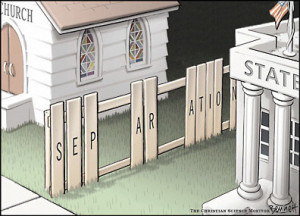
I recently proffered a brief overview of the whole ‘Wall of Separation’ idea in American jurisprudence, then dove into a few early Supreme Court Cases involving religion and public schools. 

We looked at Everson v. Board of Education (1947) in which the Court determined it was perfectly acceptable for the state to reimburse parents for transportation costs of getting their children to school, whether public or private, sectarian or secular. 

Then came Engel v. Vitale (1962), in which the Court made clear that the state could NOT require – or even promote – prayer in public schools as part of the school day. It was followed closely by Abington v. Schempp (1963) in which the same decision applied to the reading of Bible verses or the recitation of the Lord’s Prayer. 

In neither case was the goal to drive faith out of public education. The Court’s concerns, rather, were to prevent either the power of government or the foibles of politicians from unduly interfering in man’s reach for the Almighty. Or, at least, that’s how they interpreted the Framers’ concerns as expressed in the First Amendment, applicable to the states via the Fourteenth. 

The Abington decision included a little checklist by which interested parties could determine whether or not something violated the “establishment” clause or the “free exercise” clause of the First Amendment. That checklist was improved less than a decade later when the Court heard Lemon v. Kurtzman (1971).

Which is where we are now.

Separation

As of 1969, both Pennsylvania and Rhode Island had lots of private schools, the vast majority of which were Roman Catholic. Then, as now, most private schools operated on tight budgets. The average per-pupil expenditure was lower than in public schools in the same area – even when numbers were adjusted to reflect only “secular education.” 

In other words, students in private Catholic schools weren’t benefitting from the same resources as kids in public schools, even when learning science, math, or other non-religious subjects.

Both states passed legislation furnishing supplemental support for these private schools, provided the extra funds were used only for the teaching of secular subjects and buying non-religious materials. In some cases this included helping with teacher salaries.

In both states, some parents complained that this diverted resources from public schools to support sectarian institutions, thus violating the First Amendment. 

Only a few years before, the Court had determined in Board of Education v. Allen (1968) that it was acceptable for New York to provide textbooks free of charge to all secondary students (Grades 7 – 12), including those in private schools. Surely, Rhode Island and Pennsylvania reasoned, this was essentially the same sort of non-sectarian support. 

It was an interesting question. Is modest financial assistance for a sectarian school more like pushing a little prayer and some Bible verses in Engel or Abington, or supplying bus fare and textbooks as in Everson or Allen? Does state assistance constitute “establishment,” or would eliminating that help violate “free exercise”?

Spoiler Alert: the Court decided almost unanimously that it was the former. The help to Catholic schools was a big Constitutional “no-no.” 

The conclusion was far from foregone, however. Lemon came hot-on-the-heels of Walz v. Tax Commission of the City of New York (1970) in which the result had been quite different. Walz wasn’t a public school case, but many of the issues were similar. 

The city of New York granted property tax exemptions to religious organizations if the property in question was used exclusively for religious worship – putting them in the same category as schools or charities. Some property owners who did pay taxes argued this violated the Establishment Clause. 

Caution Hands OffThe Court determined that while government certainly had no business promoting religion, these tax exemptions didn’t actually do that – not quite. They merely allowed the “free exercise” of groups serving the public good, without the same taxes levied on for-profits. They weren’t “establishing,” the Court said – they were stepping back and letting faithy people do faithy stuff. 

The majority opinion, written by Chief Justice Warren Burger, cites a number of prior cases by way of illumination – many of them the public school cases we’ve already discussed. At the risk of straying too far from Lemon, he includes a wonderful homage to fallibility and balance worth sharing: 

The Establishment and Free Exercise Clauses of the First Amendment are not the most precisely drawn portions of the Constitution. The sweep of the absolute prohibitions in the Religion Clauses may have been calculated, but the purpose was to state an objective, not to write a statute…

I really like that part.  

The Court has struggled to find a neutral course between the two Religion Clauses, both of which are cast in absolute terms, and either of which, if expanded to a logical extreme, would tend to clash with the other…

In other words, the Court recognized that the best application of First Amendment values wasn’t necessarily obvious in each and every case. Sometimes, protecting the rights of everyone concerned is an imperfect balancing act. 

The First Amendment, however, does not say that, in every and all respects, there shall be a separation of Church and State. We sponsor an attitude on the part of government that shows no partiality to any one group, and that lets each flourish according to the zeal of its adherents and the appeal of its dogma…

The course of constitutional neutrality in this area cannot be an absolutely straight line; rigidity could well defeat the basic purpose of these provisions, which is to insure that no religion be sponsored or favored, none commanded, and none inhibited… 

So… we’re faithful to the principles by being flexible with specifics. How pragmatic!

Short of those expressly proscribed governmental acts, there is room for play in the joints productive of a benevolent neutrality which will permit religious exercise to exist without sponsorship and without interference…

There’s “room for play in the joints”? *snort* 

Witch Detection

It almost seems like Burger wanted to dress up what was in reality a collective, black-robed shrug – a mumble to the effect of “we’re just figuring it out was we go.” Of course, in his defense, the “figuring it out” included 15 pages of detailed analysis, history, and jurisprudence. 

We also see a foreshadowing of the following year’s “Lemon Test”:

Determining that the legislative purpose of tax exemption is not aimed at establishing, sponsoring, or supporting religion does not end the inquiry, however. We must also be sure that the end result — the effect — is not an excessive government entanglement with religion. The test is inescapably one of degree. Either course, taxation of churches or exemption, occasions some degree of involvement with religion…

Speaking of Lemon v. Kurtzman (1971), we should probably get back to that one – seeing as how it’s in the title of the post and all. 

As previously mentioned, both laws – in Rhode Island and in Pennsylvania – were found to be unconstitutional entanglements of the state with religion. As with Walz, Chief Justice Burger wrote the majority opinion. 

He again acknowledges the difficulty of neither promoting nor hindering religion, although with much less aplomb than he’d managed the year before. 

The language of the Religion Clauses of the First Amendment is, at best, opaque, particularly when compared with other portions of the Amendment…  

A law may be one “respecting” the forbidden objective while falling short of its total realization. A law “respecting” the proscribed result, that is, the establishment of religion, is not always easily identifiable as one violative of the Clause. A given law might not establish a state religion, but nevertheless be one “respecting” that end in the sense of being a step that could lead to such establishment, and hence offend the First Amendment.

Yeah, exactly! And also, huh?! 

Lemon Test

He quickly redeems himself, however, with that surprise judicial hit, “The Lemon Test” – the first of many to come from the Burger Court.

Also, it’s funny to say “Burger Court” and mean something totally for real and serious. 

Every analysis in this area must begin with consideration of the cumulative criteria developed by the Court over many years. Three such tests may be gleaned from our cases. First, the statute must have a secular legislative purpose; second, its principal or primary effect must be one that neither advances nor inhibits religion… finally, the statute must not foster “an excessive government entanglement with religion”…

Or, rephrased to apply more specifically to the case at hand:

In order to determine whether the government entanglement with religion is excessive, we must examine the character and purposes of the institutions that are benefited, the nature of the aid that the State provides, and the resulting relationship between the government and the religious authority…

Justice Burger goes on to explain how very clearly religious these private schools were. Most were located on the same grounds or in close proximity to associated churches. Religious symbols pervaded each campus. Roughly two-thirds of the instructors were nuns. 

To cap it all off, the Catholic faith was pretty explicit about the fact that a large part of the reason they had parochial schools to begin with was to spread their faith. So are they religious? Is the Pope Cath-

Um… you probably get the idea. 

But what about Allen a few years prior?

In Allen, the Court refused to make assumptions, on a meager record, about the religious content of the textbooks that the State would be asked to provide. We cannot, however, refuse here to recognize that teachers have a substantially different ideological character from books. 

Sister Act

Good to know someone realizes that. Can we add “or online courses”?

In terms of potential for involving some aspect of faith or morals in secular subjects, a textbook’s content is ascertainable, but a teacher’s handling of a subject is not. We cannot ignore the danger that a teacher under religious control and discipline poses to the separation of the religious from the purely secular aspects of pre-college education. The conflict of functions inheres in the situation.

You gotta love a phrase like “the conflict of functions inheres in the situation.” And despite several more pages of explanation, that pretty much sums it up. The balance between pushing religion and punishing it is a tricky one, yes – but in this case, the Court decided, the state had some seriously conflicted inhering going on.

It wasn’t malicious. It wasn’t fair to expect teachers to completely separate their spiritual function from their secular labors. 

We need not and do not assume that teachers in parochial schools will be guilty of bad faith or any conscious design to evade the limitations imposed by the statute and the First Amendment. We simply recognize that a dedicated religious person, teaching in a school affiliated with his or her faith and operated to inculcate its tenets, will inevitably experience great difficulty in remaining religiously neutral.

Doctrines and faith are not inculcated or advanced by neutrals. With the best of intentions, such a teacher would find it hard to make a total separation between secular teaching and religious doctrine…

Finally, expecting the state to supervise or punish violations of this unattainable “total separation” created the exact sort of entanglement the First Amendment hoped to circumvent. It made the government into the theology police. 

To ensure that no trespass occurs, the State has therefore carefully conditioned its aid with pervasive restrictions…

Unlike a book, a teacher cannot be inspected once so as to determine the extent and intent of his or her personal beliefs and subjective acceptance of the limitations imposed by the First Amendment. These prophylactic contacts will involve excessive and enduring entanglement between state and church. 

So bus fare and math books are OK. Government-led prayer or devotional readings are not. And, after Lemon, direct support to sectarian schools – under whatever formula – is out as well. 

On the other hand, I wish I were young enough to start a band just so I could call it the “Prophylactic Contacts.” But the conflict of functions would probably inhere in my situation.

RELATED POST: A Wall of Separation – Engel v. Vitale (1962)

RELATED POST: A Wall of Separation – Everson v. Board of Education (1947)

RELATED POST: Building A Wall of Separation (Faith & School)  

Blue Serials (9/11/16)

Sometimes we need a little help to cut through the clutter and decipher the nonsense.

 [[{“type”:”media”,”view_mode”:”media_small”,”fid”:”2329″,”attributes”:{“alt”:””,”class”:”media-image”,”typeof”:”foaf:Image”}}]]

But fret not, my #11FF – I’m here for you. 

*tenderembrace*

I know, I know… me too. But we must press forward. We’re sometimes all they have. Besides, I know what will help you feel better, re-energize, sharpen that ol’ focus…

Here are a few things you simply MUST NOT MISS from the world of edu-bloggery this past week!

OKEducationTruthsOn Ditch Diggers & Dreamers – Rick Cobb, OKEducationTruths. Cobb posts about Labor Day, but being him, the post is about so much more than that – and… videos!

Working and dreaming are not mutually exclusive endeavors. Our nation was not built by those who are content with the world they saw around them. Innovation has never been left to the conformists. We work so we can play. And so we can dream. But first, we work.

This one, I confess, left me a tad misty-eyed. No joke. Follow @okeducation on Twitter or YOU’RE DOING EVERYTHING WRONG. #oklaed 

Peter GreeneCan Evidence Improve America’s Schools? – Peter Greene, Curmudgucation. Greene is all about using research to improve his teaching. He just doesn’t buy most of what’s being sold as “research.” 

When some guy shows up to say, “I’ve never done your job, and I’ve never watched you do your job, and I don’t know your kids, or your school or your community or you, but I would like to tell you how you should totally change what you do based on one flawed piece of research with ten bits of data, and by the way, I’m hoping to make a ton of money by selling this to you–” Well, that’s just not a pitch I’m buying.

I’m an education researcher every day of my professional life.

Research @palan57 on Twitter or YOU’LL CONTINUE TO WANDER THROUGH THE DARK ALONE. 

Caffeinated RagePublic Schools Aren’t Businesses. Don’t Believe Me? Try Running a Business as a Public School. – Stu Egan, Caffeinated Rage. Egan is new to me, but I love the blog title already – not to mention his mildly quirky sense of frothing indignation. 

 I invite you to try and see if you could run a business like a public school. Maybe the differences between a public service and private enterprise might become more apparent because you’re not even comparing apples to oranges. You’re comparing apples to rocks.

So he seems nice. 

Follow @ragecaffeinated on Twitter and froth along. I think I’m a fan. 

Mrs Megan MorganDear Educator Mom – Mrs. Megan Morgan, on the appropriately named MrsMeganMorgan.

Moms. To Do. Teachers. To Do. Guilt. To Don’t. 

Just like state standards, there is too much to accomplish.  Pick your hills to die on (We don’t have to have the same ones)… Once these things are accomplished, then everything else is gravy.

Own your hills and don’t try to match others. I’ve accepted that my house is even close to magazine worthy and I have no guilt about it.

Follow @MrsMeganMorgan on Twitter or HAPPINESS WILL NEVER BE YOURS.

Pernille RippHow to Create Empowered Readers – A Beginning / So Much Depends On The Word “Yet”… – Pernille Ripp, PernilleSRipp.com. A double shot of Ripp, with three extra squirts of passion. 

I don’t do much in the way of ‘caring nurturing inspiring’ posts, but Ripp brings a validity to that flavor of passion like only a handful of others can. 

How many of our students have not experienced what is means to complete a series that one has become so invested in that it feels like the loss of a family member once the last page has been read?  How many years has it been for some, if at all, since they truly loved a book?  While we cannot change the past, we do have control over the now, over what happens in our classrooms. 

Driving home today, I kept thinking about how far we still have to go. How much these brand new kids don’t know. How they don’t get me or us. How hard it is to get them started with something… How a new year is hard and you end up questioning every single thing you do because surely you must be doing something wrong because didn’t this go much better the year before?

Follow @PernilleRipp on Twitter or CLEARLY YOU HATE BOTH CHILDREN AND HAPPINESS. 

Finally, Edu-Bloggery Classic – Posts Worth Revisiting (or Visiting, if you Missed Them the First Time)…

JennWillTeachThe Creature Speaks: Why I Still Teach Frankenstein (10/18/15) / Needing A Connection (3/3/16) – Jennifer Williams, JennWillTeach. A pair from Williams – one about the tragedy of failed human connections, and one about the power of true communication.

Not quite two sides of the same coin, but certainly two chapters in the same Truth Crockpot Cookbook.

Every chance I get, I will continue teaching Frankenstein because it can still speak to a modern audience. With public shaming, bullying, and discrimination seemingly on the rise, our society needs to listen to the Creature. He represents every person society pushes to the fringes; he represents every child seen as not good enough by society; he represents every human made to feel ugly and unlovable.

The world is chaotic, but words, especially written words, can bring order to that chaos. An essay or novel or tweet is NOT creating something from nothing; they are attempts to bring structure and infuse meaning into the disorder. 

I want my students to learn the rules of format and Standard English so they can more effectively communicate with others. Then, I want them to learn how and when to break those rules. 

Break a few rules with @JennWillTech on Twitter or WHY IS AMERICA EVEN AMERICA?  #oklaed 

Stay strong, my beloveds.

You are more than you think and better than you know. As for me, sometimes I feel like the Tiger, but more often… the Lady. In terms of this song, I mean.

Not for the normal reasons you might think.

[[{“type”:”media”,”view_mode”:”media_small”,”fid”:”2337″,”attributes”:{“alt”:””,”class”:”media-image”,”typeof”:”foaf:Image”}}]]