
I’ve been working my way through the Oklahoma Constitution. Many current legislators insist rather dramatically that they’re defending the values and requirements therein, so I figured it was time I looked a bit more closely to see just what those are. You can read my Introduction in Part One and my brilliant analysis of Articles I & II in Part Two.
Article III is about suffrage and elections. No real surprises here.
Article IV is very brief:
The powers of the government of the State of Oklahoma shall be divided into three separate departments: The Legislative, Executive, and Judicial; and except as provided in this Constitution, the Legislative, Executive, and Judicial departments of government shall be separate and distinct, and neither shall exercise the powers properly belonging to either of the others.
OK, then.
Article V is not very brief. In the U.S. Constitution, the first and longest section is devoted to the Legislative Branch. Article V reflects a similar concern with the state version of the same.
Section V-1: Legislature – Authority and composition – Powers reserved to people.
The Legislative authority of the State shall be vested in a Legislature, consisting of a Senate and a House of Representatives; but the people reserve to themselves the power to propose laws and amendments to the Constitution and to enact or reject the same at the polls independent of the Legislature, and also reserve power at their own option to approve or reject at the polls any act of the Legislature.
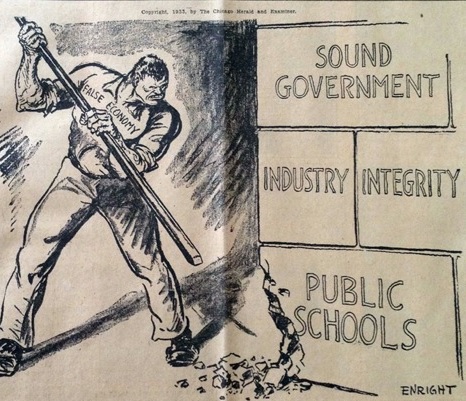 This mindset was a precursor to the Progressive Era and its Amendments – the 16th, 17th, 18th, and 19th. Basically, there was a concern that government at all levels was too far removed from ‘the people.’ Various reforms gave voters more direct input on who was elected and what changes could be made – recalls, referendums, etc.
This language reflects that. “We’re about to outline your authority,” it says, “but keep in mind we can trump you at any time – so don’t let yourself get TOO far removed from what we sent you up there to do.”
The other option, of course, is to simply run against the existing legislature en masse. Heh.
The next several paragraphs detail referendums and other powers of ‘the people’ directly – before even discussing the actual Legislature.
This bit is interesting:
Section V-7: Powers of Legislature not affected.
The reservation of the powers of the initiative and referendum in this article shall not deprive the Legislature of the right to repeal any law, propose or pass any measure, which may be consistent with the Constitution of the State and the Constitution of the United States.
This clarifies that the rights of the people to do stuff directly doesn’t limit the legislature’s authority to do ITS job, but that’s not the interesting part. It’s that latter half, which suggests that our State Legislators are expected to limit themselves to acts consistent with the U.S. Constitution.
 That’s important in a decade during which we repeatedly introduce, debate, and occasionally pass state laws which are undeniably doomed once challenged in the courts. We spend hundreds of thousands of dollars fighting for the right to return to the 19th century.
This is arguably evil as much as fiscally idiotic, but it’s also specifically prohibited by the exact Constitution those pushing untenable laws claim to defend with such froth and drama.
The next several paragraphs – updated since the original – are less exciting. They detail how Senate and House Districts will be established, requirements for running for state office, blah blah blah.
Our state legislature is limited to meeting from February through May, other than a few housekeeping duties which begin just prior. There are deadlines and limits throughout those four months, presumably designed to not only bring some order to the chaos, but to limit how much damage they can do in a given year.
So that part could have worked out better.
Section V-33: Revenue bills – Origination – Amendment – Limitations on passage – Effective date – Submission to voters.
A. All bills for raising revenue shall originate in the House of Representatives. The Senate may propose amendments to revenue bills.
B. No revenue bill shall be passed during the five last days of the session.
That’s the original language of Article V, Paragraph 33, and it’s still there. The first subsection echoes the U.S. Constitution and the second suggests a concern that lawmakers might ‘sneak in’ unpopular taxes ‘at the last minute’ and then adjourn before anyone could protest.
This concern was expanded by State Question 640, a citizen-initiated measure of the sort so warmly defended earlier in Article V. It passed by vote of the people in 1992, and added this language:
C. Any revenue bill originating in the House of Representatives shall not become effective until it has been referred to the people of the state at the next general election held throughout the state…
D. Any revenue bill originating in the House of Representatives may become law without being submitted to a vote of the people of the state if such bill receives the approval of three-fourths (3/4) of the membership of the House of Representatives and three-fourths (3/4) of the membership of the Senate and is submitted to the Governor for appropriate action…
In other words, as of 1992, tax increases can only become law through a direct vote of the people OR by being approved by 3/4 vote of both the House and the Senate before being signed by the Governor. This has happened exactly once in the nearly 25 years since –tobacco taxes were increased in 2004.
 This has caused untold grief since oil prices crashed. Due to previously passed legislation, the tax cuts for top earners across the state keep waterfalling at preplanned intervals, despite little evidence they’re producing all of that ‘prosperity’ used to justify them in the first place. When anyone suggests perhaps we could slow down on that a bit until we’re no longer feeding on the weak and the young, our legislature cries with hands upraised – “What can we do?! It’s… it’s… AGAINST THE RULES!”
What they mean is that it’s damn inconvenient for them to do what’s right. That’s not the same thing.
Starting in Paragraph 37, we start to get to powers of the State Legislature as specifically delineated by the framers. This would be comparable to Article I, Section 8, in the U.S. Constitution. For once, however, there are FEWER specifics than in its federal counterpart.
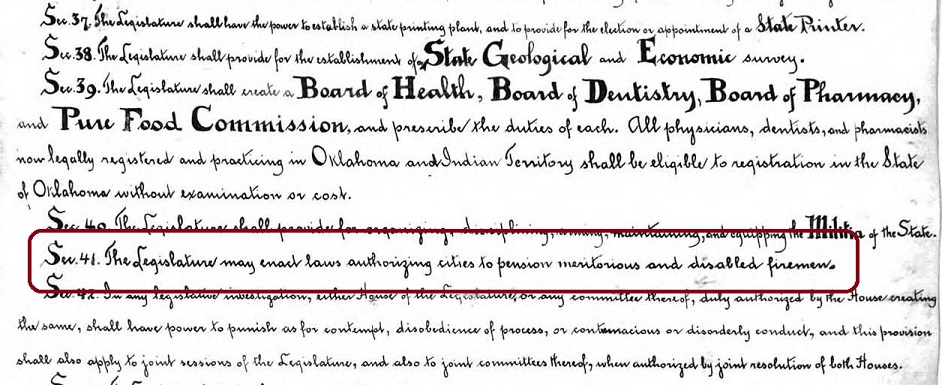
The state can establish a state printing plant and hire a state printer. The state must establish a Geological and Economic Survey. It must create a Board of Health, Board of Dentistry, Board of Pharmacy, and a Pure Food Commission. The Legislature shall provide for organizing, disciplining, arming, maintaining, and equipping the Militia of the State. It may also enact laws authorizing cities to pension meritorious and disabled firemen.
Um… I’m in NO WAY anti-firemen, but isn’t that a strangely specific provision? That’s not something added later to appease an influential Congressman or honor a special interest group. It’s in the original.
There follows a long list of things the State Legislature CAN’T do – this one LONGER than its counterpart in the U.S. Constitution (Article I, Section 9). Most of them pertain to local vs. state control on particular issues. I’m not familiar enough with things like adoption law or polling regulations to know if any of these are unusual.
On the other hand, here’s one I’ve learned to hate:
Section V-58: Time of taking effect of statutes – Emergency measures.
No act shall take effect until ninety days after the adjournment of the session at which it was passed… unless, in case of emergency, to be expressed in the act, the Legislature, by a vote of two-thirds of all members elected to each House, so directs. An emergency measure shall include only such measures as are immediately necessary for the preservation of the public peace, health, or safety…
If you’ve ever researched proposed legislation, you’ve discovered that the vast majority of bills conclude with a declaration of emergency as described above.
 We’d like to tweak the A-F School District Shaming System by juggling a few phrases, and ohyeahbytheway – THIS IS AN EMERGENCY AND IMMEDIATELY NECESSARY FOR THE PRESERVATION OF THE PUBLIC PEACE, HEALTH, AND SAFETY.
We should put the alternative certification process for Oklahoma teachers under the purview of the “Office of Educational Quality and Accountability”, which of course MUST BE AN EMERGENCY AND IMMEDIATELY NECESSARY FOR THE PRESERVATION OF THE PUBLIC PEACE, HEALTH, AND SAFETY.
I’d like to modify the reporting procedures for districts complying with such and such obscure statutes and no one knows why we’re doing it anyway except that THIS IS AN EMERGENCY AND IMMEDIATELY NECESSARY FOR THE PRESERVATION OF THE PUBLIC PEACE, HEALTH, AND SAFETY.
Here’s why this bugs me so much.
Common usage of this ‘EMERGENCY’ clause means that, as a matter of course, legislators are practically required to cynically manipulate the language of everything they propose or support – in clear contrast to the intent of the Constitution – just to get stuff done. In other words, it’s a given that they can’t really mean everything they’re saying or passing. We just kinda have to do it this way because… the system.
Maybe that’s a small thing, like not reading User Agreements before you ‘Accept’ them, or signing off on paperwork from meetings you didn’t even attend, but it seems to me an unfortunate symbol of cynicism and dishonesty becoming normalized. Banal, even.
No matter how idealistic a new legislator may be, they first time she writes a bill or casts a vote, she’s agreeing to a ‘wink wink nudge nudge’ bit of game-playing of the sort we all say we hate in politics. He’s calling something what it is NOT in order to get what he wants.
It’s only a little leaven, of course. Just a small manipulation – a pragmatic lie. But the storybooks tell us those initial compromises start us down a path which never ends well.
I fear history agrees.
RELATED LINK: The Oklahoma Constitution (Part One)
RELATED LINK: The Oklahoma Constitution (Part Two)
RELATED LINK: The Oklahoma Constitution (Part Four)
RELATED LINK: The Blaine Game (Updated)
 When the Republican Party became a thing in the 1850s, it pushed two basic tenets: (1) Slavery is bad, and (2) Polygamy is bad. The second was clearly in response to the Latter Day Saints.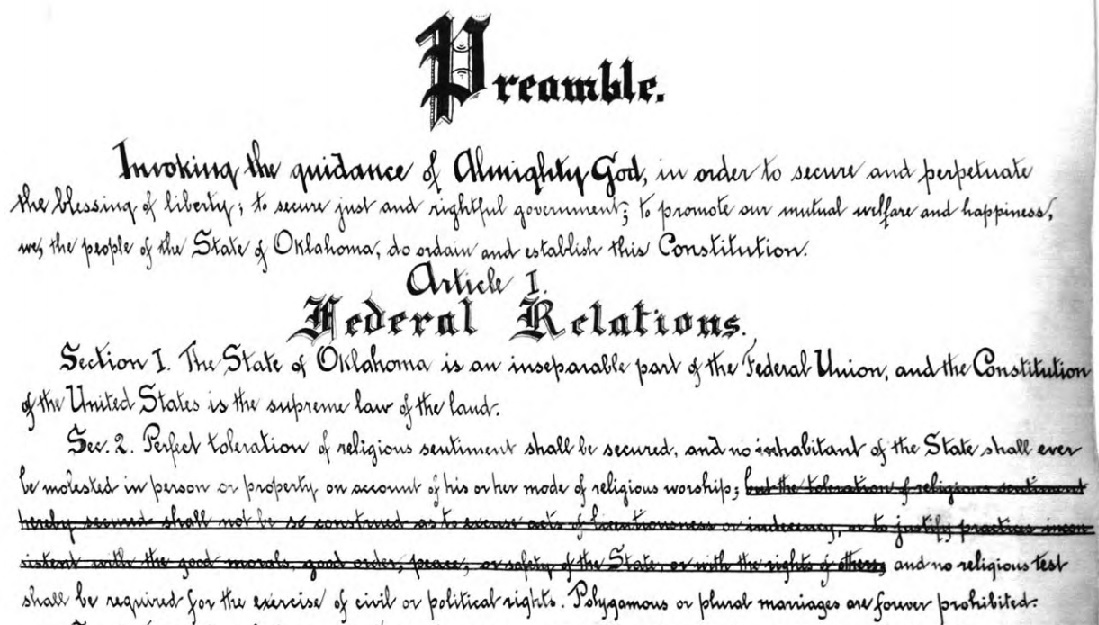
 Look at that. We DID know about the Reconstruction Amendments way back then. Wonder how we lost THAT collective awareness…
 That’s perfectly consistent with American ideals. Jefferson may have changed “life, liberty, and property” to “life, liberty, and the pursuit of happiness,” but the original phrase is used often enough elsewhere to leave little doubt regarding intent.
 The U.S. Constitution, including all 27 Amendments, takes up less than 14 pages as a Word document with normal fonts and margins. The Oklahoma Constitution, in contrast, takes 221 pages.
 If you know anything about Alfalfa Bill, this is either painfully ironic or ridiculously amusing. Even if you don’t, the founding of Oklahoma on ‘modern thought’ and the ‘highest estimate of intelligence and progress’ should produce some sort of reaction. Perhaps even involuntary regurgitation.
  In 1906, the U.S. Congress passed the “Oklahoma Enabling Act,” providing for a single state to be formed from Oklahoma and Indian Territories. Each half sent delegates – mostly Democrats – and William H. Murray was – big shocker here – elected president of this new Constitutional Convention.
 Early in the document (Article II), the drafters enumerated thirty-three rights in the Bill of Rights Article. This was followed by the article on suffrage. The right to vote, except in school board elections, was restricted to males. (The constitution was amended giving women the right to vote in 1918, two years before the U.S. Constitution was amended giving women the right to vote.)
  That thing where so many positions are elected rather than appointed is creating headaches even today. It was an age of ‘let the people decide’, creating rules not conducive to our love of ‘voting the party ticket’ for everything from Governor to Dog Catcher to Insurance Commissioner.
 That last part is what’s been so-often cited to explain why we simply CAN’T slow down the almost complete elimination of taxes for anyone wearing expensive suits and smoking cigars in darkened back rooms. Once the process is begun, the argument goes, any reduction of the destruction amounts to a ‘tax increase’.
 William Jennings Bryan told the members of the Oklahoma Constitutional Convention that they had borrowed the best provisions of the existing state and national constitutions and had, in the process, created the best constitution ever written. Scholars who believe that brief constitutions devoid of policy make the best constitutions would disagree with Bryan’s assessment.
 Our 3rd grade OCCT high stakes test starts Monday. This test, due to RSA and our Oklahoma legislature, requires our 8-year-old students to pass the test or being retained in 3rd grade (unless ridiculous and out of reach exemptions are met).
  There’s a cliché in education about teaching the child, not merely the subject. The more annoying version is that students don’t care how much you know until they know how much you care. I’m not in love with either platitude, but like most things with unfortunate sticking power, they’re not entirely wrong.

 Her 1st Period class is Biology 101 and has 34 students (this is obviously pre-budget cuts). Just under half are pretty much getting it and will hopefully do fine on the Big Test. Their actual enthusiasm for truly understanding science varies widely, but whatever.
  Ms. Endocrine could put more time and energy into figuring out what’s behind all of this, but she has 147 other students, many of whom DO show up and need regular attention. If it’s left on her, she’ll have to either ignore the absences or issue standardized consequences – detention. Suspension. ‘F’.
  Except the research says dozens of other factors impact how or even if kids learn. The science says it matters how we adjust to actual, real students in front of us, whether we wish it were necessary or not. Ms. Endocrine COULD just teach the material. If they refuse to learn for whatever reason, she could give logical consequences – detention. Suspension. ‘F’.
  One girl’s mom is sick – really sick. Two kids have undiagnosed ADD or OCD or some sort of acronym making things difficult all ‘round. Judy needs glasses, but keeps not getting them. A few are probably under the influence of something illegal, far too many are scarred by some form of sexual abuse in their recent past, and it’s pretty obvious to everyone that Gary has SERIOUS anger issues he doesn’t know how to control.
  So we hire extra counselors, partnering with outside organizations when we can and eating the cost ourselves when we can’t. We create separate classrooms or activities and find specialized staff to mitigate the outside realities we can’t directly control.
  It’s about trying to teach kids Biology, and English, and Math – things we can’t do without some regard for who we’re trying to teach and what they’ve brought with them that might get in the way. If it were as simple as just delivering content, we could pack them in the gym and show a video lecture each day. Even better, just send a DVD home with them – see you when it’s time to assess.