
 I hate to be difficult.
Actually, that’s not true – I enjoy being difficult sometimes. It’s how I learn, and how I try to force others to acknowledge problems they might not otherwise address, or clarify my own thinking regarding issues I find important. In this case, I’m very much hoping those more insightful than me will explain why I’m completely and totally mistaken.
Because on this one, I don’t like what I’m about to say. It runs against my libertarian ideals. Worse, it’s one more thing likely to annoy the people I most admire in the education blogosphere, some of who have been quite decent to me even though I’m a bit player at best.
I’m not sure “local standards” are a good idea for public education.
To be sure, nationalized tests and oppressive curriculum requirements are a disaster. Forget Common Core – ANY standardization of what every child in every situation everywhere must know and be able to do as measured by bubble fillinnery, based on their chronological grouping is, well… insane. In a “you’re a very bad man” kind of way.
State requirements aren’t much better, at least around here. They flip and they flop and they still come with all sorts of stupid tests which crush anything positive about public schooling. They make us hate our jobs and they make kids hate school, all while accomplishing nothing – since the results aren’t actually used to fix or change anything.
So of course the only remaining alternative is to let local districts, local parents, local school boards, based on local circumstances, decide what their students should and shouldn’t study, and how success will be measured.
In some cases, this would be wonderful. Perhaps in many cases.
 But while I love my state, rural Oklahoma is full of districts who don’t much cotton to them big city ideals. I don’t want to burst into a musical number from Tatooine, The Musical (“Beyond Uncle Owen’s Moisture Farm” is my personal favorite) but there are numerous districts where the toughest thing about teaching high school is convincing families there’s anything out there bigger than the local poultry processing plant or Assistant Manager at Dollar General.
I’m not one to argue that every child in every situation absolutely MUST pursue a doctoral degree before fixing air conditioners for a living, but I can’t abide the image of thousands of Oklahoma teens stuck hanging out at the Quikie Mart eating hot lamp chicken until their prowess at The Last Starfighter or a dancing Kevin Bacon frees them from the backwater morass.
Local standards may not aspire to be much more than local. And you can’t become what you can’t see.
I love my state, but Oklahoma voters – the same ones I presume would be helping to set ‘local standards’ in their districts – keep electing Representatives like John Bennett and Sally Kern and Senators like Josh Brecheen.
Senator Josh Brecheen, of course, is the man who recently cited the Old Testament of the Bible – specifically a passage suggesting that those outside the faith be hunted down and killed with swords – to support his opposition to Common Core. We really must get him together with Representative John Bennett who is currently on his “Muslims are all Sleeper Cells” speaking tour condemning Islam – any form, any practice, any believer thereof. His reason? The Quran demands the deaths of non-believers. You know, like the Bible.
 Kern is most known for her crusade against gay people, who are apparently much like Bennett’s terrorists. She uses her background as an educator to explain that she’s just keeping it simple for folks, explaining it this way. In her defense, she doesn’t much like blacks or women (?!?) either. Because so many disagree with her, and are in fact horrified by her remarks, she’s also the victim of the worst sorts of persecution.
“It just broke my heart because so often what they were doing, they weren’t just stoning me, they were stoning and desecrating the God that I love…
There was just so much hate, they accuse me of being hateful, and I never once said anything hateful. Such hate expressed against the Lord and against his word and then the way they, I mean these people, I believe these people, I believe scripture teaches this, they’re deceived and to me the real hate is from those people who say, ‘you’re born this way and you can’t change, deal with it’…”
In other words, because not everyone accepts her bizarre hate speech, she is the real victim. Well, her and God – who in Kern’s theology apparently has many of the same attributes and insecurities of Tinkerbell. New whine in old skins.
This is ‘Merica and they can believe as they like, although I question political leaders using their position in government to attack segments of our own populace. Kerr assumes blacks are naturally criminals because they’re lazy, but she’s not executing them in broad daylight for not walking on the sidewalk, so… um… I guess it’s all relative? And I have friends who are not particularly fond of Islam no matter what its trappings and more who just don’t buy gay as a morally neutral issue. That’s fine – whatever.
But those friends aren’t setting the curriculum for my local public school. Xenophobia may be there in practice, but it’s not codified in the official standards for all to follow. Gay-bashing may occur verbally or even physically, but it’s not generally promoted by the authority at the front of the room or sitting at the big desk down front. On paper, at least, we’re trying to function in a global society. On paper, at least, we’re trying to look beyond the pissy Presbyterian next door and realize that right or wrong, we’re just going to have to deal with the “others.”
Local standards would roll this back. I’m not trying to be conspiratorial, but I see who these people elect. Repeatedly.
 It’s already problematic in many rural areas to cover the basics of various faiths as part of World Cultures class, or to explain Evolution even as a ‘theory’. I recently attended a workshop with a lady in a nearby state whose head was exploding because Noah’s flood was the mandated correct response in World History class covering major population movements.
Nothing against Noah or Noah’s god – but is that really so much less onerous than Common Core’s suggestion that written arguments must be supported with facts and reasoning?
And that’s not even getting into novels or sex education or racially integrated cheerleading squads – stuff that really sets folks off ‘round these parts.
Given the recent kerfuffle over curriculums challenging the narrative of America as the infallible bulwark of justice and freedom-eagles, can you imagine the approved versions of history in areas still angrily downing 32 oz. Keystones, listening to Lynyrd Skynyrd, and cursing the War of Northern Aggression? We can’t stop Donald Trump from arguing that Obama’s not a citizen, but that doesn’t mean we have to make “Kenya” the only acceptable answer on the multiple choice quiz, either.
I hate federal government programs and demands. I’m not a huge fan of the Department of Education or most other bureaucratic leviathans who feed on the nectar of paycheck deductions and red tape. But every time we’ve left important decisions up to local control in the past century, things get pretty weird.
Outside standards don’t guarantee anything, and we can’t write enough rules to force well-rounded, questioning young people to magically appear out of every high school. But surely we can’t just smile and trust that the same people who’ve got us to where we are today can will somehow burst forth in wise, long-term thinking about tomorrow.
 There’s a kerfuffle going on in Texas (again) and Colorado (huh?) regarding the level of flag-waving patriotism in history textbooks and curriculums, including APUSH. The short version is this:
 The Modern Liberal Academics are upset that these flag-waving right-wing extremists want to whitewash American history to feed their predetermined paradigm of American Exceptionalism. There’s something Orwellian (or at least Valdimir Putinian) about euphemizing (or simply ignoring) travesties like slavery, genocide, and Woodrow Wilson. The Academics would like more emphasis on effective questioning and understanding multiple points of view. American schools should be shaping good world citizens ready to confront things of which we cannot yet conceive, not drones painted red, white, and blue.
 This is about choosing
  I liked Aquaman.
 Why can we not allow Thomas Jefferson the same intellectual and moral complexity we accept in Mystique? Why accommodate a Batman who does dark twisted things so soccer moms feel safe but insist on ‘hero’ or ‘villain’ labels for Andrew Jackson or Malcolm X? Can we not accept that real people – who lived monumental lives and did big stuff – might be at least as unpredictable as Magneto or Malcolm Reynolds?
 In the same way that the people around you are so much more meaningful, useful, interesting, when they allow you to see something beyond the façade… in the same way heroes are far more heroic when you know what a mess they are, but they keep trying to do the right thing anyway… our history, our icons, our story resonates far more – not less – when we do our best to lay it all out there as whatever it is.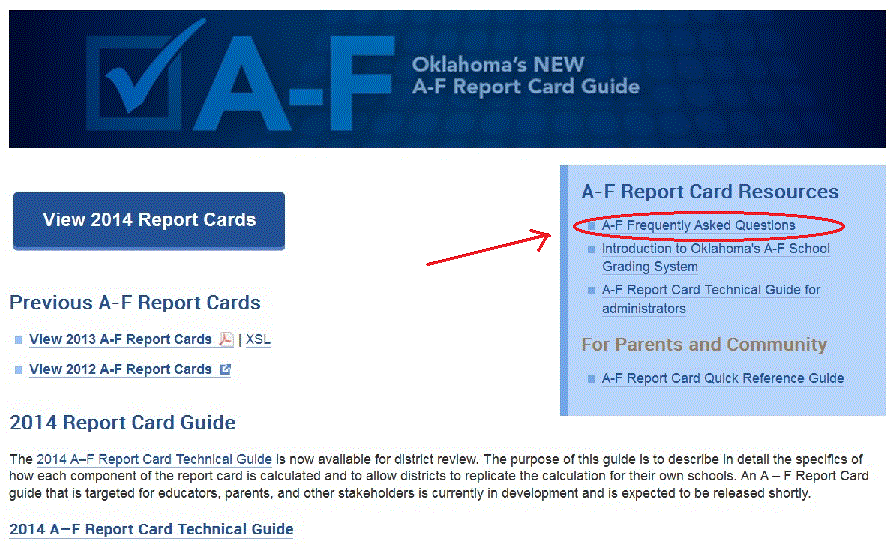
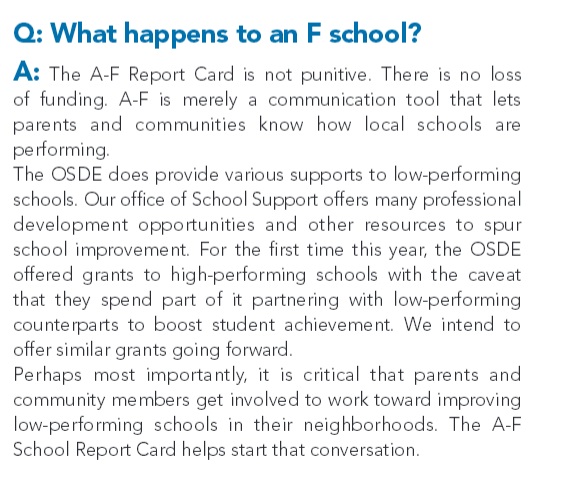
 6. Can you tell the ‘spur’ thing bugs me? You spur a horse that’s not trying very hard or moving very fast. You spur a horse because horses are too stupid to know which way they’re supposed to go on their own. You dig your metal into its flank and keep your bit in its mouth so it will remain compliant – an extension of your own purposes. Spurring suggests schools and teachers get F’s because they’re just not trying very hard. They’re meandering, munching some grass, peeing a long time – just standing there until the SDE comes to do some spurrin’. Giddy-up go, Ms. Hernandez – giddy-up, go! Because you know what grade a horse really wants? A neighhhhh…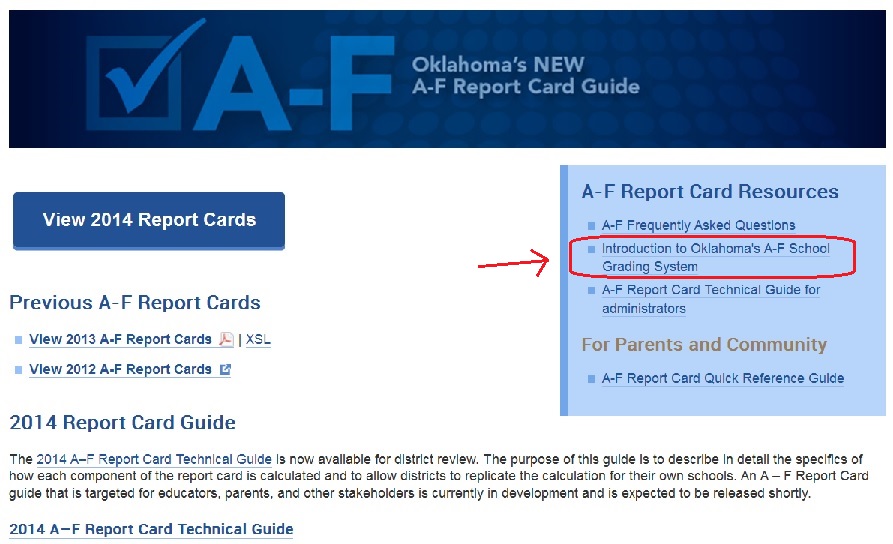


 The State of Oklahoma, like many others, is determined to assign numbers and letters to the schools and teachers within its purview. Like the standardized testing of students on which many of these numbers and letters are based, the conviction seems to be that if you just keep pretending to measure things in ridiculously oversimplified ways designed to guarantee widespread failure, you’re “reforming” the system and calling forth a brighter future for all. This is analogous to – actually, never mind the analogy. It’s just stupid.
 Summative Assessment is the other category. It’s the ‘BIG TEST’ at the end of a unit or a semester. These attempt to document what students “walk away with” in knowledge and skills. The data can identify strengths and weaknesses of individual teachers so we can help each other improve, or help compare classes from year to year. For students it’s generally the finish line, for better or worse – here’s how you did, now off with thee.
 The A-F Report Card given by the State of Oklahoma to its public schools each year does none of the things assessment is supposed to do. It provides no support, and intentionally limits the data it is willing to consider. There are no adjustments on the part of the state based on how well a given school is doing, and no conversation regarding options for improvement. It’s not even measuring most of the things we claim are most valuable to us. It is merely calculated and published, and each year more and more schools are sent to sit in the corner with their ‘dunce’ caps on.
 There is a good case to be made that part of our job as educators is to prepare students for the ‘real world’ – whatever that is. We could thus argue that deadlines and responsibility are valid goals of public education. In the ‘real world’, you’re expected to do stuff when it needs to get done. Rolling in at 3 p.m. with “hey, here are those burgers you asked for during the lunch rush” isn’t going to cut it, nor will you get paid half if you simply don’t make them at all.
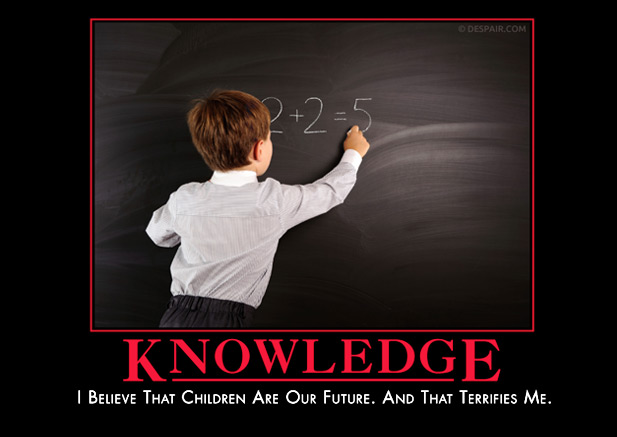 And no matter how modern or flipped or inquiry-based I may try to be, there are still things that require grading. I hate grading, but there’s a limit to how much I can job out to students and still be able to sleep at night. There are things they can learn from peer evaluation, but half-a-class spent announcing that #1 is A, #2 is C, etc., is an embarrassing waste of limited time. Besides, most of what I’m grading isn’t multiple choice.
 Yeah, yeah – poor overworked teacher. But this isn’t about me missing my tee time after school. What it means instead is that when I am working, at my desk or at home, I’m spending far more time and energy trying to figure out why little Johnny has handed in a page of Level Questions over some – well, over SOMETHING, I’m not sure WHAT – and whether or not they correspond to anything he’s missing in the gradebook – than I’m spending coming up with better ways to teach Johnny’s 150 peers the next unit. Flexible deadlines and nurturing late work policies mean I spend more time grading than preparing, or teaching, or collaborating, or whatever.
 How many angry lil’ Republicans are created this way – barely into high school and already learning that the harder they work, the more they are expected to drag along those who can’t or won’t, often at the expense of their own progress? At least under the old framework the best and brightest were merely ignored and marginalized under the assumption they’d still pass state tests and stay out of discipline trouble – under this new approach we can actively punish them for being responsible!